

Helping verbs and main verbs work together in many English verb phrases, but they perform different grammatical jobs. A helping verb supports another verb, while the main verb carries the central action, event, process, or state meaning of the verb phrase.
This article explains helping verb vs main verb through clear definitions, sentence patterns, comparison tables, verb-phrase examples, and identification methods. You will also see how be, have, and do can change roles and how several helping verbs can support one main verb.
What Is a Helping Verb?
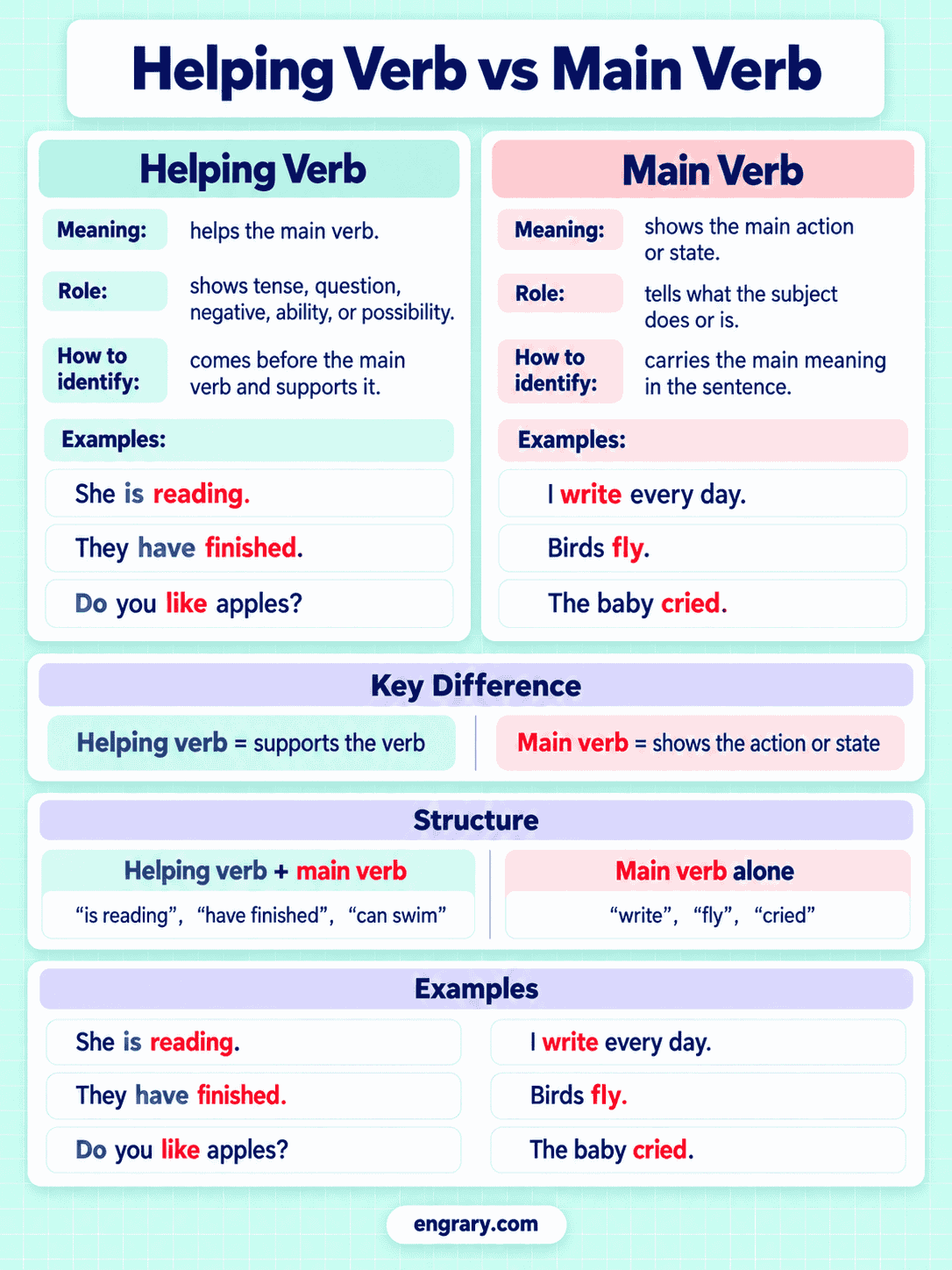
A helping verb works with a main verb to add grammatical information to a verb phrase. Helping verbs can help express tense, aspect, voice, questions, negatives, emphasis, possibility, ability, or other modal meanings.
Examples:
She is reading.
They have finished.
He can swim.
I did call.
In these examples:
is helps reading
have helps finished
can helps swim
did helps call
A common pattern is:
helping verb + main verb
Some verb phrases contain more than one helping verb.
For example:
She has been studying.
Here, has and been are helping verbs, while studying is the main verb.
What Is a Main Verb?
A main verb carries the central lexical meaning of a clause or verb phrase. It tells what the subject does, experiences, becomes, or is.
Examples:
She reads every evening.
He opened the door.
They laughed loudly.
Mia knows the answer.
The last example is important because a main verb is not always an action verb. The verb knows expresses a state rather than a physical action, but it is still the main verb.
A main verb can appear alone:
She runs.
Or it can appear with one or more helping verbs:
She is running.
They have been waiting.
In each case, the main verb carries the central meaning.
Helping Verb vs Main Verb: Quick Difference
The main difference lies in the role each verb performs inside the verb phrase.
| Helping Verb | Main Verb |
|---|---|
| Supports another verb | Carries the central lexical meaning |
| Adds grammatical information | Expresses the main action, state, event, or process |
| Usually comes before the main verb | Usually comes last in a multi-verb phrase |
| She is reading. | She is reading. |
| They have finished. | They have finished. |
| He can swim. | He can swim. |
| I did call. | I did call. |
A sentence may contain a main verb without a helping verb, but a helping verb normally supports a main verb.
Helping Verb vs Main Verb Structure
Verb-phrase structure makes the difference easier to see. The number of helping verbs can change, but the main verb remains the lexical center of the phrase.
| Verb Phrase Type | Structure | Example |
|---|---|---|
| Main verb only | subject + main verb | She laughs. |
| One helping verb | subject + helping + main verb | She is reading. |
| Two helping verbs | subject + helping + helping + main verb | She has been working. |
| Modal + helping + main verb | subject + modal + helping + main verb | He might have left. |
| Three helping verbs + main verb | subject + helping + helping + helping + main verb | They will have been waiting. |
The main verb normally appears after the helping verbs in the same verb phrase.
Helping Verb and Main Verb Examples
The following examples show how helping and main verbs work together.
| Sentence | Helping Verb | Main Verb |
|---|---|---|
| She is reading. | is | reading |
| They have finished. | have | finished |
| He can swim. | can | swim |
| We will leave. | will | leave |
| Mia might come. | might | come |
| I did call. | did | call |
| They were playing. | were | playing |
| She has written a letter. | has | written |
| We should wait. | should | wait |
| He must leave. | must | leave |
| You are learning quickly. | are | learning |
| The door was opened. | was | opened |
In each sentence, the helping verb adds grammatical meaning while the main verb carries the core meaning.
Main Verbs Without Helping Verbs
Not every sentence needs a helping verb. A main verb can form the complete verb phrase by itself.
Examples:
She runs every morning.
He opened the door.
They laughed loudly.
We finished early.
The baby slept peacefully.
I understand the question.
Sara likes music.
The key point is:
Every complete verb phrase has a main verb, but not every verb phrase has a helping verb.
This distinction prevents the common mistake of searching for a helping verb in every sentence.
More Than One Helping Verb With One Main Verb
Longer verb phrases can contain two or more helping verbs before a single main verb. The helping verbs work together to add tense, aspect, voice, or modal meaning.
Examples:
She has been studying all morning.
They will be leaving soon.
He might have forgotten.
The work has been completed.
They will have been waiting for hours.
Consider:
has + been + studying
Helping verbs: has, been
Main verb: studying
Another example:
might + have + forgotten
Helping verbs: might, have
Main verb: forgotten
And:
will + have + been + waiting
Helping verbs: will, have, been
Main verb: waiting
These patterns show why identifying the whole verb phrase is more useful than looking at one verb at a time.
Be, Have, and Do as Helping or Main Verbs
The verbs be, have, and do can function as helping verbs in some sentences and as main verbs in others. Their role depends on how they work in the sentence.
Be
Be can help another verb or function as the main copular verb of a clause.
| Helping Use | Main/Copular Use |
|---|---|
| She is reading. | She is happy. |
| They are working. | They are ready. |
| He was sleeping. | He was quiet. |
In:
She is reading.
is helps the main verb reading.
In:
She is happy.
is functions as the main copular verb and connects the subject to happy.
Have
Have can function as a helping verb or carry the main meaning itself.
| Helping Use | Main Verb Use |
|---|---|
| He has finished. | He has a bicycle. |
| They have arrived. | They have two children. |
| We had left. | We had enough time. |
In:
He has finished.
has helps finished.
In:
He has a bicycle.
has carries the central meaning and functions as the main verb.
Do
Do also changes role according to sentence structure.
| Helping Use | Main Verb Use |
|---|---|
| She does understand. | She does her homework. |
| Do you agree? | I do the cleaning. |
| He did call. | He did the task. |
When do, does, or did supports another verb, it functions as a helping verb.
When it carries the central meaning itself, it functions as the main verb.

How Helping Verbs Work With Main Verbs
Helping verbs perform different grammatical jobs depending on the pattern they form with the main verb.
| Function | Pattern | Example |
|---|---|---|
| Continuous | be + -ing form | She is reading. |
| Perfect | have + V3 | He has finished. |
| Passive | be + V3 | The door was opened. |
| Question | do + base verb | Do you know? |
| Negative | do + not + base verb | She does not agree. |
| Emphasis | do + base verb | I did call. |
| Modal meaning | modal + base verb | He can swim. |
These patterns show that the helping verb adds grammatical information, while the main verb supplies the central lexical meaning.
How to Identify Helping and Main Verbs
A reliable method is to examine the complete verb phrase instead of identifying verbs from a memorized list.
Look for the Verb That Supports Another Verb
First, look for a verb that works with another verb.
She is reading.
is supports reading.
They have finished.
have supports finished.
He can swim.
can supports swim.
These supporting verbs function as helping verbs.
Find the Verb With the Central Meaning
Next, identify which verb carries the main lexical meaning.
She is reading.
The central activity is reading.
They have finished.
The central event is finished.
He can swim.
The central ability concerns swim.
That verb is the main verb.
Use the Last-Verb Test
In a multi-verb phrase, the main verb normally comes last.
She has been working.
Helping verbs: has, been
Main verb: working
He might have forgotten.
Helping verbs: might, have
Main verb: forgotten
They will have been waiting.
Helping verbs: will, have, been
Main verb: waiting
This is a useful shortcut for verb phrases, but the whole sentence should still guide the final analysis.
Helping Verb vs Main Verb vs Linking Verb
Helping, main, and linking verbs perform different grammatical roles.
| Helping Verb | Main Verb | Linking Verb |
|---|---|---|
| Supports another verb | Carries the central lexical meaning | Connects the subject to a complement |
| She is reading. | She is reading. | She is tired. |
| He has finished. | He has finished. | He became angry. |
| They will leave. | They will leave. | They seem ready. |
A form such as is can therefore perform different roles depending on the structure.
Compare:
She is reading.
is = helping verb
She is tired.
is = linking/main copular verb
Common Mistakes With Helping and Main Verbs
Most confusion comes from assuming that every sentence must contain a helping verb or that certain words always perform the same role.
| Mistake | Correct Understanding |
|---|---|
| Every sentence has a helping verb | Some sentences contain only a main verb |
| The first verb is always the main verb | Helping verbs usually come before the main verb |
| have is always helping | It can also be a main verb |
| do is always helping | It can also be a main verb |
| be has only one role | It can be helping or main/copular |
| Main verb always means action verb | A main verb can express an action, state, event, or process |
| A sentence can have several main verbs in one verb phrase | One verb phrase normally has one lexical main verb with possible auxiliaries |
A useful habit is to identify the full verb phrase first and then decide which verbs support the phrase and which verb carries its central meaning.
FAQs
A helping verb supports another verb and adds grammatical meaning, while the main verb carries the central action, event, process, or state meaning of the verb phrase.
Yes. In She runs every morning, runs is the main verb and no helping verb is present.
Yes. In She has been studying, has and been are helping verbs, while studying is the main verb.
Yes. Their role depends on context. For example, has is helping in He has finished, but it is the main verb in He has a bicycle.
Look for the verb that carries the central lexical meaning. In a multi-verb phrase, it normally comes after the helping verbs, as in has been working, where working is the main verb.
You May Also Like



Leave a Comment