
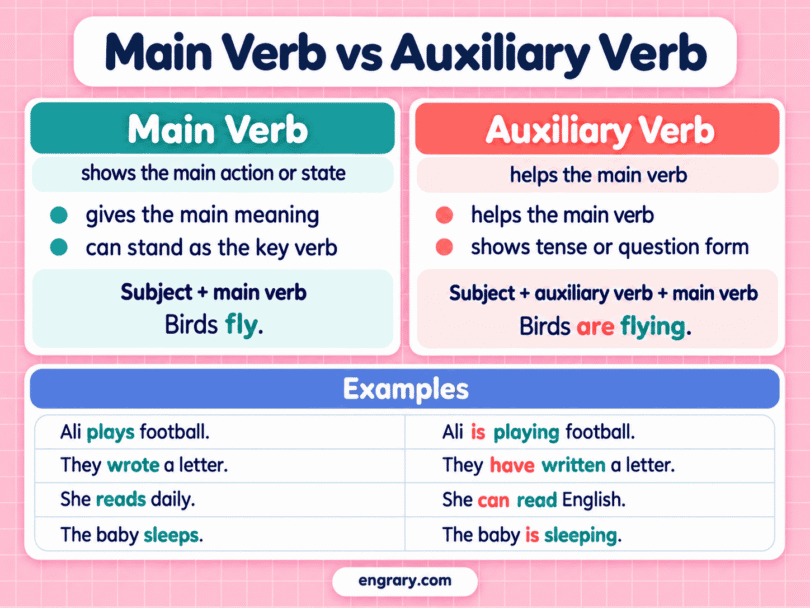
Main verbs and auxiliary verbs work together inside English verb phrases, but they do not perform the same job. The main verb carries the central lexical meaning, while auxiliary verbs add grammatical information such as tense, aspect, voice, mood, questions, negatives, emphasis, or modal meaning.
This article explains main verb vs auxiliary verb by showing how verb phrases are built, how primary and modal auxiliaries work, how several auxiliaries can appear before one main verb, and how to identify each role accurately. It also covers auxiliary order, questions, short answers, and common verb-phrase errors.
What Is the Difference?
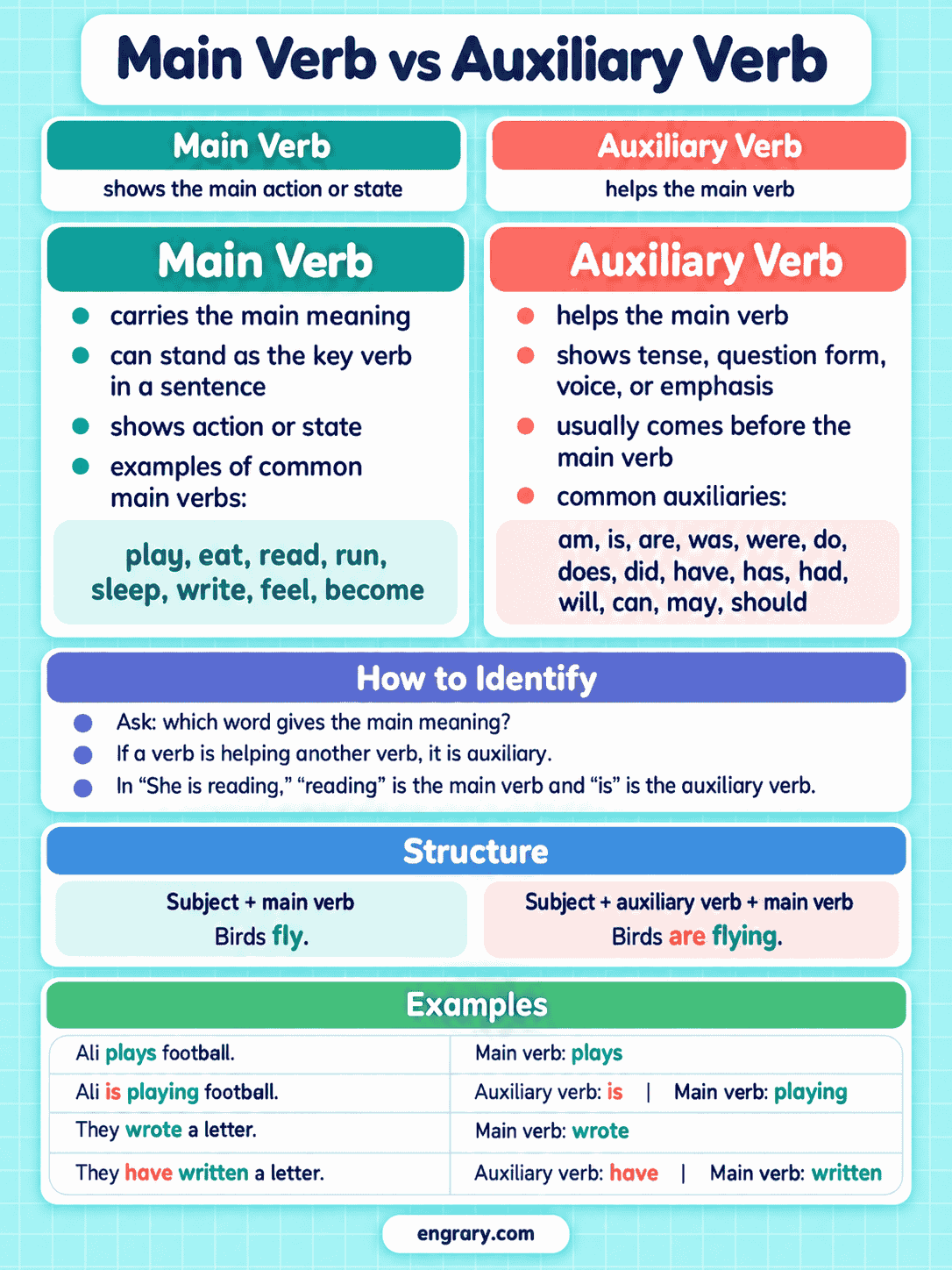
The simplest distinction is:
main verb = carries the central lexical meaning
auxiliary verb = adds grammatical information to the main verb
Compare:
She is reading.
is = auxiliary verb
reading = main verb
Another example:
They have finished.
have = auxiliary verb
finished = main verb
A clause may contain a main verb without an auxiliary, but an auxiliary normally supports a main verb or an understood verb phrase.
What Is a Main Verb?
A main verb carries the central action, state, event, or process meaning of a clause or verb phrase.
Examples:
She reads every evening.
They finished early.
He works here.
Mia knows the answer.
The main verb does not have to describe a physical action.
For example:
Mia knows the answer.
Here, knows expresses a state, but it is still the main verb because it carries the central lexical meaning.
A main verb may stand alone:
She laughed.
Or it may appear after one or more auxiliaries:
She is laughing.
She has been laughing.
In each case, laughing carries the main lexical meaning.
What Is an Auxiliary Verb?
An auxiliary verb works with a main verb to add grammatical information.
Auxiliaries can help express:
- continuous aspect
- perfect aspect
- passive voice
- questions
- negatives
- emphasis
- ability
- possibility
- necessity
- prediction
Examples:
She is reading.
They have finished.
Do you agree?
He can swim.
In learner grammar, auxiliary verb and helping verb usually refer to the same grammatical category.
Main Verb vs Auxiliary Verb at a Glance
The two verb types differ mainly in what they contribute to the verb phrase.
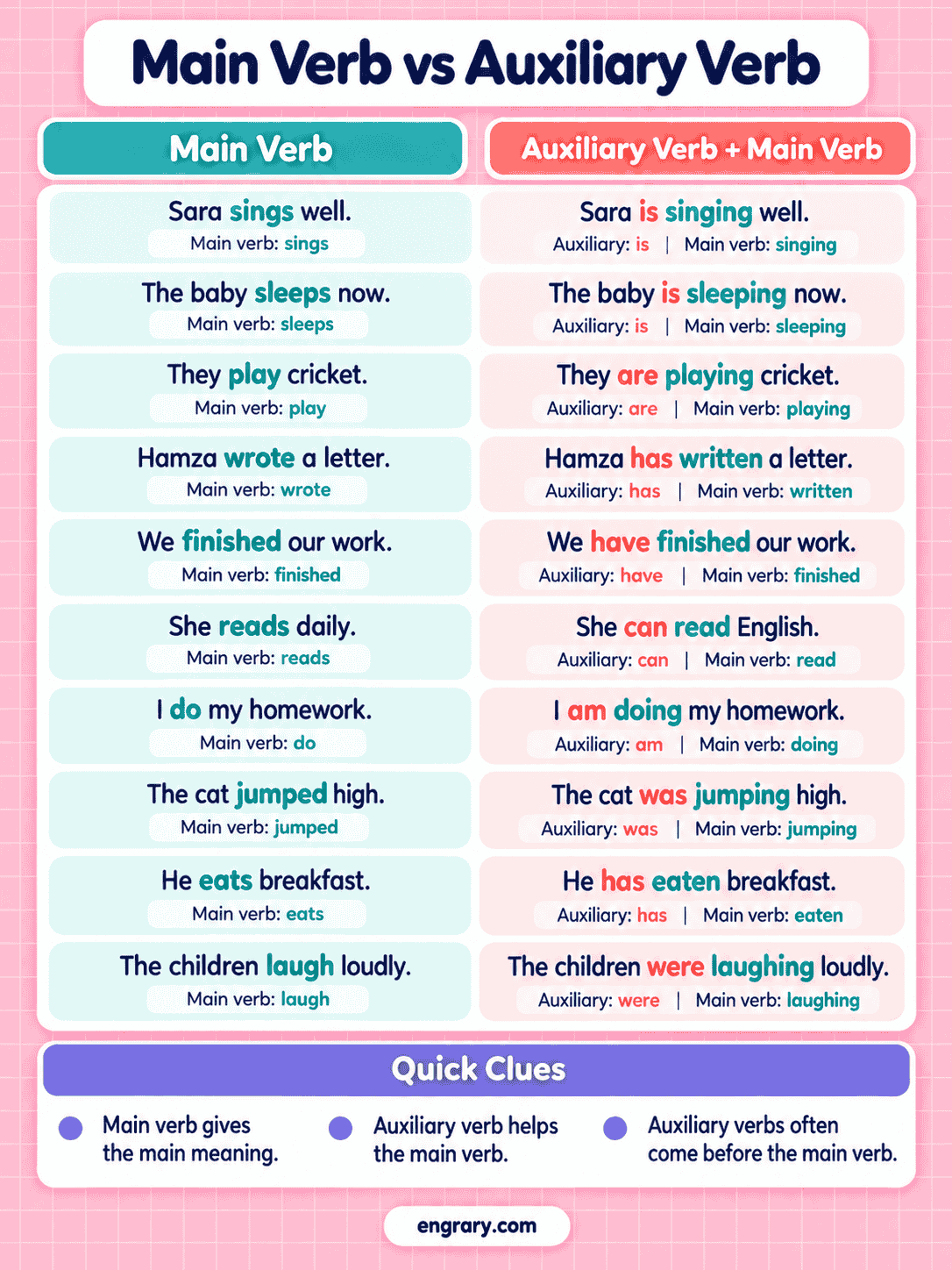
| Main Verb | Auxiliary Verb |
|---|---|
| Carries the central lexical meaning | Adds grammatical information |
| Can form a verb phrase by itself | Usually supports a main verb |
| Normally comes last in a multi-verb phrase | Comes before the main verb |
| Can express action, state, event, or process | Can express tense, aspect, voice, mood, or modality |
| She reads. | She is reading. |
| They have finished. | They have finished. |
| He can swim. | He can swim. |
A useful rule is:
Every complete verb phrase has a main verb, but not every verb phrase has an auxiliary.
How a Verb Phrase Is Built
A verb phrase can contain only a main verb or several auxiliary verbs before the main verb.
Compare how the phrase expands:
works
main verb only
is working
auxiliary + main verb
has been working
auxiliary + auxiliary + main verb
might have been working
modal auxiliary + auxiliary + auxiliary + main verb
The central lexical meaning stays with working, while the auxiliaries add grammatical information around it.
This progression is useful because it shows that auxiliaries can accumulate without replacing the main verb.
Main and Auxiliary Verbs Inside Verb Phrases
The following table shows common verb-phrase patterns.
| Sentence | Auxiliary Verb(s) | Main Verb |
|---|---|---|
| She is reading. | is | reading |
| They have finished. | have | finished |
| He can swim. | can | swim |
| We will leave. | will | leave |
| She has been working. | has, been | working |
| He might have forgotten. | might, have | forgotten |
| The door was opened. | was | opened |
| I did call. | did | call |
| They will have arrived. | will, have | arrived |
| We should have been waiting. | should, have, been | waiting |
The auxiliaries add grammatical structure, while the main verb remains the lexical center of the phrase.
Main Verbs Without Auxiliaries
Some clauses contain no auxiliary verb at all.
Examples:
She laughs.
He works here.
They arrived early.
We waited outside.
Mia knows the answer.
The child slept peacefully.
These are complete verb phrases even though only the main verb appears.
The key point is:
main verbs are essential to complete verb phrases; auxiliaries are not always present.
Primary Auxiliary Verbs
English has three primary auxiliaries:
- be
- have
- do
These verbs are especially important because they can also function as main verbs.
Be
Be can function as an auxiliary or as the main copular verb of a clause.
| Auxiliary Use | Main/Copular Use |
|---|---|
| She is reading. | She is happy. |
| They are working. | They are ready. |
| He was sleeping. | He was quiet. |
In:
She is reading.
is supports reading, so it is auxiliary.
In:
She is happy.
is functions as the main copular verb and connects the subject to happy.
Have
Have can also switch between auxiliary and main-verb use.
| Auxiliary Use | Main Verb Use |
|---|---|
| He has finished. | He has a bicycle. |
| They have arrived. | They have two children. |
| We had left. | We had enough time. |
In:
He has finished.
has supports finished.
In:
He has a bicycle.
has carries the central meaning itself.
Do
Do can function as an auxiliary in questions, negatives, and emphatic statements.
| Auxiliary Use | Main Verb Use |
|---|---|
| Do you agree? | She does her homework. |
| She does understand. | I do the cleaning. |
| He did call. | He did the task. |
The sentence structure determines whether do is auxiliary or main.
Modal Auxiliary Verbs
Modal auxiliaries add meanings such as ability, possibility, necessity, advice, prediction, or willingness.
Common modal auxiliaries include:
- can
- could
- may
- might
- must
- shall
- should
- will
- would
Examples:
She can swim.
They might come later.
You should rest.
We will leave soon.
He must finish today.
Modal auxiliaries normally appear before the base form of the main verb:
can swim
might come
should rest
will leave
Auxiliary Order in Longer Verb Phrases
When several auxiliaries occur together, they follow a regular order.
Consider:
They might have been waiting.
The phrase breaks down as:
might = modal auxiliary
have = perfect auxiliary
been = progressive auxiliary
waiting = main verb
Another example:
The report may have been completed.
may = modal auxiliary
have = perfect auxiliary
been = passive auxiliary
completed = main verb
A useful general pattern is:
modal + perfect have + form of be + main verb
Not every verb phrase uses every position, but when multiple auxiliaries appear, they precede the main verb in a predictable sequence.
What Auxiliary Verbs Add to the Main Verb
Different auxiliaries add different kinds of grammatical information.
| Function | Pattern | Example |
|---|---|---|
| Continuous | be + -ing | She is reading. |
| Perfect | have + V3 | He has finished. |
| Passive | be + V3 | The door was opened. |
| Question | do + base verb | Do you agree? |
| Negative | do + not + base verb | She does not agree. |
| Emphasis | do + base verb | I did call. |
| Modal meaning | modal + base verb | He can swim. |
The auxiliary changes the grammatical meaning of the phrase without replacing the lexical meaning carried by the main verb.
How to Read a Multi-Verb Phrase
Long verb phrases become easier to analyze when you separate the lexical verb from the auxiliaries around it.
Find the Main Verb
Start by asking:
Which verb carries the central lexical meaning?
Examples:
She is reading.
They have finished.
He can swim.
They might have been waiting.
The highlighted verbs provide the main action, state, event, or process.
Identify the Auxiliaries
Next, look at the verbs that add grammatical information.
She is reading.
They have finished.
He can swim.
They might have been waiting.
These verbs function as auxiliaries.
Check Their Order
In a multi-verb phrase, the main verb normally appears last.
She has been working.
Auxiliaries: has, been
Main verb: working
He might have forgotten.
Auxiliaries: might, have
Main verb: forgotten
They will have been waiting.
Auxiliaries: will, have, been
Main verb: waiting
This last-verb pattern is a useful shortcut inside a verb phrase, although the full sentence should always guide the analysis.
Can an Auxiliary Stand Alone?
An auxiliary can sometimes appear without an overt main verb when the missing material is understood from context.
For example:
“Can she swim?”
“Yes, she can.”
The full meaning is:
“Yes, she can swim.”
Another example:
“Has he finished?”
“Yes, he has.”
The understood meaning is:
“Yes, he has finished.”
This kind of omission is common in short answers because repeating the main verb is unnecessary when the meaning is already clear.
Auxiliary Verbs in Questions
Questions reveal another important property of auxiliary verbs.
Start with:
She likes coffee.
To form a question:
Does she like coffee?
Here:
does = auxiliary verb
like = main verb
When an auxiliary is already present:
She is reading.
The question becomes:
Is she reading?
Another example:
They have finished.
Have they finished?
The auxiliary moves before the subject, while the main verb remains inside the verb phrase.
Main Verb vs Auxiliary Verb vs Linking Verb
These categories perform different grammatical jobs.
| Main Verb | Auxiliary Verb | Linking Verb |
|---|---|---|
| Carries central lexical meaning | Adds grammatical information | Connects subject to a complement |
| She reads. | She is reading. | She is tired. |
| He finished. | He has finished. | He became angry. |
| They waited. | They will wait. | They seem ready. |
Forms of be require special attention.
She is reading.
is = auxiliary
She is tired.
is = main/copular or linking verb
Its role depends on sentence structure.
Common Errors in Verb-Phrase Analysis
Most errors happen when verbs are classified by the word itself instead of by their function.
| Mistake | Correct Understanding |
|---|---|
| Every sentence needs an auxiliary | Some verb phrases contain only a main verb |
| The first verb is always the main verb | Auxiliaries usually come before the main verb |
| be, have, do are always auxiliaries | They can also function as main verbs |
| Modal verbs are main verbs | They function as auxiliaries in standard grammar |
| Main verb means action verb | Main verbs can also express states |
| An auxiliary can never appear alone | It can stand alone when omitted material is understood |
| A multi-verb phrase contains several main verbs | One verb phrase normally has one lexical main verb plus possible auxiliaries |
A reliable approach is to identify the whole verb phrase first and then determine which verb carries the lexical meaning and which verbs add grammatical information.
FAQs
A main verb carries the central lexical meaning of the verb phrase, while an auxiliary adds grammatical information such as tense, aspect, voice, mood, questions, or emphasis.
Its role depends on the sentence. In She is reading, is supports the main verb reading. In She is happy, is functions as the main copular verb.
Yes. In They might have been waiting, might, have, and been are auxiliaries, while waiting is the main verb.
Yes. In Can she swim? Yes, she can, the omitted main verb swim is understood from context.
Yes. Core modal verbs such as can, could, may, might, must, shall, should, will, and would function as auxiliary verbs.
You May Also Like



Leave a Comment