

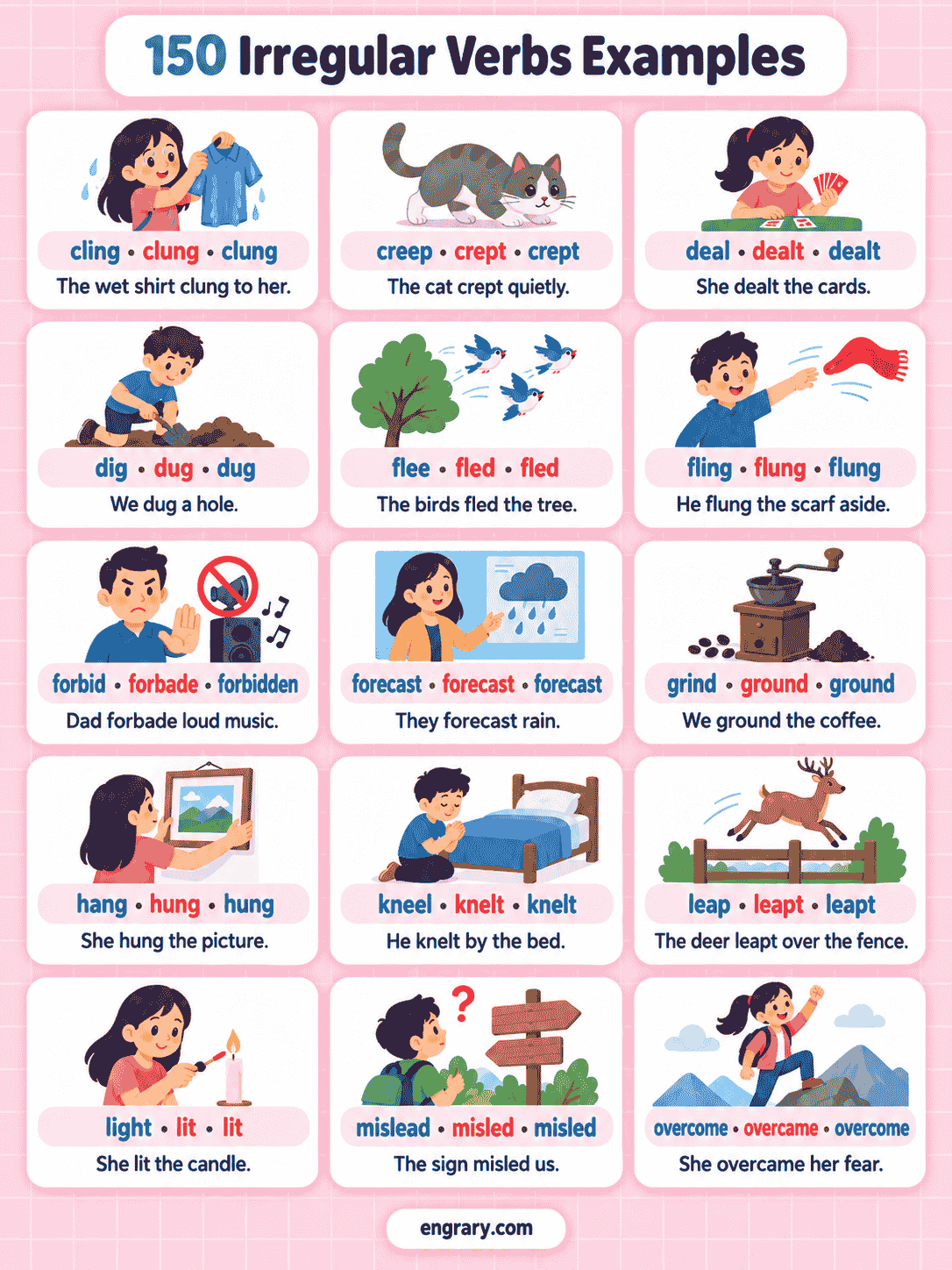
Irregular verbs do not form the past in one predictable way. Some change greatly, some change only part of the word, and others keep the same form. For example, go becomes went and gone, while cut remains cut in V1, V2, and V3.
This article brings together 150 distinct irregular verb examples and groups them by useful patterns instead of presenting another alphabetical reference list. You will also see how V2 and V3 work in sentences, which forms have accepted variants, and which mistakes learners commonly make.

What Are Irregular Verbs?
An irregular verb forms its past tense or past participle without following the usual regular -ed pattern.
For example:
go → went → gone
eat → ate → eaten
write → wrote → written
buy → bought → bought
cut → cut → cut
In these patterns:
V1 = base form
V2 = simple past
V3 = past participle
Unlike regular verbs, irregular verbs do not follow one common V2/V3 rule. Grouping similar forms makes them easier to compare and remember.
150 Irregular Verb Examples
The following groups contain exactly 150 different verbs. Each verb appears once in the numbered set, so the total is easy to verify.
Irregular Verbs That Stay the Same
Some irregular verbs keep the same form in V1, V2, and V3.
| No. | V1 | V2 | V3 |
|---|---|---|---|
| 1 | bet | bet | bet |
| 2 | burst | burst | burst |
| 3 | cast | cast | cast |
| 4 | cost | cost | cost |
| 5 | cut | cut | cut |
| 6 | hit | hit | hit |
| 7 | hurt | hurt | hurt |
| 8 | let | let | let |
| 9 | put | put | put |
| 10 | set | set | set |
| 11 | shed | shed | shed |
| 12 | shut | shut | shut |
| 13 | split | split | split |
| 14 | spread | spread | spread |
| 15 | thrust | thrust | thrust |
The spelling stays unchanged, but tense and sentence structure still determine the grammatical form.
For example:
I cut the paper yesterday.
She has put the books away.
The balloon burst suddenly.

Irregular Verbs With the Same V2 and V3
A large group of irregular verbs changes from V1 but uses the same form for V2 and V3.
| No. | V1 | V2 | V3 |
|---|---|---|---|
| 16 | bend | bent | bent |
| 17 | bind | bound | bound |
| 18 | bleed | bled | bled |
| 19 | breed | bred | bred |
| 20 | bring | brought | brought |
| 21 | build | built | built |
| 22 | buy | bought | bought |
| 23 | catch | caught | caught |
| 24 | deal | dealt | dealt |
| 25 | dig | dug | dug |
| 26 | feed | fed | fed |
| 27 | feel | felt | felt |
| 28 | fight | fought | fought |
| 29 | find | found | found |
| 30 | flee | fled | fled |
| 31 | have | had | had |
| 32 | hear | heard | heard |
| 33 | hold | held | held |
| 34 | keep | kept | kept |
| 35 | lay | laid | laid |
| 36 | lead | led | led |
| 37 | leave | left | left |
| 38 | lend | lent | lent |
| 39 | lose | lost | lost |
| 40 | make | made | made |
| 41 | mean | meant | meant |
| 42 | meet | met | met |
| 43 | pay | paid | paid |
| 44 | say | said | said |
| 45 | seek | sought | sought |
| 46 | sell | sold | sold |
| 47 | send | sent | sent |
| 48 | shoot | shot | shot |
| 49 | sit | sat | sat |
| 50 | sleep | slept | slept |
| 51 | spend | spent | spent |
| 52 | stand | stood | stood |
| 53 | stick | stuck | stuck |
| 54 | sting | stung | stung |
| 55 | sweep | swept | swept |
| 56 | teach | taught | taught |
| 57 | tell | told | told |
| 58 | think | thought | thought |
| 59 | weep | wept | wept |
| 60 | win | won | won |
These verbs are useful to learn as pairs because once you know V2, you also know V3.
For example:
She brought her notebook.
She has brought her notebook before.
I found my keys.
I have found the missing key.

Irregular Verbs With Different V2 and V3
Many familiar irregular verbs use one form for the simple past and another for the past participle.
| No. | V1 | V2 | V3 |
|---|---|---|---|
| 61 | arise | arose | arisen |
| 62 | awake | awoke | awoken |
| 63 | be | was/were | been |
| 64 | bear | bore | borne |
| 65 | beat | beat | beaten |
| 66 | become | became | become |
| 67 | begin | began | begun |
| 68 | bite | bit | bitten |
| 69 | blow | blew | blown |
| 70 | break | broke | broken |
| 71 | choose | chose | chosen |
| 72 | come | came | come |
| 73 | do | did | done |
| 74 | draw | drew | drawn |
| 75 | drink | drank | drunk |
| 76 | drive | drove | driven |
| 77 | eat | ate | eaten |
| 78 | fall | fell | fallen |
| 79 | fly | flew | flown |
| 80 | forbid | forbade | forbidden |
| 81 | forget | forgot | forgotten |
| 82 | forgive | forgave | forgiven |
| 83 | forsake | forsook | forsaken |
| 84 | freeze | froze | frozen |
| 85 | get | got | got/gotten |
| 86 | give | gave | given |
| 87 | go | went | gone |
| 88 | grow | grew | grown |
| 89 | hide | hid | hidden |
| 90 | know | knew | known |
| 91 | lie | lay | lain |
| 92 | ride | rode | ridden |
| 93 | ring | rang | rung |
| 94 | rise | rose | risen |
| 95 | run | ran | run |
| 96 | see | saw | seen |
| 97 | shake | shook | shaken |
| 98 | sing | sang | sung |
| 99 | sink | sank | sunk |
| 100 | speak | spoke | spoken |
| 101 | spring | sprang | sprung |
| 102 | steal | stole | stolen |
| 103 | stride | strode | stridden |
| 104 | swear | swore | sworn |
| 105 | swim | swam | swum |
| 106 | take | took | taken |
| 107 | tear | tore | torn |
| 108 | throw | threw | thrown |
| 109 | wear | wore | worn |
| 110 | write | wrote | written |
These verbs cause many V2/V3 mistakes because both forms must be learned separately.
Compare:
She wrote the email yesterday.
She has written the email already.
We went home.
We have gone home.

Irregular Verbs With Accepted Variant Forms
Some irregular verbs have more than one accepted past or past-participle form. Usage may vary by dialect, style, or meaning.
| No. | V1 | V2 | V3 |
|---|---|---|---|
| 111 | burn | burned/burnt | burned/burnt |
| 112 | dream | dreamed/dreamt | dreamed/dreamt |
| 113 | dwell | dwelled/dwelt | dwelled/dwelt |
| 114 | kneel | kneeled/knelt | kneeled/knelt |
| 115 | knit | knitted/knit | knitted/knit |
| 116 | lean | leaned/leant | leaned/leant |
| 117 | leap | leaped/leapt | leaped/leapt |
| 118 | learn | learned/learnt | learned/learnt |
| 119 | light | lighted/lit | lighted/lit |
| 120 | prove | proved | proved/proven |
| 121 | sew | sewed | sewn/sewed |
| 122 | show | showed | shown/showed |
| 123 | smell | smelled/smelt | smelled/smelt |
| 124 | spell | spelled/spelt | spelled/spelt |
| 125 | spill | spilled/spilt | spilled/spilt |
| 126 | spoil | spoiled/spoilt | spoiled/spoilt |
| 127 | speed | speeded/sped | speeded/sped |
| 128 | swell | swelled | swollen/swelled |
| 129 | strive | strove/strived | striven/strived |
| 130 | wet | wetted/wet | wetted/wet |
Neither variant should automatically be treated as incorrect.
For example, learned is common in American English, while learnt is widely used in British English.

Compound Irregular Verb Examples
Compound verbs often inherit the irregular pattern of the main verb inside them.
| No. | V1 | V2 | V3 |
|---|---|---|---|
| 131 | foresee | foresaw | foreseen |
| 132 | foretell | foretold | foretold |
| 133 | mislead | misled | misled |
| 134 | misunderstand | misunderstood | misunderstood |
| 135 | outgrow | outgrew | outgrown |
| 136 | overcome | overcame | overcome |
| 137 | overdo | overdid | overdone |
| 138 | oversleep | overslept | overslept |
| 139 | overspend | overspent | overspent |
| 140 | overtake | overtook | overtaken |
| 141 | overthrow | overthrew | overthrown |
| 142 | redo | redid | redone |
| 143 | retake | retook | retaken |
| 144 | rewrite | rewrote | rewritten |
| 145 | undergo | underwent | undergone |
| 146 | undertake | undertook | undertaken |
| 147 | uphold | upheld | upheld |
| 148 | withdraw | withdrew | withdrawn |
| 149 | withhold | withheld | withheld |
| 150 | withstand | withstood | withstood |
The connection becomes easier to see when the compound is compared with its base verb:
write → wrote → written
rewrite → rewrote → rewritten
and:
take → took → taken
retake → retook → retaken
overtake → overtook → overtaken

How V2 and V3 Work in Irregular Verbs
The difference between V2 and V3 is one of the most important parts of learning irregular verbs.
V2 normally appears in the simple past:
She went home.
We ate lunch.
He wrote a letter.
V3 commonly follows have, has, or had:
She has gone home.
We have eaten lunch.
He has written a letter.
The difference is especially clear when the two forms are placed side by side.
| Simple Past | Past Participle |
|---|---|
| She went home. | She has gone home. |
| We ate lunch. | We have eaten lunch. |
| He wrote a letter. | He has written a letter. |
| They saw the film. | They have seen the film. |
| I took the test. | I have taken the test. |
| Dad drove home. | Dad has driven home. |
| The bird flew away. | The bird has flown away. |
| She spoke clearly. | She has spoken clearly. |
V2 and V3 may share a spelling in some verbs, but their grammatical roles remain different.
Useful Vowel-Change Patterns
Some of the 150 examples become easier to remember when similar vowel changes are placed together.
A well-known pattern is:
begin → began → begun
drink → drank → drunk
ring → rang → rung
sing → sang → sung
swim → swam → swum
Another group includes:
drive → drove → driven
ride → rode → ridden
rise → rose → risen
write → wrote → written
The resemblance can help with memorization, but these are patterns rather than universal rules.
Similar -ought and -aught Forms
Several common irregular verbs have similar-looking past forms.
bring → brought → brought
buy → bought → bought
think → thought → thought
catch → caught → caught
teach → taught → taught
For example:
She brought her notebook.
We bought some fruit.
I thought about the question.
He caught the ball.
Our teacher taught us a new rule.
The similar spelling makes these verbs useful to learn together.
Common Irregular Verbs in Everyday Sentences
Many of the verbs above appear constantly in ordinary English.
Communication
She said hello.
He told me the answer.
We spoke after class.
I wrote a message.
She read the book yesterday.
Movement
We went to the park.
She came home early.
Noah ran outside.
Dad drove to work.
The plane flew over the city.
Daily Actions
We ate breakfast.
She drank some water.
Dad made dinner.
I took my bag.
He gave me a pencil.
We bought some bread.
Thinking and Learning
I knew the answer.
She thought carefully.
We understood the lesson.
The teacher taught us English.
He forgot his homework.

Special Irregular Verb Forms
A few irregular verbs need extra attention because meaning, pronunciation, or dialect affects their forms.
Get
The common pattern is:
get → got → got/gotten
British English commonly uses got as V3.
American English often uses gotten in meanings related to becoming or obtaining.
I got a message yesterday.
She has gotten much better at English.
Bear
The main pattern is:
bear → bore → borne
However, born is used when talking about birth.
She was born in June.
The cost was borne by the company.
Read
The spelling remains:
read → read → read
However, the pronunciation changes.
V1 read rhymes with need.
V2 and V3 read rhyme with bed.
I read every evening.
I read that book yesterday.
I have read it twice.
Regular and Irregular Verb Examples
Regular and irregular verbs differ mainly in the way they form V2 and V3.
| Regular Verbs | Irregular Verbs |
|---|---|
| play → played → played | go → went → gone |
| work → worked → worked | write → wrote → written |
| clean → cleaned → cleaned | see → saw → seen |
| help → helped → helped | eat → ate → eaten |
| walk → walked → walked | take → took → taken |
Regular verbs follow predictable past-form patterns, while irregular verbs use other forms.

Common Mistakes With Irregular Verbs
Many mistakes happen when -ed is added to an irregular verb or when V2 is used instead of V3.
| Incorrect | Correct | Why |
|---|---|---|
| goed | went | V2 of go is went |
| buyed | bought | buy is irregular |
| writed | wrote | V2 of write is wrote |
| taked | took | V2 of take is took |
| catched | caught | V2 of catch is caught |
| has went | has gone | gone is V3 |
| has saw | has seen | seen is V3 |
| has ate | has eaten | eaten is V3 |
| has wrote | has written | written is V3 |
| has took | has taken | taken is V3 |
A simple reminder is:
simple past → V2
have / has / had → V3
Compare:
She went home.
She has gone home.
FAQs
Common examples include go → went → gone, eat → ate → eaten, write → wrote → written, see → saw → seen, and buy → bought → bought.
Examples include She went home, We ate lunch, He wrote a letter, They saw the movie, and I took the bus.
Irregular verbs do not follow one fixed past-form rule, so some use one form for V2 and another for V3. For example, write → wrote → written and go → went → gone.
Examples include cut, hit, hurt, let, put, set, shut, split, and spread.
Yes. Some verbs have accepted variants, such as burned/burnt, learned/learnt, and spelled/spelt.
Both can be correct. Got is common as V3 in British English, while gotten is widely used in American English for several meanings.
You May Also Like



Leave a Comment