
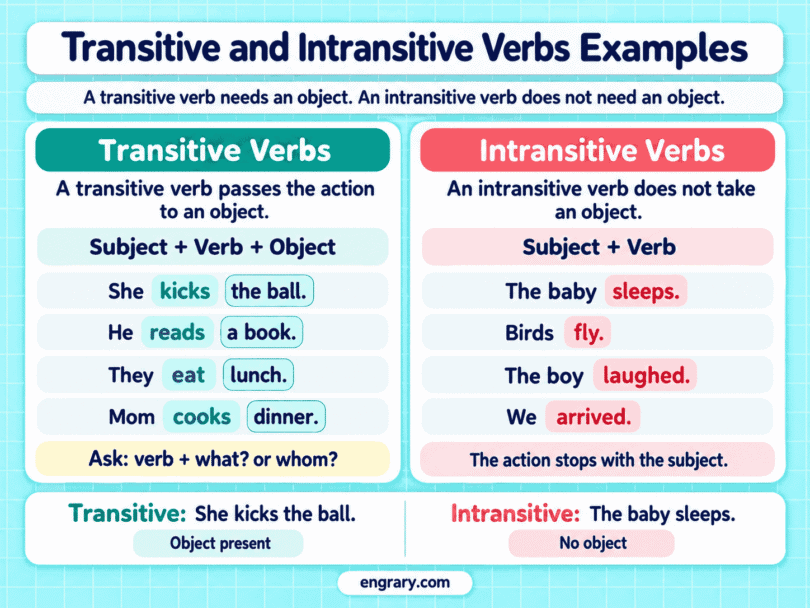
A verb is transitive when it is used with a direct object and intransitive when it is used without one. Comparing both types in real sentences helps learners see whether the verb acts on something or completes its meaning without a direct object.
You’ll see clear transitive and intransitive examples, side-by-side comparisons, verbs that work both ways, direct-object identification, extra information after intransitive verbs, and exactly 150 examples in sentences.
Transitive Verb Examples
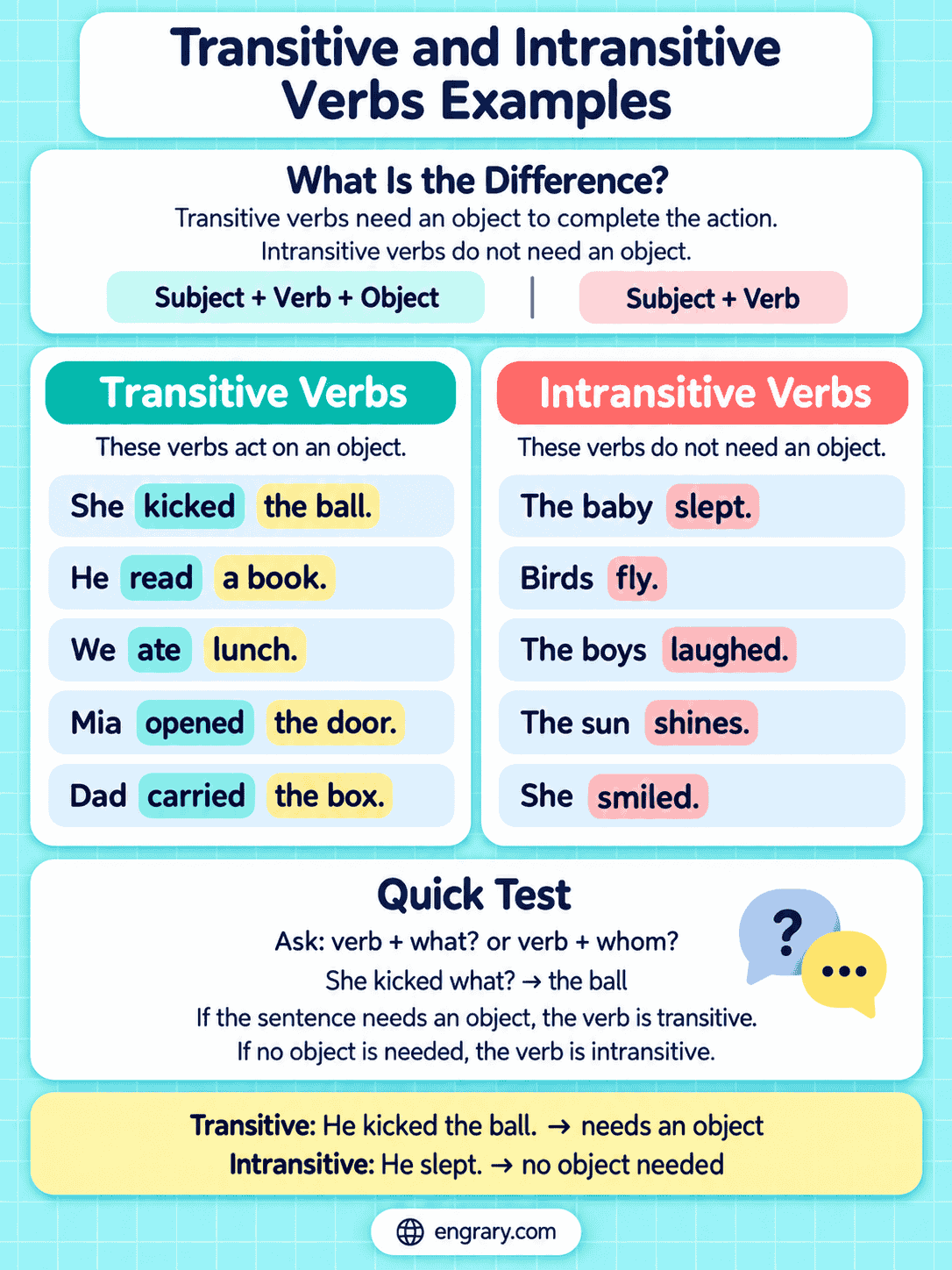
A transitive verb has a direct object in the sentence.
Examples:
Mia opened the door.
Noah kicked the ball.
Ava read the story.
Dad fixed the chair.
We watched the film.
The teacher explained the rule.
In each example, the verb acts on a direct object.
The common pattern is:
subject + transitive verb + direct object
For example:
Noah kicked the ball.
Subject: Noah
Verb: kicked
Direct object: the ball
Intransitive Verb Examples
An intransitive verb does not have a direct object in the sentence.
Examples:
The baby slept.
The guests arrived.
It rained.
The children laughed.
Noah waited outside.
The bird flew away.
These verbs complete their meaning without direct objects.
However, an intransitive verb can still have extra information after it.
Transitive and Intransitive Examples Side by Side
The clearest way to see the difference is to compare both uses directly.
| Transitive Example | Intransitive Example |
|---|---|
| She opened the door. | The door opened. |
| We ate lunch. | We ate early. |
| He drives a van. | He drives carefully. |
| They played football. | They played outside. |
| She left the building. | She left. |
| He wrote a letter. | He wrote for an hour. |
| Dad broke the glass. | The glass broke. |
| They increased the price. | The price increased. |
The basic contrast is:
transitive → direct object present
intransitive → no direct object
Same Verb Used Transitively and Intransitively
Many verbs can work both ways. Their classification depends on how they function in the sentence.
Open
She opened the door.
Here, opened is transitive because the door is the direct object.
The door opened.
Here, opened is intransitive because there is no direct object.
Eat
We ate lunch.
ate = transitive
lunch = direct object
We ate early.
ate = intransitive
early only tells when.
Drive
He drives a van.
drives = transitive
a van = direct object
He drives carefully.
drives = intransitive
carefully tells how.
Play
They played football.
played = transitive
football = direct object
They played outside.
played = intransitive
outside tells where.
Write
She wrote a letter.
wrote = transitive
a letter = direct object
She wrote for an hour.
wrote = intransitive
for an hour tells how long.
The verb itself does not always belong permanently to one category. Its use in the sentence determines whether it is transitive or intransitive.
Examples With Direct Objects Identified
A direct object tells what or whom the verb acts on.
| Sentence | Verb | Direct Object |
|---|---|---|
| Mia opened the door. | opened | the door |
| Noah kicked the ball. | kicked | the ball |
| Ava read the story. | read | the story |
| Dad fixed the chair. | fixed | the chair |
| We watched the film. | watched | the film |
| The teacher explained the lesson. | explained | the lesson |
| Mia carried the bag. | carried | the bag |
| Noah wrote a letter. | wrote | a letter |
For example:
Noah kicked the ball.
Ask:
kicked what?
Answer:
the ball
So the ball is the direct object.
Intransitive Examples With Extra Details
An intransitive verb can be followed by extra information even though it has no direct object.
Examples:
The baby slept peacefully.
The guests arrived at noon.
The dog ran quickly.
Noah waited outside.
The bird flew over the trees.
The children laughed loudly.
The extra words may tell:
- how;
- when;
- where;
- how long.
They do not automatically become direct objects.
Direct Object vs Extra Information
A direct object and extra information do different jobs.
Compare:
The boy carried the bag.
the bag = direct object
It answers:
carried what?
Now compare:
The boy ran to school.
to school = prepositional phrase
It tells where he ran.
Another pair:
She opened the window.
the window = direct object
She walked into the room.
into the room = prepositional phrase
The key distinction is:
direct object → tells what or whom the verb acts on
extra information → tells how, when, where, or how long
Use the What? or Whom? Test to Find the Direct Object
The what? / whom? test can help identify transitive use.
Example:
Noah kicked the ball.
Ask:
kicked what?
Answer:
the ball
So kicked is transitive.
Now compare:
The baby slept peacefully.
Ask:
slept what?
There is no direct-object answer.
So slept is intransitive.
Another example:
Mia called Noah.
Called whom?
Noah
So called is transitive.
Use this test together with the meaning of the sentence rather than applying it mechanically.
When the Object Becomes the Subject
Some verbs can change from transitive to intransitive use when the object in one sentence becomes the subject in another.
Compare:
Mia opened the door.
the door = direct object
Now:
The door opened.
the door = subject
Another pair:
Dad broke the glass.
The glass broke.
And:
They increased the price.
The price increased.
Also:
The storm changed the weather.
The weather changed.
These examples show why the same verb can function differently depending on sentence structure.
Transitive Verbs With Two Objects
Some transitive verbs can take both an indirect object and a direct object.
Example:
Mia gave Noah a book.
Verb:
gave
Indirect object:
Noah
Direct object:
a book
Other examples:
The teacher showed us the answer.
Dad sent Mia a message.
Ava told Noah the story.
The direct object still answers what?
For example:
gave what?
a book
150 Transitive and Intransitive Verb Examples in Sentences
The following table contains exactly 150 examples: 75 transitive and 75 intransitive.
| Sentence | Type | Verb | Direct Object / Extra Information |
|---|---|---|---|
| Mia opened the door. | Transitive | opened | the door |
| Noah kicked the ball. | Transitive | kicked | the ball |
| Ava read the story. | Transitive | read | the story |
| Dad fixed the chair. | Transitive | fixed | the chair |
| We watched the film. | Transitive | watched | the film |
| The teacher explained the rule. | Transitive | explained | the rule |
| Mia carried the bag. | Transitive | carried | the bag |
| Noah wrote a letter. | Transitive | wrote | a letter |
| Ava bought a pencil. | Transitive | bought | a pencil |
| The child closed the window. | Transitive | closed | the window |
| We cleaned the room. | Transitive | cleaned | the room |
| Dad made a table. | Transitive | made | a table |
| Mia drew a picture. | Transitive | drew | a picture |
| Noah caught the ball. | Transitive | caught | the ball |
| Ava threw the stone. | Transitive | threw | the stone |
| Dad washed the car. | Transitive | washed | the car |
| We painted the wall. | Transitive | painted | the wall |
| The chef cut the vegetables. | Transitive | cut | the vegetables |
| Mia folded the paper. | Transitive | folded | the paper |
| Noah lifted the box. | Transitive | lifted | the box |
| Ava chose a book. | Transitive | chose | a book |
| Dad opened the gate. | Transitive | opened | the gate |
| We used the computer. | Transitive | used | the computer |
| Mia found her keys. | Transitive | found | her keys |
| Noah helped his friend. | Transitive | helped | his friend |
| Ava called her mother. | Transitive | called | her mother |
| Dad built a shelf. | Transitive | built | a shelf |
| The student answered the question. | Transitive | answered | the question |
| The teacher checked the work. | Transitive | checked | the work |
| We finished the project. | Transitive | finished | the project |
| Mia packed her clothes. | Transitive | packed | her clothes |
| Noah sent a message. | Transitive | sent | a message |
| Ava told the story. | Transitive | told | the story |
| Dad brought the groceries. | Transitive | brought | the groceries |
| We moved the table. | Transitive | moved | the table |
| The child broke the toy. | Transitive | broke | the toy |
| Mia changed the plan. | Transitive | changed | the plan |
| Noah started the game. | Transitive | started | the game |
| Ava finished her homework. | Transitive | finished | her homework |
| Dad drove the car. | Transitive | drove | the car |
| We played football. | Transitive | played | football |
| Mia ate lunch. | Transitive | ate | lunch |
| Noah drank the juice. | Transitive | drank | the juice |
| Ava cooked dinner. | Transitive | cooked | dinner |
| Dad read the newspaper. | Transitive | read | the newspaper |
| We visited the museum. | Transitive | visited | the museum |
| Mia answered him. | Transitive | answered | him |
| Noah helped her. | Transitive | helped | her |
| We invited them. | Transitive | invited | them |
| Ava thanked us. | Transitive | thanked | us |
| Dad gave Mia a gift. | Transitive | gave | a gift |
| The teacher showed us the answer. | Transitive | showed | the answer |
| Noah sent Ava a letter. | Transitive | sent | a letter |
| Mia taught Noah the rule. | Transitive | taught | the rule |
| Ava asked him a question. | Transitive | asked | a question |
| Dad handed me the book. | Transitive | handed | the book |
| We offered them some food. | Transitive | offered | some food |
| The coach taught the players a skill. | Transitive | taught | a skill |
| Mia showed Ava the picture. | Transitive | showed | the picture |
| Noah wrote a poem. | Transitive | wrote | a poem |
| Ava opened the box. | Transitive | opened | the box |
| Dad increased the price. | Transitive | increased | the price |
| We changed the schedule. | Transitive | changed | the schedule |
| Mia rolled the ball. | Transitive | rolled | the ball |
| Noah rang the bell. | Transitive | rang | the bell |
| Ava began the lesson. | Transitive | began | the lesson |
| Dad stopped the machine. | Transitive | stopped | the machine |
| We grew tomatoes. | Transitive | grew | tomatoes |
| Mia boiled the water. | Transitive | boiled | the water |
| Noah melted the butter. | Transitive | melted | the butter |
| Ava dropped the glass. | Transitive | dropped | the glass |
| Dad turned the handle. | Transitive | turned | the handle |
| We won the match. | Transitive | won | the match |
| Mia left the building. | Transitive | left | the building |
| Noah entered the room. | Transitive | entered | the room |
| The baby slept peacefully. | Intransitive | slept | peacefully |
| The guests arrived at noon. | Intransitive | arrived | at noon |
| The dog ran quickly. | Intransitive | ran | quickly |
| It rained all night. | Intransitive | rained | all night |
| The children laughed loudly. | Intransitive | laughed | loudly |
| The bird flew away. | Intransitive | flew | away |
| Noah waited outside. | Intransitive | waited | outside |
| The glass fell onto the floor. | Intransitive | fell | onto the floor |
| Mia smiled warmly. | Intransitive | smiled | warmly |
| The baby cried during the night. | Intransitive | cried | during the night |
| Ava walked slowly. | Intransitive | walked | slowly |
| The workers rested after lunch. | Intransitive | rested | after lunch |
| The door opened suddenly. | Intransitive | opened | suddenly |
| We ate early. | Intransitive | ate | early |
| He drives carefully. | Intransitive | drives | carefully |
| They played outside. | Intransitive | played | outside |
| She left quietly. | Intransitive | left | quietly |
| He wrote for an hour. | Intransitive | wrote | for an hour |
| The glass broke suddenly. | Intransitive | broke | suddenly |
| The price increased sharply. | Intransitive | increased | sharply |
| The weather changed overnight. | Intransitive | changed | overnight |
| The lesson began at nine. | Intransitive | began | at nine |
| The machine stopped suddenly. | Intransitive | stopped | suddenly |
| The water boiled quickly. | Intransitive | boiled | quickly |
| The butter melted slowly. | Intransitive | melted | slowly |
| The ball rolled away. | Intransitive | rolled | away |
| The bell rang loudly. | Intransitive | rang | loudly |
| The leaves fell gently. | Intransitive | fell | gently |
| The sun rose early. | Intransitive | rose | early |
| The children laughed together. | Intransitive | laughed | together |
| The baby sneezed twice. | Intransitive | sneezed | twice |
| The guests waited patiently. | Intransitive | waited | patiently |
| Mia worked quietly. | Intransitive | worked | quietly |
| Noah lived nearby. | Intransitive | lived | nearby |
| Ava stayed at home. | Intransitive | stayed | at home |
| The dog barked loudly. | Intransitive | barked | loudly |
| The audience clapped enthusiastically. | Intransitive | clapped | enthusiastically |
| The child jumped high. | Intransitive | jumped | high |
| The horse galloped across the field. | Intransitive | galloped | across the field |
| The baby crawled slowly. | Intransitive | crawled | slowly |
| The boys swam in the pool. | Intransitive | swam | in the pool |
| The girls danced gracefully. | Intransitive | danced | gracefully |
| Dad worked all morning. | Intransitive | worked | all morning |
| The teacher paused briefly. | Intransitive | paused | briefly |
| The crowd cheered loudly. | Intransitive | cheered | loudly |
| Mia hesitated for a moment. | Intransitive | hesitated | for a moment |
| Noah yawned loudly. | Intransitive | yawned | loudly |
| Ava coughed twice. | Intransitive | coughed | twice |
| The boy ran to school. | Intransitive | ran | to school |
| The bird flew over the trees. | Intransitive | flew | over the trees |
| The train arrived on time. | Intransitive | arrived | on time |
| The visitors came early. | Intransitive | came | early |
| The child fell asleep. | Intransitive | fell | asleep |
| The accident happened yesterday. | Intransitive | happened | yesterday |
| The stars appeared at night. | Intransitive | appeared | at night |
| The sun disappeared behind the clouds. | Intransitive | disappeared | behind the clouds |
| The flowers grew quickly. | Intransitive | grew | quickly |
| The temperature rose suddenly. | Intransitive | rose | suddenly |
| The crowd gathered outside. | Intransitive | gathered | outside |
| The children sat quietly. | Intransitive | sat | quietly |
| Mia stood near the door. | Intransitive | stood | near the door |
| Noah walked through the park. | Intransitive | walked | through the park |
| The dog slept under the table. | Intransitive | slept | under the table |
| The guests departed after dinner. | Intransitive | departed | after dinner |
| The baby smiled at me. | Intransitive | smiled | at me |
| Ava laughed at the joke. | Intransitive | laughed | at the joke |
| The children talked for hours. | Intransitive | talked | for hours |
| Dad returned late. | Intransitive | returned | late |
| Noah stumbled on the stairs. | Intransitive | stumbled | on the stairs |
| The bird landed on the branch. | Intransitive | landed | on the branch |
| The ship sailed across the sea. | Intransitive | sailed | across the sea |
| The car stopped at the light. | Intransitive | stopped | at the light |
| The students listened quietly. | Intransitive | listened | quietly |
| The baby woke suddenly. | Intransitive | woke | suddenly |
| Mia replied politely. | Intransitive | replied | politely |
The first 75 sentences show transitive use because each verb has a direct object. The next 75 show intransitive use because none has a direct object, even when an adverb or prepositional phrase follows the verb.
Common Transitive and Intransitive Verb Mistakes
| Mistake | Correct Understanding |
|---|---|
| Every action verb is transitive. | Some action verbs do not take direct objects. |
| Nothing can follow an intransitive verb. | Adverbs and prepositional phrases can follow it. |
| Every phrase after a verb is a direct object. | It may provide extra information about how, when, or where. |
| A verb is permanently transitive or intransitive. | Many verbs can work both ways. |
| “To school” is a direct object in “ran to school.” | It is a prepositional phrase. |
| Every transitive verb has only one object. | Some transitive verbs can take two objects. |
| Intransitive verbs normally form passive sentences. | They usually cannot because they have no direct object. |
For example:
The boy carried the bag.
the bag is a direct object, so carried is transitive.
By contrast:
The boy ran to school.
to school is a prepositional phrase, so ran is intransitive.
FAQs
Transitive examples include Mia opened the door, Noah kicked the ball, and Ava read the story. Intransitive examples include The baby slept, The guests arrived, and The children laughed.
Check whether the verb has a direct object. If a word or phrase answers what? or whom? after the verb and functions as the direct object, the use is transitive. If there is no direct object, the use is intransitive.
Yes. For example, eat is transitive in We ate lunch but intransitive in We ate early.
Yes. Adverbs and prepositional phrases can follow an intransitive verb. For example, The dog ran quickly and The boy ran to school both contain extra information but no direct object.
The direct object tells what or whom the verb acts on. In Noah kicked the ball, the ball is the direct object.
You May Also Like



Leave a Comment