Main verb examples help learners see which verb carries the central action, event, or state in a sentence. A main verb can work alone or appear after one or more helping verbs.
You’ll see simple main verbs, examples with helping verbs, action and state verbs, linking verbs used as main verbs, different verb forms, and exactly 100 sentence examples with the main verb clearly identified.
Main Verbs in Simple Sentences
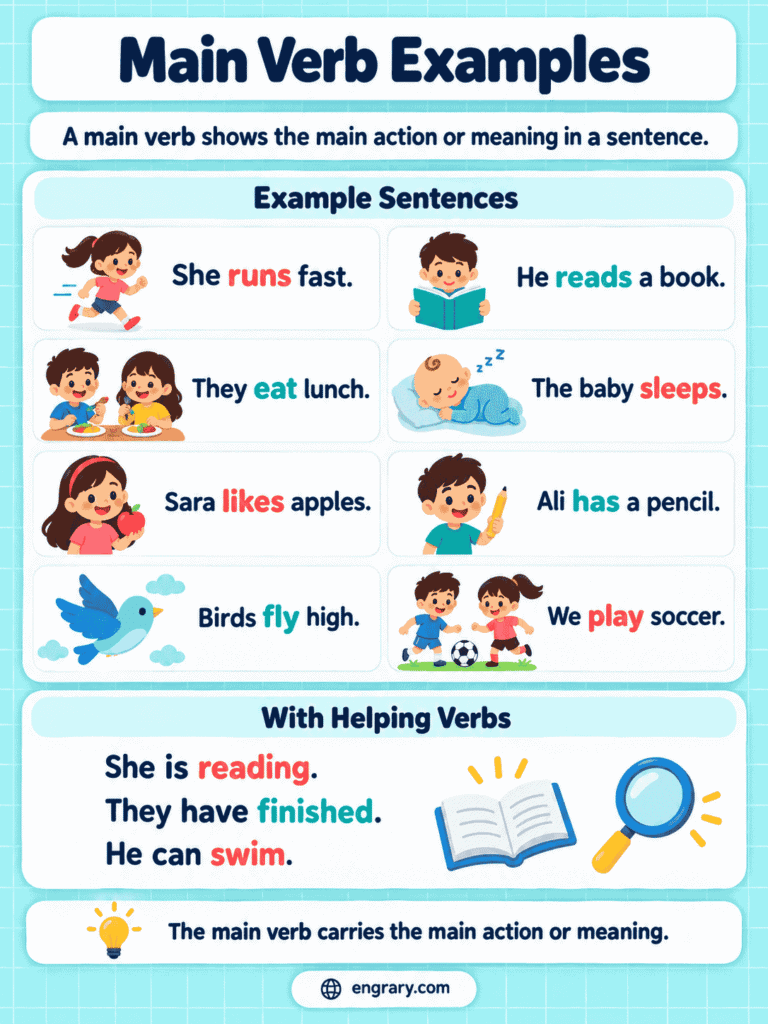
A main verb can carry the central meaning without a helping verb.
| Sentence | Main Verb |
|---|---|
| Mia reads every night. | reads |
| Noah writes neatly. | writes |
| The dog barked loudly. | barked |
| We laughed together. | laughed |
| The baby slept peacefully. | slept |
| Ava runs every morning. | runs |
| Dad cooks dinner. | cooks |
| The children played outside. | played |
| She knows the answer. | knows |
| He owns a bicycle. | owns |
In each sentence, the bold verb carries the main meaning.
Main Verb Examples With Helping Verbs
Helping verbs can appear before the main verb.
| Sentence | Helping Verb | Main Verb |
|---|---|---|
| She is reading. | is | reading |
| They have finished. | have | finished |
| Noah can swim. | can | swim |
| We will travel tomorrow. | will | travel |
| Mia was drawing. | was | drawing |
| The children are playing. | are | playing |
| Dad has repaired the chair. | has | repaired |
| Ava may join us. | may | join |
| They were laughing. | were | laughing |
| I should leave now. | should | leave |
The helping verb supports the verb phrase, while the main verb carries the central action or state.
Main Verbs With More Than One Helping Verb
A main verb can have several helping verbs before it.
She might have finished the work.
Helping verbs: might, have
Main verb: finished
They may have been waiting outside.
Helping verbs: may, have, been
Main verb: waiting
Noah could have been sleeping.
Helping verbs: could, have, been
Main verb: sleeping
The number of helping verbs can increase, but the verb phrase still centers on one main verb.
Action Main Verb Examples
Action main verbs describe something the subject does.
The boy runs quickly.
Mia writes a letter.
The children build a tower.
Noah swims every morning.
Dad carries the boxes.
The teacher explains the rule.
Ava opens the window.
The player kicks the ball.
We clean the classroom.
The dog chases the bird.
These verbs carry the main action of their clauses.
State Main Verb Examples
Main verbs can also express states, feelings, possession, needs, or relationships.
She knows the answer.
Mia likes music.
We need help.
He owns a bicycle.
The bag belongs to Noah.
The child wants some water.
Ava prefers tea.
The students understand the rule.
Therefore, a main verb does not have to describe visible movement.
Linking Verbs Used as Main Verbs
A linking verb can also function as the main verb.
The soup is hot.
Mia seems tired.
The flower smells sweet.
The sky became dark.
The blanket feels soft.
The cake tastes delicious.
Here, the verb links the subject to a description or identity.
Compare:
The soup is boiling.
Helping verb: is
Main verb: boiling
By contrast:
The soup is hot.
Main/linking verb: is
Be, Have, and Do as Main Verbs
The verbs be, have, and do can work as main verbs in some sentences and helping verbs in others.
Be
She is a teacher.
Main/linking verb: is
She is working.
Helping verb: is
Main verb: working
Have
They have lunch at noon.
Main verb: have
They have finished lunch.
Helping verb: have
Main verb: finished
Do
I do my homework after dinner.
Main verb: do
Do you like apples?
Helping verb: do
Main verb: like
Their role depends on how they function in the sentence.
Main Verb Examples in Different Forms
A main verb can appear in several forms.
| Form | Example |
|---|---|
| Base | They play outside. |
| Third-person singular | Mia plays outside. |
| Past | They played yesterday. |
| -ing form | They are playing now. |
| Past participle | They have played before. |
Another example is:
write → writes → wrote → writing → written
In sentences:
I write every day.
Noah writes every day.
Mia wrote yesterday.
The students are writing now.
They have written their answers.
The form changes, but the verb still carries the central meaning.
Main Verbs With and Without Objects
Some main verbs take direct objects, while others can work without one.
| With an Object | Without an Object |
|---|---|
| She opened the door. | The baby laughed. |
| Noah kicked the ball. | The dog ran. |
| The teacher explained the lesson. | The children slept. |
| Mia carried the bag. | The audience clapped. |
| Dad fixed the bicycle. | The bird flew. |
Both types can function as main verbs.

100 Main Verb Examples in Sentences
The following table gives exactly 100 main verb examples in context.
| Sentence | Main Verb |
|---|---|
| Mia reads every night. | reads |
| Noah writes neatly. | writes |
| Ava runs every morning. | runs |
| The dog barks loudly. | barks |
| Dad cooks dinner. | cooks |
| We laugh together. | laugh |
| The baby sleeps peacefully. | sleeps |
| The children play outside. | play |
| Mia draws a flower. | draws |
| Noah opens the door. | opens |
| Dad carries the box. | carries |
| Ava climbs the stairs. | climbs |
| The bird flies away. | flies |
| We wash the dishes. | wash |
| She folds the paper. | folds |
| The boy kicks the ball. | kicks |
| The children build a tower. | build |
| Dad repairs the chair. | repairs |
| Mia paints a picture. | paints |
| Noah throws the ball. | throws |
| The teacher explains the lesson. | explains |
| Ava answers the question. | answers |
| We study together. | study |
| The students listen carefully. | listen |
| Mia chooses a book. | chooses |
| Noah solves the puzzle. | solves |
| Dad drives to work. | drives |
| The child jumps over the rope. | jumps |
| We travel by train. | travel |
| Ava plants flowers. | plants |
| The chef cuts the vegetables. | cuts |
| Mia needs help. | needs |
| Noah likes football. | likes |
| She knows the answer. | knows |
| Dad owns a car. | owns |
| The bag belongs to Ava. | belongs |
| The child wants some juice. | wants |
| Mia prefers tea. | prefers |
| The soup is hot. | is |
| Noah seems tired. | seems |
| The flower smells sweet. | smells |
| The blanket feels soft. | feels |
| The sky became dark. | became |
| The cake tastes delicious. | tastes |
| She is reading a story. | reading |
| They are playing outside. | playing |
| Noah has finished his work. | finished |
| We will visit the museum. | visit |
| Mia can swim well. | swim |
| Dad was repairing the gate. | repairing |
| The children were laughing. | laughing |
| Ava may join the class. | join |
| We should leave now. | leave |
| Noah has written a letter. | written |
| They have arrived safely. | arrived |
| Mia might have finished already. | finished |
| The students may have been waiting. | waiting |
| Dad has been working all morning. | working |
| The baby was sleeping quietly. | sleeping |
| Ava will be traveling tomorrow. | traveling |
| Noah can draw very well. | draw |
| The dog ran across the yard. | ran |
| We ate lunch early. | ate |
| Mia wrote a story yesterday. | wrote |
| The children sang together. | sang |
| Dad made a table. | made |
| Ava found her pencil. | found |
| Noah gave me the book. | gave |
| The class learned a new rule. | learned |
| The teacher asked a question. | asked |
| We finished the project. | finished |
| Mia opened the window. | opened |
| Noah closed the gate. | closed |
| The children cleaned the room. | cleaned |
| Dad lifted the box. | lifted |
| Ava carried her bag. | carried |
| The dog chased the cat. | chased |
| Mia called her friend. | called |
| Noah answered the phone. | answered |
| We watched the birds. | watched |
| The students copied the sentence. | copied |
| Dad washed the car. | washed |
| Ava packed her clothes. | packed |
| The chef prepared lunch. | prepared |
| Noah fixed the toy. | fixed |
| The children danced on stage. | danced |
| Mia smiled at her friend. | smiled |
| The baby cried loudly. | cried |
| We walked to school. | walked |
| Dad bought some fruit. | bought |
| Ava sent a message. | sent |
| Noah read the note. | read |
| The students discussed the story. | discussed |
| Mia decided to stay. | decided |
| We planned the trip. | planned |
| The teacher checked the answers. | checked |
| Ava measured the table. | measured |
| Noah selected a book. | selected |
| The children created a poster. | created |
| Dad organized the tools. | organized |
These examples show main verbs expressing actions, states, and linking relationships, both alone and inside longer verb phrases.

How to Identify the Main Verb in Each Example
Start by finding the verb or verb phrase.
Then ask:
Which verb carries the main action, event, or state?
For example:
They have been waiting.
Verb phrase:
have been waiting
Helping verbs:
have, been
Main verb:
waiting
Another example:
She can sing.
Verb phrase:
can sing
Helping verb:
can
Main verb:
sing
Now compare:
The soup is hot.
There is no second verb. Here, is functions as the main linking verb.
Therefore, meaning and function are more useful than simply choosing the first verb in the sentence.
Common Main Verb Mistakes
| Mistake | Correct Understanding |
|---|---|
| The first verb is always the main verb. | Helping verbs can come before the main verb. |
| Main verbs only describe actions. | They can also describe states. |
| Is is always a helping verb. | It can also be a main linking verb. |
| Have is always a helping verb. | It can also function as the main verb. |
| Do is always a helping verb. | It can carry the main action in some sentences. |
| Main verb and action verb mean exactly the same thing. | Main verbs can be action, state, or linking verbs. |
| Every sentence needs a helping verb. | Many sentences contain only a main verb. |
For example:
She is running.
is helps, while running is the main verb.
By contrast:
She is happy.
Here, is functions as the main linking verb.
FAQs
Examples include Mia reads every night, Noah writes neatly, The dog barked loudly, She knows the answer, and The soup is hot.
Yes. In Mia reads, reads works as the main verb without any helping verb.
Examples include is reading, have finished, can swim, will travel, and was drawing. The helping verb supports the main verb, while the main verb carries the central meaning.
Yes. In The soup is hot, is functions as both the linking verb and the main verb.
Find the verb or verb phrase, then identify the verb that carries the central action, event, or state. In They have been waiting, waiting is the main verb.
You May Also Like