Countable and uncountable nouns are an important part of English grammar. They help us choose the correct articles, numbers, and quantity words when we speak and write. Once children understand the difference, they can make fewer grammar mistakes and write more natural English sentences.
You’ll learn what countable and uncountable nouns are, how they are different, when to use each type, and how to recognize them with easy examples. You’ll also practice using them correctly in everyday situations.
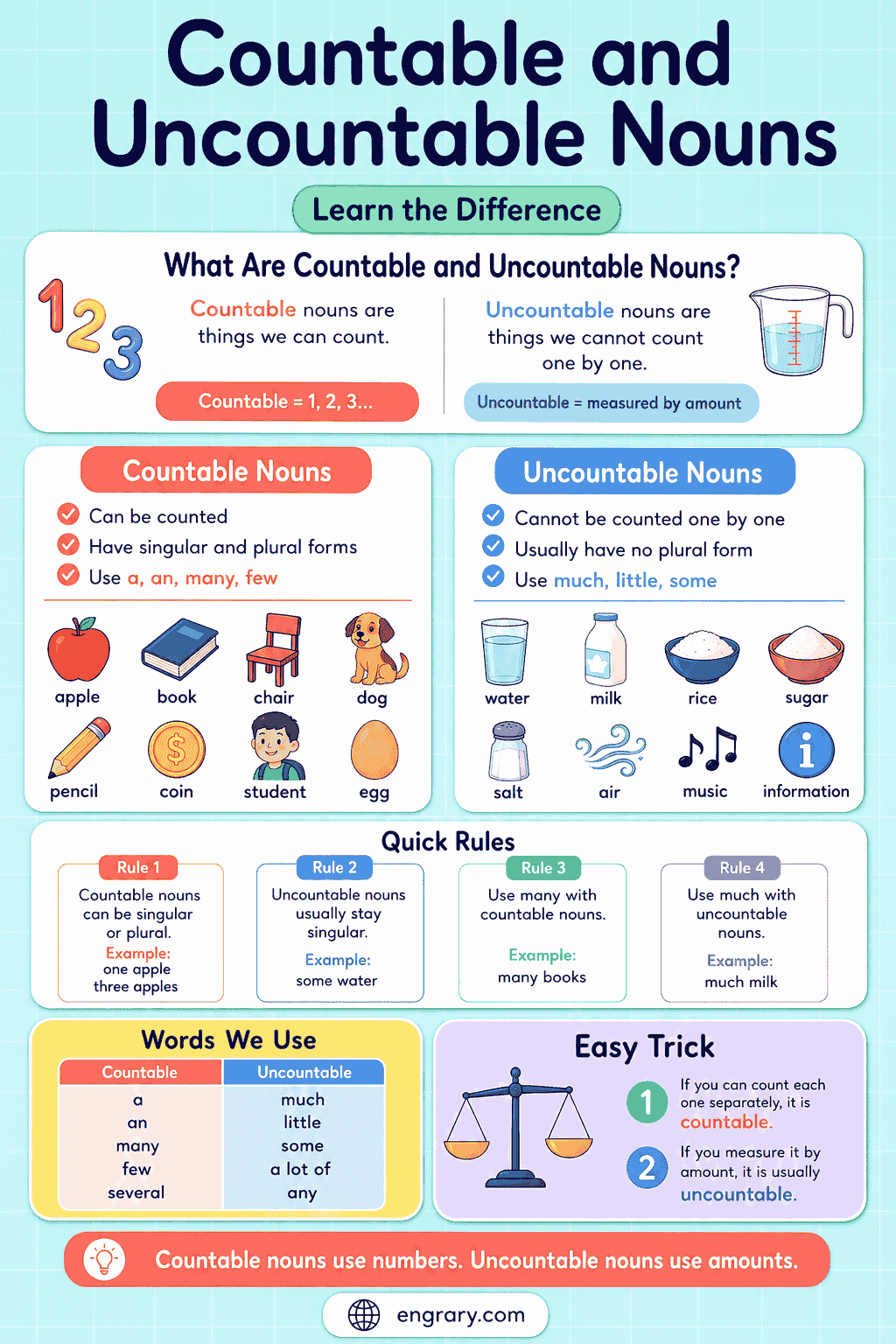
What Are Countable and Uncountable Nouns?
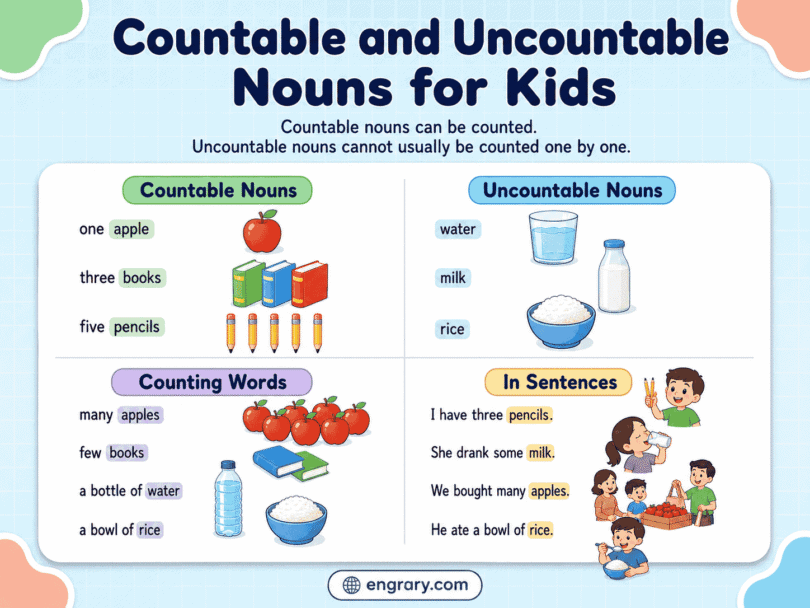
We call nouns countable or uncountable based on how we usually count them in English.
What Is a Countable Noun?
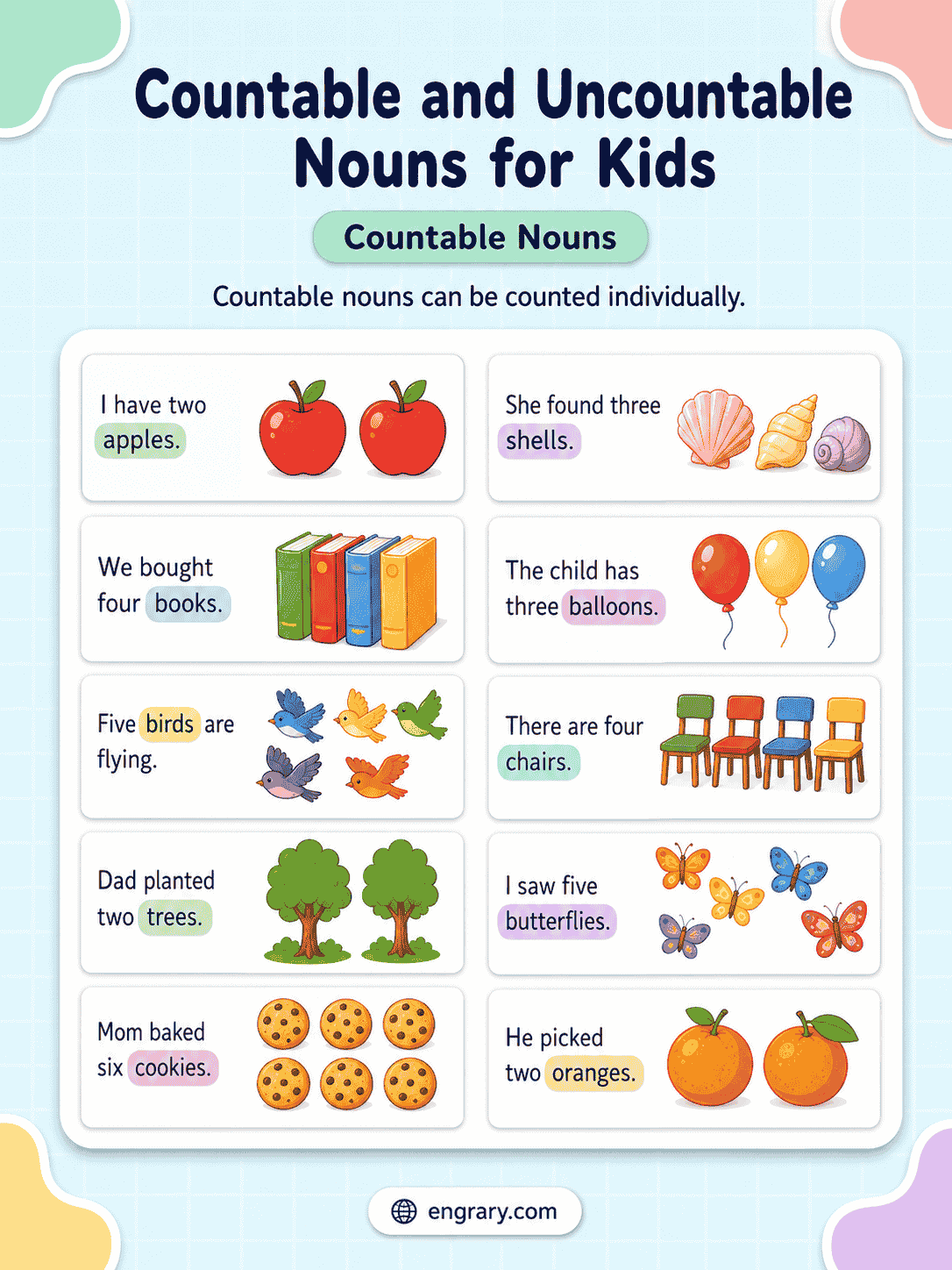
A countable noun names something we can normally count as separate people, animals, places, objects, or ideas.
Examples include:
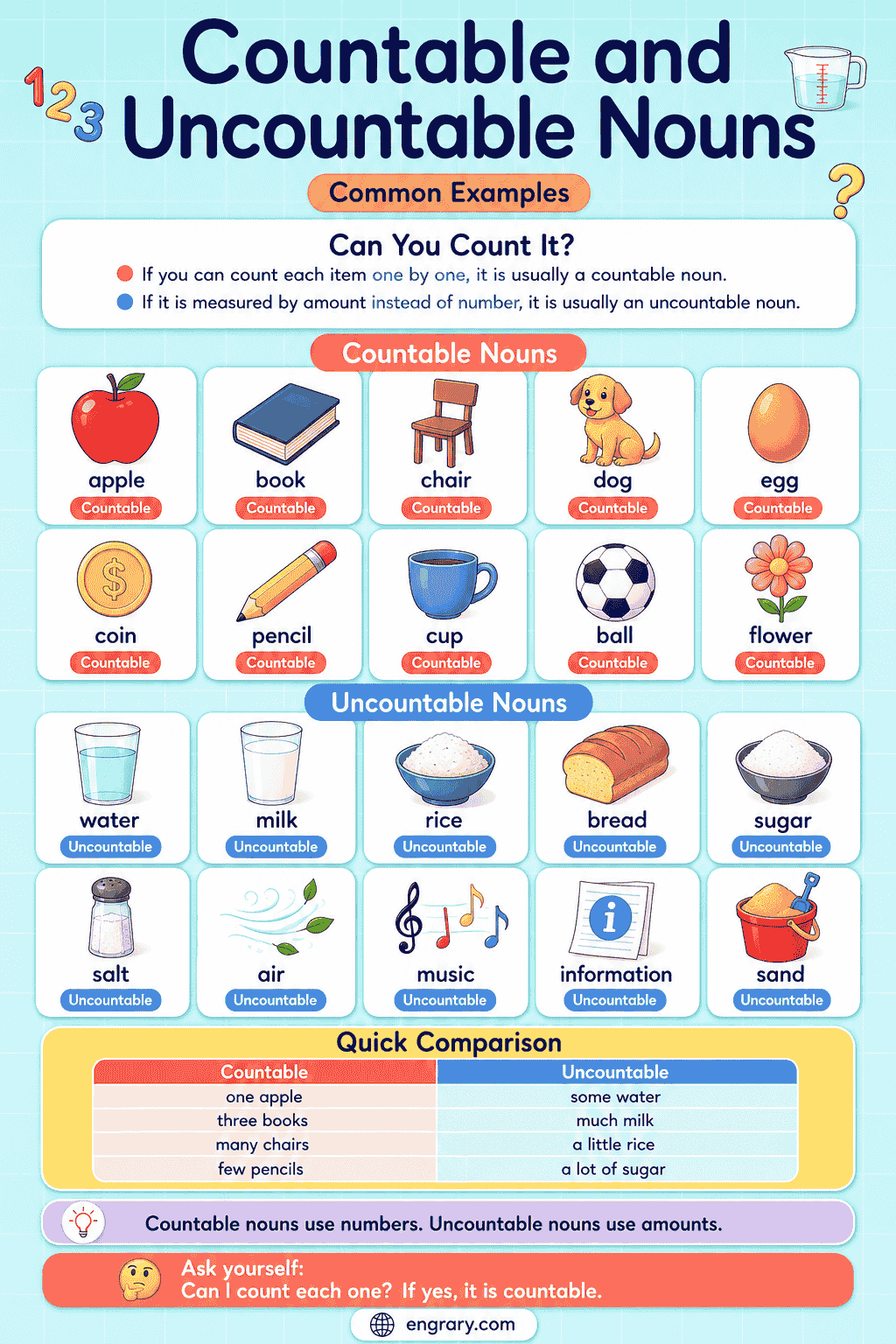
- apple;
- student;
- dog;
- chair;
- question;
- idea.
Countable nouns usually have a singular form for one item and a plural form for more than one.
For example:
- book → books;
- cookie → cookies;
- child → children.
We can also use numbers directly before countable nouns:
- two pencils;
- five students;
- ten balloons.
When we talk about one countable item, we often use a or an.
For example:
- a pencil;
- a teacher;
- an orange;
- an umbrella.
What Is an Uncountable Noun?
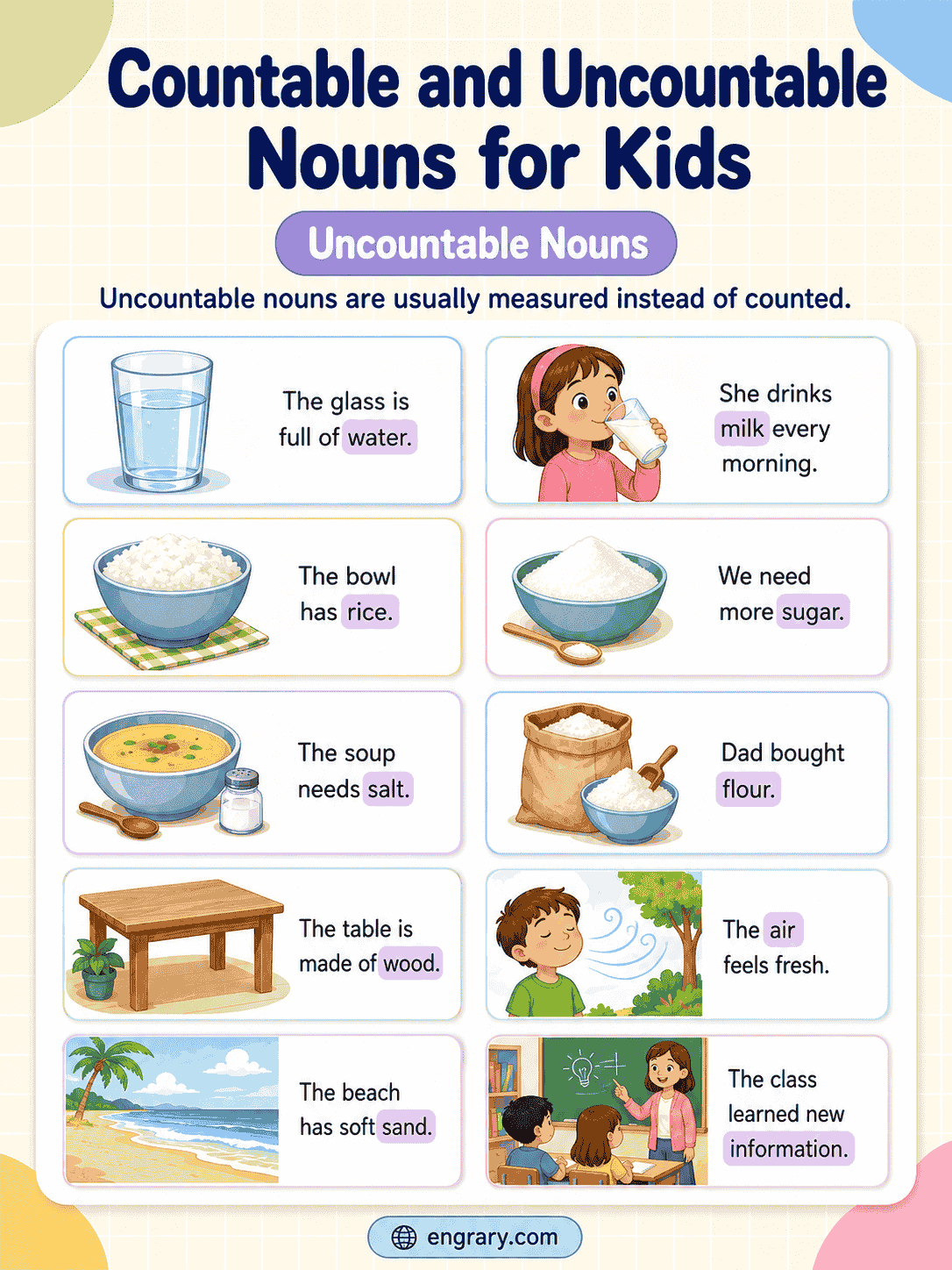
An uncountable noun names something that English usually treats as an amount, material, substance, or whole rather than as separate items.
Common examples include:
- water;
- rice;
- bread;
- sand;
- information;
- furniture;
- advice;
- homework.
When a noun is being used as uncountable, we do not normally count it directly with numbers.
For example, these forms are not correct in their usual meanings:
- two rices;
- three informations;
- four furnitures.
Instead, we talk about an amount:
- some rice;
- a little water;
- a lot of furniture.
We can also count a unit, such as a bowl of rice or two bottles of water. You will learn more about these expressions later.
Countable vs. Uncountable Nouns
The main difference is whether English normally treats a noun as separate items or as an amount.
| Feature | Countable Nouns | Uncountable Nouns |
|---|---|---|
| Numbers directly before the noun | three books | usually not three milks for the substance |
| Singular form | a book | usually no a/an directly |
| Plural form | books | usually no ordinary plural |
| a/an | a chair | not a furniture |
| many | many apples | no |
| much | no | much water |
| a few | a few cookies | no |
| a little | no | a little juice |
| Question form | How many? | How much? |
These patterns are useful clues. However, context also matters because some nouns can be countable in one meaning and uncountable in another.
How to Tell if a Noun Is Countable or Uncountable
A few simple checks can help you identify the noun type.
First, ask whether you can naturally place a number directly before the noun.
For example:
- one book;
- two books;
- three books.
These forms sound natural, so book is countable.
Now try the same test with rice. We do not normally say one rice or two rices when we mean rice as food. Therefore, rice is usually uncountable.
Next, check whether the noun normally has a singular and plural form.
For example:
- apple → apples;
- chair → chairs;
- student → students.
These nouns are countable.
In contrast, nouns such as information, furniture, and advice do not normally take ordinary plural endings in their usual meanings.
You can also check whether a or an works naturally before the noun.
Correct:
- a bicycle;
- an egg;
- a notebook.
Incorrect in the usual meanings:
- a rice;
- an information;
- a furniture.
Finally, ask whether you need to count a piece, container, serving, or other unit instead. Expressions such as a slice of bread and a piece of advice are clues that the main noun is being used as uncountable.
Numbers, Singular Forms, and Plurals
Countable nouns work naturally with numbers and usually show whether there is one item or more than one.
Using Numbers With Countable Nouns
A number can come directly before a plural countable noun.
For example, we can say two cats, four sandwiches, six pencils, or ten balloons.
Compare:
- three apples;
- some juice.
We count the apples directly because they are separate items. However, we usually talk about juice as an amount unless we count its containers or servings.
Singular and Plural Countable Nouns
A singular countable noun refers to one item, while a plural countable noun refers to more than one.
Examples include:
- one book → two books;
- one flower → several flowers;
- one question → many questions.
Many nouns form their plurals by adding -s or -es, while others change in different ways.
For example:
- cat → cats;
- bus → buses;
- child → children.
Detailed plural spelling rules belong in a separate lesson. Here, the important point is that countable nouns can normally show the difference between one and more than one.
Using A and An With Countable Nouns
We often use a or an with one countable noun.
Use a before a consonant sound, as in a dog, a pencil, and a chair.
Use an before a vowel sound, as in an apple, an egg, and an umbrella.
A singular countable noun usually needs a determiner such as a, an, the, this, that, my, or your.
Incorrect:
I bought pencil.
Correct:
I bought a pencil.
Examples of Countable and Uncountable Nouns
Looking at familiar groups can make the difference easier to understand.
Common Countable Nouns
Countable nouns may name people, animals, objects, places, or ideas.
| Group | Examples |
|---|---|
| people | student, teacher, friend |
| animals | dog, rabbit, bird |
| objects | pencil, chair, cup |
| places | school, park, store |
| ideas or events | idea, question, mistake |
Examples in sentences:
- Three students opened their books.
- A rabbit crossed the path.
- Mia asked two questions.
Common Uncountable Nouns
Uncountable nouns often name liquids, foods, materials, or other things English usually treats as amounts.
| Group | Examples |
|---|---|
| liquids | water, milk, juice |
| foods | rice, bread, sugar |
| materials | sand, wood, glass |
| other common uncountable nouns | advice, information, homework, furniture |
Examples in sentences:
- There is some milk in the carton.
- We need a little sugar.
- The teacher gave us some homework.
These groups are useful, but they are not perfect rules. Always pay attention to how the noun is used.
Nouns Can Belong to More Than One Category
Countable and uncountable are not the only noun classifications.
For example:
- apple is concrete, common, singular, and countable;
- water is concrete, common, and uncountable;
- advice is abstract, common, and uncountable;
- idea is abstract, common, and countable.
Therefore, a concrete noun is not automatically countable, and an abstract noun is not automatically uncountable.
Quantity Words for Countable and Uncountable Nouns
The noun type helps us choose the correct quantity word.
Much and Many
Use many with plural countable nouns.
Examples include many books, many students, many apples, and many toys.
Use much with uncountable nouns, especially in questions and negative sentences.
For example:
- How much water do we need?
- How much sugar is left?
- We do not have much milk.
- There is not much time before class.
In everyday positive sentences, a lot of often sounds more natural than much.
Natural:
We have a lot of water.
Less natural in everyday conversation:
We have much water.
A Few and A Little
Use a few with plural countable nouns, such as a few cookies, a few books, or a few students.
Use a little with uncountable nouns, such as a little milk, a little rice, or a little sugar.
Compare:
Ava packed a few sandwiches.
Ava poured a little juice.
Both expressions describe a small quantity, but the noun type determines which one we use.
How Much and How Many
Use how many when asking about countable nouns.
For example:
- How many apples are in the basket?
- How many students are in the room?
- How many books did you borrow?
Use how much when asking about uncountable nouns.
For example:
- How much water is in the bottle?
- How much rice do we need?
- How much homework do you have?
Remember:
How many + plural countable noun
How much + uncountable noun
Words Used With Both Countable and Uncountable Nouns
Some quantity words can be used with both noun types.
Some, Any, and A Lot of
We can use some with plural countable nouns and uncountable nouns.
For example:
- some apples;
- some cookies;
- some water;
- some information.
The word any also works with both types.
For example:
- Do you have any pencils?
- Do you have any paper?
- We do not have any apples.
- We do not have any milk.
Similarly, a lot of works with both groups:
- a lot of books;
- a lot of homework.
These words are useful because their form does not change when the noun type changes.
Making Uncountable Nouns Countable
When a noun is being used as uncountable, we usually count a piece, container, serving, or unit instead of counting the noun directly.
Using Pieces, Containers, and Units
Consider water. We can count its containers or servings:
- one glass of water;
- two bottles of water;
- three cups of water.
The same pattern works with many other uncountable nouns.
| Uncountable Noun | Countable Expression |
|---|---|
| water | a glass of water |
| milk | a bottle of milk |
| rice | a bowl of rice |
| bread | a slice of bread |
| cheese | a piece of cheese |
| sugar | a spoonful of sugar |
| information | a piece of information |
| advice | a piece of advice |
Notice which word becomes plural:
- one slice of bread;
- three slices of bread.
The noun bread stays the same because we are counting the slices.
Similarly:
- one piece of advice;
- two pieces of advice.
We count the pieces, not advices.
The unit can change according to meaning. For example, we may say a slice of bread for one piece or a loaf of bread for a whole baked unit.
Nouns That Can Be Countable or Uncountable
Some nouns can be countable in one situation and uncountable in another. Their meaning in the sentence tells us how they are being used.
Consider chicken:
We ate chicken for dinner.
Here, chicken means food, so it is uncountable.
Three chickens walked across the yard.
Here, chickens means individual animals, so it is countable.
Now consider coffee:
Dad drinks coffee every morning.
Here, coffee refers to the drink in general.
The server brought two coffees.
Here, two coffees means two servings or cups of coffee.
The noun glass can also change:
The window is made of glass.
Here, glass means the material, so it is uncountable.
Four glasses are on the table.
Here, glasses means drinking containers, so it is countable.
Always read the complete sentence before deciding how a noun is being used.
Countable and Uncountable Nouns in Sentences
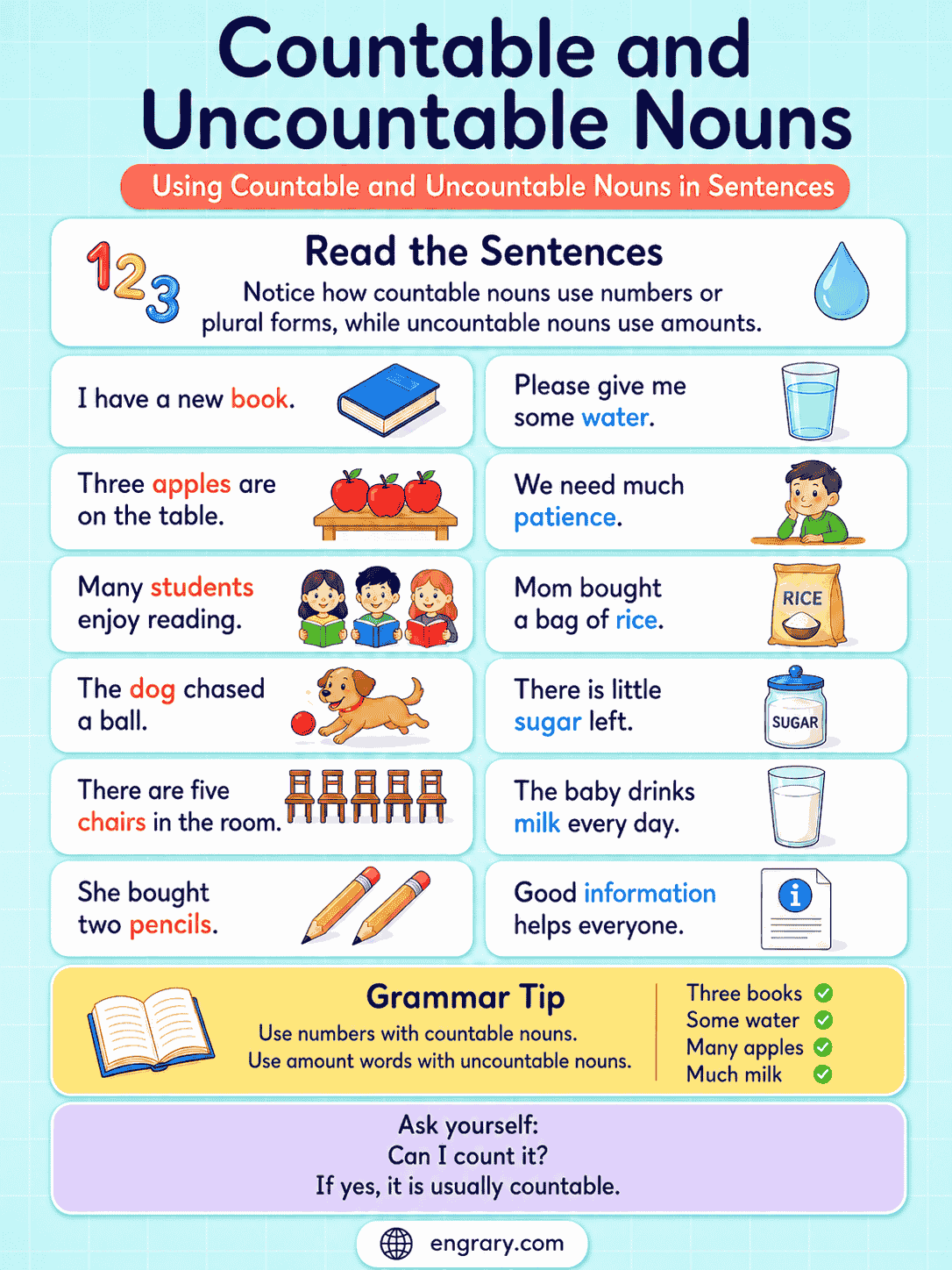
A sentence may contain both countable and uncountable nouns.
Emma packed three sandwiches and some juice.
- sandwiches — countable;
- juice — uncountable.
The teacher gave us two worksheets and some homework.
- worksheets — countable;
- homework — uncountable.
Dad bought three apples and a bottle of milk.
- apples — countable;
- milk — uncountable.
A countable unit may also appear with an uncountable noun.
Mia drank two glasses of water.
Here, glasses is countable, while water is uncountable.
Looking at complete sentences helps children understand how countability affects the words around a noun.
Common Countable and Uncountable Noun Mistakes
Children often make mistakes when a number, article, quantity word, or plural ending does not match the noun type.
Do Not Use Many With Uncountable Nouns
Incorrect:
We need many water.
Correct:
We need a lot of water.
Water is uncountable, so many is incorrect. In everyday positive sentences, a lot of water sounds more natural than much water.
Do Not Use Much With Plural Countable Nouns
Incorrect:
She has much pencils.
Correct:
She has many pencils.
Use many with plural countable nouns.
Do Not Add Ordinary Plural Endings to Uncountable Nouns
Incorrect:
I found two informations.
Correct:
I found two pieces of information.
Similarly, use advice rather than advices and furniture rather than furnitures in their usual uncountable meanings.
Do Not Use A or An Directly With an Uncountable Noun
Incorrect:
Dad gave me an advice.
Correct:
Dad gave me some advice.
You can also say:
Dad gave me a piece of advice.
Do Not Leave Out a Determiner Before a Singular Countable Noun
Incorrect:
Ava bought notebook.
Correct:
Ava bought a notebook.
A singular countable noun usually needs a suitable determiner.
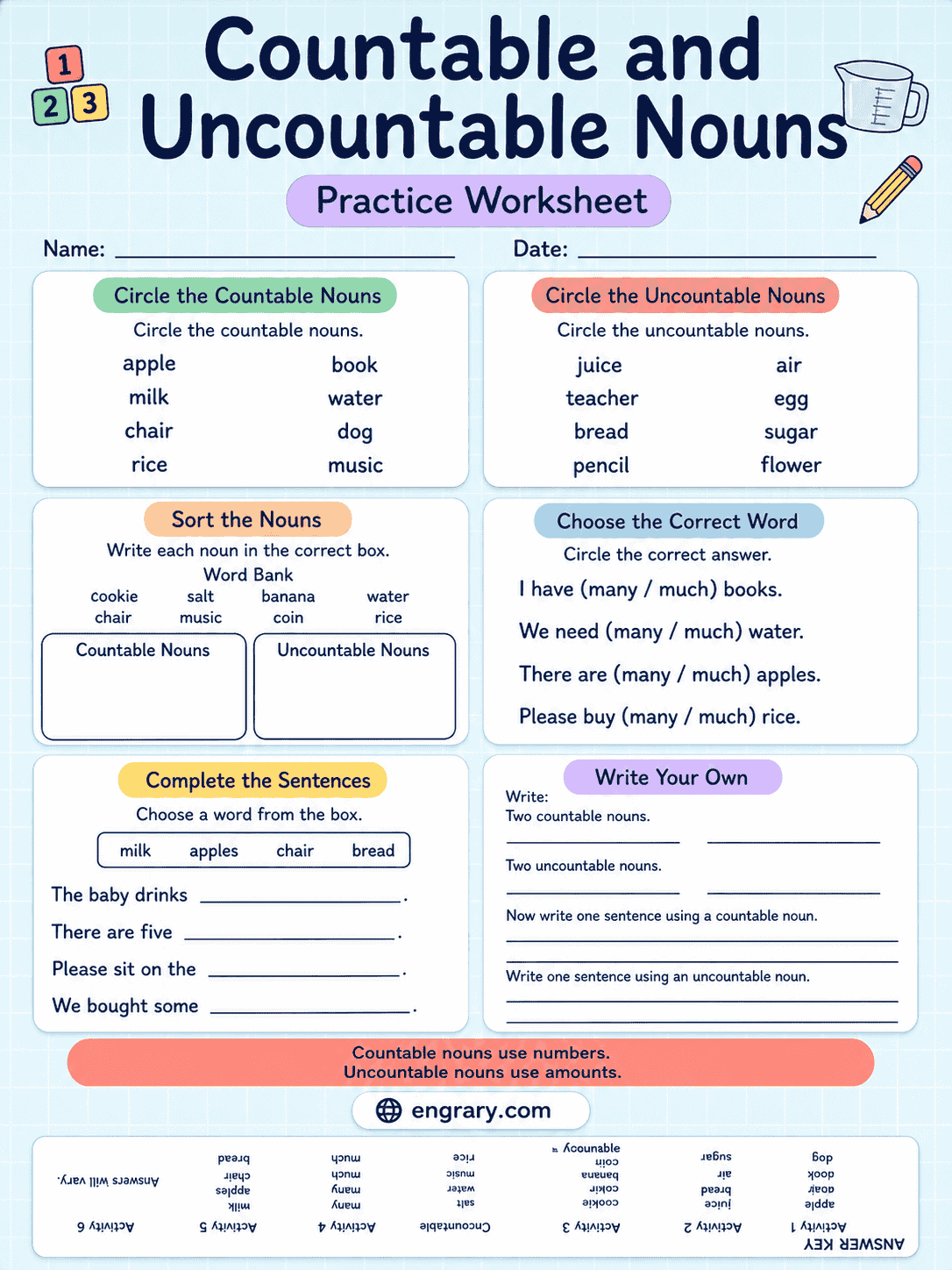
Countable and Uncountable Nouns Practice for Kids
Complete each activity before checking the answer key.
Countable or Uncountable?
Write countable or uncountable.
- apple
- milk
- chair
- rice
- information
- pencil
- sugar
- student
- furniture
- cookie
Find the Nouns in Sentences
Identify each bold noun as countable or uncountable.
- Emma packed three sandwiches and some juice.
- The teacher gave us some homework.
- Noah placed two books on the table.
- We need a little sugar for the recipe.
- Dad bought a bottle of milk.
- Mia found useful information for her project.
Choose A, An, or Some
Choose the correct word.
- ___ apple
- ___ rice
- ___ pencil
- ___ information
- ___ egg
- ___ milk
- ___ chair
- ___ advice
Choose the Correct Quantity Words
Choose the correct answer.
- How (many / much) books are on the shelf?
- We do not have (many / much) milk.
- Sam ate (a few / a little) crackers.
- Pour (a few / a little) juice into the cup.
- How (many / much) apples are in the basket?
- How (many / much) rice do we need?
- There are (many / much) pencils in the box.
- Add (a few / a little) sugar.
Make Uncountable Nouns Countable
Use this word bank:
bottles, slices, bowl, pieces
- two ________ of water
- three ________ of bread
- a ________ of rice
- two ________ of advice
Use Context to Decide
Write countable or uncountable for each bold noun.
- We ate chicken for dinner.
- Three chickens walked across the yard.
- Dad drinks coffee every morning.
- The server brought two coffees.
- The window is made of glass.
- Four glasses are on the table.
Correct the Mistakes
Rewrite each sentence correctly.
- We do not have many milk.
- She gave me an advice.
- Liam bought three bread.
- There are much pencils on the desk.
- I found two informations.
- Ava bought notebook.
Write Your Own Sentences
Write:
- one sentence using many with a plural countable noun;
- one sentence using a little with an uncountable noun;
- one sentence using some with an uncountable noun;
- one sentence using a piece of with an uncountable noun;
- one sentence containing both a countable and an uncountable noun.
Answer Key
Countable or Uncountable?
- apple — countable
- milk — uncountable
- chair — countable
- rice — uncountable
- information — uncountable
- pencil — countable
- sugar — uncountable
- student — countable
- furniture — uncountable
- cookie — countable
Find the Nouns in Sentences
- sandwiches — countable; juice — uncountable
- teacher — countable; homework — uncountable
- books — countable; table — countable
- sugar — uncountable
- bottle — countable; milk — uncountable
- information — uncountable
Choose A, An, or Some
- an apple
- some rice
- a pencil
- some information
- an egg
- some milk
- a chair
- some advice
Choose the Correct Quantity Words
- many
- much
- a few
- a little
- many
- much
- many
- a little
Make Uncountable Nouns Countable
- two bottles of water
- three slices of bread
- a bowl of rice
- two pieces of advice
Use Context to Decide
- chicken — uncountable
- chickens — countable
- coffee — uncountable
- coffees — countable
- glass — uncountable
- glasses — countable
Correct the Mistakes
- We do not have much milk.
- She gave me some advice.
Also correct: She gave me a piece of advice. - Liam bought three loaves of bread.
Three slices of bread is also correct if individual slices are intended. - There are many pencils on the desk.
- I found two pieces of information.
- Ava bought a notebook.
Write Your Own Sentences
Answers will vary. Possible answers include:
- There are many books on the shelf.
- Add a little sugar to the bowl.
- We need some water.
- Dad gave me a piece of advice.
- Emma packed two sandwiches and some juice.
FAQs
A countable noun can normally be counted as separate items, such as one book or three books. An uncountable noun is usually treated as an amount or whole, such as water or rice.
Try placing a number directly before it. If expressions such as one apple, two apples, three apples sound natural, the noun is probably countable in that meaning.
English normally treats bread as a food or substance. We count units of it instead, such as two loaves of bread or three slices of bread.
Yes. We can say some apples with a plural countable noun and some water with an uncountable noun.
Yes. The meaning can change with context. For example, chicken is uncountable when it means food, but a chicken is countable when it means one animal.
You May Also Like
- Nouns for Kids
- Singular and Plural Nouns
- Common and Proper Nouns
- Concrete and Abstract Nouns
- Collective Nouns
- Possessive Nouns
- Articles: A, An, and The
- Much and Many