Linking verbs are an important part of English grammar because they connect the subject of a sentence to information about that subject. They help us describe people, places, animals, and things or tell what someone or something becomes, seems, feels, or appears to be.
You’ll learn what linking verbs are, how they connect the subject to describing or naming words, which linking verbs are common, and how to tell them apart from action and helping verbs. You’ll also practice finding and using linking verbs correctly in sentences.
What Is a Linking Verb?
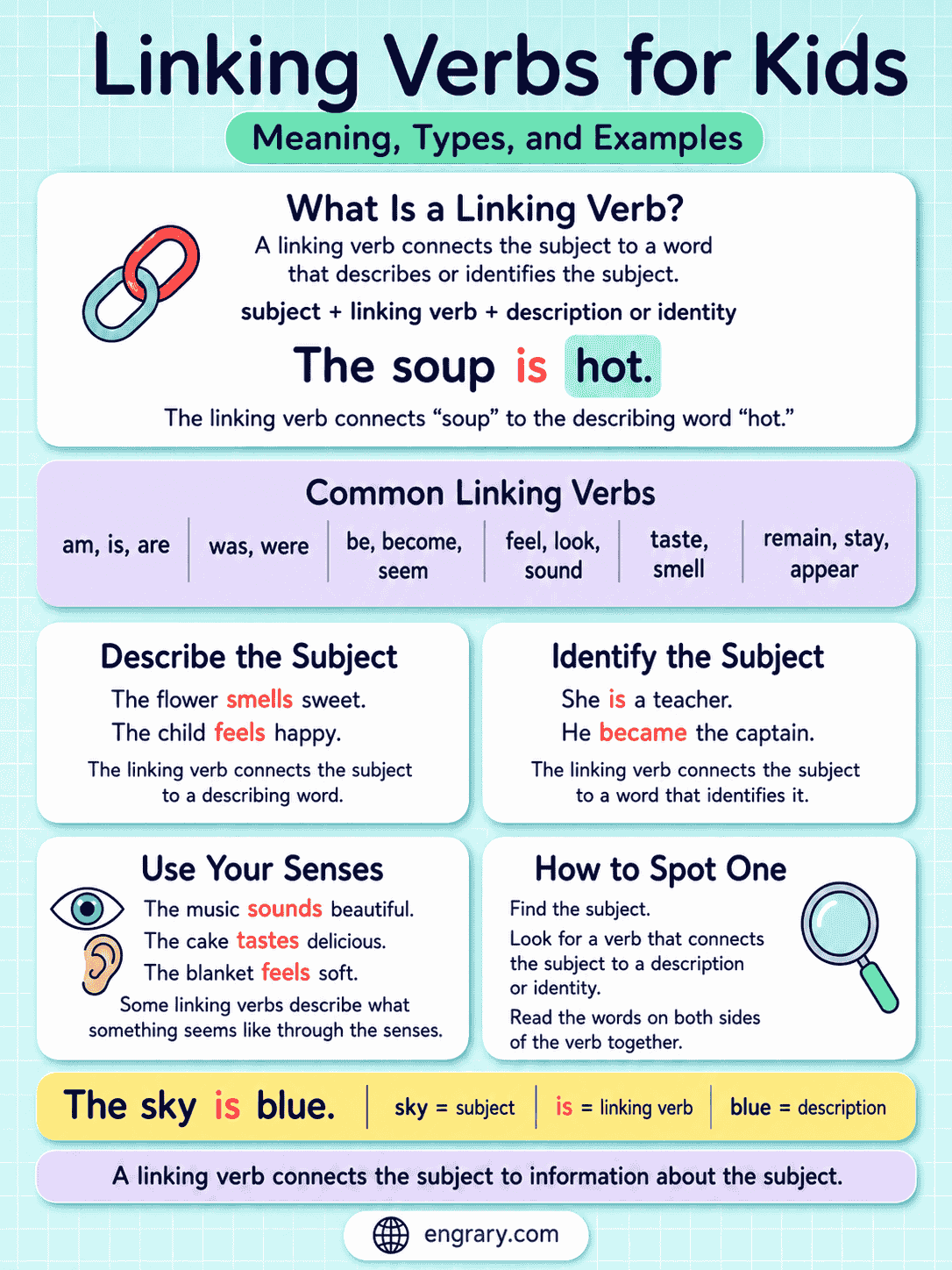
A linking verb connects the subject of a sentence to information that describes, identifies, or renames the subject.
Look at this sentence:
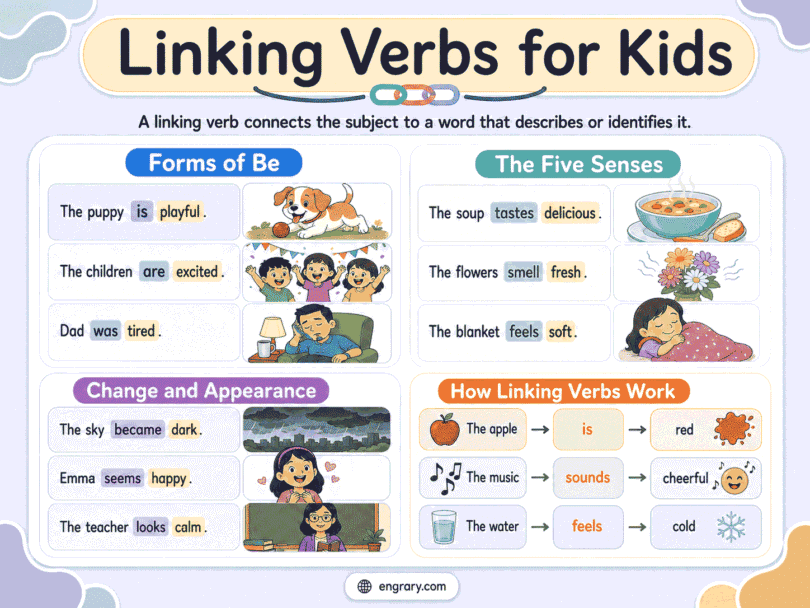
The puppy is playful.
The subject is puppy. The linking verb is connects the puppy to the word playful, which describes it.
The verb does not show an action performed by the puppy. Instead, it creates a link between the subject and information about the subject.
Another example is:
Mia became captain.
The linking verb became connects Mia to captain, which tells us what Mia became.
How Linking Verbs Connect the Subject
A simple pattern can help children understand linking verbs:
subject → linking verb → information about the subject
For example:
- The sky → is → blue.
- The soup → smells → delicious.
- Noah → seems → tired.
- Mia → became → captain.
The word after the linking verb tells us something about the subject.
Sometimes it describes the subject:
The blanket feels soft.
The word soft describes the blanket.
Sometimes it renames or identifies the subject:
Ava is the leader.
The word leader identifies Ava.
This connection is the most important clue when identifying a linking verb.
Linking Verb Examples
Here are some clear examples of linking verbs in sentences.
| Sentence | Subject | Linking Verb | Information About the Subject |
|---|---|---|---|
| The sky is blue. | sky | is | blue |
| Mia is happy. | Mia | is | happy |
| The soup smells delicious. | soup | smells | delicious |
| The blanket feels soft. | blanket | feels | soft |
| The music sounds peaceful. | music | sounds | peaceful |
| Noah became captain. | Noah | became | captain |
| The children seem excited. | children | seem | excited |
| The leaves turned yellow. | leaves | turned | yellow |
Notice that the linking verb connects the subject to information about it rather than showing an action the subject performs.
How to Find Linking Verbs in a Sentence
You can use a simple step-by-step method to find a linking verb.
First, find the subject of the sentence.
Consider:
The cookies smell delicious.
The subject is cookies.
Next, find the verb.
The verb is smell.
Then ask whether the subject is performing an action or whether the verb connects the subject to information about it.
Here, the cookies are not actively smelling something. Instead, smell connects cookies to delicious.
So:
- subject — cookies
- linking verb — smell
- information about subject — delicious
A useful method is:
- Find the subject.
- Find the verb.
- Ask whether the verb shows an action.
- Check whether the verb connects the subject to a describing or naming word.
- Read the complete sentence before deciding.
This final step is especially important because some verbs can be linking in one sentence and action verbs in another.
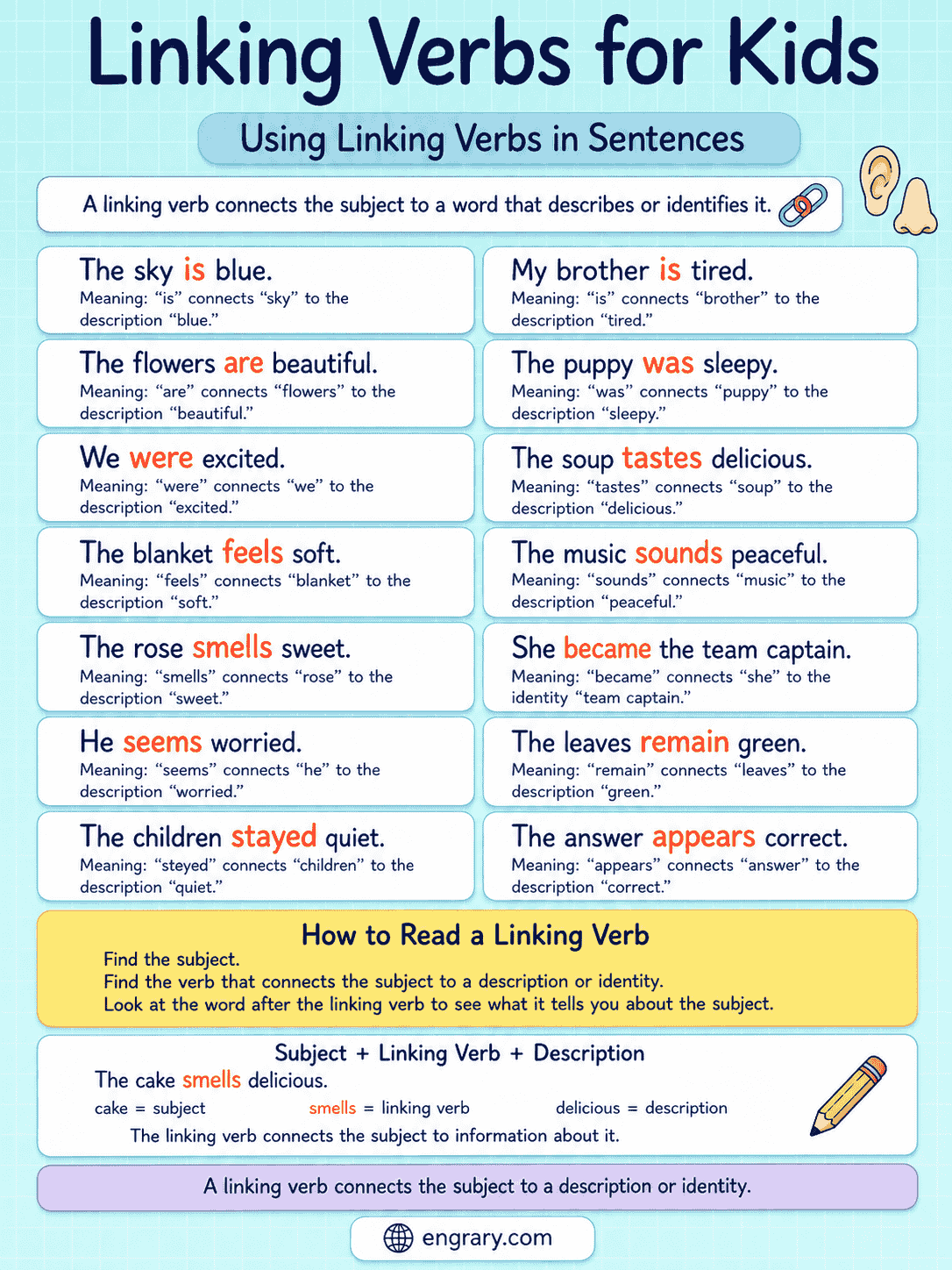
Common Linking Verbs
Some linking verbs appear very often in English.
Forms of be are the most common, but several other verbs can also work as linking verbs.
Forms of Be as Linking Verbs
Common forms of be include:
- am
- is
- are
- was
- were
- be
- been
- being
These forms can act as linking verbs when they connect the subject to information about it.
For example:
I am ready.
Mia is cheerful.
The children are quiet.
Noah was nervous.
We were tired.
In each sentence, the form of be connects the subject to a describing word.
Forms of be can also connect a subject to a naming word.
For example:
Ava is the captain.
Mr. Reed was our coach.
However, forms of be are not always linking verbs. Sometimes they act as helping verbs, so the complete sentence matters.
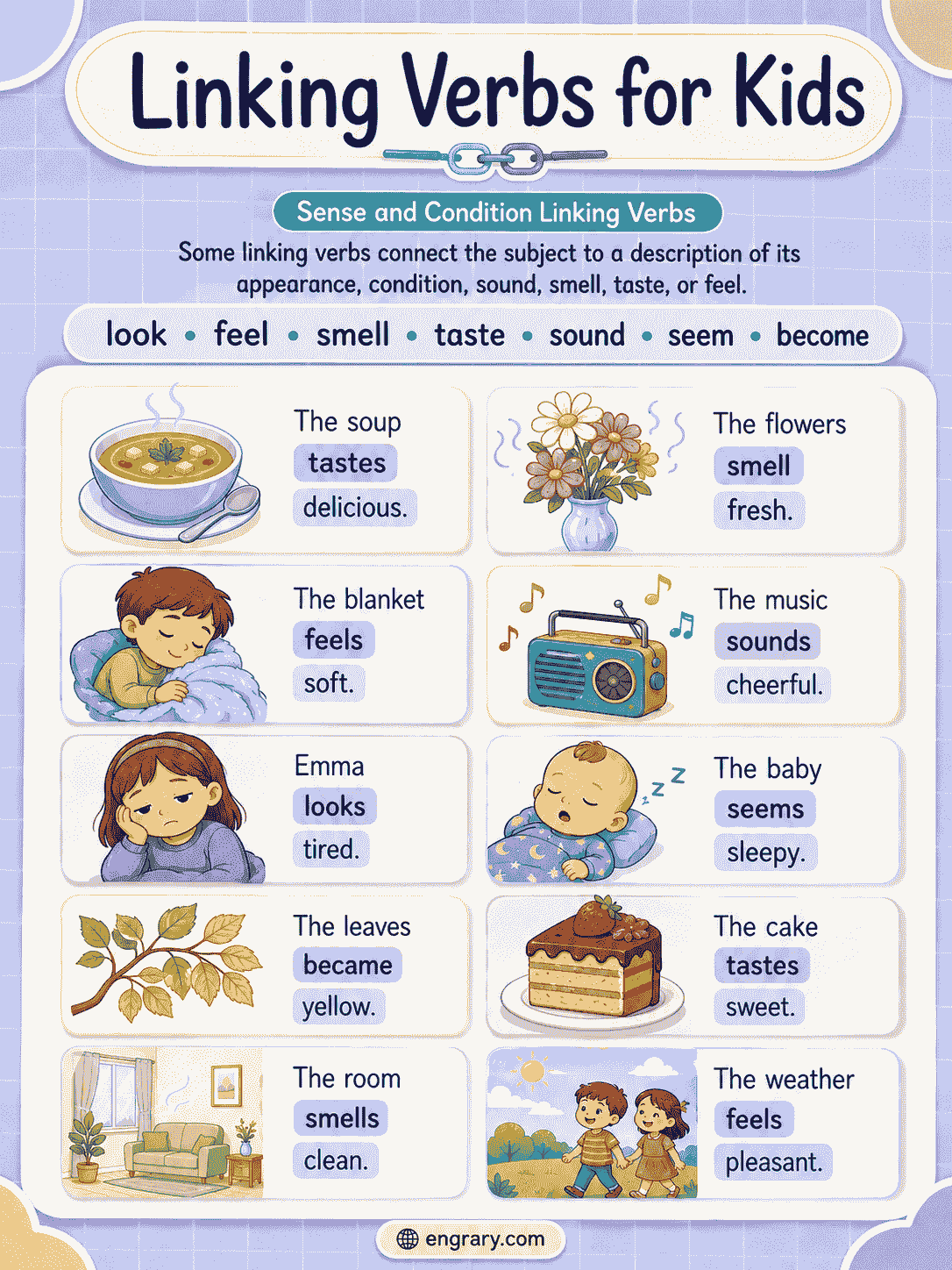
Other Common Linking Verbs
Other verbs can also act as linking verbs.
Common examples include:
- seem
- become
- appear
- remain
- feel
- look
- smell
- taste
- sound
- grow
- turn
For example:
The puppy seems sleepy.
The sky became dark.
The room remained quiet.
The blanket feels warm.
The flowers smell sweet.
The soup tastes salty.
The music sounds beautiful.
The child grew tired.
These verbs are not always linking verbs. Some can also show actions, so children should always check how the verb works in the sentence.
What Comes After a Linking Verb?
A linking verb connects the subject to a word or phrase that gives information about it.
That information usually does one of two jobs:
- it describes the subject;
- it renames or identifies the subject.
Predicate Adjectives: Words That Describe the Subject
A word that describes the subject after a linking verb is called a predicate adjective.
Consider:
The water feels cold.
The subject is water.
The linking verb is feels.
The word cold describes the water, so cold is a predicate adjective.
Another example is:
The puppy looks sleepy.
Here:
- puppy — subject
- looks — linking verb
- sleepy — predicate adjective
More examples include:
The sky became dark.
The music sounds peaceful.
The cookies smell wonderful.
In each sentence, the word after the linking verb describes the subject.
Children do not need to memorize the term predicate adjective before understanding the basic idea. The important point is that the describing word gives information about the subject.
Predicate Nouns: Words That Rename the Subject
A noun that renames or identifies the subject after a linking verb is called a predicate noun.
Consider:
Mia is the captain.
The subject is Mia.
The linking verb is is.
The noun captain identifies Mia, so captain is a predicate noun.
Another example is:
Mr. Reed became the coach.
Here:
- Mr. Reed — subject
- became — linking verb
- coach — predicate noun
More examples include:
Ava is my friend.
Noah became the winner.
Mrs. Clark is our teacher.
The predicate noun gives the subject another name or identity.
Linking Verbs vs. Action Verbs
A linking verb connects the subject to information about the subject.
An action verb tells what the subject does.
Compare:
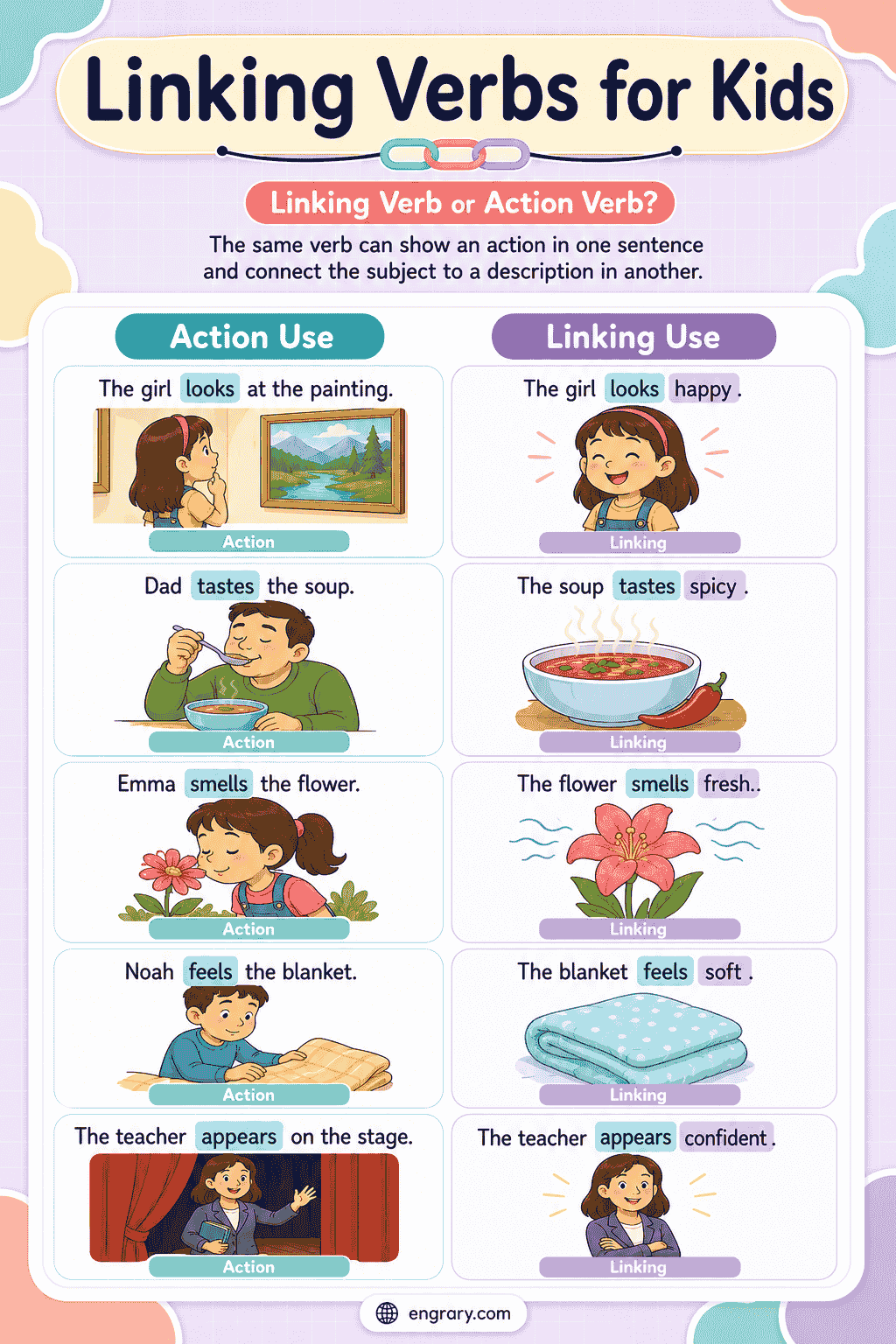
The flowers smell sweet.
Here, smell is a linking verb because it connects flowers to sweet.
Now compare:
Mia smells the flowers.
Here, smells is an action verb because Mia is performing the action of smelling.
Another pair is:
The blanket feels soft.
Feels is linking because soft describes the blanket.
Ava feels the blanket.
Feels is an action verb because Ava is touching the blanket.
A third example is:
The soup tastes delicious.
Tastes links soup to delicious.
Noah tastes the soup.
Tastes is an action because Noah is doing the tasting.
The same verb can therefore have different jobs depending on the sentence.
When the Same Verb Can Have Different Jobs
Several verbs commonly switch between linking and action uses.
| Linking Use | Action Use |
|---|---|
| The flowers smell sweet. | Mia smells the flowers. |
| The blanket feels soft. | Ava feels the blanket. |
| The soup tastes salty. | Noah tastes the soup. |
| The dog looks tired. | Ben looks at the dog. |
| The bell sounds loud. | Ava sounds the bell. |
Do not classify a verb only by memorizing its name.
Instead, ask:
Is the subject doing an action, or does the verb connect the subject to information about it?
That question usually makes the difference clearer.
Linking Verbs vs. Helping Verbs
Forms of be can be linking verbs or helping verbs.
Compare:
The dog is sleepy.
Here, is connects the subject dog to the describing word sleepy. Therefore, is is a linking verb.
Now look at:
The dog is sleeping.
Here, is works with the main verb sleeping. Therefore, is is a helping verb.
Another pair is:
The children are excited.
Are is linking because it connects children to excited.
The children are playing.
Are is helping because it works with the main verb playing.
A useful clue is:
- form of be + describing or naming information → often linking;
- form of be + another verb → often helping.
Detailed helping-verb rules belong in a separate lesson, but this comparison helps prevent a common classification mistake.
Common Linking Verb Mistakes
Children often make mistakes when they classify a verb by the word alone instead of checking its job in the sentence.
Thinking Only Forms of Be Can Be Linking Verbs
Forms of be are common linking verbs, but other verbs can link the subject to information about it.
For example:
The soup smells delicious.
The blanket feels soft.
Mia became captain.
The verbs smells, feels, and became are linking verbs in these sentences.
Thinking Every Form of Be Is a Linking Verb
A form of be is not automatically a linking verb.
Compare:
Ava is happy.
is = linking
Ava is reading.
is = helping
Always look at the complete verb phrase and sentence.
Assuming Sensory Verbs Are Always Linking Verbs
Verbs such as look, feel, smell, taste, and sound can have different jobs.
For example:
The cake smells wonderful.
linking
Noah smells the cake.
action
The sentence determines the verb type.
Looking Only for “No Action”
A linking verb does more than simply avoid showing action.
A better test is to check whether the verb creates this relationship:
subject → linking verb → information about subject
For example:
The sky became dark.
The verb became links sky to dark.
Assuming the Word After a Linking Verb Must Be an Adjective
A linking verb can connect the subject to an adjective:
The puppy is playful.
It can also connect the subject to a noun:
The puppy is a retriever.
The first word describes the subject, while the second renames it.
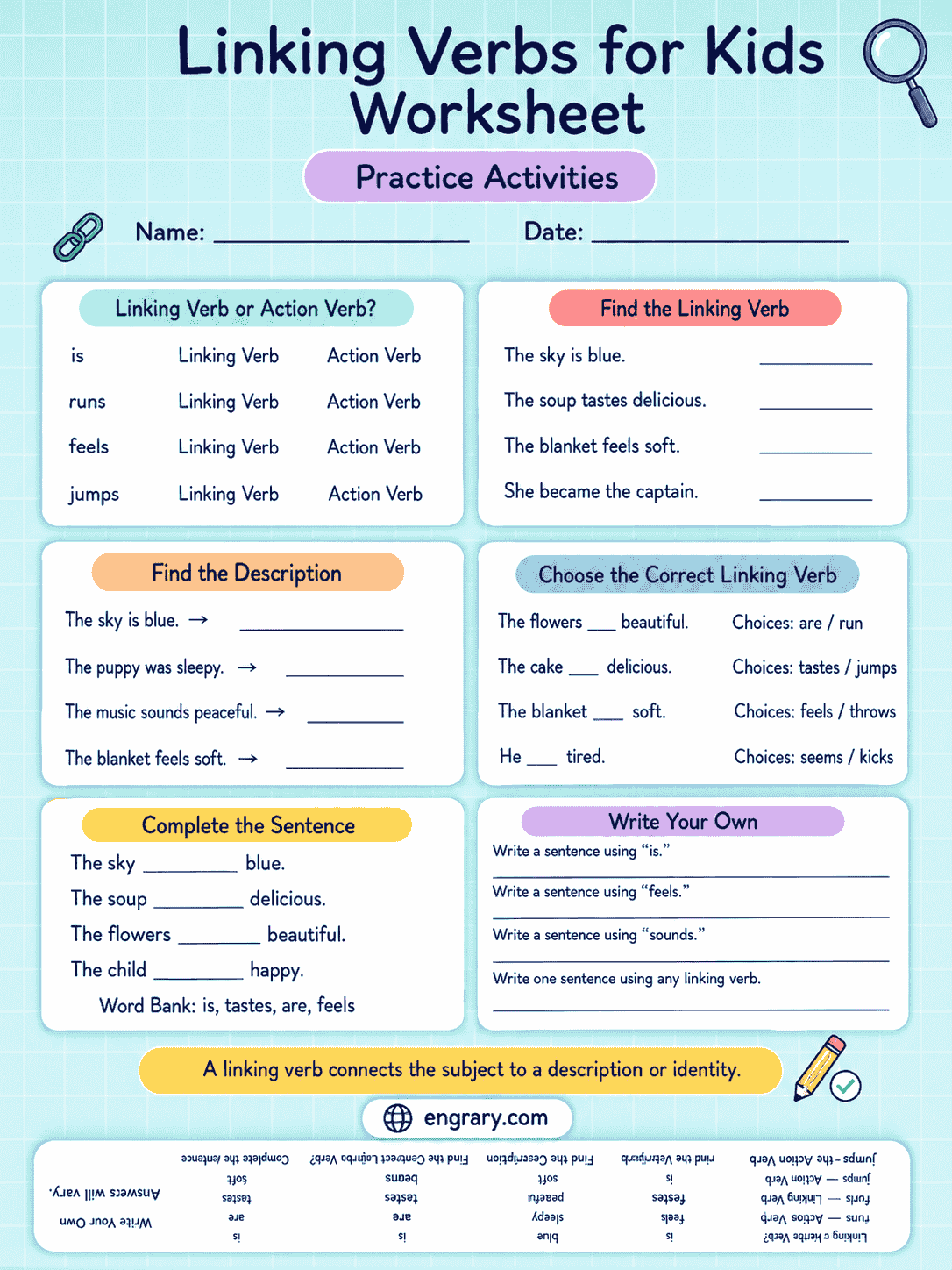
Linking Verbs Practice for Kids
Complete each activity before checking the answer key.
Find the Subject, Linking Verb, and Subject Information
Identify the subject, linking verb, and information about the subject.
- The sky is blue.
- The soup smells delicious.
- Mia seems tired.
- The blanket feels soft.
- Noah became captain.
- The children were excited.
Describes or Renames?
Decide whether the bold word describes or renames the subject.
- The puppy is playful.
- Ava is the captain.
- The water feels cold.
- Mr. Reed became the coach.
- The music sounds peaceful.
- Mrs. Clark is our teacher.
Linking or Action Verb?
Identify the bold verb as linking or action.
- The flowers smell sweet.
- Mia smells the flowers.
- The blanket feels soft.
- Ava feels the blanket.
- The soup tastes delicious.
- Noah tastes the soup.
- The dog looks tired.
- Ben looks at the dog.
Linking or Helping Verb?
Identify the bold verb as linking or helping.
- The dog is sleepy.
- The dog is sleeping.
- The children are excited.
- The children are playing.
- Mia was nervous.
- Mia was reading.
Choose the Correct Linking Verb
Choose the correct verb.
- Mia (is / are) happy.
- The children (is / are) ready.
- Noah (was / were) nervous.
- The cookies (smell / smells) delicious.
- The soup (taste / tastes) salty.
- The flowers (look / looks) beautiful.
Correct the Mistakes
Rewrite each sentence correctly.
- The children is excited.
- Mia are happy.
- The cookies smells delicious.
- The soup taste salty.
- Noah were nervous.
- The flowers looks beautiful.
Write Sentences With Linking Verbs
Write:
- one sentence using is as a linking verb;
- one sentence using are as a linking verb;
- one sentence using feel as a linking verb;
- one sentence using sound as a linking verb;
- one sentence with a predicate adjective;
- one sentence with a predicate noun.
Answer Key
Find the Subject, Linking Verb, and Subject Information
- subject — sky; linking verb — is; information — blue
- subject — soup; linking verb — smells; information — delicious
- subject — Mia; linking verb — seems; information — tired
- subject — blanket; linking verb — feels; information — soft
- subject — Noah; linking verb — became; information — captain
- subject — children; linking verb — were; information — excited
Describes or Renames?
- playful — describes
- captain — renames
- cold — describes
- coach — renames
- peaceful — describes
- teacher — renames
Linking or Action Verb?
- smells — linking
- smells — action
- feels — linking
- feels — action
- tastes — linking
- tastes — action
- looks — linking
- looks — action
Linking or Helping Verb?
- is — linking
- is — helping
- are — linking
- are — helping
- was — linking
- was — helping
Choose the Correct Linking Verb
- is
- are
- was
- smell
- tastes
- look
Correct the Mistakes
- The children are excited.
- Mia is happy.
- The cookies smell delicious.
- The soup tastes salty.
- Noah was nervous.
- The flowers look beautiful.
Write Sentences With Linking Verbs
Answers will vary. Possible answers include:
- The puppy is playful.
- The children are excited.
- The blanket feels soft.
- The music sounds peaceful.
- The water is cold.
- Ava is the captain.
FAQs
A linking verb connects the subject of a sentence to information that describes or renames the subject. In The sky is blue, is links sky to blue.
Common linking verbs include forms of be, such as am, is, are, was, and were. Other verbs that can act as linking verbs include seem, become, feel, look, smell, taste, and sound.
Find the subject and verb, then check whether the verb connects the subject to a describing or naming word. If it does, the verb is probably linking in that sentence.
Yes. In The soup smells delicious, smells is linking. In Mia smells the soup, smells is an action verb.
A linking verb connects the subject to information about it, as in The dog is tired. A helping verb works with another verb, as in The dog is sleeping.
You May Also Like