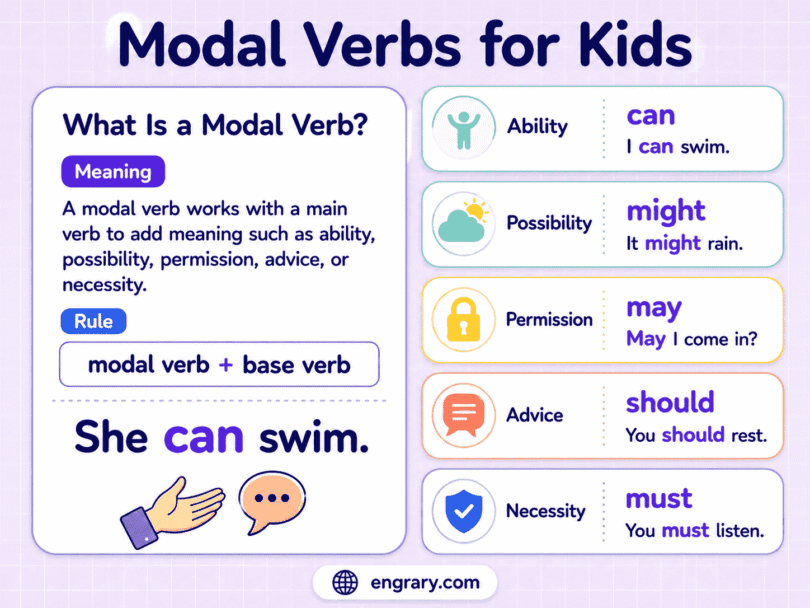
Modal verbs are an important part of English grammar because they help us express ideas such as ability, possibility, permission, advice, necessity, and future plans. When children understand how modal verbs work, they can form clearer sentences and avoid common mistakes such as She can swims or He must to go.
You’ll learn what modal verbs are, how they work with main verbs, what the most common modal verbs mean, and how to use them in statements, negative sentences, and questions. You’ll also compare commonly confused modals and practice using them correctly in everyday English.
What Is a Modal Verb?
A modal verb is a helping verb that works with a main verb to add a special meaning.
Modal verbs can show:
- ability;
- possibility;
- permission;
- advice;
- necessity;
- future meaning;
- polite requests;
- imagined situations.
Look at this sentence:
Mia can swim.
The modal verb is can. The main verb is swim.
Together, they form the verb phrase can swim.
The modal can adds the meaning of ability. It tells us that Mia is able to swim.
Another example is:
Noah should study tonight.
Here:
- should — modal verb;
- study — main verb;
- should study — verb phrase.
The modal should adds the meaning of advice.
Modal Verbs and Main Verbs
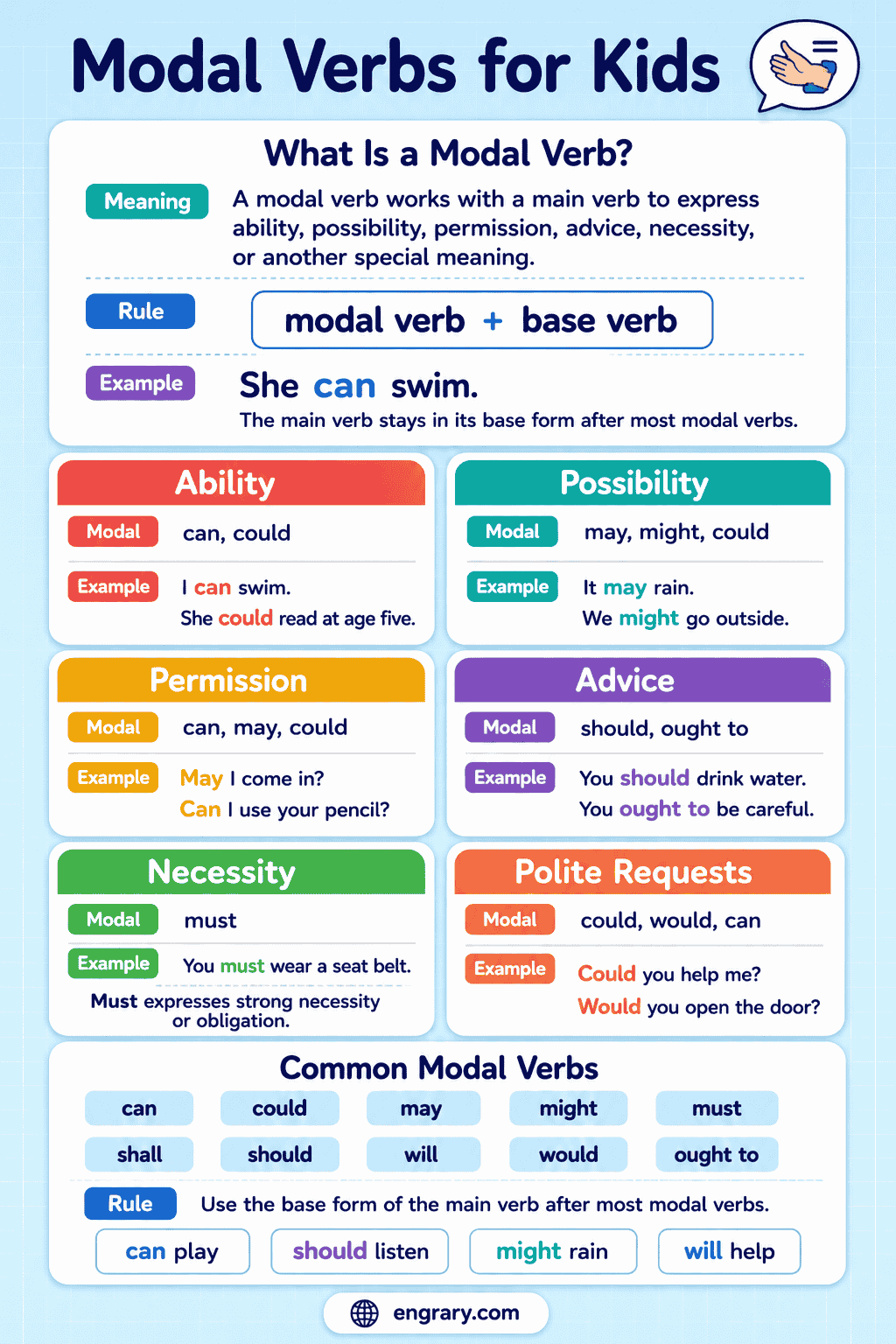
A modal verb works with a main verb rather than carrying the whole meaning by itself.
For example:
Ava might visit tomorrow.
The main action is visit. The modal might tells us that the visit is possible but not certain.
Consider another sentence:
We must leave now.
The main verb is leave, while must adds the idea of strong necessity.
A useful pattern is:
modal verb + main verb
Examples include:
- can swim;
- could help;
- may come;
- might rain;
- must finish;
- should rest;
- will leave;
- would choose.
The Modal + Base Verb Rule
One of the most important rules about modal verbs is simple:
A core modal verb is followed by the base form of the main verb.
The base form is the basic form of a verb, such as:
- swim;
- read;
- write;
- play;
- go;
- help.
Look at these correct examples:
She can swim.
Noah must finish his work.
We should leave early.
Mia will call later.
The main verb stays in its base form.
Incorrect:
She can swims.
Correct:
She can swim.
Incorrect:
Noah must finishes.
Correct:
Noah must finish.
Incorrect:
We should left early.
Correct:
We should leave early.
A core modal is also not normally followed by to.
Incorrect:
You must to listen.
Correct:
You must listen.
Incorrect:
Ava can to read.
Correct:
Ava can read.
Remember this pattern:
subject + modal + base verb
For example:
Mia + can + swim
Mia can swim.
Common Modal Verbs for Kids
Eight modal verbs are especially useful for children to learn.
| Modal Verb | Common Uses | Example |
|---|---|---|
| can | ability, permission | Ava can swim. |
| could | past ability, possibility, polite request | Noah could read at five. |
| may | permission, possibility | May I come in? |
| might | possibility | It might rain. |
| must | necessity, strong obligation | You must stop. |
| should | advice, recommendation | You should rest. |
| will | future action or prediction | We will leave soon. |
| would | polite request, imagined situation | Would you help me? |
These meanings are useful starting points. However, some modal verbs can express more than one idea depending on the sentence.
What Do Modal Verbs Express?
Modal verbs allow speakers to add different meanings to the main verb.
Ability and Permission
Ability
Use can to talk about an ability someone has now.
Mia can swim.
The bird can fly.
Noah can solve the puzzle.
Use could to talk about an ability someone had in the past.
Ava could read when she was five.
Dad could run very fast when he was younger.
In these examples, can and could tell us what someone is or was able to do.
Permission
We can also use can and may when asking for permission.
Can I use your pencil?
May I come in?
In everyday American English, Can I…? is very common.
May I…? often sounds more formal or especially polite.
Compare:
Can I borrow your book?
May I borrow your book?
Both can be appropriate, but the second is more formal.
Possibility
The modal verbs may, might, and could can express possibility.
For example:
It may rain this afternoon.
It might rain tonight.
The package could arrive tomorrow.
These sentences tell us that something is possible, but not certain.
Do not assume that may and might always show exact levels of probability. In some situations, might can sound more uncertain, but the difference depends on context.
Another example:
Mia may join us later.
Mia might join us later.
Both sentences express possibility.
Advice and Necessity
Advice
Use should to give advice or make a recommendation.
You should drink more water.
Mia should finish her homework first.
We should leave before it gets dark.
The modal should suggests that something is a good idea.
Necessity and Obligation
Use must for strong necessity, rules, or obligations.
You must wear a seat belt.
Students must follow the school rules.
We must finish our work.
The meaning of must is stronger than should.
Compare:
You should wear a jacket.
This is advice.
You must wear a helmet.
This is a strong requirement.
Another important form is must not or mustn’t.
You must not run in the hallway.
This means running is not allowed.
It does not simply mean that running is unnecessary.
Future, Polite, and Imagined Meanings
Future Meaning With Will
Use will for future actions, decisions, intentions, or predictions.
We will visit Grandma tomorrow.
Mia will call later.
It will rain tonight.
The modal will helps show that the action relates to the future.
Keep in mind that detailed future-tense rules belong in a separate lesson. Here, the important point is that will + base verb commonly expresses future meaning.
Polite Requests With Would
Use would in many polite requests.
Would you help me?
Would you open the door?
Would you pass the book, please?
Using would can make a request sound polite.
Imagined Situations With Would
Would can also appear in imagined situations.
I would travel more if I could.
Ava would choose the blue backpack.
Children do not need to learn advanced conditional rules here. The important idea is that would can describe something imagined rather than certain.
Same Modal Verb, Different Meanings
A modal verb does not always have only one meaning. The sentence and context help us understand its job.
Can
Ability
Noah can skate.
Permission
Can I borrow your pencil?
The same modal expresses two different ideas.
Could
Past ability
I could swim when I was six.
Possibility
It could rain later.
Polite request
Could you help me?
So could does not always mean past ability.
May
Permission
May I leave the room?
Possibility
It may snow tonight.
Reading the whole sentence helps children determine which meaning the modal expresses.
Modal Verbs Do Not Change With the Subject
Ordinary present-tense verbs often change with he, she, or it.
For example:
- I play.
- She plays.
Modal verbs work differently.
A core modal stays the same with every subject.
Compare:
- I can swim.
- You can swim.
- He can swim.
- She can swim.
- We can swim.
- They can swim.
We do not add -s to the modal.
Incorrect:
He cans swim.
Correct:
He can swim.
The same rule applies to other core modals:
- she should read;
- they should read;
- Noah will come;
- the children will come;
- Mia might help;
- we might help.
A simple rule is:
Core modal verbs do not change with the subject.
Negative Modal Verbs
To make most modal sentences negative, place not after the modal.
The pattern is:
subject + modal + not + base verb
Examples:
Mia cannot swim.
Noah should not worry.
It might not rain.
We must not run.
Ava will not come today.
Common negative forms include:
| Modal | Negative Form | Contraction |
|---|---|---|
| can | cannot | can’t |
| could | could not | couldn’t |
| may | may not | — |
| might | might not | mightn’t is uncommon in American English |
| must | must not | mustn’t |
| should | should not | shouldn’t |
| will | will not | won’t |
| would | would not | wouldn’t |
Notice that cannot is normally written as one word.
Compare:
Mia can swim.
Mia cannot swim.
The main verb swim stays in the base form in both sentences.
Questions With Modal Verbs
Modal verbs can move before the subject to form questions.
The basic pattern is:
modal + subject + base verb?
Examples:
Can you swim?
Could Mia help?
Should we leave?
Will Noah come?
Would you open the window?
Notice that we do not normally add do, does, or did to a question that already contains a core modal.
Incorrect:
Do you can swim?
Correct:
Can you swim?
Incorrect:
Does Mia will come?
Correct:
Will Mia come?
The main verb also stays in its base form.
Incorrect:
Can Mia swims?
Correct:
Can Mia swim?
Commonly Confused Modal Verbs
Some modal verbs have similar meanings, so comparing them can make their differences clearer.
Can vs. Could
Use can mainly for present ability and everyday permission.
Mia can swim.
Can I borrow your pencil?
Use could for past ability, possibility, or polite requests.
Mia could swim when she was five.
It could rain later.
Could you help me?
Because could has several uses, context matters.
May vs. Might
Both may and might can express possibility.
It may rain later.
It might rain later.
May can also ask for formal permission.
May I come in?
Avoid treating may and might as if they always represent exact probability levels. Their meanings can overlap.
Must vs. Should
Use must for strong necessity, rules, or requirements.
Students must arrive on time.
Use should for advice or recommendations.
Students should review their work.
Compare:
You must wear a seat belt.
You should bring a jacket.
The first expresses a strong requirement, while the second gives advice.
Will vs. Would
Use will commonly for future meaning.
We will leave tomorrow.
Use would for polite requests or imagined situations.
Would you help me?
I would visit if I had time.
Keep this basic distinction in mind without trying to learn every use of will and would at once.
Common Modal Verb Mistakes
Modal-verb mistakes often happen when children change the modal, use the wrong form of the main verb, or add unnecessary words.
| Incorrect | Correct | Why? |
|---|---|---|
| She can swims. | She can swim. | Use the base verb after a modal. |
| He cans run. | He can run. | The modal does not change with the subject. |
| You must to leave. | You must leave. | Do not add to after a core modal. |
| They should studied. | They should study. | Use the base form after should. |
| Do you can swim? | Can you swim? | Do not use do with a core modal question. |
| Does Mia will come? | Will Mia come? | Move the modal before the subject. |
| He might goes. | He might go. | The main verb stays in the base form. |
Another meaning mistake involves must not.
You must not touch that wire.
This means touching the wire is prohibited.
It does not mean that touching it is simply unnecessary.
Modal Verbs Practice for Kids
Complete the activities before checking the answer key.
Find the Modal and Its Meaning
Identify the modal verb and its meaning.
Choose from:
ability, possibility, permission, advice, necessity, future, polite request
- Mia can swim across the pool.
- It might rain this evening.
- May I use your ruler?
- You should drink more water.
- Students must follow the rules.
- We will visit Grandma tomorrow.
- Would you help me carry this box?
- Noah could read when he was five.
Choose the Correct Modal
Choose the best modal for each sentence.
- You (must / might) wear a seat belt in the car.
- Ava (can / must) play the piano very well.
- You look tired. You (should / will) rest.
- We (will / could) visit the museum tomorrow; the trip is already planned.
- (May / Must) I come into the classroom?
- When Noah was four, he (could / should) count to one hundred.
- The sky is very dark. It (might / must) rain later.
- You (must / could) not touch the hot stove.
Use Modal + Base Verb
Choose the correct verb form.
- Mia can (swim / swims).
- Noah should (study / studied) tonight.
- We must (leave / to leave) now.
- Ava will (call / calls) later.
- The dog might (bark / barks).
- He could (read / reads) at age five.
- They should (finish / finished) their work.
- Mia would (choose / chooses) the blue one.
Make Negatives and Questions
Follow the instruction for each sentence.
- Make negative: Mia can swim.
- Make a question: Noah can skate.
- Make negative: We should leave.
- Make a question: Ava will come.
- Make negative: It might rain.
- Make a question: The children should wait.
Choose Between Similar Modals
Choose the modal that best fits the meaning given.
- Strong rule: Students (must / should) wear safety goggles.
- Advice: You (must / should) get more sleep.
- Past ability: Mia (can / could) read when she was five.
- Present ability: Noah (can / could) swim very well now.
- Polite request: (Will / Would) you help me, please?
- Future plan: We (will / would) visit the library tomorrow.
- Formal permission: (May / Must) I leave the room?
- Possibility: The package (might / must) arrive later.
Correct the Mistakes
Rewrite each sentence correctly.
- Mia can swims fast.
- Noah cans play soccer.
- We must to finish our work.
- Ava should studied tonight.
- Do you can ride a bike?
- Does Mia will come tomorrow?
- The dog might barks.
- He could reads when he was five.
Write Sentences With Modal Verbs
Write:
- one sentence showing ability with can;
- one sentence showing possibility with might;
- one sentence asking permission with may or can;
- one sentence giving advice with should;
- one sentence showing necessity with must;
- one sentence showing future meaning with will;
- one polite request with would;
- one modal question.
Answer Key
Find the Modal and Its Meaning
- can — ability
- might — possibility
- may — permission
- should — advice
- must — necessity
- will — future
- would — polite request
- could — past ability
Choose the Correct Modal
- must
- can
- should
- will
- May
- could
- might
- must
Use Modal + Base Verb
- swim
- study
- leave
- call
- bark
- read
- finish
- choose
Make Negatives and Questions
- Mia cannot swim.
- Can Noah skate?
- We should not leave.
- Will Ava come?
- It might not rain.
- Should the children wait?
Contractions such as can’t and shouldn’t are also correct where appropriate.
Choose Between Similar Modals
- must
- should
- could
- can
- Would
- will
- May
- might
Correct the Mistakes
- Mia can swim fast.
- Noah can play soccer.
- We must finish our work.
- Ava should study tonight.
- Can you ride a bike?
- Will Mia come tomorrow?
- The dog might bark.
- He could read when he was five.
Write Sentences With Modal Verbs
Answers will vary. Possible answers include:
- Ava can swim across the pool.
- It might rain this evening.
- May I borrow your pencil?
- You should finish your homework first.
- Students must follow the classroom rules.
- We will visit the zoo tomorrow.
- Would you help me carry these books?
- Can Noah ride a bike?
FAQs
A modal verb is a helping verb that works with a main verb to add meanings such as ability, possibility, permission, advice, necessity, or future meaning. For example, can is the modal verb in Mia can swim.
Common modal verbs include can, could, may, might, must, should, will, and would.
Core modal verbs are followed by the base form of the main verb. Therefore, we say She can swim, not She can swims, and You must leave, not You must to leave.
Must expresses strong necessity, a rule, or an obligation, while should usually gives advice or a recommendation. For example, You must wear a seat belt is stronger than You should bring a jacket.
Yes. Put not after the modal to make a negative, as in Mia cannot swim. To make a question, place the modal before the subject, as in Can Mia swim?
You May Also Like