

Finite and non-finite verbs differ mainly in how they express tense and agreement. A finite verb shows tense and can reflect the subject’s person or number, while a non-finite verb does not show tense, person, or number by itself.
This article explains finite vs non-finite verbs through clear definitions, comparison tables, verb forms, tense and agreement patterns, sentence examples, and clause use. You will also learn the main types of non-finite verbs and how to identify both forms accurately in a sentence.

What Is a Finite Verb?
A finite verb is a verb form that shows tense and can also reflect person or number agreement with the subject.
Examples:
I work every day.
She works every day.
They worked yesterday.
He is tired.
In these examples, the finite verb marks present or past tense.
Finite verbs can also show agreement.
Compare:
I work.
She works.
The change from work to works shows subject agreement in the present tense.
However, a finite verb does not always have an obvious ending.
For example:
I work.
They work.
The form looks the same, but work is still finite because it functions as a present-tense verb in a finite clause.
What Is a Non-Finite Verb?
A non-finite verb does not show tense, person, or number by itself.
Common non-finite forms include:
- to-infinitives
- bare infinitives
- -ing forms
- past participles
Examples:
to work
can work
working
written
These forms do not change according to the subject.
Compare:
I want to work.
She wants to work.
They wanted to work.
The non-finite form to work remains unchanged.
Finite vs Non-Finite Verbs: Quick Difference
The main difference lies in tense and grammatical agreement.
| Finite Verb | Non-Finite Verb |
|---|---|
| Shows tense | Does not show tense by itself |
| Can reflect person or number | Does not change for person or number |
| Functions as the finite verb of a clause | Commonly appears in non-finite phrases or clauses |
| She works here. | She wants to work here. |
| They worked yesterday. | They enjoy working here. |
| He is tired. | He can be patient. |
The lexical verb itself is not permanently finite or non-finite. Its form and grammatical role determine the category.
Finite vs Non-Finite Verb Structure
Finite and non-finite forms appear in different sentence patterns.
| Verb Type | Typical Pattern | Example |
|---|---|---|
| Finite verb | subject + tense-marked verb | She works. |
| To-infinitive | to + base verb | She wants to work. |
| Bare infinitive | modal + base verb | She can work. |
| -ing form | verb + -ing | She enjoys working. |
| Past participle | participle form | The letter was written. |
In:
She is working.
is = finite
working = non-finite
The finite auxiliary carries tense and agreement, while the -ing form does not.
Finite vs Non-Finite Verb Examples
The following examples show the contrast clearly.
| Finite Verb | Non-Finite Verb |
|---|---|
| She works hard. | She wants to work hard. |
| He reads daily. | He enjoys reading daily. |
| They left early. | They decided to leave early. |
| She writes well. | She can write well. |
| He spoke clearly. | He hopes to speak clearly. |
| The door closed. | The closed door was locked. |
| She walks every day. | Walking every day helps. |
| They finished the task. | The task was finished yesterday. |
The finite forms carry tense, while the non-finite forms do not mark tense themselves.

Same Verb in Finite and Non-Finite Forms
The same lexical verb can appear as finite or non-finite depending on its form and role.
| Verb | Finite Use | Non-Finite Use |
|---|---|---|
| work | She works every day. | She wants to work. |
| go | He goes home early. | He may go home early. |
| read | She reads every night. | She enjoys reading. |
| write | He wrote the report. | The report was written. |
| leave | They left early. | They decided to leave. |
| walk | She walks daily. | Walking is healthy. |
These examples show why the verb word alone does not determine whether it is finite or non-finite.
Types of Non-Finite Verbs
Non-finite verbs appear in several common forms. Each form has its own structure, but none marks tense independently.
To-Infinitive
The to-infinitive uses:
to + base verb
Examples:
I want to leave.
She hopes to win.
They decided to stay.
He plans to study.
The infinitive remains unchanged even when the subject or tense of the main clause changes.
Compare:
She wants to leave.
They want to leave.
She wanted to leave.
The form to leave does not change.
Bare Infinitive
A bare infinitive is the base form without to.
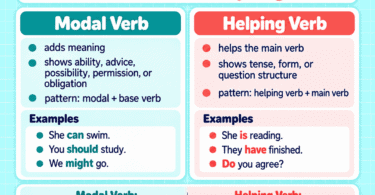
It commonly appears after modal auxiliaries.
Examples:
She can swim.
They must leave.
He may come later.
We should wait.
In:
She can swim.
can = finite modal auxiliary
swim = non-finite bare infinitive
The modal carries the finite grammatical information, while the main verb remains in its base form.
-ing Form
The -ing form can appear in several structures.
Examples:
She enjoys reading.
Walking every day helps.
He left without saying goodbye.
They kept talking.
In these uses, the -ing form does not mark tense by itself.
Compare:
She is working.
Here:
is = finite
working = non-finite
The tense and agreement appear on is, not working.
Past Participle
A past participle is another common non-finite form.
Examples:
The report was written yesterday.
The window was broken.
Taken together, the results support the conclusion.
The closed door blocked the entrance.
A past participle should not be confused with a finite simple-past form.
Compare:
She worked yesterday.
worked = finite simple past
The finished work looked good.
finished = non-finite participle
Finite and Non-Finite Verbs in the Same Sentence
A sentence can contain both finite and non-finite verb forms.
For example:
She wants to leave.
wants = finite
to leave = non-finite
Another:
They enjoy playing football.
enjoy = finite
playing = non-finite
Another:
He can swim well.
can = finite modal auxiliary
swim = non-finite bare infinitive
Another:
She has finished the work.
has = finite auxiliary
finished = non-finite past participle within the verb phrase
Another:
They are waiting outside.
are = finite
waiting = non-finite
This pattern is common in English because a finite auxiliary can carry tense while the following lexical verb appears in a non-finite form.
Tense, Person, and Number: The Key Difference
Tense and agreement provide the clearest distinction between finite and non-finite verbs.
Consider the finite forms:
| Subject | Finite Verb |
|---|---|
| I | work |
| She | works |
| They | work |
Now compare tense:
She works today.
She worked yesterday.
The finite verb changes according to tense and, in some forms, according to the subject.
Now compare the non-finite form:
I want to work.
She wants to work.
They wanted to work.
The form to work remains unchanged.
The same distinction appears in continuous structures:
She is working.
They are working.
The finite auxiliary changes from is to are, while working remains unchanged.
This shows where agreement is actually marked.
Finite vs Non-Finite Clauses
Finite and non-finite verbs also help distinguish clause types.
A finite clause contains a finite verb.
Examples:
She left because she was tired.
They arrived after the meeting ended.
Each finite verb marks tense.
A non-finite clause contains a non-finite verb form and normally depends on another clause or the surrounding context for time reference.
Examples:
Before leaving, she checked the door.
To finish on time, we started early.
Written clearly, the instructions were easy to understand.
The time of the non-finite clause comes from the surrounding sentence rather than from the non-finite verb itself.
How to Identify Finite and Non-Finite Verbs
The best method is to examine both the form of the verb and its grammatical role in the sentence.
Check Whether the Verb Carries Tense
Ask whether the verb itself marks present or past tense.
She works here.
works = finite present
They worked yesterday.
worked = finite past
Now compare:
She wants to work here.
to work does not mark tense.
Therefore, it is non-finite.
Check Whether It Changes With the Subject
Subject agreement provides another useful clue.
Compare:
I work.
She works.
They work.
The finite verb changes where English grammar requires agreement.
Now compare:
I want to work.
She wants to work.
They want to work.
The infinitive does not change.
This test is especially useful with present-tense forms.
Look for an Infinitive or Participle Form
Common non-finite forms include:
to write
write after a modal
writing
written
For example:
She wants to write.
She can write.
She enjoys writing.
The letter was written.
These forms do not carry tense independently.
Common Mistakes With Finite and Non-Finite Verbs
Finite and non-finite verbs can be confusing because similar-looking forms can perform different grammatical jobs.
| Mistake | Correct Understanding |
|---|---|
| Every verb in a sentence is finite | One sentence can contain both finite and non-finite forms |
| Every -ing form is finite | The -ing form itself is normally non-finite |
| Every past-looking verb is non-finite | Simple past verbs can be finite |
| A past participle always expresses past tense | It does not mark tense by itself |
| A bare infinitive is finite because it has no to | It can still be non-finite |
| Non-finite verbs have no time meaning at all | Their time reference can come from context |
| Finite verbs always have a visible tense ending | Some finite forms look identical across subjects |
| The verb word determines finiteness | Form and sentence function determine it |
A reliable approach is to check where tense and agreement are marked rather than relying only on the appearance of the verb.
FAQs
A finite verb marks tense and may show subject agreement, while a non-finite verb does not mark tense, person, or number by itself.
Yes. In She wants to leave, wants is finite and to leave is non-finite.
The main types are to-infinitives, bare infinitives, -ing forms, and past participles.
The -ing form itself is non-finite. In She is working, is is finite while working is non-finite.
Check which verb marks tense and, where relevant, agrees with the subject. In She works every day, works is finite.
You May Also Like



Leave a Comment