

Helping verbs work with main verbs to add meaning such as tense, possibility, ability, necessity, emphasis, or voice. Words such as is, have, do, can, should, and will often appear before another verb and help form a complete verb phrase.
This article gives a clear helping verbs list, explains the traditional 23 helping verbs taught in many classrooms, and separates primary helping verbs from modal helping verbs. You will also see how helping verbs work in sentences, how they differ from main and linking verbs, and which mistakes to avoid.
What Are Helping Verbs?
A helping verb works with a main verb to add grammatical meaning.
For example:
She is reading.
They have finished.
He can swim.
We will leave soon.
I did finish the work.
In these examples, is, have, can, will, and did help the main verbs reading, finished, swim, leave, and finish.
Helping verbs are commonly used to show:
- tense
- aspect
- possibility
- ability
- necessity
- obligation
- emphasis
- passive voice
Helping Verbs and Auxiliary Verbs
The terms helping verb and auxiliary verb usually refer to the same grammatical role.
An auxiliary supports another verb inside a verb phrase.
For example:
She has written a letter.
has = helping or auxiliary verb
written = main verb
Another example:
They were playing outside.
were = helping verb
playing = main verb
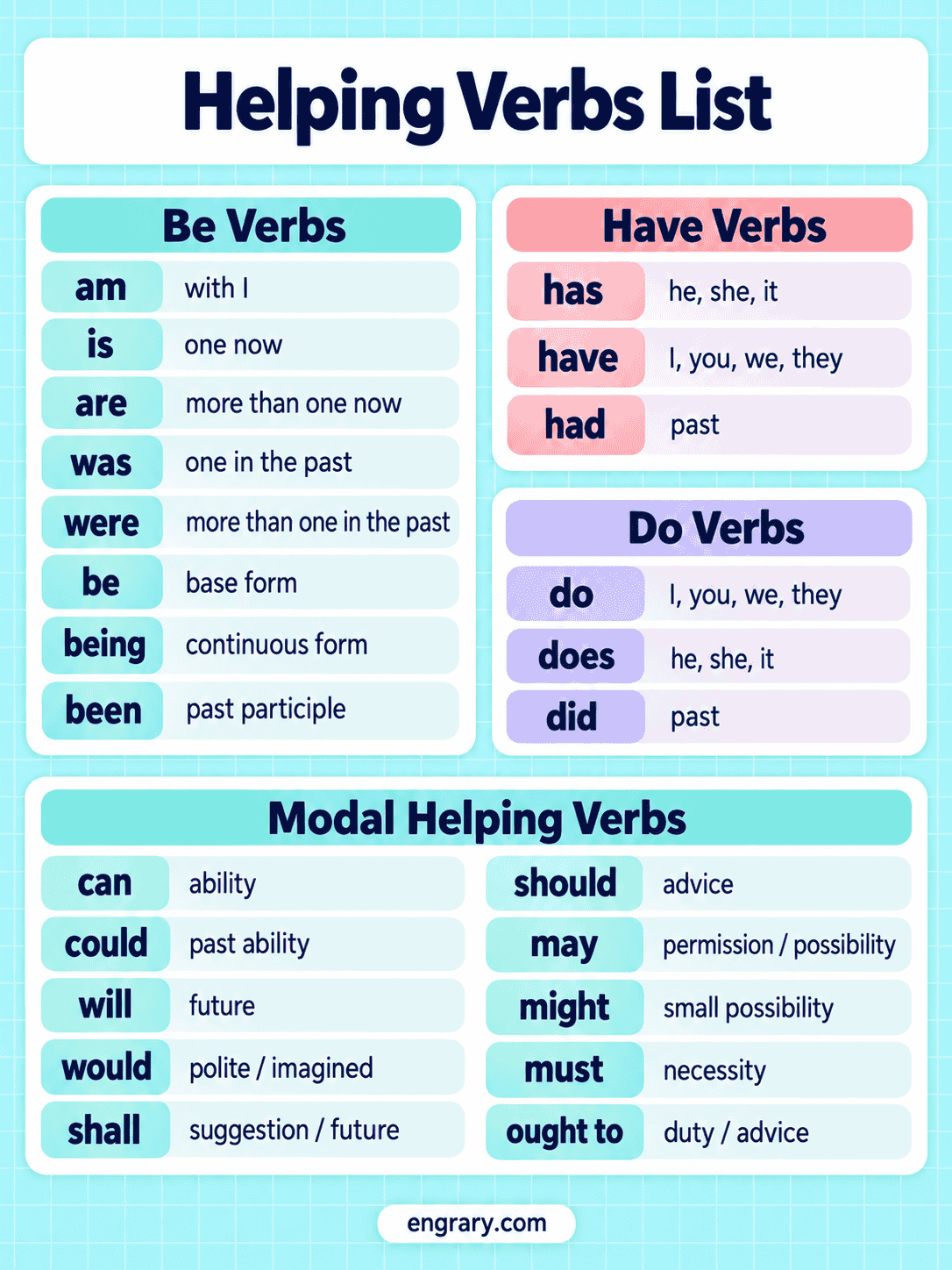
Complete Helping Verbs List
Helping verbs are best understood in groups rather than as one fixed total.
The main groups are:
| Type | Helping Verbs |
|---|---|
| Primary auxiliaries | be, have, do |
| Core modal auxiliaries | can, could, may, might, must, shall, should, will, would |
| Common extended modal | ought to |
The primary auxiliaries have several forms, which is why traditional school lists often contain more than these base verbs.
Traditional 23 Helping Verbs List
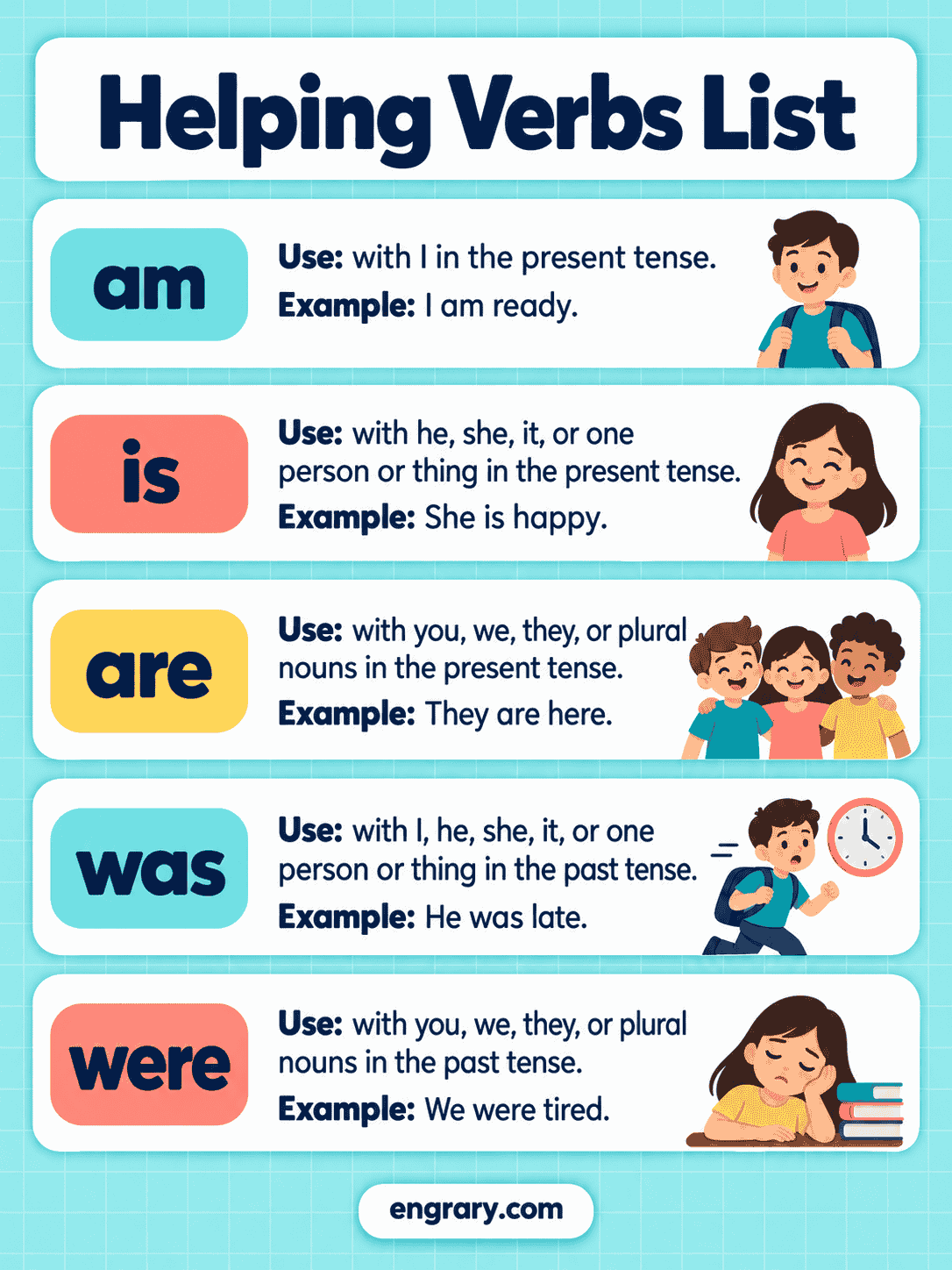
Many school grammar books teach the following 23 helping-verb forms:
- am
- is
- are
- was
- were
- be
- being
- been
- have
- has
- had
- do
- does
- did
- can
- could
- may
- might
- must
- shall
- should
- will
- would
This is a useful classroom list, but it is important to understand what it represents.
Forms such as am, is, are, was, were, being, and been all belong to the verb be. Likewise, have, has, had are forms of have, while do, does, did are forms of do.
So the traditional list counts individual auxiliary forms, not 23 completely separate base helping verbs.
Primary Helping Verbs
The three primary helping verbs are be, have, and do.
They can work as helping verbs, but they can also perform other grammatical roles depending on the sentence.
Be
The main forms of be are:
- am
- is
- are
- was
- were
- be
- being
- been
As a helping verb, be commonly forms continuous structures and passive constructions.
Examples:
She is reading.
They are playing.
He was sleeping.
We were waiting.
The room was cleaned.
The car is being repaired.
She has been working all day.
In each case, a form of be supports another verb.
However, be is not always a helping verb.
Compare:
She is reading.
is = helping verb
She is happy.
is = linking verb
The function depends on what follows it.
Have
The main auxiliary forms of have are:
- have
- has
- had
As a helping verb, have forms perfect structures.
Examples:
I have finished.
She has arrived.
They had left.
We have seen the movie.
He has written the report.
Again, have is not always a helping verb.
Compare:
He has finished the work.
has = helping verb
He has a bicycle.
has = main verb
Do
The auxiliary forms of do are:
- do
- does
- did
As a helping verb, do commonly forms questions, negatives, and emphasis.
Examples:
Do you know her?
Does he work here?
Did they call?
She does not agree.
We do not understand.
I did finish the task.
Like be and have, do can also work as a main verb.
Compare:
She does understand the lesson.
does = helping verb
She does her homework every evening.
does = main verb

Modal Helping Verbs List
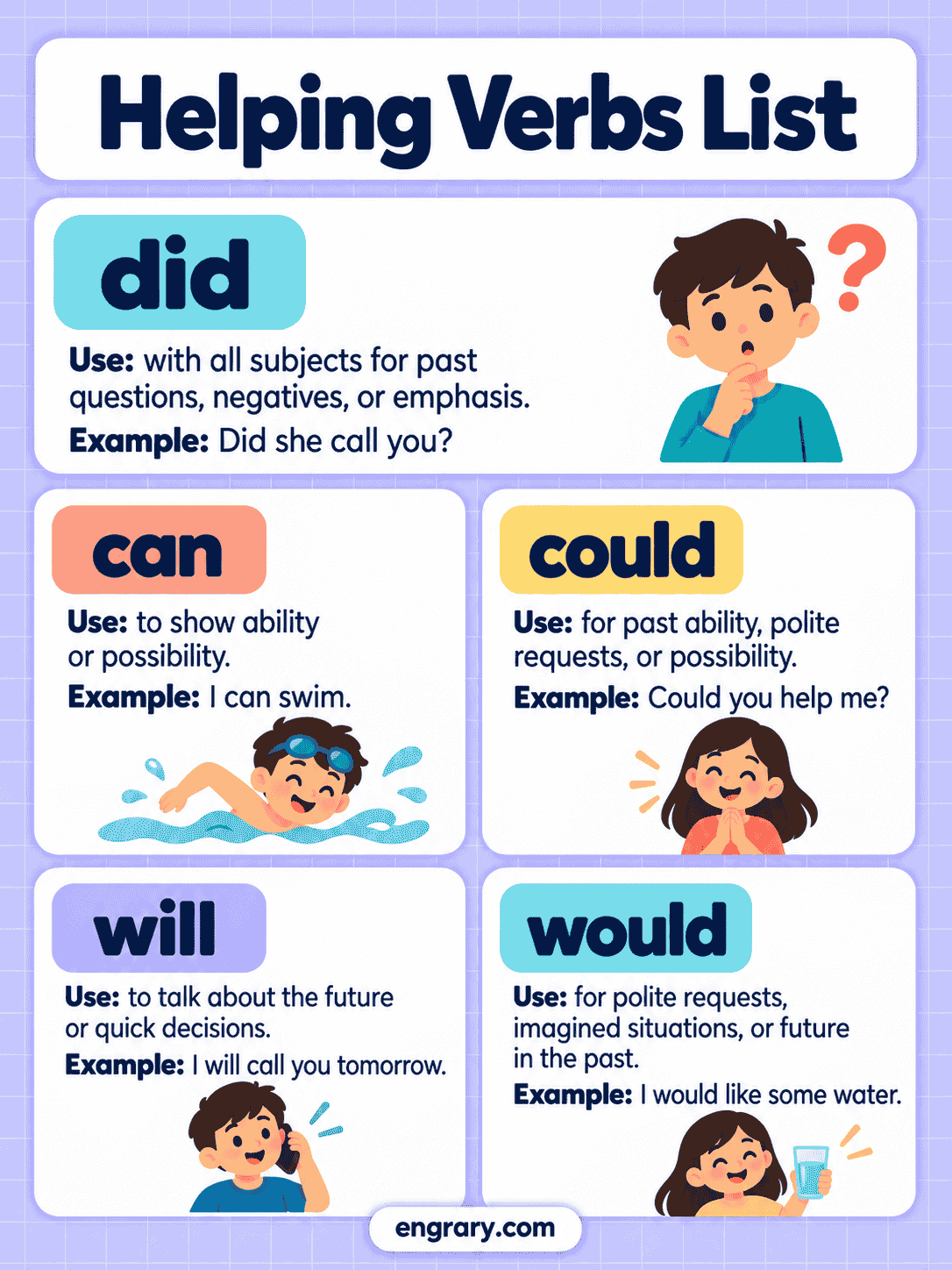
Modal helping verbs add meanings such as ability, possibility, necessity, advice, willingness, or prediction.
The main modal helping verbs are:
- can
- could
- may
- might
- must
- shall
- should
- will
- would
Many learner resources also include ought to.
Examples:
She can swim.
He could help us.
You may leave now.
It might rain.
We must hurry.
I shall return.
You should rest.
They will arrive soon.
She would agree.
You ought to listen.
Modal verbs are followed by the base form of the main verb.
Correct:
She can swim.
Incorrect:
She can swims.

Helping Verbs by Function
Helping verbs perform different jobs depending on the sentence.
Continuous Actions
Forms of be help form continuous verb phrases.
She is studying.
They were running.
We are waiting.
He was sleeping.
Perfect Forms
Forms of have help form perfect structures.
She has finished.
We have arrived.
They had left.
He has written the letter.
Questions and Negatives
Forms of do often help form questions and negative sentences.
Do you agree?
Does she know him?
Did they leave?
I do not understand.
He does not work here.
They did not call.
Ability and Possibility
Common helping verbs include can, could, may, and might.
She can drive.
He could read at five.
You may enter.
It might rain later.
Necessity and Advice
Helping verbs such as must, should, and ought to can express obligation or advice.
You must stop.
We should leave now.
You ought to rest.
Future and Prediction
Will and, in more limited contexts, shall can express future meaning.
She will arrive tomorrow.
We will call later.
I shall return soon.
Helping Verb and Main Verb Examples
A helping verb works together with the main verb to form a verb phrase.
| Sentence | Helping Verb | Main Verb |
|---|---|---|
| She is reading. | is | reading |
| They have finished. | have | finished |
| He can swim. | can | swim |
| We will leave. | will | leave |
| Mia might come. | might | come |
| I did finish it. | did | finish |
| They were playing. | were | playing |
| She has written a letter. | has | written |
| We should wait. | should | wait |
| He must leave. | must | leave |
The main verb carries the central meaning, while the helping verb adds grammatical information.
Helping Verbs in Longer Verb Phrases
A verb phrase can contain more than one helping verb.
Examples:
She has been studying.
They will be leaving.
He might have arrived.
We should have finished.
The work has been completed.
In:
She has been studying.
has and been are helping verbs, while studying is the main verb.
In:
He might have arrived.
might and have are helping verbs, while arrived is the main verb.
Longer verb phrases show how auxiliaries can work together.
Helping Verbs vs Main Verbs
The same word can act as a helping verb in one sentence and as a main verb in another.
| Helping Verb Use | Main Verb Use |
|---|---|
| She is reading. | — |
| He has finished. | He has a car. |
| She does understand. | She does her homework. |
The verb be needs a slightly different comparison because it often works as a linking verb rather than a main action verb.
The key question is:
Is the verb helping another verb?
If yes, it is functioning as a helping verb.
Helping Verbs vs Linking Verbs
Helping verbs and linking verbs can sometimes look alike, especially with forms of be.
Compare:
She is running.
Here, is helps the main verb running.
She is tired.
Here, is links the subject she with the description tired.
Another example:
The soup smells good.
smells is a linking verb because it connects soup with good. It is not helping another verb.
So a helping verb must work with another verb, while a linking verb connects the subject to a description or identity.
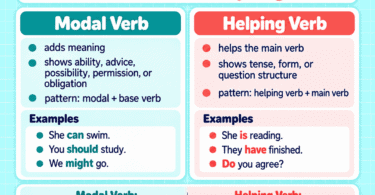
Modal Verbs and Semi-Modals
Not every expression that adds modal meaning behaves like a core modal auxiliary.
Core modals include:
- can
- could
- may
- might
- must
- shall
- should
- will
- would
Related semi-modal expressions can include:
- need
- dare
- used to
- have to
- be able to
For example:
She has to leave.
He is able to swim.
They used to live here.
These expressions can express meanings similar to modal verbs, but their grammar is not identical to core modals such as can or must.
Are Being and Been Helping Verbs?
Being and been are forms of be, and they can appear inside verb phrases.
Examples:
The room is being cleaned.
She has been working all morning.
In the first sentence, is and being help form the passive continuous structure.
In the second sentence, has and been help the main verb working.
This is why being and been appear in the traditional 23 helping-verbs list.
Are Having, Doing, and Done Helping Verbs?
Having, doing, and done are forms of have and do, but they are not usually included in the traditional 23 helping-verbs list.
Their function depends on the sentence.
For example:
She is doing her homework.
Here, doing is the main verb.
He has done the work.
Here, has is the helping verb and done is the main verb in the verb phrase.
So it is better to identify helping verbs by their grammatical role rather than by memorizing every possible form of have or do.
Common Mistakes With Helping Verbs
Helping-verb mistakes often happen when the wrong auxiliary or main-verb form is used.
| Incorrect | Correct | Why |
|---|---|---|
| She reading. | She is reading. | Continuous form needs a form of be |
| He have finished. | He has finished. | Singular subject requires has |
| They does not know. | They do not know. | Plural subject takes do |
| She can swims. | She can swim. | Modal takes the base verb |
| He will goes. | He will go. | Will takes the base verb |
| Did she went? | Did she go? | Did takes the base verb |
| He has ate. | He has eaten. | Has takes the past participle |
| She is write. | She is writing. | Continuous form uses the -ing form |
A useful check is to look at both the helping verb and the form of the main verb that follows it.
FAQs
Helping verbs work with main verbs to add grammatical meaning such as tense, possibility, ability, necessity, emphasis, or voice.
The traditional classroom list is am, is, are, was, were, be, being, been, have, has, had, do, does, did, can, could, may, might, must, shall, should, will, and would.
The three primary helping verbs are be, have, and do.
The core modal helping verbs are can, could, may, might, must, shall, should, will, and would.
Yes. Their role depends on the sentence. For example, has is helping in He has finished, but it is the main verb in He has a car.
Yes. In She has been studying, both has and been are helping verbs.
You May Also Like



Leave a Comment