
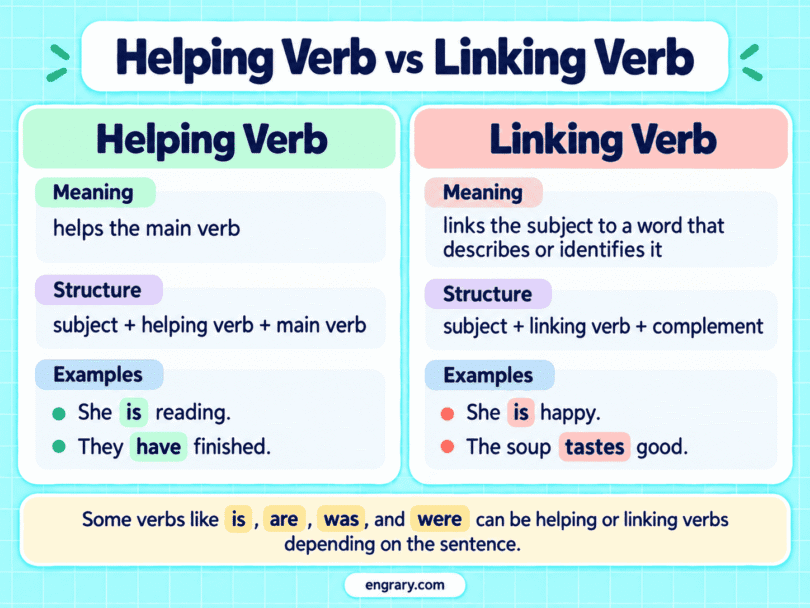
Helping verbs and linking verbs can look similar because forms such as is, are, was, and were can perform either role. The difference depends on what the verb does in the sentence: a helping verb supports another verb, while a linking verb connects the subject to a description or identity.
This article explains helping verb vs linking verb through clear definitions, sentence patterns, side-by-side comparisons, forms of be, subject complements, and identification tests. You will also see how helping, linking, and main verbs differ and which common mistakes to avoid.
What Is a Helping Verb?
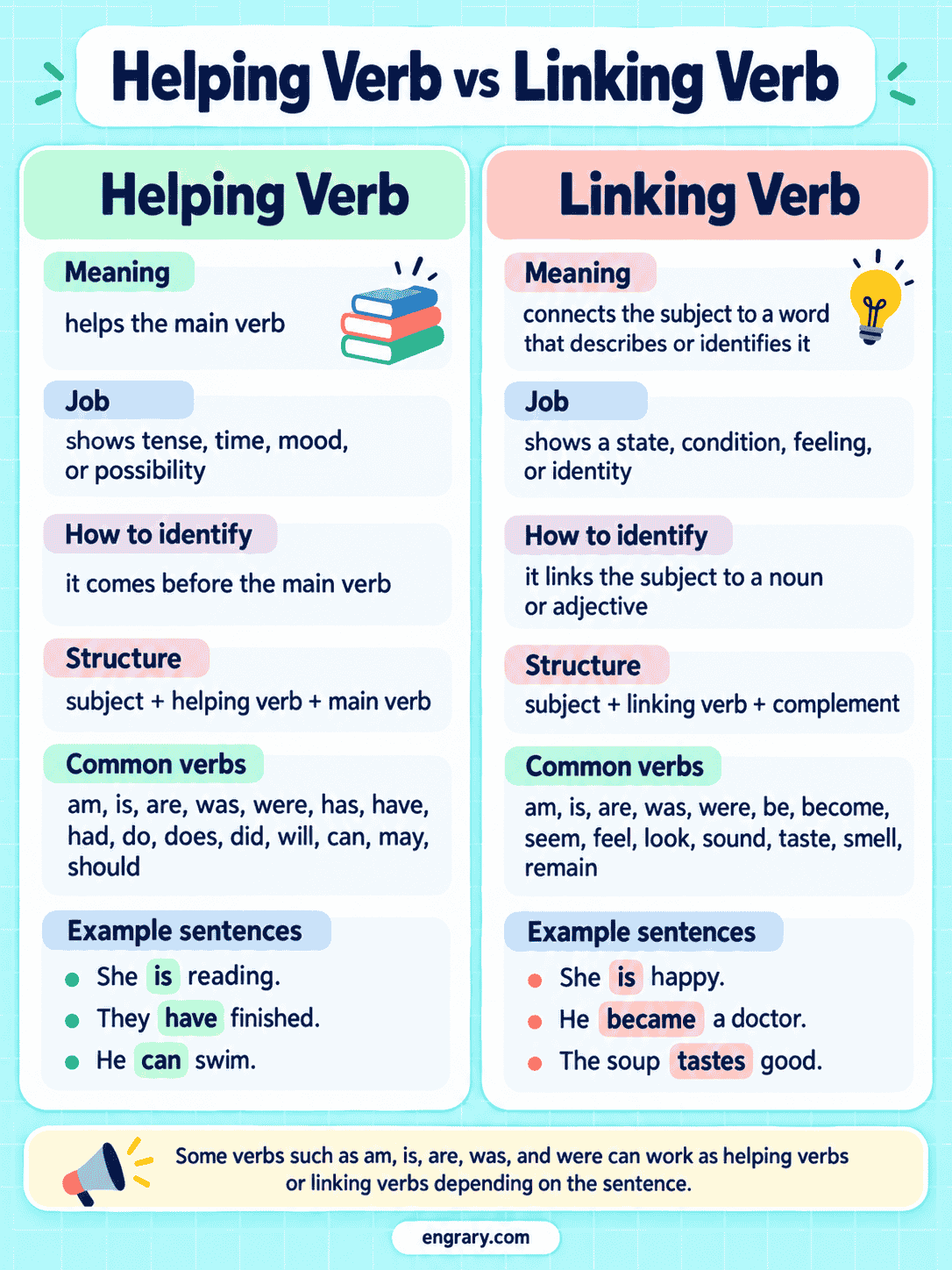
A helping verb, also called an auxiliary verb, works with a main verb to form a verb phrase and add grammatical meaning.
For example:
She is reading.
They have finished.
He can swim.
I did call.
In these sentences, the helping verbs support the main verbs reading, finished, swim, and call.
A common structure is:
subject + helping verb + main verb
For example:
She is reading.
She = subject
is = helping verb
reading = main verb
What Is a Linking Verb?
A linking verb connects the subject to a subject complement that describes or identifies it.
For example:
She is tired.
He became captain.
The soup tastes salty.
In these sentences, the linking verbs connect the subjects to information about those same subjects.
A common structure is:
subject + linking verb + subject complement
For example:
She is tired.
She = subject
is = linking verb
tired = subject complement
Helping Verb vs Linking Verb: Quick Difference
The easiest way to distinguish the two is to look at what follows the verb and what role the verb performs.
| Helping Verb | Linking Verb |
|---|---|
| Works with a main verb | Connects the subject to a complement |
| Forms part of a verb phrase | Links the subject to a description or identity |
| Usually supports another verb | Usually connects to an adjective or noun phrase |
| She is reading. | She is tired. |
| They were working. | They were ready. |
| He has finished. | He became captain. |
The same word can sometimes perform either role, especially forms of be.
Helping Verb vs Linking Verb Structure
Sentence structure often makes the difference easier to identify.
| Verb Type | Common Structure | Example |
|---|---|---|
| Helping verb | subject + helping verb + main verb | She is reading. |
| Linking verb + adjective | subject + linking verb + adjective | She is tired. |
| Linking verb + noun | subject + linking verb + noun | He became captain. |
The basic contrast is:
helping verb → another verb follows
linking verb → a description or identity follows
Forms of Be as Helping and Linking Verbs
Forms of be create the most confusion because they can function as either helping verbs or linking verbs.
| Form | Helping Use | Linking Use |
|---|---|---|
| am | I am studying. | I am tired. |
| is | She is reading. | She is happy. |
| are | They are working. | They are ready. |
| was | He was sleeping. | He was quiet. |
| were | We were waiting. | We were nervous. |
| been | She has been studying. | She has been sick. |
In the helping examples, the form of be supports another verb.
In the linking examples, the form of be connects the subject to a description.
For example:
She is reading.
is helps reading, so it functions as a helping verb.
She is happy.
is connects she to happy, so it functions as a linking verb.
Helping Verb + Main Verb vs Linking Verb + Subject Complement
The most important grammatical difference is what follows the verb.
| Helping Structure | Linking Structure |
|---|---|
| She is reading. | She is tired. |
| is = helping verb | is = linking verb |
| reading = main verb | tired = subject complement |
Another example:
| Helping Structure | Linking Structure |
|---|---|
| They were playing. | They were happy. |
| were = helping verb | were = linking verb |
| playing = main verb | happy = subject complement |
So the key contrast is:
helping verb + main verb
versus:
linking verb + subject complement
Main Verb vs Subject Complement
The word after the verb often tells you which type you are dealing with.
After a helping verb, look for a main verb.
She is reading.
reading is the main verb.
They have finished.
finished is the main verb.
He can swim.
swim is the main verb.
After a linking verb, look for a subject complement.
She is tired.
tired describes the subject.
He became captain.
captain identifies the subject.
The soup tastes salty.
salty describes the soup.
A subject complement may be an adjective, noun, or noun phrase.
How to Identify Helping and Linking Verbs
A few simple checks can make the distinction much easier.
Look for Another Verb
First, check whether the possible helping verb works with another verb.
She is reading.
is supports reading.
They have finished.
have supports finished.
He can swim.
can supports swim.
If the verb supports another verb in the same verb phrase, it functions as a helping verb.
Look for a Subject Complement
Next, check whether the verb connects the subject to a description or identity.
She is tired.
tired describes she.
He became captain.
captain identifies he.
The soup smells good.
good describes soup.
If the word or phrase after the verb refers back to the subject, the verb is likely linking.
Compare the Sentence Function
Matched sentence pairs make the difference especially clear.
| Helping Verb | Linking Verb |
|---|---|
| She is running. | She is tired. |
| They are working. | They are ready. |
| He was sleeping. | He was quiet. |
| We were waiting. | We were nervous. |
In the first column, each form of be helps another verb.
In the second column, each form connects the subject to a description.

Have and Do as Helping Verbs, Not Linking Verbs
The verbs have and do often function as helping verbs, but they do not normally work as linking verbs in the same way as be.
Examples with have:
She has finished.
They have arrived.
We had left.
Here, has, have, and had help the main verbs finished, arrived, and left.
Examples with do:
Do you understand?
She does not agree.
He did call.
Here, do, does, and did help form questions, negatives, or emphasis.
The major overlap between helping and linking functions therefore comes from be.
Linking Verb vs Helping Verb vs Main Verb
Helping, linking, and main verbs perform different jobs.
| Linking Verb | Helping Verb | Main Verb |
|---|---|---|
| Connects the subject to a complement | Supports another verb | Carries the main action or state |
| She is tired. | She is reading. | She reads daily. |
| He became angry. | He has finished. | He finished the work. |
| They seem ready. | They will leave. | They left early. |
The comparison shows that a helping verb depends on another verb, while a linking verb depends on a subject complement.
Common Mistakes With Helping and Linking Verbs
Many errors happen when the verb is classified by its spelling instead of its role in the sentence.
| Mistake | Correct Understanding |
|---|---|
| is is always a helping verb | It can be helping or linking |
| Every form of be is linking | Forms of be can also function as helping verbs |
| A linking verb helps another verb | A linking verb connects the subject to a complement |
| A helping verb is followed by an adjective | A helping verb normally supports a main verb |
| The verb word alone determines its type | Sentence function determines the role |
| was always belongs to one category | It can be helping or linking depending on context |
For example:
He was sleeping.
was is helping because it supports sleeping.
He was tired.
was is linking because it connects he to tired.
FAQs
A helping verb supports a main verb, while a linking verb connects the subject to a word or phrase that describes or identifies it.
Yes. In She is reading, is is a helping verb. In She is tired, is is a linking verb.
Check what follows it. In He was sleeping, was helps the main verb sleeping. In He was tired, was connects the subject to the adjective tired.
A helping verb normally works with a main verb, as in is reading, has finished, can swim, and will leave.
A linking verb is followed by a subject complement that describes or identifies the subject, as in is tired, became captain, or tastes sweet.
You May Also Like



Leave a Comment