
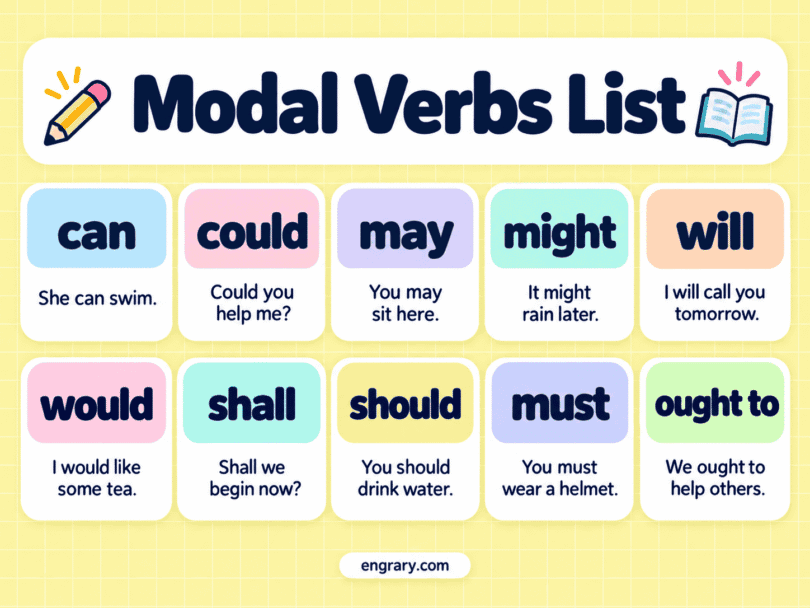
Modal verbs are important auxiliary verbs because they help express ideas such as ability, possibility, permission, necessity, advice, prediction, willingness, and certainty. Words such as can, could, may, might, must, should, will, and would work with a main verb to add these meanings.
This article gives a clear modal verbs list, explains the nine core modal auxiliaries, and shows how each one is used. You will also learn the main modal rules, negative and question forms, modal perfects, semi-modals, common comparisons, and mistakes to avoid.
What Are Modal Verbs?
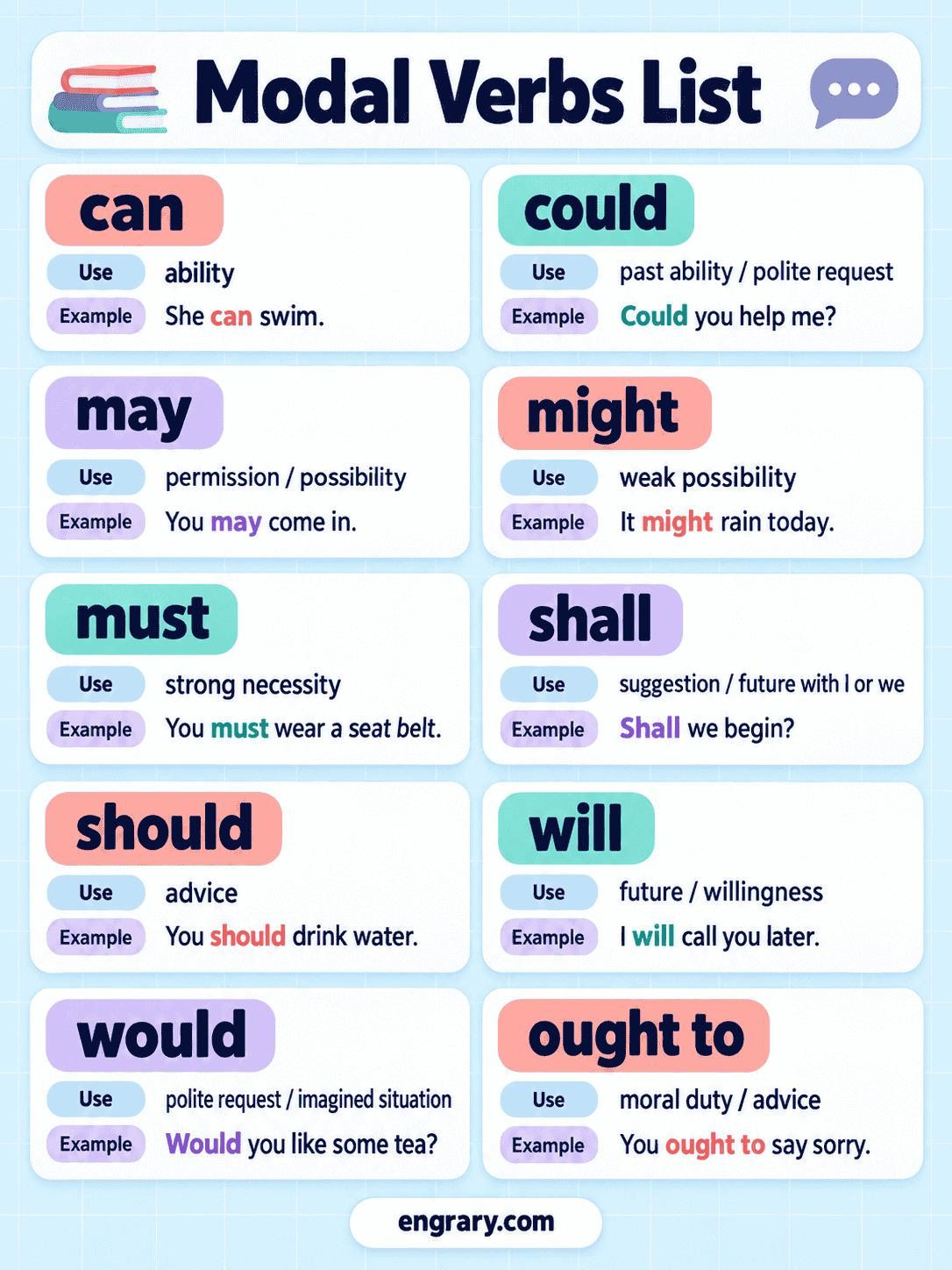
A modal verb is an auxiliary verb that works with a main verb to express meanings such as ability, possibility, permission, necessity, advice, prediction, or willingness.
For example:
She can swim.
It might rain.
You must leave.
We should wait.
They will arrive soon.
In each example, the modal verb changes or adds to the meaning of the main verb.
Core modal verbs normally use this pattern:
modal verb + base form of the main verb
For example:
can swim
should go
might come
will leave
Core Modal Verbs List
English has nine core modal auxiliaries.
| Modal Verb | Common Uses | Example |
|---|---|---|
| can | ability, permission, possibility | She can swim. |
| could | past ability, possibility, polite request | He could read at four. |
| may | permission, possibility | It may rain. |
| might | possibility | She might come. |
| must | necessity, obligation, strong deduction | You must stop. |
| shall | suggestion, offer, formal future | Shall we begin? |
| should | advice, expectation | You should rest. |
| will | future, willingness, prediction | They will arrive. |
| would | conditional meaning, polite requests, past habits | I would help. |
These verbs are called core modals because they share several grammatical features. They do not normally take -s, -ed, or -ing, and they are generally followed by the base form of another verb.
Is Ought To a Modal Verb?
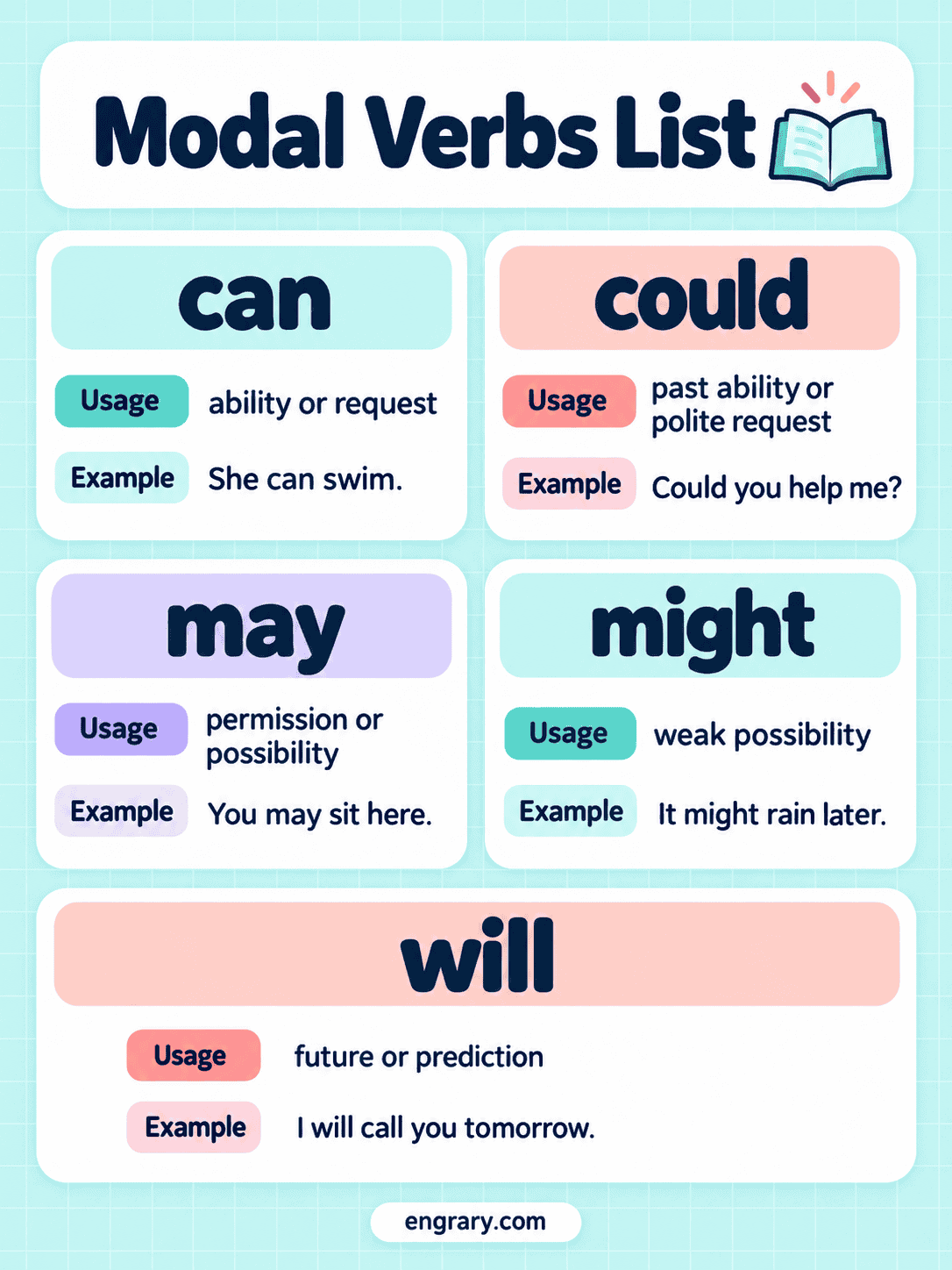
Ought to is commonly taught with modal verbs because it expresses advice, expectation, or obligation.
For example:
You ought to rest.
We ought to leave soon.
She ought to apologize.
However, grammar systems do not always classify ought to in exactly the same way as the nine core modal auxiliaries.
A clear learner-friendly distinction is:
Nine core modal verbs:
can, could, may, might, must, shall, should, will, would
Commonly included extended modal:
ought to
This avoids treating one classification system as the only possible one.
Modal Verbs by Function
Modal verbs can express several different meanings. The same modal may also perform more than one function depending on context.
Ability
Can commonly expresses present ability, while could can express past ability.
She can swim.
I can drive.
He could read at five.
They could speak English well.
Permission
Common modal verbs for permission include can, could, and may.
Can I leave early?
Could I borrow your pen?
May I come in?
May we sit here?
May is often more formal than can in permission questions.
Possibility
Modal verbs such as may, might, and could can express possibility.
It may rain later.
She might come tonight.
They could be at home.
The plan might work.
These verbs do not all express exactly the same degree of possibility, so context matters.
Necessity and Obligation
Must expresses strong necessity or obligation.
You must wear a seat belt.
We must finish today.
Students must follow the rules.
Should and ought to can also express obligation, but usually with less force.
You should arrive on time.
You ought to keep your promise.
Advice
Should, ought to, and sometimes could can express advice or suggestions.
You should rest.
She ought to see a doctor.
You could try another method.
We should check the details first.
Future and Prediction
Will commonly expresses future meaning, willingness, or prediction.
They will arrive tomorrow.
I will call you later.
It will rain tonight.
Shall can also refer to the future, although it is less common in everyday modern English.
I shall return soon.
We shall see what happens.
Requests and Offers
Several modals can make requests or offers.
Can you help me?
Could you open the door?
Will you wait here?
Would you like some tea?
Shall I carry your bag?
The choice of modal can affect politeness and formality.
Deduction and Certainty
Modal verbs can also show how certain the speaker is about a situation.
She must be at home.
They may be late.
It might be true.
He could be the manager.
That can’t be correct.
Here, the modal expresses the speaker’s level of certainty rather than ability or permission.
How to Use Modal Verbs
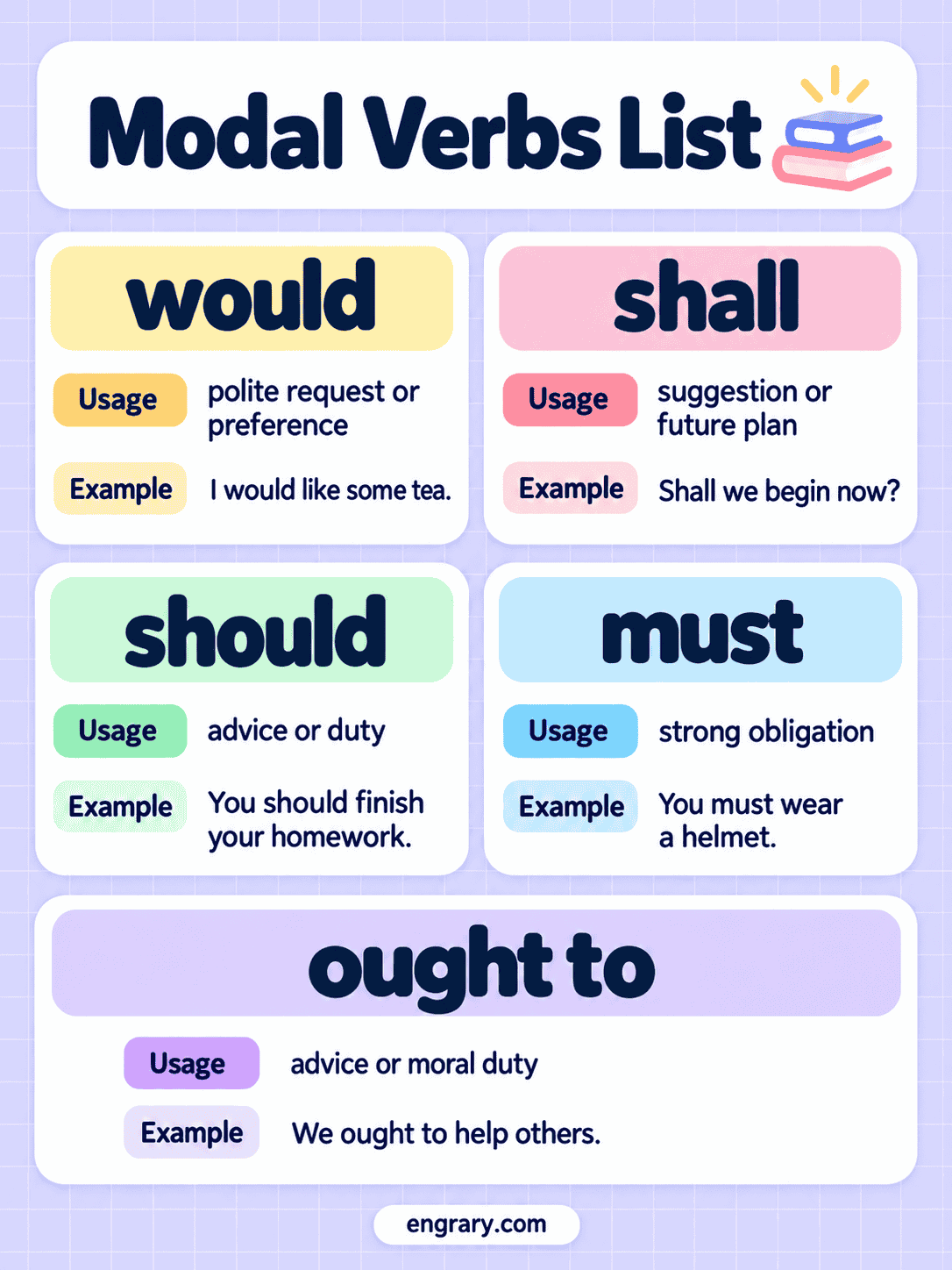
Core modal verbs follow several important grammatical patterns.
Modal + Base Verb
A core modal is normally followed by the base form of the main verb.
Correct:
She can swim.
He should go.
They might come.
We must leave.
Incorrect:
She can swims.
He should goes.
They might to come.
The main verb remains in its base form after a core modal.
Modal Verbs Do Not Change Form
Core modal verbs do not normally take -s for third-person singular subjects.
Correct:
I can swim.
She can swim.
They can swim.
Incorrect:
She cans swim.
Likewise:
He must leave.
Not:
He musts leave.
Core modal verbs also do not normally have regular -ed or -ing forms.
Negative Forms
Most core modals form negatives by adding not.
| Modal | Negative Form |
|---|---|
| can | cannot / can’t |
| could | could not / couldn’t |
| may | may not |
| might | might not |
| must | must not / mustn’t |
| shall | shall not / shan’t |
| should | should not / shouldn’t |
| will | will not / won’t |
| would | would not / wouldn’t |
Examples:
She cannot swim.
They might not come.
You must not enter.
We should not wait.
He will not agree.
Questions With Modal Verbs
Core modal verbs normally move before the subject in questions.
Can you swim?
Could you help me?
May I enter?
Should we leave?
Will they come?
Would you wait?
A separate do, does, or did is not needed.
No Do, Does, or Did With Core Modals
Core modal verbs form questions and negatives directly.
Correct:
Can she swim?
Incorrect:
Does she can swim?
Correct:
He cannot come.
Incorrect:
He does not can come.
Correct:
Will they arrive?
Incorrect:
Do they will arrive?
This rule helps distinguish core modals from ordinary main verbs.
Modal Perfect Forms
Modal verbs can combine with have + past participle to refer to past situations.
The pattern is:
modal + have + V3
Examples:
She might have forgotten.
He must have left.
They could have won.
You should have called.
We would have stayed.
These structures can express past possibility, deduction, regret, missed opportunity, or hypothetical meaning.
For example:
He must have left.
This expresses a strong deduction about the past.
You should have called.
This expresses criticism or regret about a past action.
Core Modal Verbs vs Semi-Modals
Core modals and semi-modal expressions can express similar meanings, but they do not behave in exactly the same grammatical way.
| Core Modals | Semi-Modals or Related Expressions |
|---|---|
| can | be able to |
| could | have to |
| may | need to |
| might | used to |
| must | had better |
| shall | dare |
| should | need |
| will | ought to |
| would | — |
The core modal verbs share a more consistent grammatical pattern, while semi-modals often contain ordinary verb forms or infinitive structures.
Have To
Have to expresses necessity or obligation.
I have to leave.
She has to work tomorrow.
They had to wait.
Unlike must, the expression changes form for tense and subject.
Be Able To
Be able to expresses ability.
She is able to swim.
They were able to finish.
He will be able to come.
Unlike can, it can appear in a wider range of tense structures.
Used To
Used to commonly describes past habits or states that no longer continue.
We used to live there.
She used to walk to school.
He used to be shy.
Had Better
Had better expresses strong advice or a warning.
You had better leave now.
We had better hurry.
She had better call the doctor.
Despite containing had, this expression normally refers to present or future advice rather than past time.
Must vs Have To
Both can express necessity, but they differ grammatically.
| Must | Have To |
|---|---|
| core modal | related modal expression |
| does not change for subject | changes form |
| must leave | has to leave |
| forms questions directly in formal uses | normally uses do-support |
Examples:
You must leave now.
She has to leave now.
The two forms can overlap in meaning, but they are not grammatically identical.
Can vs Be Able To
Both can express ability, but their grammatical behavior differs.
| Can | Be Able To |
|---|---|
| core modal | modal-like expression |
| can swim | is able to swim |
| limited forms | works in more tense structures |
| no infinitive to can | can use to be able to |
Examples:
She can swim.
She is able to swim.
I want to be able to drive.
The phrase be able to is useful when can cannot fit the required grammatical structure.
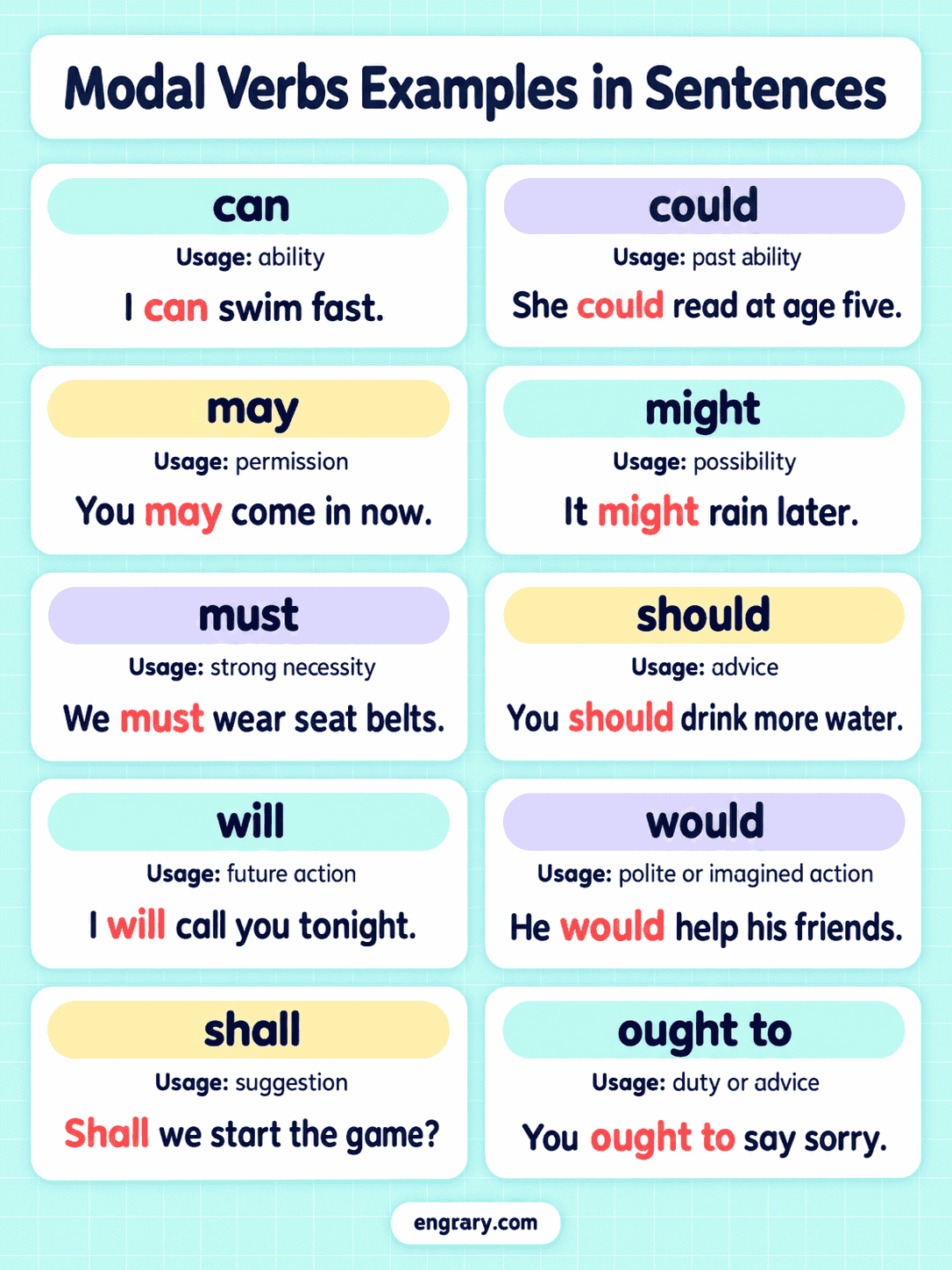
Modal Verbs Examples in Sentences
The following examples show common modal verbs in everyday sentences.
She can drive.
He could swim at six.
You may enter.
It might rain.
We must leave.
Shall we begin?
You should rest.
They will come tomorrow.
I would help you.
You ought to apologize.
She can speak French.
They might arrive late.
We should check the answer.
He must be tired.
Would you like some coffee?
These examples show that modals can express different meanings even though they follow similar grammatical patterns.
Common Mistakes With Modal Verbs
Modal-verb mistakes often happen when learners add endings or unnecessary words after the modal.
| Incorrect | Correct | Why |
|---|---|---|
| She can swims. | She can swim. | modal takes base verb |
| He should goes. | He should go. | no -s after modal |
| They might to come. | They might come. | core modal takes base verb |
| She cans drive. | She can drive. | modal does not take -s |
| He musts leave. | He must leave. | modal form does not change |
| Do you can swim? | Can you swim? | modal forms the question directly |
| She will to come. | She will come. | no to after core modal |
| He may comes. | He may come. | modal takes base verb |
| Does she should wait? | Should she wait? | no do-support with core modal |
| He could went. | He could go. | modal takes base verb |
Checking the word immediately after the modal can prevent many of these errors.
FAQs
Modal verbs are auxiliary verbs that work with a main verb to express meanings such as ability, possibility, permission, necessity, advice, prediction, or willingness.
The nine core modal verbs are can, could, may, might, must, shall, should, will, and would.
Ought to is commonly taught with modal verbs because it expresses advice or obligation, although grammar systems differ in whether they classify it as a core modal.
A core modal verb normally takes the base form of the main verb, as in can swim, should go, and might come.
Core modal verbs normally do not take -s, -ed, or -ing endings. For example, we say She can swim, not She cans swim.
Core modal verbs follow a special auxiliary pattern, while semi-modals and related expressions such as have to, be able to, used to, and had better behave differently in grammar even when they express similar meanings.
You May Also Like



Leave a Comment