

Helping verbs work with main verbs to add meaning such as tense, possibility, ability, necessity, emphasis, or voice. Words such as is, have, do, can, should, and will often appear with another verb and help form a complete verb phrase.
This article explains helping verbs through clear sentence examples, helping-and-main-verb pairs, primary auxiliaries, modal verbs, longer verb phrases, questions, negatives, and emphasis. It also shows how to identify helping verbs and distinguish them from main and linking verbs.

What Are Helping Verbs?
A helping verb works with a main verb to add grammatical meaning.
For example:
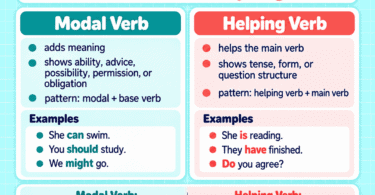
She is reading.
They have finished.
He can swim.
We will leave soon.
I did finish the work.
In these examples, is, have, can, will, and did are helping verbs because they work with the main verbs reading, finished, swim, leave, and finish.
Helping verbs are also called auxiliary verbs.
Common Helping Verb Examples
Common helping verbs include forms of be, have, and do, along with modal verbs.
| Type | Common Examples |
|---|---|
| Be | am, is, are, was, were, be, being, been |
| Have | have, has, had |
| Do | do, does, did |
| Modals | can, could, may, might, must, shall, should, will, would |
Examples in verb phrases include:
am learning
is working
were playing
have finished
has written
did call
can swim
might come
should rest
will leave
The exact role of a word depends on how it is used in the sentence.

Helping Verb Examples in Sentences
Helping verbs appear in many different kinds of sentences.
She is reading a book.
They are playing outside.
He was sleeping.
We were waiting.
I have finished my work.
She has written a letter.
They had left already.
Do you know him?
She does not agree.
I did finish the task.
He can swim.
She could help us.
You may leave.
It might rain.
We must hurry.
You should rest.
They will arrive soon.
I would help if I could.
Each helping verb changes or adds to the meaning of the main verb.
Helping Verb and Main Verb Examples
A helping verb and a main verb often work together as one verb phrase.
| Sentence | Helping Verb | Main Verb |
|---|---|---|
| She is reading. | is | reading |
| They have finished. | have | finished |
| He can swim. | can | swim |
| We will leave. | will | leave |
| Mia might come. | might | come |
| I did finish it. | did | finish |
| They were playing. | were | playing |
| She has written a letter. | has | written |
| We should wait. | should | wait |
| He must leave. | must | leave |
The main verb carries the central meaning, while the helping verb adds grammatical information.

Helping Verb Examples With Be
Forms of be commonly help form continuous structures and passive constructions.
Common forms include:
- am
- is
- are
- was
- were
- be
- being
- been
Examples:
I am studying.
She is reading.
They are working.
He was sleeping.
We were talking.
The car is being repaired.
She has been studying all morning.
The rooms were cleaned yesterday.
In each example, a form of be works with another verb.
However, be is not always a helping verb.
Compare:
She is reading.
is = helping verb
She is tired.
is = linking verb
Helping Verb Examples With Have
Forms of have help form perfect verb phrases.
The main auxiliary forms are:
- have
- has
- had
Examples:
I have finished.
She has arrived.
They had left.
We have seen the movie.
He has written the report.
The students have completed the task.
She had forgotten her book.
In these examples, have, has, and had work with past participles.
However, have can also work as a main verb.
Compare:
He has finished the work.
has = helping verb
He has a bicycle.
has = main verb
Helping Verb Examples With Do
Forms of do often help form questions, negatives, and emphatic statements.
The main auxiliary forms are:
- do
- does
- did
Examples:
Do you know her?
Does he live here?
Did they call?
I do not agree.
She does not work here.
They did not leave.
I do understand.
She does want to come.
He did finish the assignment.
When do, does, or did works as a helping verb, the main verb stays in its base form.
Correct:
Did she go?
Incorrect:
Did she went?

Modal Helping Verb Examples
Modal helping verbs add meanings such as ability, possibility, necessity, advice, prediction, or willingness.
Ability
Use can and could.
She can swim.
He can drive.
Mia could read at five.
We could help them.
Possibility
Use may, might, and sometimes could.
It may rain.
She might come later.
They could arrive early.
You may need more time.
Necessity and Advice
Use must, should, and sometimes ought to.
You must stop.
We must leave now.
You should rest.
She should study more.
You ought to listen carefully.
Future and Prediction
Use will and, in some contexts, shall.
They will arrive tomorrow.
We will call later.
It will rain tonight.
I shall return soon.
Willingness and Conditional Meaning
Use would in many conditional, polite, or hypothetical contexts.
I would help you.
She would agree.
He would come if he had time.
We would stay longer.
Modal verbs are followed by the base form of the main verb.
Correct:
She can swim.
Incorrect:
She can swims.

Helping Verbs in Longer Verb Phrases
A sentence can contain more than one helping verb.
Examples:
She has been studying.
They will be leaving.
He might have arrived.
We should have finished.
The work has been completed.
They will have been waiting for hours.
In:
She has been studying.
has and been are helping verbs.
studying is the main verb.
In:
He might have arrived.
might and have are helping verbs.
arrived is the main verb.
In:
They will have been waiting.
will, have, and been are helping verbs.
waiting is the main verb.
These examples show that one verb phrase can contain several auxiliaries.
Helping Verbs by Function
Helping verbs can perform different jobs depending on the sentence.
Questions
Helping verbs often come before the subject in questions.
Do you understand?
Does she know him?
Did they leave?
Can he swim?
Will you come?
Have they finished?
Has she arrived?
Negatives
Helping verbs also help form negative sentences.
She does not know.
They did not leave.
He cannot swim.
We will not wait.
She has not finished.
They were not working.
I have not seen him.
Emphasis
Forms of do can add emphasis.
I do understand.
She does want to come.
He did finish the work.
We do need more time.
Here, do, does, and did emphasize the statement rather than simply marking tense.
A quick summary:
| Function | Example |
|---|---|
| Continuous | She is reading. |
| Perfect | He has finished. |
| Question | Do you agree? |
| Negative | She does not know. |
| Ability | He can swim. |
| Possibility | It might rain. |
| Necessity | You must stop. |
| Advice | You should rest. |
| Future | We will leave. |
| Emphasis | I did call. |
How to Identify a Helping Verb
A practical way to identify a helping verb is to look for a verb that works with another verb in the same verb phrase.
For example:
She is reading.
Here, is helps reading.
They have finished.
Here, have helps finished.
He can swim.
Here, can helps swim.
Now compare:
She is happy.
Here, is is not helping another verb. Instead, it links she with happy.
Ask:
Is this verb helping another verb in the sentence?
If yes, it is functioning as a helping verb.
Helping Verb vs Main Verb Examples
Some words can be helping verbs in one sentence and main verbs in another.
| Helping Verb Use | Main Verb Use |
|---|---|
| He has finished. | He has a car. |
| She does understand. | She does her homework. |
| They did complete it. | They did the task. |
The difference depends on whether the verb supports another verb.
In:
He has finished.
has supports finished.
In:
He has a car.
has carries the main meaning itself.
Helping Verb vs Linking Verb Examples
Helping verbs and linking verbs can sometimes look alike, especially with forms of be.
Compare:
She is running.
Here, is is a helping verb because it supports running.
She is tired.
Here, is is a linking verb because it connects she with tired.
Another example:
The soup smells good.
smells is a linking verb because it connects soup with the description good.
A helping verb supports another verb, while a linking verb connects the subject to a description or identity.
Common Mistakes With Helping Verbs
Helping-verb mistakes often happen when the wrong auxiliary or main-verb form is used.
| Incorrect | Correct | Why |
|---|---|---|
| She reading. | She is reading. | Continuous form needs be |
| He have finished. | He has finished. | Singular subject takes has |
| They does not know. | They do not know. | Plural subject takes do |
| She can swims. | She can swim. | Modal takes base verb |
| He will goes. | He will go. | Will takes base verb |
| Did she went? | Did she go? | Did takes base verb |
| He has ate. | He has eaten. | Has takes past participle |
| She is write. | She is writing. | Continuous form uses -ing |
A useful check is to look at both the helping verb and the form of the main verb that follows it.
FAQs
Common examples include is reading, have finished, can swim, might come, should rest, and will leave.
Examples include She is reading, They have finished, He can swim, and We will leave soon.
Yes. In She has been studying, both has and been are helping verbs.
A helping verb supports another verb, while the main verb carries the central action or meaning. In She is reading, is is helping and reading is the main verb.
No. In She is reading, is is a helping verb. In She is happy, is is a linking verb.
You May Also Like



Leave a Comment