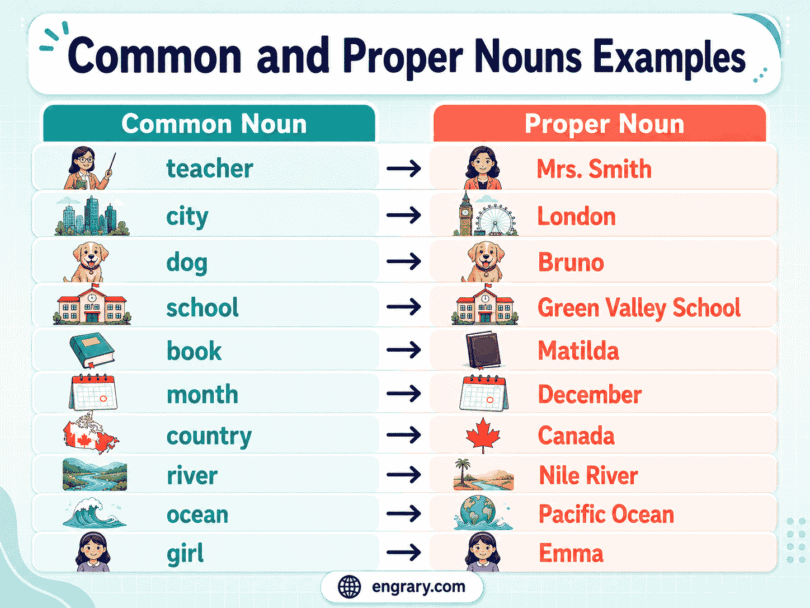
Common and proper nouns help children distinguish general names from exact names. This difference also improves capitalization because common nouns usually remain lowercase, while proper nouns begin with capital letters when they identify specific people, places, organizations, days, months, languages, and other named things.
You’ll see easy common and proper noun examples, general and specific name pairs, examples by category, and both noun types used in sentences. You’ll also learn how capitalization works, how common nouns can appear inside proper names, how family words and titles change according to use, and which common mistakes to avoid.
What Are Common and Proper Nouns?
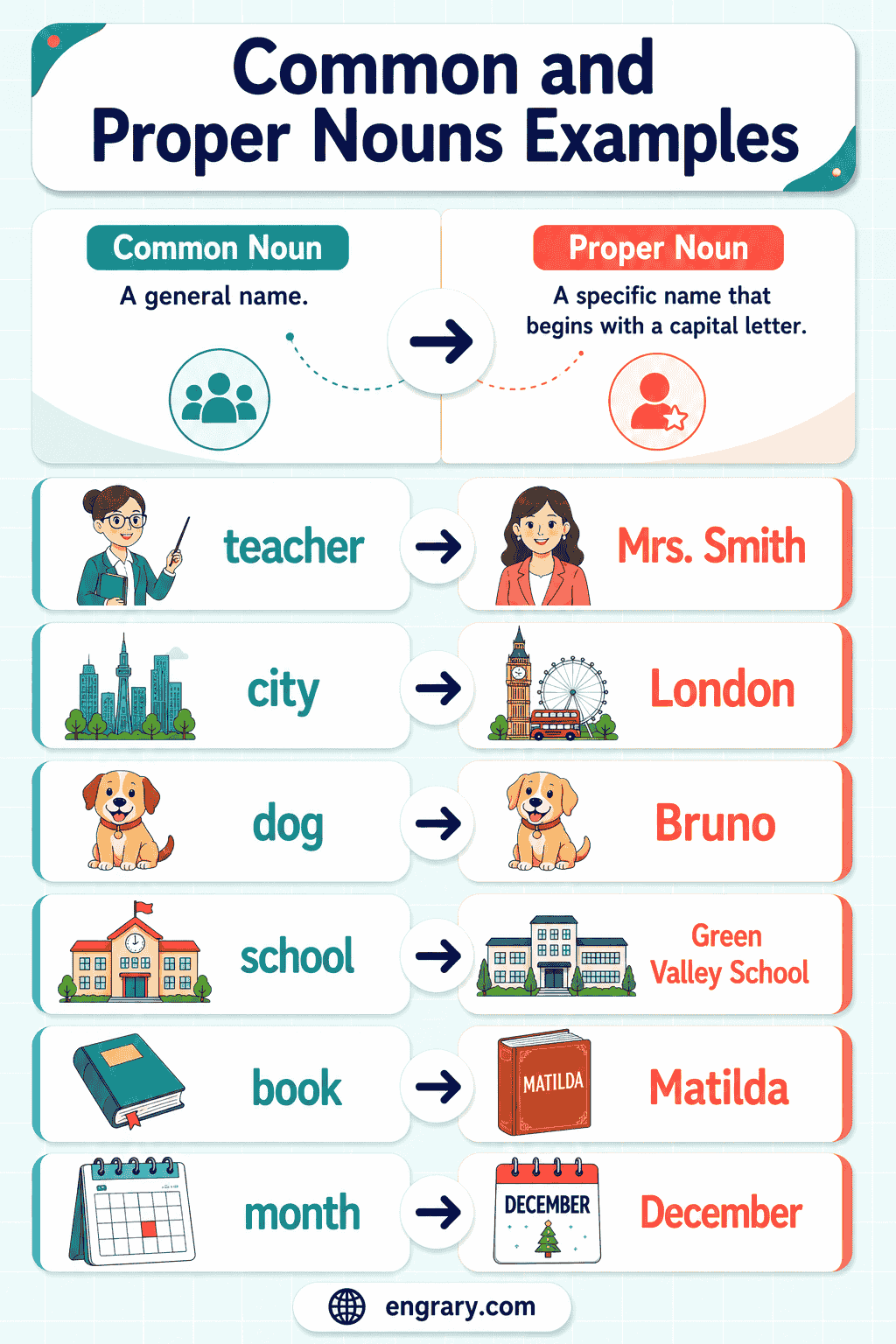
A common noun gives a general name for a person, animal, place, object, organization, or other thing.
A proper noun gives the specific name of a particular person, place, organization, day, month, language, event, or named thing.
For example:
city → London
City can refer to any city, so it is a common noun. London identifies one particular city, so it is a proper noun.
Another example is:
teacher → Ms. Green
Teacher names a general occupation, while Ms. Green identifies a particular teacher.
The basic distinction is:
common noun → general name
proper noun → specific name
Easy Common and Proper Noun Examples
The following pairs show how a general noun relates to a specific proper name.
| Common Noun | Proper Noun | Category |
|---|---|---|
| girl | Emma | person |
| boy | Noah | person |
| teacher | Ms. Green | person |
| doctor | Dr. Khan | person |
| dog | Bruno | animal |
| cat | Luna | animal |
| city | London | place |
| country | Canada | place |
| park | Central Park | place |
| river | Amazon River | geographical feature |
| mountain | Mount Everest | geographical feature |
| ocean | Pacific Ocean | geographical feature |
| day | Monday | time |
| month | January | time |
| holiday | Christmas | event |
| language | English | language |
| school | Lincoln Elementary School | institution |
| university | Oxford University | institution |
| company | company | |
| organization | United Nations | organization |
The words in the first column name categories. The names in the second column identify particular members of those categories.
General Names and Specific Names
The clearest way to understand common and proper nouns is to compare a general category with one exact name.
school → Lincoln Elementary School
The noun school can refer to any school. Lincoln Elementary School identifies one particular institution.
river → Amazon River
The noun river names a type of geographical feature. Amazon River gives the name of one specific river.
Specificity, not capitalization alone, determines whether a noun is common or proper.
Common and Proper Nouns by Type
Common and proper nouns appear across many everyday categories. Comparing related examples helps children see how the distinction works in different contexts.
People
Common nouns for people describe them generally by role, type, or description. Proper nouns identify particular individuals.
| Common Noun | Proper Noun |
|---|---|
| girl | Emma |
| boy | Noah |
| teacher | Ms. Green |
| doctor | Dr. Khan |
| scientist | Albert Einstein |
| writer | William Shakespeare |
The teacher entered the classroom.
Ms. Green entered the classroom.
The first noun names an occupation generally. The second identifies a particular person.
Animals
Animal names are usually common nouns when they name a type of animal. A personal name for one animal is a proper noun.
| Common Noun | Proper Noun |
|---|---|
| dog | Bruno |
| cat | Luna |
| horse | Daisy |
| parrot | Coco |
| rabbit | Snowy |
The dog barked at the gate.
Bruno barked at the gate.
Here, dog names the animal type, while Bruno gives the individual animal’s name.
Places
General place words are common nouns. Exact place names are proper nouns.
| Common Noun | Proper Noun |
|---|---|
| city | London |
| country | Canada |
| park | Central Park |
| school | Lincoln Elementary School |
| university | Oxford University |
| street | Baker Street |
The city has many parks.
London has many parks.
The first sentence refers to a type of place. The second names one city.
Geographical Features and Landmarks
Words such as river, mountain, ocean, desert, park, and tower are common nouns when used generally. Their exact names are proper nouns.
| Common Noun | Proper Noun |
|---|---|
| river | Amazon River |
| mountain | Mount Everest |
| ocean | Pacific Ocean |
| desert | Sahara Desert |
| park | Central Park |
| monument | Taj Mahal |
| tower | Eiffel Tower |
The mountain is very high.
Mount Everest is very high.
The full name identifies the specific geographical feature or landmark.
Days, Months, and Holidays
The words day, month, and holiday are common nouns. Their exact names are proper nouns.
| Common Noun | Proper Noun |
|---|---|
| day | Monday |
| day | Friday |
| month | January |
| month | December |
| holiday | Eid |
| holiday | Christmas |
The day was busy.
Monday was busy.
Names such as Monday, January, Eid, and Christmas take capital letters because they are specific names.
Languages
The word language is a common noun. Names of individual languages are proper nouns in English.
| Common Noun | Proper Noun |
|---|---|
| language | English |
| language | Urdu |
| language | French |
| language | Spanish |
| language | Japanese |
She studies a language at school.
She studies English at school.
The first sentence gives a general category, while the second names a particular language.
Schools, Companies, and Organizations
General institution or business words are common nouns. Their official names are proper nouns.
| Common Noun | Proper Noun |
|---|---|
| school | Lincoln Elementary School |
| university | Oxford University |
| company | |
| company | Microsoft |
| organization | United Nations |
| organization | World Health Organization |
The company develops software.
Microsoft develops software.
The exact company name makes the second noun proper.
Books, Movies, and Games
General words such as book, movie, game, and website are common nouns. Specific titles and names identify particular works or products.
| Common Noun | Proper Name |
|---|---|
| book | The Hunger Games |
| movie | The Lion King |
| game | Minecraft |
| website | Khan Academy |
Mia read a book.
Mia read The Hunger Games.
The first sentence names a category. The second identifies one specific work.
Common and Proper Nouns in Sentences
Common and proper nouns often appear together in the same sentence.
Sara carried a book.
Sara is proper because it identifies one person. Book is common because it names an object generally.
The students visited Central Park.
Students is common, while Central Park is proper.
The teacher works at Oxford University.
Teacher gives a general occupation. Oxford University identifies one institution.
Noah walked his dog through Central Park.
Noah and Central Park are proper nouns. Dog is a common noun.
The family celebrated Christmas.
Family is common, while Christmas is proper.
The company opened an office in Paris.
Company and office are common nouns. Paris identifies a particular city.
Emma studies English at Lincoln Elementary School.
Emma, English, and Lincoln Elementary School are proper nouns.
The doctor spoke to Sara.
Doctor is common, while Sara is proper.
These examples show that noun type depends on whether the word gives a general category or a specific name.
Capitalization of Common and Proper Nouns
Common nouns usually remain lowercase unless they begin a sentence. Proper nouns use capital letters because they function as specific names.
Compare:
city → London
day → Monday
month → January
language → English
company → Google
Incorrect:
london
Correct:
London
Incorrect:
monday
Correct:
Monday
Incorrect:
english
Correct:
English
However, capitalization alone does not turn a common noun into a proper noun.
Incorrect:
The Teacher entered the room.
Correct:
The teacher entered the room.
The word teacher remains general, even if someone writes it with a capital letter.
By contrast:
Ms. Green entered the room.
Here, Ms. Green identifies one particular person.
The important rule is:
specific naming determines the noun type; capitalization reflects that status.
Common Nouns Inside Proper Names
A common noun can form part of a longer proper name.
Consider:
Amazon River
Oxford University
Central Park
Pacific Ocean
The words river, university, park, and ocean are common nouns when they appear alone.
The river is wide.
Here, river names the geographical feature generally.
The Amazon River is wide.
Here, the full expression Amazon River identifies one specific river.
Another example is:
The university has many students.
Oxford University has many students.
Likewise:
The park is crowded.
Central Park is crowded.
A proper noun can therefore contain several words, including words that function as common nouns when used separately.
Other examples include:
- Sahara Desert
- World Health Organization
- Lincoln Elementary School
Family Words and Titles
Some family words and titles can appear as general common nouns or as capitalized name-like forms depending on context.
Family Words
My mom is cooking.
Here, mom follows my and names a family relationship generally.
I asked Mom for help.
Here, Mom functions like the person’s name.
Compare:
my dad
I asked Dad.
my grandma
I called Grandma.
my aunt
I visited Aunt Maria.
A useful distinction is:
general family role → lowercase
family word used like a name → capitalized
Titles
Job titles and honorifics also depend on how they function.
The principal spoke to the students.
Here, principal is a general job title.
Principal Hudson spoke to the students.
Here, the title directly accompanies a specific name.
Another comparison is:
The doctor entered the room.
Dr. Khan entered the room.
A general title usually stays lowercase, while a title directly attached to a person’s name uses capitalization.
Common Mistakes With Common and Proper Nouns
Several common errors involve confusing general categories with specific names or using capitalization incorrectly.
| Mistake or Incorrect Idea | Better Explanation |
|---|---|
| london | London is a specific city name and needs a capital letter. |
| teacher is proper because it names a person | Teacher is general; Ms. Green identifies a specific person. |
| Monday is common because it is a day | Monday is the specific name of one day. |
| River is always proper | River alone is common; Amazon River is proper. |
| Winter is always proper | Season names such as winter are usually common nouns. |
| my Mom | Use my mom when the family word follows a possessive word. |
| History is always proper | The general subject history is usually lowercase. |
| Capitalizing a common noun makes it proper | The noun must function as a specific name; capitalization reflects that status. |
Two additional contrasts are especially useful.
winter / Winter Olympics
I enjoy winter.
Here, winter names a season generally.
The Winter Olympics is the name of a specific event, so Winter forms part of the proper name.
history / English
Mia studies history.
The general school subject stays lowercase.
Mia studies English.
Language names such as English, Urdu, French, and Spanish use capitals.
FAQs
Examples include city → London, country → Canada, teacher → Ms. Green, dog → Bruno, river → Amazon River, day → Monday, and company → Google. The first word names a general category, while the second gives a specific name.
A common noun names a person, place, animal, object, or other thing generally. A proper noun identifies a specific person, place, organization, or named thing. For example, school is common, while Lincoln Elementary School is proper.
Proper nouns use capital letters because they function as specific names. Examples include London, Monday, English, Google, and Mount Everest. Capitalization reflects proper-name status; it does not create it.
Yes. Specific day and month names such as Monday, Friday, January, and December are proper nouns. The general words day and month are common nouns.
Their use determines capitalization. Mom takes a capital when it functions like a person’s name, while mom stays lowercase in a phrase such as my mom. Similarly, Principal Hudson uses a capitalized title before a specific name, while principal remains lowercase when used generally.
You May Also Like