Proper nouns help children identify the exact names of people, places, days, months, organizations, landmarks, languages, and other specific things. Understanding them also improves capitalization because English uses capital letters for proper names.
You’ll see easy proper noun examples, common and proper noun pairs, examples by category, sentence use, capitalization patterns, multiword names, family words, titles, and common mistakes. The article keeps the focus on examples and explanation without worksheet or practice sections.
What Is a Proper Noun?
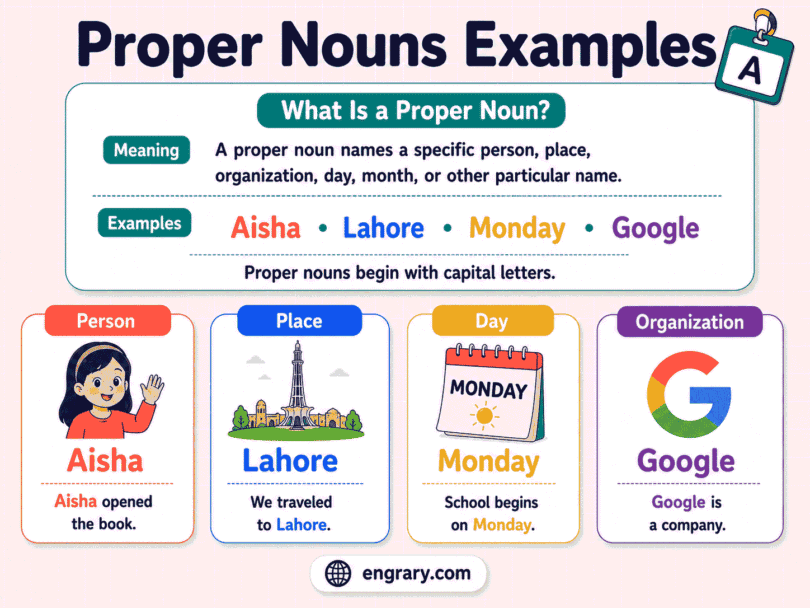
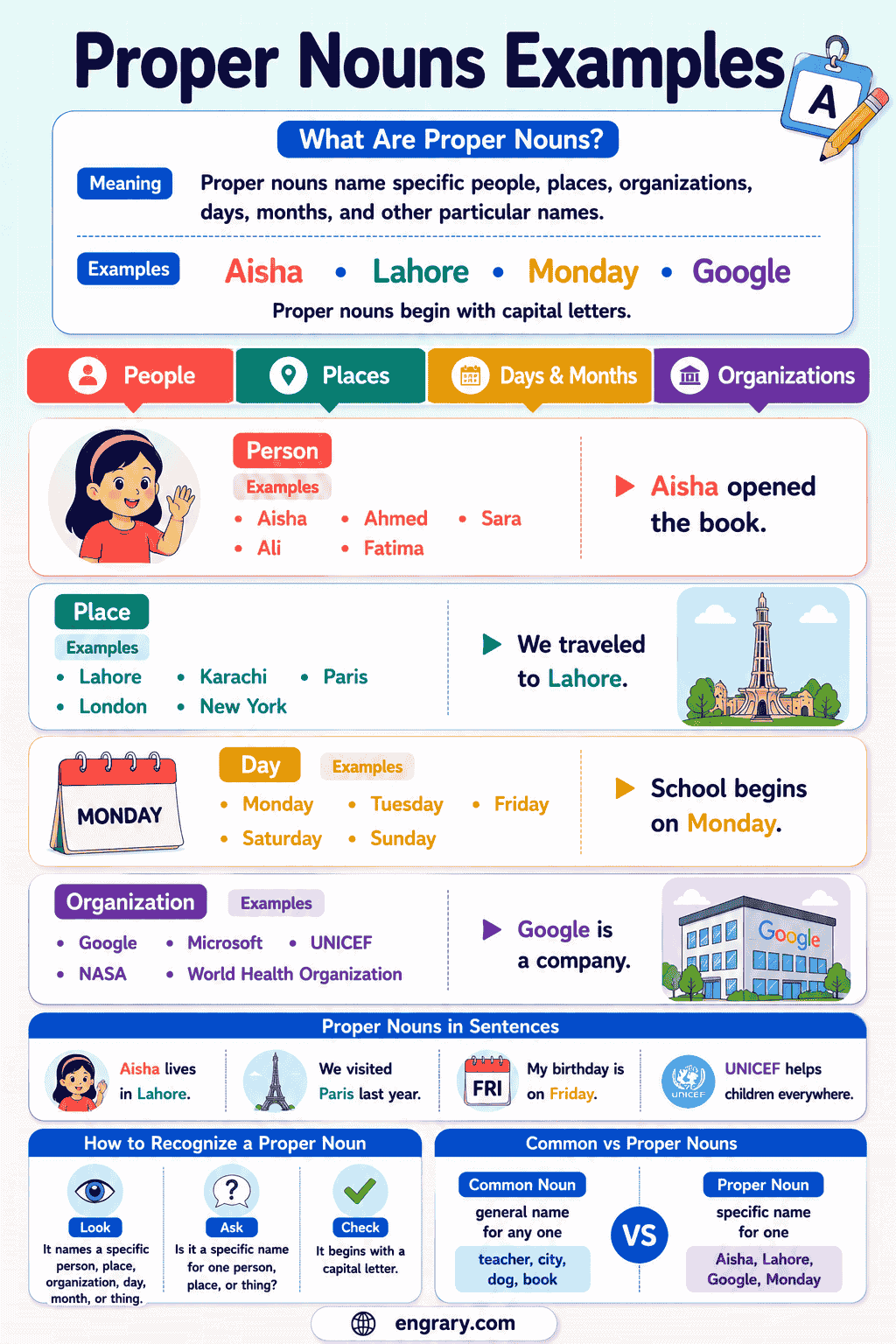
A proper noun gives the specific name of a particular person, place, organization, day, month, language, work, or other named thing.
Examples include:
- Emma
- Pakistan
- London
- Monday
- January
- English
- Mount Everest
A simple distinction is:
common noun → general name
proper noun → specific name
For example:
city → London
The word city gives a general name, while London identifies one particular city.
Similarly:
country → Pakistan
The word country is common because it can refer to any country. Pakistan is proper because it identifies one specific country.
Proper nouns normally begin with capital letters.
Easy Proper Noun Examples
The following examples show proper nouns from several familiar categories.
| Proper Noun | Category | General/Common Noun |
|---|---|---|
| Emma | person | person |
| Noah | person | person |
| Pakistan | country | country |
| Canada | country | country |
| London | city | city |
| Karachi | city | city |
| Mount Everest | mountain | mountain |
| Amazon River | river | river |
| Monday | day | day |
| Friday | day | day |
| January | month | month |
| December | month | month |
| Eid | holiday | holiday |
| Christmas | holiday | holiday |
| English | language | language |
| Urdu | language | language |
| company | company | |
| Microsoft | company | company |
| Oxford University | institution | university |
| United Nations | organization | organization |
Each example identifies one specific person, place, time name, language, institution, company, or organization.
Common Nouns and Proper Nouns
Common nouns and proper nouns differ mainly in how specific they are.
A common noun gives a general name.
A proper noun gives the exact name of a particular person, place, organization, or other named thing.
| Common Noun | Proper Noun |
|---|---|
| girl | Emma |
| boy | Noah |
| city | London |
| country | Pakistan |
| river | Amazon River |
| mountain | Mount Everest |
| school | Lincoln Elementary School |
| month | January |
| day | Monday |
| company | |
| university | Oxford University |
| organization | United Nations |
The girl opened the book.
The word girl can refer to any girl, so it is a common noun.
Emma opened the book.
Emma identifies one specific person, so it is a proper noun.
The river is very long.
Here, river gives a general name.
The Amazon River is very long.
Here, Amazon River identifies one particular river.
Common Types of Proper Nouns
Proper nouns can name many kinds of specific people, places, institutions, time periods, languages, and works.
Names of People
A person’s name is a proper noun because it identifies a specific individual.
Examples include:
- Emma
- Noah
- Ali
- Sara
- Albert Einstein
- William Shakespeare
Sara reads every evening.
Noah plays football after school.
Albert Einstein was a scientist.
Words such as girl, boy, student, scientist, and writer are common nouns. Names such as Sara, Noah, Albert Einstein, and William Shakespeare are proper nouns.
Countries and Cities
Names of specific countries and cities are proper nouns.
Examples include:
- Pakistan
- Canada
- Japan
- France
- London
- Karachi
- Paris
- Tokyo
We live in Pakistan.
Her family traveled to Canada.
She visited Paris during the summer.
The words country and city are common nouns because they name general categories. Pakistan, Canada, Paris, and Tokyo identify particular places.
Geographical Places and Landmarks
Specific rivers, mountains, parks, oceans, monuments, and landmarks also have proper names.
Examples include:
- Amazon River
- River Nile
- Mount Everest
- Central Park
- Pacific Ocean
- Taj Mahal
- Eiffel Tower
- Sahara Desert
Mount Everest is a famous mountain.
They visited the Taj Mahal.
The Amazon River flows through South America.
The Pacific Ocean covers a vast area.
Each name identifies one particular geographical place or landmark.
Days, Months, and Holidays
Names of days, months, and recognized holidays are proper nouns.
Examples include:
- Monday
- Friday
- Sunday
- January
- March
- December
- Eid
- Christmas
- Thanksgiving
School starts again on Monday.
My birthday is in March.
The family celebrated Eid together.
The words day, month, and holiday are common nouns. Their specific names are proper nouns.
Languages
Names of languages are proper nouns in English.
Examples include:
- English
- Urdu
- French
- Spanish
- Japanese
- Arabic
Mia speaks English.
Ali studies Urdu at school.
Noah is learning French.
Language names always begin with capital letters in English.
Schools, Companies, and Organizations
Specific schools, universities, companies, and organizations use proper names.
Examples include:
- Oxford University
- Harvard University
- Microsoft
- United Nations
- World Health Organization
Her brother studies at Oxford University.
Google is a company name.
The United Nations is an international organization.
A word such as university or company gives a general name, while Oxford University and Google give specific names.
Books, Movies, and Games
Titles of specific books, movies, and games function as proper names.
Examples include:
- Harry Potter
- The Lion King
- The Hunger Games
- Minecraft
Mia read Harry Potter.
The children watched The Lion King.
Noah played Minecraft after finishing his homework.
These titles identify particular works or games.
Proper Nouns in Sentences
Proper nouns appear naturally in everyday English. The bold words below identify specific people, places, days, months, languages, organizations, or other named things.
Emma
Emma reads every evening.
Pakistan
We live in Pakistan.
Karachi
Sara traveled to Karachi.
London
Her family visited London.
Monday
School begins on Monday.
January
The new course starts in January.
Mount Everest
Mount Everest is a famous mountain.
Amazon River
The Amazon River flows through South America.
English
Mia studies English at school.
Google
Noah searched for the information using Google.
Oxford University
Her brother studies at Oxford University.
Eid
The family celebrated Eid together.
Taj Mahal
They visited the Taj Mahal.
Microsoft
Microsoft develops computer software and services.
Friday
Our class has an activity on Friday.
These sentences show that proper nouns can appear as subjects, objects, place names, time names, and names within prepositional phrases.
Capital Letters With Proper Nouns
Proper nouns begin with capital letters because they identify specific names.
Incorrect:
emma
Correct:
Emma
Incorrect:
pakistan
Correct:
Pakistan
Incorrect:
monday
Correct:
Monday
Incorrect:
january
Correct:
January
Incorrect:
english
Correct:
English
The basic rule is:
Specific names begin with capital letters.
Compare:
The city is crowded.
London is crowded.
The first sentence uses a general noun. The second uses a specific city name.
Another comparison is:
We will meet on a day next week.
We will meet on Monday.
The word day is common, while Monday is proper.
Multiword Proper Nouns
A proper noun can contain more than one word.
Examples include:
- New York
- South Africa
- Mount Everest
- Oxford University
- United Nations
- Amazon River
- Central Park
- World Health Organization
They traveled to South Africa.
She studies at Oxford University.
The United Nations held a meeting.
Multiword proper nouns use capitalization according to the established form of the name.
Some proper names conventionally include the:
- the United States
- the United Nations
- the Himalayas
Many proper nouns do not use the:
- Emma
- Pakistan
- London
The article the is therefore not a general requirement for proper nouns.
Proper Nouns and Special Capitalization Cases
Some words can appear with either lowercase or capital letters depending on how they function in the sentence.
Family Words
Family words such as mom, dad, grandma, aunt, uncle, and grandpa may function either as general family-role nouns or as name-like words.
My mom is cooking.
Here, mom follows the possessive word my, so it names the family role generally.
I asked Mom for help.
Here, Mom replaces the person’s name, so it begins with a capital letter.
Compare:
my dad
I asked Dad.
my grandma
I called Grandma.
my aunt
I visited Aunt Maria.
The useful rule is:
Capitalize a family word when it functions like a person’s name.
Titles Before Names
Titles may also use capitals depending on their position and function.
The principal spoke to the class.
Here, principal gives a general job title.
Principal Hudson spoke to the class.
Here, Principal forms part of a specific name.
Similarly:
The president gave a speech.
President Lincoln gave a speech.
The distinction is:
general title → lowercase
title directly before a specific name → capitalized
Other examples include:
- Doctor Ahmed
- Professor Khan
- Captain Smith
- Queen Elizabeth II
Capitalization With Days, Months, Seasons, and Subjects
Some time words and school subjects follow different capitalization patterns.
Days and Months
Capitalize the names of days and months:
- Monday
- Tuesday
- Friday
- January
- April
- December
We will meet on Monday.
Her birthday is in December.
These are specific names, so they take capitals.
Seasons
Season names usually remain lowercase:
- spring
- summer
- autumn
- winter
I enjoy winter.
Flowers grow in spring.
However, capitalize a season when it forms part of an official proper name:
the Winter Olympics
Here, Winter belongs to the official name of the event.
School Subjects
General school subjects usually remain lowercase:
- history
- math
- science
- geography
Mia studies history and math.
However, language names use capitals:
- English
- Urdu
- French
- Spanish
Official course names also use capitalization according to their names:
- World History
- English Literature
This distinction helps prevent unnecessary capitalization.
Proper Nouns for People and Titles
Names can appear alone or with titles.
Examples:
- Sara
- Mr. Ahmed
- Dr. Khan
- Professor Smith
- Queen Elizabeth II
- President Lincoln
Dr. Khan spoke to the students.
Professor Smith taught the class.
Sara answered the question.
The person’s specific name remains proper whether or not a title appears before it.
Proper Nouns for Specific Places
A general place word becomes part of a proper noun when it belongs to the official name of a specific place.
Compare:
river → Amazon River
mountain → Mount Everest
park → Central Park
ocean → Pacific Ocean
desert → Sahara Desert
The students learned about the Sahara Desert.
They walked through Central Park.
The Pacific Ocean lies between several continents.
These examples show that a proper noun may contain a common geographical word such as river, mountain, park, ocean, or desert as part of its full name.
Proper Nouns for Institutions and Groups
Proper nouns also name specific schools, universities, companies, teams, agencies, and organizations.
Examples include:
- Oxford University
- Microsoft
- United Nations
- World Health Organization
A university is a general type of institution.
Oxford University identifies one specific university.
A company is a general category.
Microsoft identifies a specific company.
An organization is a common noun.
United Nations identifies a particular organization.
This general-to-specific relationship helps explain why these names count as proper nouns.
Proper Nouns for Time and Events
Specific names for days, months, holidays, festivals, and named events also function as proper nouns.
Examples include:
- Monday
- January
- Eid
- Christmas
- Thanksgiving
- Winter Olympics
The event begins on Monday.
Classes start in January.
The family celebrated Christmas.
Athletes competed in the Winter Olympics.
The exact event or time name requires capitalization.
Proper Nouns for Languages
Language names provide another clear set of proper noun examples.
Examples include:
- English
- Urdu
- Arabic
- French
- Spanish
- Japanese
She reads books in English.
He speaks Urdu at home.
Mia studies Japanese.
Do not confuse a language name with a general school subject such as history or science. Language names are capitalized.
Proper Nouns in Questions
Proper nouns can appear in questions just as they appear in statements.
Does Sara live in Karachi?
Are you visiting London this summer?
Does the class meet on Friday?
Do you speak English?
Have you visited the Taj Mahal?
The capitalization rule remains the same regardless of sentence type.
Proper Nouns in Negative Sentences
Proper nouns also retain capitalization in negative sentences.
Emma does not live in London.
We are not traveling to Canada this year.
The meeting is not on Monday.
Noah does not study French.
She does not work for Microsoft.
Sentence structure does not change the status of a proper noun.
Common Proper Noun Mistakes
Proper noun mistakes usually involve missing capital letters or adding capitals to general words unnecessarily.
| Mistake | Correct Form | Why? |
|---|---|---|
| london | London | It names a specific city. |
| monday | Monday | It names a specific day. |
| january | January | It names a specific month. |
| english | English | Language names use capitals. |
| my Mom | my mom | The family role follows a possessive word. |
| principal Hudson | Principal Hudson | The title directly precedes a name. |
| Winter | winter | A season name is usually common. |
| History | history | A general school subject is usually lowercase. |
| mount everest | Mount Everest | It is a specific geographical name. |
| united nations | United Nations | It is the name of a specific organization. |
Another common mistake is capitalizing every important-looking noun.
Incorrect:
The Teacher entered the Classroom.
Correct:
The teacher entered the classroom.
Neither word gives a specific name in that sentence.
By contrast:
Ms. Green entered Room 12.
Here, the words identify specific names or labels.
How to Recognize a Proper Noun in Examples
A simple way to identify a proper noun is to ask whether the noun gives a general category or an exact name.
Consider:
teacher
This word can refer to any teacher, so it is common.
Ms. Green
This name identifies one particular teacher, so it is proper.
Another example:
city
This word gives a general category.
Karachi
This word identifies one specific city.
You can use the same comparison with many examples:
- country → Pakistan
- day → Monday
- month → January
- language → English
- company → Google
- mountain → Mount Everest
- university → Oxford University
Capitalization then confirms the specific name in standard English writing.
Proper Nouns and Common Nouns in the Same Sentence
A sentence can contain both common and proper nouns.
Sara carried a book.
Sara is proper because it names one person.
Book is common because it names a general object.
Another example:
The students visited Central Park.
Students is common.
Central Park is proper.
The teacher works at Oxford University.
Teacher is common.
Oxford University is proper.
These examples make the general-versus-specific distinction easier to see in context.
Why Proper Nouns Need Capitalization
Capitalization marks a word as a specific name.
Compare:
The school is large.
Oxford University is large.
The first sentence uses a general institution word. The second names a specific institution.
Similarly:
The river crosses the region.
The Amazon River crosses the region.
The capital letters help readers recognize the proper name immediately.
However, capitalization alone does not make a word proper. The word must actually function as a specific name.
For example:
Winter is not normally correct simply because it begins with a capital. The standard general season name is winter.
FAQs
Common examples include Emma, Pakistan, London, Monday, January, Eid, English, Google, Mount Everest, Amazon River, and Oxford University.
A common noun gives a general name, while a proper noun gives a specific name. For example, city is common, while London is proper.
English uses capital letters to mark specific names. Therefore, names such as Sara, Pakistan, Monday, January, and Google begin with capitals.
Yes. Names such as Monday, January, Eid, and Christmas are proper nouns and begin with capital letters. Seasons such as winter and summer usually remain lowercase.
They can function like proper names in certain contexts. Mom takes a capital when it replaces a person’s name, while Principal Hudson uses a capitalized title because the title directly precedes a specific name.
You May Also Like