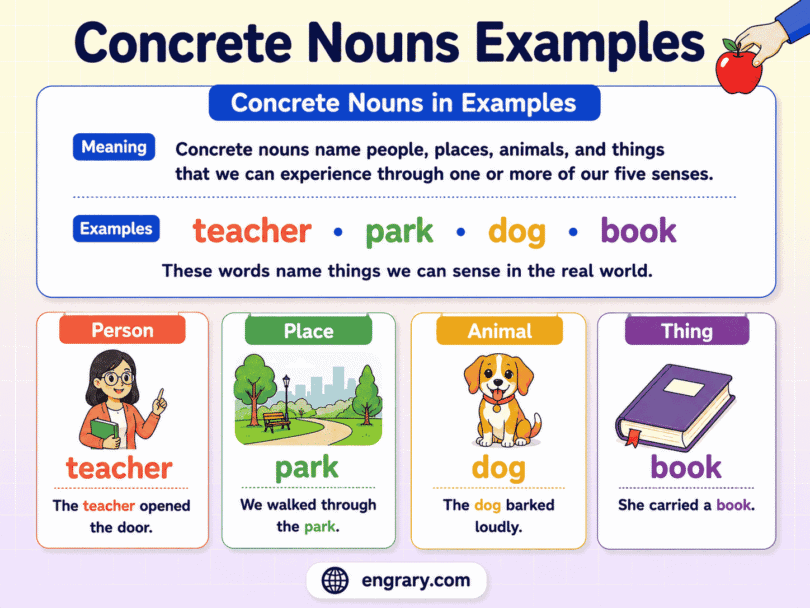
Concrete nouns help children name the people, animals, places, objects, foods, sounds, and substances they experience in everyday life. Learning these nouns makes it easier to understand how English describes things that connect with the five senses.
You’ll see easy concrete noun examples with meanings, sensory groups, categories, and sentences. You’ll also compare concrete and abstract nouns, learn how concrete nouns overlap with other noun types, review common mistakes, and practice using them correctly.
What Is a Concrete Noun?
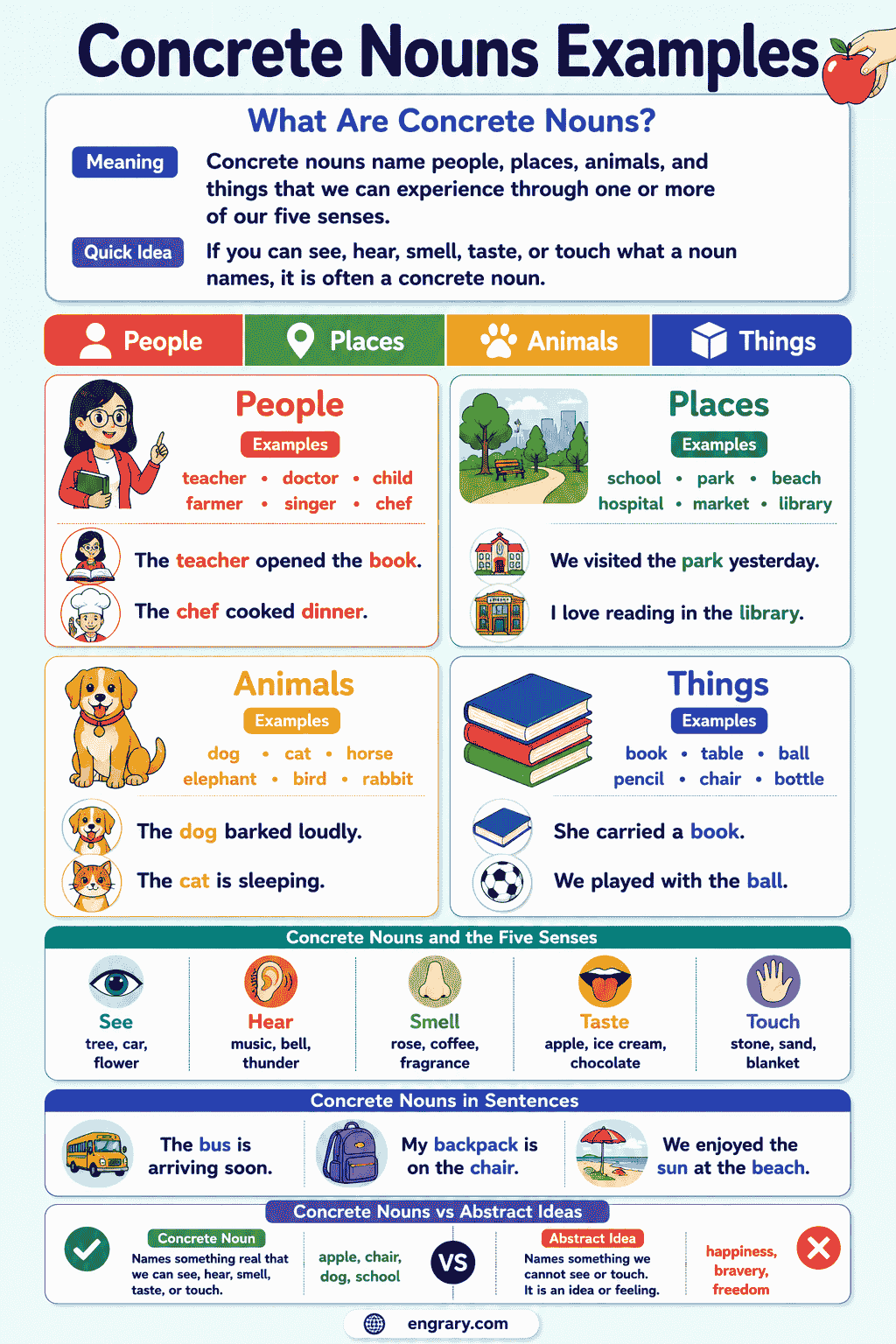
A concrete noun names something that we can experience through at least one of the five senses: sight, hearing, smell, taste, or touch.
Common examples include:
- teacher
- dog
- apple
- bell
- perfume
- music
- rain
- sand
- air
- book
The dog slept beside the door.
We can see, hear, and touch a dog, so dog is a concrete noun.
We heard the bell ring.
Hearing allows us to experience the bell, so bell is also a concrete noun.
A useful rule is:
If we can experience what a noun names through at least one physical sense, the noun is concrete.
Easy Concrete Noun Examples
The following examples include people, animals, plants, places, objects, foods, sounds, weather, and substances.
| Concrete Noun | Category | Main Sense |
|---|---|---|
| teacher | person | sight, hearing |
| child | person | sight, hearing |
| dog | animal | sight, hearing, touch |
| cat | animal | sight, hearing, touch |
| tree | plant | sight, touch |
| flower | plant | sight, smell |
| school | place | sight |
| park | place | sight |
| chair | object | sight, touch |
| book | object | sight, touch |
| apple | food | taste, sight, touch |
| bread | food | smell, taste |
| milk | drink | taste |
| bell | object | hearing |
| music | sound | hearing |
| perfume | substance | smell |
| rain | weather | sight, hearing, touch |
| sand | substance | touch, sight |
| air | substance | physical sensation |
| smoke | substance | sight, smell |
These examples show that concrete nouns do not only name solid objects. Sounds, weather, liquids, smells, and other physically perceivable things can also function as concrete nouns.
Common Concrete Nouns With Meanings
Selected examples become easier to remember when children understand what each noun names and which sense helps identify it.
Teacher
A teacher is a person who helps students learn. We can see and hear a teacher, so teacher is a concrete noun.
Apple
An apple is a physical fruit that we can see, touch, smell, and taste. Therefore, apple is a concrete noun.
Bell
A bell is an object that produces a ringing sound. We can see the bell and hear its sound, so bell is concrete.
Perfume
Perfume is a scented liquid that we can smell. Since smell is one of the five senses, perfume functions as a concrete noun.
Music
Music consists of sounds that we can hear. Although we cannot hold music in our hands, hearing allows us to experience it through a physical sense.
Sand
Sand consists of tiny grains of rock. We can see and feel sand, so the noun is concrete.
Rain
Rain consists of drops of water that fall from clouds. We can see, hear, and feel rain.
Air
Air is the mixture of gases around us. We may not see it, but we can feel moving air, so it counts as concrete.
Bread
Bread is a physical food that we can see, smell, touch, and taste. The noun bread is concrete even though it is usually uncountable.
Library
A library is a physical place where people read, study, or borrow books. We can visit and see a library.
Rabbit
A rabbit is an animal that we can see, hear, and touch. Therefore, rabbit is a concrete noun.
Stone
A stone is a hard piece of rock that we can see and touch. The word stone clearly names a physical object.
Concrete Nouns and the Five Senses
The five senses provide a useful way to recognize concrete nouns. However, one noun may connect with several senses, so the groups below show one clear sensory connection rather than an exclusive classification.
Things We Can See
Sight helps us identify many concrete nouns.
Examples include:
- rainbow
- mountain
- eagle
- river
- clock
A rainbow appeared after the storm.
We can see a rainbow, so rainbow is a concrete noun.
The eagle flew above the trees.
An eagle is a physical animal that we can see.
Things We Can Hear
Some concrete nouns connect strongly with hearing.
Examples include:
- bell
- thunder
- music
- song
- noise
We heard loud thunder during the storm.
Although thunder is not an object we can hold, we can hear it.
The music became louder.
Hearing gives us direct sensory experience of music.
Things We Can Smell
Smell can also help identify concrete nouns.
Examples include:
- perfume
- smoke
- coffee
- rose
- bread
The perfume smelled sweet.
Fresh coffee filled the kitchen with a strong smell.
Both nouns name physical substances we can experience through smell.
Things We Can Taste
Taste helps us identify many foods and drinks.
Examples include:
- lemon
- chocolate
- soup
- honey
- milk
Mia tasted the lemon.
Noah ate some chocolate.
Both nouns name physical substances that we can taste.
Things We Can Touch or Feel
Touch helps us identify objects, materials, and substances.
Examples include:
- blanket
- stone
- sand
- water
- chair
The blanket felt soft.
Warm sand covered the beach.
We can physically feel both nouns, so they are concrete.
Common Types of Concrete Nouns
Concrete nouns can also be grouped according to what they name. These categories show how broad concrete nouns can be.
People
Names for people often function as concrete nouns because people have physical existence.
Examples include:
- doctor
- teacher
- child
- farmer
- firefighter
- student
- baker
- singer
The doctor entered the room.
A farmer worked in the field.
Animals and Plants
Animals and plants provide many familiar concrete noun examples.
Examples include:
- rabbit
- elephant
- frog
- butterfly
- eagle
- tree
- rose
- sunflower
- cactus
- grass
A rabbit sat near the fence.
The sunflower grew beside the path.
Places
Physical locations can also function as concrete nouns.
Examples include:
- school
- park
- beach
- library
- river
- mountain
- kitchen
- garden
The children walked along the beach.
The library closes in the evening.
A place does not need to be movable to be concrete. Physical existence is enough.
Objects
Objects provide some of the easiest concrete noun examples.
Examples include:
- pencil
- phone
- backpack
- spoon
- bottle
- suitcase
- clock
- lamp
Mia sharpened her pencil.
Noah carried a suitcase.
Food and Drinks
Foods and drinks often connect with several senses.
Examples include:
- orange
- bread
- chocolate
- soup
- milk
- juice
- honey
- lemon
Noah ate an orange after lunch.
The bread smelled fresh.
Sounds, Weather, and Substances
Some concrete nouns name physical phenomena or substances rather than ordinary objects.
Examples include:
- music
- thunder
- rain
- snow
- smoke
- air
- wind
- water
The snow covered the ground.
Cool air entered through the window.
We heard loud music outside.
These examples show why concrete nouns should not be defined only as touchable objects.
Concrete Nouns in Sentences
Concrete nouns appear naturally in everyday English. The bold words below name things that we can experience through one or more senses.
Horse
The horse ran across the field.
Doctor
The doctor spoke to the family.
Orange
Mia ate an orange after lunch.
Clock
The clock hung above the door.
Coffee
Fresh coffee smelled strong.
Thunder
Loud thunder shook the windows.
Snow
The snow covered the road.
Eagle
An eagle flew above the trees.
Popcorn
The popcorn smelled delicious.
Stone
The stone felt cold.
Wind
Strong wind moved the branches.
Library
The children visited the library.
Pencil
Noah placed the pencil on the desk.
Juice
Mia drank juice with breakfast.
Rose
The rose had a pleasant smell.
Concrete Nouns vs. Abstract Nouns
Concrete and abstract nouns differ in what they name.
A concrete noun names something we can physically perceive.
An abstract noun names a quality, feeling, state, idea, or relationship.
The pairs below are comparison examples, not exact opposites.
| Concrete Noun | Abstract Noun |
|---|---|
| friend | friendship |
| child | childhood |
| flower | beauty |
| soldier | courage |
| smile | happiness |
| person | honesty |
The friend arrived early.
Friend names a physical person, so it is concrete.
Their friendship lasted for years.
Friendship names a relationship, so it is abstract.
The flower grew beside the wall.
We can see and touch a flower.
Its beauty attracted attention.
Beauty names a quality rather than a physical object.
The soldier entered the room.
Soldier names a person.
The soldier showed courage.
Courage names a quality.
A smile is something we can see, while happiness names an internal feeling.
The key distinction is:
concrete noun → physically perceivable
abstract noun → quality, feeling, state, idea, or relationship
Common and Proper Concrete Nouns
A noun can belong to more than one category at the same time.
| Noun | Common or Proper? | Concrete? |
|---|---|---|
| teacher | common | yes |
| dog | common | yes |
| school | common | yes |
| London | proper | yes |
| Mount Everest | proper | yes |
| River Nile | proper | yes |
Teacher is both a common noun and a concrete noun.
London is both a proper noun and a concrete noun.
These labels describe different features:
concrete tells us that the noun refers to something physically perceivable.
common or proper tells us whether the noun gives a general or specific name.
Countable and Uncountable Concrete Nouns
Concrete nouns can be countable or uncountable.
| Countable Concrete Nouns | Uncountable Concrete Nouns |
|---|---|
| chair | water |
| apple | sand |
| dog | air |
| bottle | rice |
| pencil | smoke |
A chair is countable because we can say one chair, two chairs, or three chairs.
Water is concrete because it is a physical substance, but it is usually uncountable.
Therefore:
concrete → whether the noun refers to something physically perceivable
countable or uncountable → how English expresses number or quantity
Material Nouns That Are Also Concrete
Many material nouns also function as concrete nouns because materials name physical substances.
Examples include:
- wood
- gold
- cotton
- glass
- water
- steel
| Noun | Material Noun? | Concrete Noun? |
|---|---|---|
| wood | yes | yes |
| gold | yes | yes |
| cotton | yes | yes |
| glass | yes | yes |
| water | yes | yes |
| steel | yes | yes |
The table is made of wood.
Wood is a material noun because it names a substance. It is also a concrete noun because it refers to physical matter.
The bottle is made of glass.
Again, glass names a material that we can physically perceive.
The two labels describe different features:
material noun → names a substance or material
concrete noun → names something physically perceivable
Common Concrete Noun Mistakes
Some common misconceptions can make concrete nouns confusing.
| Mistake | Better Explanation |
|---|---|
| Concrete nouns must be touchable. | Any physical sense can help identify a concrete noun. |
| Music is abstract because we cannot touch it. | Music is concrete under the sensory test because we can hear it. |
| Concrete nouns are always countable. | Water, sand, air, and smoke are concrete but usually uncountable. |
| Proper nouns cannot be concrete. | London and Mount Everest can be both proper and concrete. |
| Material nouns cannot be concrete. | Wood, gold, and water can belong to both categories. |
| Beauty is concrete because beautiful things can be seen. | Beauty names an abstract quality. |
The safest approach is to focus on what the noun itself names rather than on a related person, object, feeling, or quality.
Concrete Noun Practice
Complete the activities before checking the answer key.
Find the Concrete Noun
Find the concrete noun or nouns in each sentence.
- The rabbit slept near the door.
- We heard the bell.
- Mia ate an orange.
- The perfume smelled sweet.
- Cool air entered through the window.
- The children visited the library.
- The music became louder.
- A rainbow appeared after the rain.
Match Concrete Nouns With the Senses
Match each noun with the main sense that helps identify it.
- bell
- perfume
- lemon
- rainbow
- blanket
Choose from:
- sight
- hearing
- smell
- taste
- touch
Match Concrete Nouns With Their Meanings
Match each noun with its meaning.
Sand
Tiny grains of rock.
Perfume
A scented liquid.
Library
A place where people read, study, or borrow books.
Rabbit
A small animal with long ears.
Bell
An object that makes a ringing sound.
Concrete or Abstract?
Classify each noun as concrete or abstract.
- friend
- friendship
- flower
- beauty
- child
- childhood
- soldier
- courage
Identify All Suitable Noun Types
Choose all suitable labels from:
- common
- proper
- concrete
- countable
- uncountable
teacher
London
apple
water
dog
Mount Everest
Write Sentences With Concrete Nouns
Write:
- one sentence using a person;
- one sentence using an animal;
- one sentence using a place;
- one sentence using an object;
- one sentence using a sensory example.
Answer Key
Find the Concrete Noun
- rabbit and door
- bell
- orange
- perfume
- air and window
- children and library
- music
- rainbow and rain
Match Concrete Nouns With the Senses
- bell — hearing
- perfume — smell
- lemon — taste
- rainbow — sight
- blanket — touch
Match Concrete Nouns With Their Meanings
- sand — tiny grains of rock
- perfume — a scented liquid
- library — a place where people read, study, or borrow books
- rabbit — a small animal with long ears
- bell — an object that makes a ringing sound
Concrete or Abstract?
- friend — concrete
- friendship — abstract
- flower — concrete
- beauty — abstract
- child — concrete
- childhood — abstract
- soldier — concrete
- courage — abstract
Identify All Suitable Noun Types
teacher
- common
- concrete
- countable
London
- proper
- concrete
apple
- common
- concrete
- countable
water
- common
- concrete
- uncountable
dog
- common
- concrete
- countable
Mount Everest
- proper
- concrete
Write Sentences With Concrete Nouns
Answers will vary. Possible answers include:
The doctor entered the room.
The rabbit sat under the tree.
We visited the library.
Mia opened the suitcase.
We heard the thunder.
FAQs
Common examples include teacher, dog, rabbit, tree, library, chair, apple, bell, perfume, music, rain, sand, air, and water.
Yes. Under the five-senses approach, nouns such as music and thunder can be concrete because we hear them, while perfume and smoke can be concrete because we smell them.
A concrete noun names something physically perceivable, while an abstract noun names a quality, feeling, state, idea, or relationship. For example, friend is concrete, while friendship is abstract.
Yes. Chair and apple are countable concrete nouns, while water, sand, air, and smoke are usually uncountable concrete nouns.
Yes. Noun categories can overlap. Teacher is common and concrete, London is proper and concrete, and wood is both material and concrete.
You May Also Like