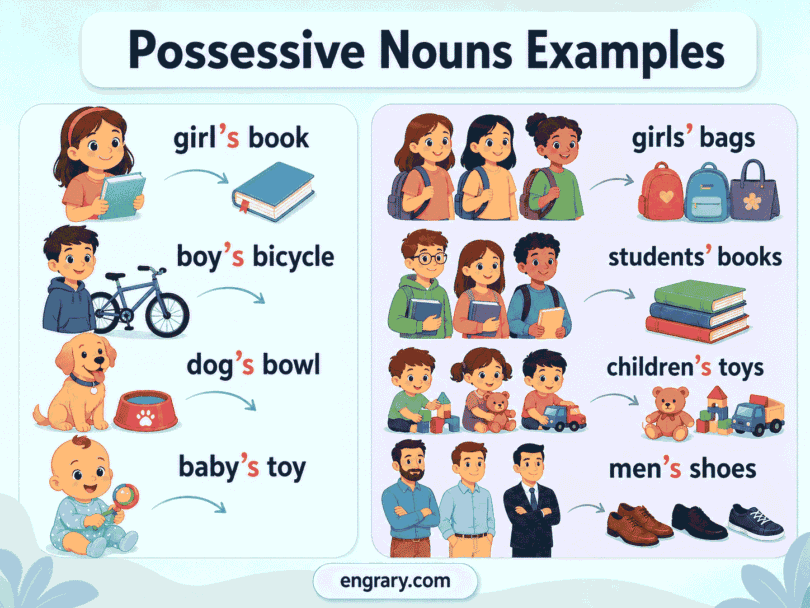
Possessive nouns help children show ownership, relationships, parts, time, and other connections between people, animals, places, and things. Learning possessive forms also improves apostrophe use because girl’s, girls’, and children’s follow different patterns.
You’ll see exactly 100 possessive noun examples, along with singular, plural, and irregular plural possessives. You’ll also learn how possessive nouns work in sentences, how names ending in s form possessives, how shared and separate possession differ, and which common apostrophe mistakes to avoid.
What Is a Possessive Noun?
A possessive noun shows that a person, animal, place, object, or idea has a relationship or connection with something else.
For example:
girl → girl’s bag
dog → dog’s collar
parents → parents’ car
children → children’s toys
The possessive form usually appears before another noun.
teacher’s desk
Here, teacher’s is the possessive noun, while desk names the related object.
Possessive nouns do not always express literal ownership. They can also indicate:
- relationships;
- parts or features;
- association;
- time;
- shared or separate possession.
For example, Sara’s brother expresses a family relationship, while today’s lesson expresses a connection with time.
Possessive Noun Examples
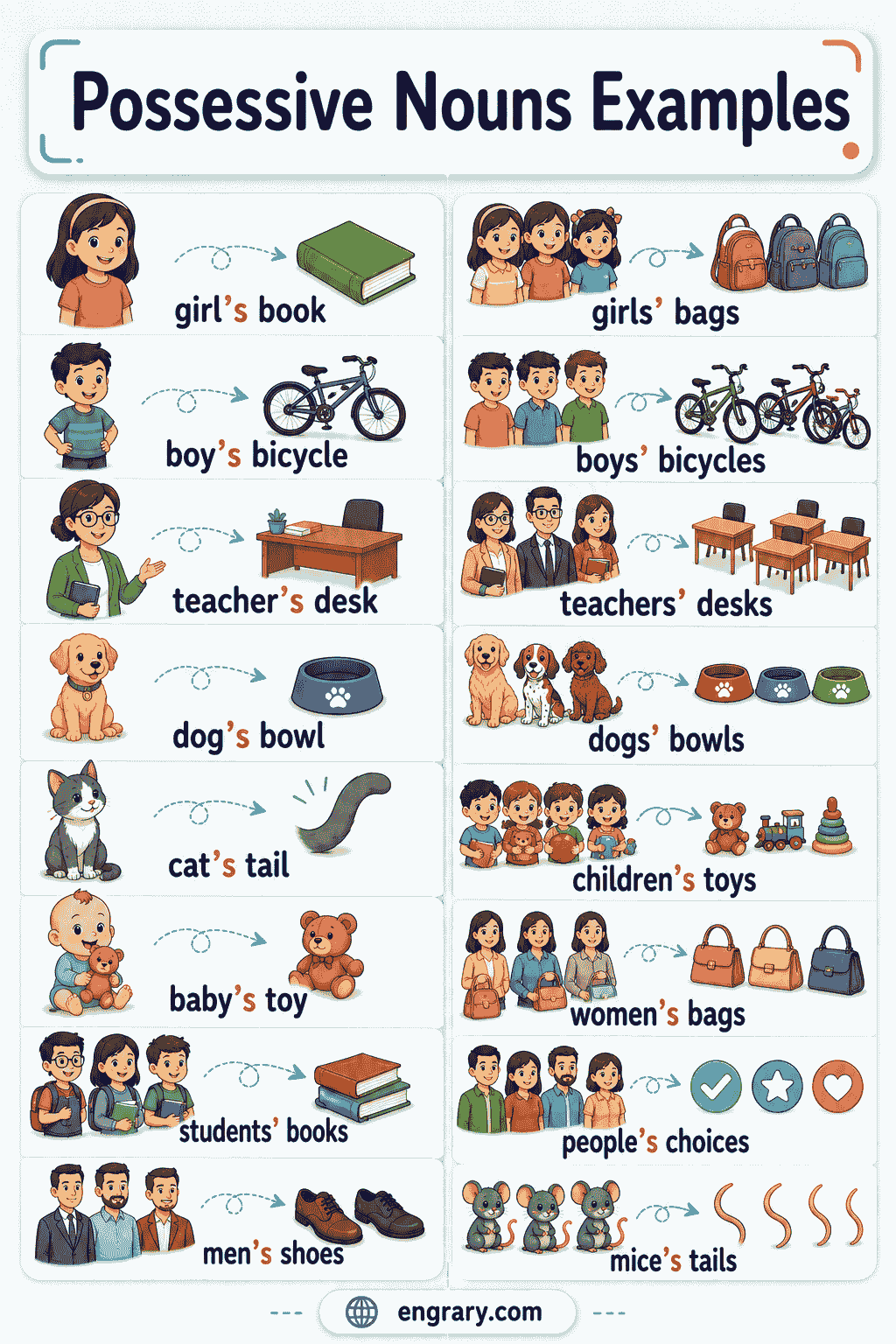
The following table contains exactly 100 possessive noun examples. It includes singular possessives, regular plural possessives, irregular plural possessives, names, time expressions, and shared or separate possession.
| Noun or Base Form | Possessive Example |
|---|---|
| girl | girl’s bag |
| boy | boy’s bicycle |
| teacher | teacher’s desk |
| doctor | doctor’s office |
| dog | dog’s collar |
| cat | cat’s bowl |
| mother | mother’s phone |
| father | father’s car |
| student | student’s book |
| friend | friend’s house |
| baby | baby’s blanket |
| child | child’s toy |
| brother | brother’s jacket |
| sister | sister’s shoes |
| uncle | uncle’s garden |
| aunt | aunt’s kitchen |
| cousin | cousin’s camera |
| farmer | farmer’s field |
| driver | driver’s seat |
| chef | chef’s knife |
| pilot | pilot’s uniform |
| nurse | nurse’s station |
| artist | artist’s painting |
| writer | writer’s notebook |
| singer | singer’s microphone |
| player | player’s jersey |
| coach | coach’s whistle |
| manager | manager’s office |
| neighbor | neighbor’s dog |
| customer | customer’s order |
| school | school’s library |
| company | company’s office |
| team | team’s captain |
| club | club’s president |
| family | family’s home |
| city | city’s park |
| country | country’s capital |
| village | village’s market |
| house | house’s roof |
| car | car’s wheels |
| book | book’s cover |
| table | table’s leg |
| chair | chair’s back |
| clock | clock’s hands |
| phone | phone’s screen |
| computer | computer’s keyboard |
| camera | camera’s lens |
| bottle | bottle’s cap |
| door | door’s handle |
| tree | tree’s branches |
| flower | flower’s petals |
| bird | bird’s wings |
| lion | lion’s mane |
| horse | horse’s saddle |
| rabbit | rabbit’s ears |
| elephant | elephant’s trunk |
| monkey | monkey’s tail |
| fox | fox’s den |
| bee | bee’s hive |
| spider | spider’s web |
| boys | boys’ room |
| girls | girls’ bags |
| teachers | teachers’ meeting |
| parents | parents’ car |
| students | students’ books |
| players | players’ uniforms |
| workers | workers’ tools |
| doctors | doctors’ lounge |
| dogs | dogs’ bowls |
| cats | cats’ beds |
| friends | friends’ plans |
| farmers | farmers’ fields |
| drivers | drivers’ licenses |
| artists | artists’ work |
| neighbors | neighbors’ gardens |
| children | children’s toys |
| men | men’s shoes |
| women | women’s bags |
| people | people’s opinions |
| mice | mice’s nests |
| geese | geese’s feathers |
| James | James’s book |
| Chris | Chris’s bicycle |
| Lucas | Lucas’s bag |
| Charles | Charles’s office |
| Jess | Jess’s notebook |
| boss | boss’s desk |
| class | class’s project |
| today | today’s lesson |
| tomorrow | tomorrow’s meeting |
| week | week’s schedule |
| day | day’s work |
| month | month’s report |
| year | year’s results |
| Sam and Emma | Sam and Emma’s house |
| Mia and Noah | Mia and Noah’s project |
| Sam and Emma | Sam’s and Emma’s bags |
| Mia and Noah | Mia’s and Noah’s books |
| school principal | school principal’s office |
| company director | company director’s decision |
These examples show that apostrophe placement depends mainly on whether the possessive noun is singular, a regular plural ending in s, or an irregular plural.
Singular Possessive Noun Examples
Most singular nouns form the possessive by adding ’s.
The basic pattern is:
singular noun + ’s
| Singular Noun | Possessive Form | Example Phrase |
|---|---|---|
| girl | girl’s | girl’s bag |
| teacher | teacher’s | teacher’s desk |
| dog | dog’s | dog’s collar |
| student | student’s | student’s book |
| mother | mother’s | mother’s phone |
| doctor | doctor’s | doctor’s office |
| child | child’s | child’s toy |
| friend | friend’s | friend’s house |
For example:
The girl’s bag is blue.
The teacher’s desk is near the window.
The dog’s collar is red.
The student’s book is on the table.
The apostrophe comes before the s because each possessive refers to one singular noun.
Plural Possessive Noun Examples
Regular plural nouns that already end in s usually form the possessive by adding only an apostrophe after the final s.
The pattern is:
plural noun ending in s + apostrophe
| Plural Noun | Possessive Form | Example Phrase |
|---|---|---|
| boys | boys’ | boys’ room |
| girls | girls’ | girls’ bags |
| teachers | teachers’ | teachers’ meeting |
| parents | parents’ | parents’ car |
| students | students’ | students’ books |
| workers | workers’ | workers’ tools |
| dogs | dogs’ | dogs’ bowls |
| doctors | doctors’ | doctors’ lounge |
For example:
The boys’ room is upstairs.
The teachers’ meeting begins at noon.
The parents’ car is outside.
The students’ books are on the shelf.
Because these nouns already contain the plural s, another s is not normally added.
Irregular Plural Possessive Examples
Irregular plural nouns such as children, men, women, people, mice, and geese do not end in the regular plural s.
They usually form the possessive by adding ’s.
| Irregular Plural | Possessive Form | Example Phrase |
|---|---|---|
| children | children’s | children’s toys |
| men | men’s | men’s shoes |
| women | women’s | women’s bags |
| people | people’s | people’s opinions |
| mice | mice’s | mice’s nests |
| geese | geese’s | geese’s feathers |
For example:
The children’s toys are on the floor.
The men’s jackets are near the door.
The women’s bags are on the table.
The people’s opinions were different.
A common error is:
childrens’ toys
The correct form is:
children’s toys
Because children does not end in s, the possessive takes ’s.
Singular and Plural Possessive Nouns
Singular and plural possessives can look very similar, but their apostrophe placement changes the meaning.
| Singular Possessive | Plural Possessive |
|---|---|
| dog’s bowl | dogs’ bowls |
| girl’s room | girls’ room |
| teacher’s desk | teachers’ desks |
| student’s book | students’ books |
| parent’s car | parents’ car |
Compare:
dog’s bowl
This refers to a bowl connected with one dog.
dogs’ bowls
This refers to bowls connected with more than one dog.
Another useful comparison is:
| Form | Meaning |
|---|---|
| girl | one girl |
| girls | more than one girl |
| girl’s | belonging or relating to one girl |
| girls’ | belonging or relating to more than one girl |
The apostrophe therefore helps distinguish a simple plural from a possessive form.
Possessive Nouns in Sentences
Possessive nouns appear naturally in everyday speech and writing.
The girl’s backpack is on the chair.
The teacher’s desk is near the window.
The dog’s bone is in the garden.
The cat’s bowl is empty.
The parents’ meeting begins at six.
The children’s books are on the shelf.
The men’s jackets are hanging near the door.
The women’s bags are on the table.
The school’s library closes at four.
The company’s office moved downtown.
The bird’s wings were wet.
The book’s cover is torn.
The mother’s phone is on the desk.
The students’ projects are on display.
The people’s opinions were different.
These sentences include singular possessives, regular plural possessives, and irregular plural possessives.
Possessives Showing Relationships and Parts
Possessive nouns can express relationships even when no one literally owns anything.
Relationships
Examples include:
- Sara’s brother
- Emma’s teacher
- Noah’s friend
- the baby’s mother
- the teacher’s student
For example:
Sara’s brother plays football.
Emma’s teacher explained the lesson.
The possessive connects one person with another.
Parts and Features
Possessive nouns can also show parts or features.
Examples include:
- dog’s tail
- bird’s wings
- lion’s mane
- book’s cover
- car’s wheels
- house’s roof
- tree’s branches
For example:
The dog’s tail moved quickly.
The bird’s wings were wet.
The book’s cover is blue.
The car’s wheels are dirty.
These phrases describe a part or feature related to another noun.
Possessive Nouns With Time Expressions
Time words can also take possessive forms.
Examples include:
- today’s lesson
- tomorrow’s meeting
- day’s work
- week’s schedule
- month’s report
- year’s results
For example:
Today’s lesson begins at nine.
Tomorrow’s meeting has been moved.
We completed a day’s work.
The possessive form connects an event, amount, or activity with a period of time.
Possessive Names Ending in S
Singular names ending in s can also take possessive endings.
Common examples include:
- James’s book
- Chris’s bicycle
- Lucas’s bag
- Charles’s office
- Jess’s notebook
For example:
James’s book is on the desk.
Chris’s bicycle is outside.
Lucas’s bag is under the chair.
Many modern style guides use ’s after a singular name ending in s.
Some styles also allow forms such as:
James’ book
The preferred form can depend on the required writing style. For general learning, adding ’s to a singular name provides a clear and widely accepted pattern.
Joint and Separate Possession
Possessive nouns can show whether two people share something or have separate things.
Shared Possession
When two people share the same thing, add ’s only to the final name.
Sam and Emma’s house
This means Sam and Emma share one house.
Mia and Noah’s project
This means Mia and Noah share one project.
Separate Possession
When each person has a separate item, make both names possessive.
Sam’s and Emma’s bags
This means Sam has a bag and Emma has a separate bag.
Mia’s and Noah’s books
This means Mia and Noah have separate books.
| Meaning | Form |
|---|---|
| shared house | Sam and Emma’s house |
| separate bags | Sam’s and Emma’s bags |
| shared project | Mia and Noah’s project |
| separate books | Mia’s and Noah’s books |
Apostrophe placement therefore helps clarify whether possession is shared or separate.
Possessive Noun vs. Contraction
The ending ’s does not always mark possession. It can also shorten is or has.
Compare:
The cat’s bowl is empty.
Here, cat’s is possessive.
The cat’s sleeping.
Here, cat’s means cat is.
Another comparison:
Sara’s book is new.
Here, Sara’s shows possession.
Sara’s reading now.
Here, Sara’s means Sara is.
A useful test is:
Can ’s be expanded to is or has?
If yes, the form is a contraction.
For example:
Tom’s finished his work.
means:
Tom has finished his work.
However:
Tom’s homework is complete.
uses a possessive noun.
Common Possessive Noun Mistakes
Possessive noun mistakes often involve missing apostrophes, incorrect apostrophe placement, or confusion between plurals and possessives.
| Incorrect | Correct | Explanation |
|---|---|---|
| girls bag | girl’s bag | one girl takes ’s |
| boys room | boys’ room | plural ending in s takes an apostrophe |
| childrens’ toys | children’s toys | irregular plural takes ’s |
| parents house | parents’ house | plural possessive needs an apostrophe |
| dogs bone | dog’s bone | one dog takes ’s |
| teachers desk | teacher’s desk | one teacher takes ’s |
| students books | students’ books | plural possessive needs an apostrophe |
| womens’ bags | women’s bags | women does not end in s |
One of the most important comparisons is:
girls
This simply means more than one girl.
girl’s
This shows possession or another relationship involving one girl.
girls’
This shows possession or another relationship involving more than one girl.
Compare the sentences:
The girls are playing.
The girl’s bag is blue.
The girls’ bags are blue.
Another important distinction involves irregular plurals:
Incorrect:
womens’ bags
Correct:
women’s bags
The plural women does not end in s, so the possessive takes ’s.
FAQs
Common examples include girl’s bag, teacher’s desk, dog’s collar, boys’ room, parents’ car, children’s toys, men’s shoes, and women’s bags.
Add ’s to most singular nouns. For example, girl → girl’s, teacher → teacher’s, and dog → dog’s.
If a regular plural already ends in s, add only an apostrophe, as in boys → boys’ and teachers → teachers’. Irregular plurals that do not end in s usually take ’s, as in children → children’s.
Girl’s shows possession by one girl, while girls’ shows possession by more than one girl. For example, the girl’s bag belongs to one girl, while the girls’ bags relate to several girls.
A common modern pattern adds ’s, as in James’s book and Chris’s bicycle. Some style systems also allow an apostrophe alone in certain names, so writers should follow the required style.
You May Also Like