
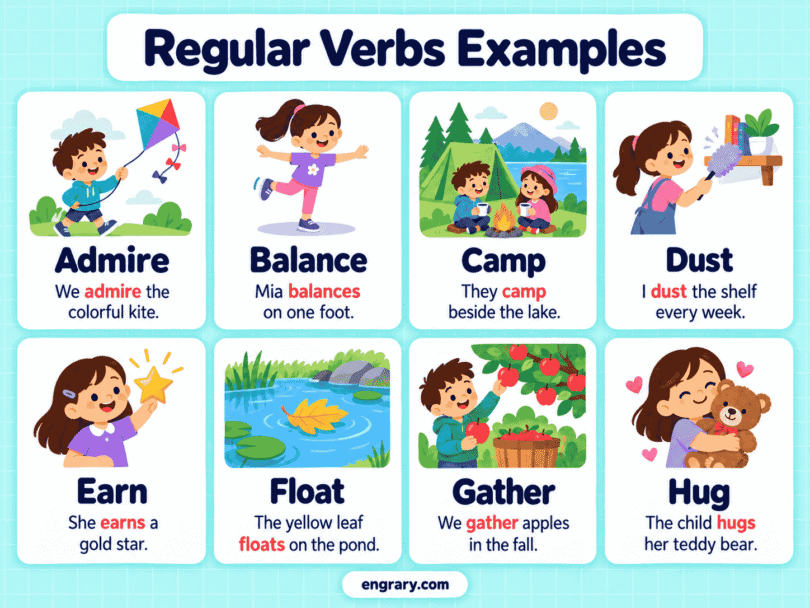
Regular verbs are easier to recognize because their past forms follow clear spelling patterns. Words such as play, clean, love, study, and stop all form the past in a predictable way, even though the spelling does not always change in exactly the same form.
This article explains regular verbs through clear examples, simple sentences, spelling patterns, and everyday use. You will also see how regular verbs work in the base, past, and past-participle forms, along with common mistakes to avoid.

What Are Regular Verbs?
A regular verb forms its past tense and past participle in a predictable way, usually by adding -ed or -d, sometimes with a spelling change.
Examples:
play → played → played
love → loved → loved
study → studied → studied
stop → stopped → stopped
The past form and past participle usually look the same in regular verbs, although they perform different jobs in sentences.
Common Regular Verb Examples
Many regular verbs appear in everyday English.
| V1 | V2 | V3 |
|---|---|---|
| ask | asked | asked |
| call | called | called |
| clean | cleaned | cleaned |
| cook | cooked | cooked |
| help | helped | helped |
| jump | jumped | jumped |
| listen | listened | listened |
| love | loved | loved |
| open | opened | opened |
| play | played | played |
| start | started | started |
| study | studied | studied |
| talk | talked | talked |
| visit | visited | visited |
| wait | waited | waited |
| walk | walked | walked |
| wash | washed | washed |
| watch | watched | watched |
| work | worked | worked |
These examples show several regular spelling patterns, including simple -ed, final -d, y → ied, and consonant doubling.

Regular Verb Examples in Sentences
Regular verbs become easier to understand when they appear in complete sentences.
Ask
Mia asked a question.
Call
I called my friend.
Clean
Noah cleaned his room.
Cook
Dad cooked dinner.
Dance
They danced at the party.
Help
She helped her brother.
Jump
The children jumped over the rope.
Listen
We listened carefully.
Love
She loved the story.
Open
He opened the window.
Play
The children played outside.
Start
The class started early.
Study
Ava studied for the test.
Talk
We talked after school.
Visit
They visited their grandparents.
Wait
I waited for the bus.
Walk
We walked home.
Wash
She washed the dishes.
Watch
I watched a movie.
Work
Dad worked late.

Base, Past, and Past Participle Examples
Regular verbs usually have the same spelling in the past and past-participle forms.
| Base Form | Past Form | Past Participle |
|---|---|---|
| play | played | played |
| work | worked | worked |
| clean | cleaned | cleaned |
| call | called | called |
| love | loved | loved |
| study | studied | studied |
| stop | stopped | stopped |
The forms may look the same, but their use is different.
Base: We play after school.
Past: We played yesterday.
Past participle: We have played here before.
Another example:
Base: She studies every day.
Past: She studied yesterday.
Past participle: She has studied this topic before.
Regular Verbs That Add -ed
Most regular verbs add -ed to the base form.
Examples:
- ask → asked
- clean → cleaned
- cook → cooked
- help → helped
- jump → jumped
- play → played
- talk → talked
- walk → walked
- wash → washed
- work → worked
Sentence examples:
She asked for help.
We cleaned the classroom.
Dad cooked lunch.
The children jumped together.
They worked all morning.
This is the simplest regular verb pattern.
Regular Verbs That Add -d
When a verb already ends in e, it usually takes only -d.
Examples:
- close → closed
- dance → danced
- live → lived
- love → loved
- move → moved
- use → used
Sentence examples:
She closed the door.
They danced together.
We lived near the school.
He moved the chair.
I used a ruler.
The final e remains, so another e is not added.

Regular Verbs That Change y to -ied
When a consonant comes before final y, the y changes to i before -ed.
Examples:
- carry → carried
- cry → cried
- reply → replied
- study → studied
- try → tried
Sentence examples:
He carried the bag.
The baby cried loudly.
She replied to the message.
We studied together.
They tried again.
If a vowel comes before y, the spelling does not change in the same way.
play → played
enjoy → enjoyed
Regular Verbs That Double the Final Consonant
Some verbs double their final consonant before -ed.
Examples:
- admit → admitted
- clap → clapped
- plan → planned
- stop → stopped
- prefer → preferred
Sentence examples:
He admitted the mistake.
The audience clapped loudly.
We planned the trip.
The car stopped suddenly.
She preferred the blue one.
The doubling pattern depends on the word’s spelling and stress, so not every verb ending in a consonant follows it.
Regular Verb Examples in Present and Past
Comparing present and past sentences makes the change easier to notice.
| Present | Past |
|---|---|
| I walk to school. | I walked to school. |
| We play outside. | We played outside. |
| She cleans her room. | She cleaned her room. |
| They visit us. | They visited us. |
| He watches television. | He watched television. |
| I study English. | I studied English. |
| We wait for the bus. | We waited for the bus. |
| She opens the shop. | She opened the shop. |
The regular verb changes in the past, while the rest of the sentence provides the time and context.
Regular Verb Examples With Past Participles
The past participle often appears after have, has, or had. It can also appear in passive structures.
Examples:
She has finished her work.
We have visited this place before.
They had cleaned the room.
He has started a new job.
I have watched that movie.
The students have completed the task.
She had opened the window.
The package was delivered yesterday.
The room was painted last week.
The lesson was explained clearly.
Although V2 and V3 usually have the same spelling in regular verbs, the surrounding sentence shows which form is being used.

Regular Verb Examples From Everyday Life
Regular verbs appear in ordinary activities at home, school, with friends, and throughout the day.
At Home
Common examples include clean, cook, wash, open, close, and help.
Mom cooked dinner.
I washed the dishes.
Dad opened the window.
We cleaned the kitchen.
She helped her sister.
At School
Useful school verbs include ask, answer, study, listen, explain, and practice.
Mia answered the question.
We studied English.
The teacher explained the lesson.
The students listened carefully.
I practiced my spelling.
With Friends
Common examples include talk, play, laugh, visit, call, and share.
We played together.
I called my friend.
They laughed at the joke.
She visited us after school.
Noah shared his snack.
Daily Activities
Regular verbs such as walk, work, start, finish, wait, and watch appear in many everyday sentences.
She walked home.
Dad worked late.
We started early.
I finished my homework.
They waited outside.
We watched television.
Regular and Irregular Verb Examples
Regular and irregular verbs form the past in different ways.
| Regular Verbs | Irregular Verbs |
|---|---|
| play → played | go → went |
| work → worked | write → wrote |
| clean → cleaned | see → saw |
| help → helped | eat → ate |
| walk → walked | take → took |
Regular verbs follow predictable spelling patterns. Irregular verbs do not follow one fixed past-form pattern.
Common Mistakes With Regular Verbs
Most mistakes happen when the correct spelling change is missed.
| Incorrect | Correct | Why |
|---|---|---|
| studyed | studied | consonant + y changes to -ied |
| stoped | stopped | the final consonant doubles |
| liveed | lived | a verb ending in e takes only -d |
| carryed | carried | final y changes to i |
| tryed | tried | final y changes to i |
| planed | planned | the final consonant doubles |
Checking the ending of the base verb usually makes the correct form easier to choose.
FAQs
Common examples include play, walk, clean, work, help, call, listen, love, study, and watch.
Examples include We played outside, She cleaned the room, I watched a movie, and They visited their grandparents.
They usually add -ed or -d, although some verbs change y to -ied or double the final consonant before adding -ed.
Regular verbs usually use the same spelling for the simple past and past participle, as in play → played → played. Their grammatical use differs according to the sentence structure.
Regular verbs follow predictable past-form patterns, such as walk → walked. Irregular verbs change differently, such as go → went.
You May Also Like



Leave a Comment