

Finite and non-finite verb examples show how different verb forms work inside real sentences. A finite verb carries tense or subject agreement, while a non-finite form does not independently show tense or change with the subject.
You’ll see finite and non-finite forms side by side, examples of infinitives, -ing forms, past participles, longer verb phrases, and exactly 150 sentence examples with each form clearly identified.
Finite Verb Examples
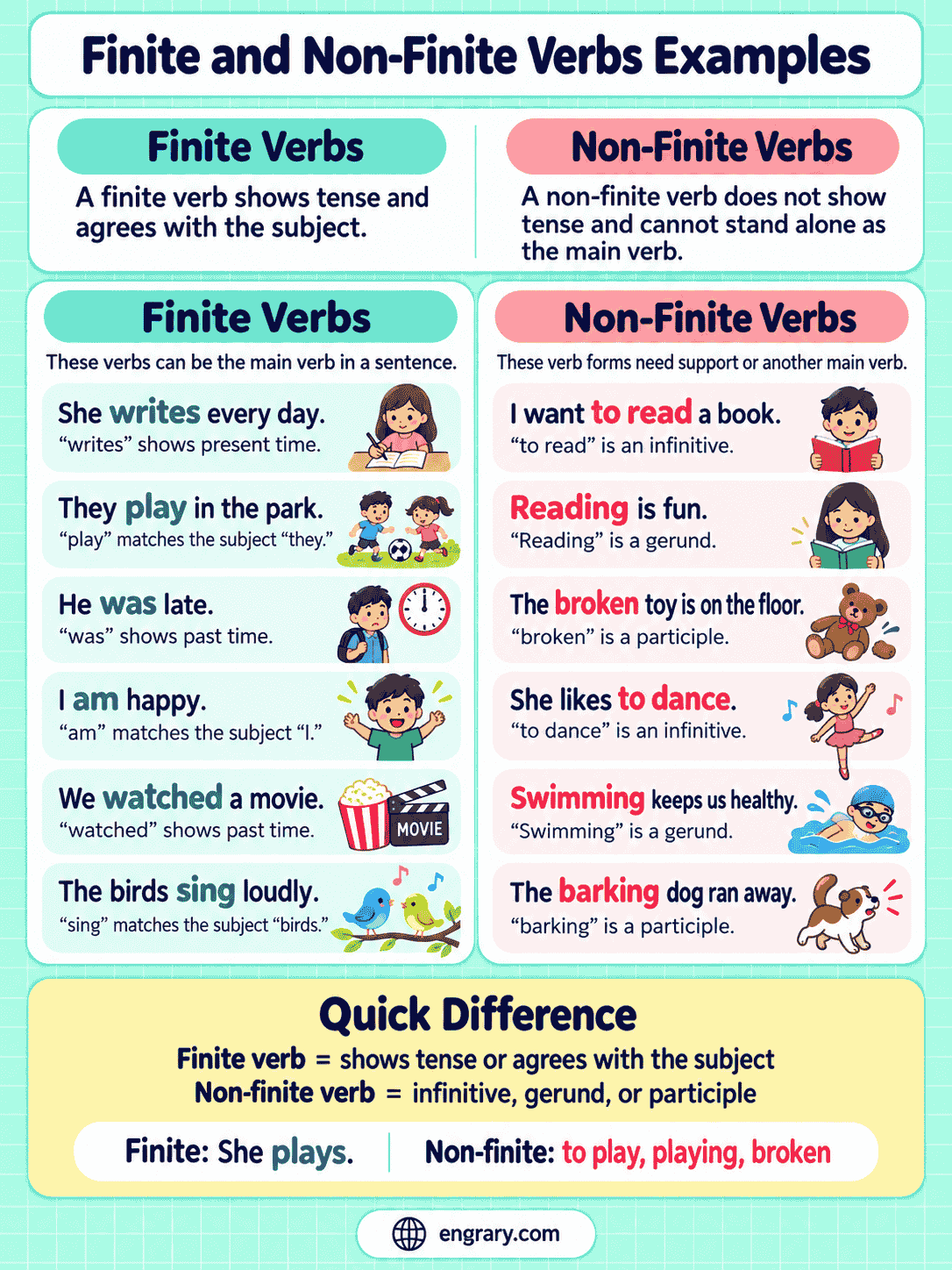
A finite verb carries tense or subject agreement in its clause.
Examples:
Mia reads every night.
Noah ran home.
Ava plays outside.
They were tired.
She knows the answer.
In each sentence, the finite verb carries grammatical information about tense or agreement.
Non-Finite Verb Examples
A non-finite verb does not independently carry tense or subject agreement.
Examples:
Mia wants to read.
Noah can swim.
Ava is drawing.
They have finished.
Dad has written a letter.
The finite verb elsewhere in the clause carries the tense.
Finite and Non-Finite Verbs in the Same Sentence
Finite and non-finite forms often appear together.
| Sentence | Finite Verb | Non-Finite Verb |
|---|---|---|
| She wants to swim. | wants | to swim |
| They decided to leave. | decided | to leave |
| Mia is reading. | is | reading |
| They have finished. | have | finished |
| Noah can swim. | can | swim |
| Ava will be waiting. | will | be, waiting |
The finite form carries the tense or finite grammatical role. The non-finite form depends on that structure or on the wider sentence context.
Same Verb Form Used as Finite and Non-Finite
A verb form should be classified by its function in the sentence, not by the word alone.
Play
I play every day.
play = finite
I can play today.
play = non-finite bare infinitive
Finish
She finished yesterday.
finished = finite past verb
She has finished.
finished = non-finite past participle
Read
They read every evening.
read = finite
They can read independently.
read = non-finite bare infinitive
Work
We work every day.
work = finite
We may work tomorrow.
work = non-finite bare infinitive
The form may look identical, but its grammatical role changes with the sentence structure.
To-Infinitive Examples
A to-infinitive uses:
to + base verb
Examples:
Mia wants to leave.
Noah decided to stay.
We hope to win.
Ava plans to study.
Dad needs to work.
In each example, the first verb is finite and the to-infinitive is non-finite.
For example:
Mia wants to leave.
Finite verb: wants
Non-finite verb: to leave
Bare Infinitive Examples
A bare infinitive uses the base form without to.
Examples:
Mia can swim.
We must leave.
Noah should study.
They may come later.
Ava will help.
The modal is finite, while the following base form is non-finite.
For example:
Noah should study.
Finite verb: should
Non-finite verb: study
-ing Form Examples
An -ing form can function as a non-finite verb.
Examples:
She is reading.
They were playing.
We are waiting.
Ava kept smiling.
Swimming is fun.
In:
She is reading.
is = finite
reading = non-finite
The -ing form does not independently carry tense.
Past Participle Examples
Past participles are also common non-finite forms.
Examples:
They have finished.
Noah has written a story.
The window was broken.
We had left early.
Mia has eaten lunch.
In:
They have finished.
have = finite
finished = non-finite past participle
A past participle can look like a past-tense form, so sentence structure matters.
Finite Auxiliary With Non-Finite Main Verb
A finite verb is not always the main lexical verb.
| Sentence | Finite Auxiliary | Non-Finite Main Verb |
|---|---|---|
| She is reading. | is | reading |
| They have finished. | have | finished |
| Noah can swim. | can | swim |
| We will travel. | will | travel |
| Ava was drawing. | was | drawing |
In She is reading, is carries finiteness, while reading carries the main lexical meaning.
More Than One Non-Finite Form in a Verb Phrase
A verb phrase can contain several non-finite forms after one finite verb.
She will be waiting.
Finite verb:
will
Non-finite forms:
be, waiting
They may have been working.
Finite verb:
may
Non-finite forms:
have, been, working
Noah could have finished.
Finite verb:
could
Non-finite forms:
have, finished
This shows that one finite verb can support several non-finite forms.
Finite and Non-Finite Forms in Longer Sentences
Finite and non-finite forms can also appear in longer sentence structures.
To finish on time, Mia worked quickly.
Non-finite: to finish
Finite: worked
Walking home, Noah saw a dog.
Non-finite: walking
Finite: saw
Ava wanted to leave because she felt tired.
Finite verbs: wanted, felt
Non-finite verb: to leave
These examples show how finite and non-finite forms can work together across clauses and phrases.
150 Finite and Non-Finite Verb Examples in Sentences
The following examples are grouped by grammatical pattern so the differences remain clear.
Finite-Only Examples
| Sentence | Finite Verb | Non-Finite Verb | Type |
|---|---|---|---|
| Mia reads every night. | reads | — | finite only |
| Noah ran home. | ran | — | finite only |
| Ava plays outside. | plays | — | finite only |
| Dad works on Saturdays. | works | — | finite only |
| The dog barked loudly. | barked | — | finite only |
| We walk to school. | walk | — | finite only |
| She knows the answer. | knows | — | finite only |
| They were tired. | were | — | finite only |
| I am ready. | am | — | finite only |
| He is happy. | is | — | finite only |
| They are quiet. | are | — | finite only |
| Mia wrote a letter. | wrote | — | finite only |
| Noah sings well. | sings | — | finite only |
| Ava smiled warmly. | smiled | — | finite only |
| The baby slept peacefully. | slept | — | finite only |
| Dad has a car. | has | — | finite only |
| She does her homework. | does | — | finite only |
| We had enough time. | had | — | finite only |
| The children laugh often. | laugh | — | finite only |
| The train arrived late. | arrived | — | finite only |
| Mia cooks dinner. | cooks | — | finite only |
| Noah opened the gate. | opened | — | finite only |
| Ava drew a flower. | drew | — | finite only |
| The teacher explains clearly. | explains | — | finite only |
| We watched the film. | watched | — | finite only |
| Dad fixed the chair. | fixed | — | finite only |
| She prefers tea. | prefers | — | finite only |
| They left early. | left | — | finite only |
| The sun rose slowly. | rose | — | finite only |
| The class began at nine. | began | — | finite only |
To-Infinitive and Bare-Infinitive Examples
| Sentence | Finite Verb | Non-Finite Verb | Type |
|---|---|---|---|
| Mia wants to read. | wants | to read | to-infinitive |
| Noah decided to leave. | decided | to leave | to-infinitive |
| We hope to win. | hope | to win | to-infinitive |
| Ava plans to study. | plans | to study | to-infinitive |
| Dad needs to work. | needs | to work | to-infinitive |
| The children want to play. | want | to play | to-infinitive |
| Mia tried to help. | tried | to help | to-infinitive |
| Noah agreed to stay. | agreed | to stay | to-infinitive |
| Ava hopes to travel. | hopes | to travel | to-infinitive |
| We need to hurry. | need | to hurry | to-infinitive |
| Dad promised to return. | promised | to return | to-infinitive |
| Mia learned to swim. | learned | to swim | to-infinitive |
| Noah chose to wait. | chose | to wait | to-infinitive |
| They forgot to call. | forgot | to call | to-infinitive |
| Ava asked to leave. | asked | to leave | to-infinitive |
| Mia can swim. | can | swim | bare infinitive |
| We must leave. | must | leave | bare infinitive |
| Noah should study. | should | study | bare infinitive |
| They may come later. | may | come | bare infinitive |
| Ava will help. | will | help | bare infinitive |
| Dad could drive. | could | drive | bare infinitive |
| Mia might join us. | might | join | bare infinitive |
| We shall begin now. | shall | begin | bare infinitive |
| Noah would help gladly. | would | help | bare infinitive |
| Ava can draw well. | can | draw | bare infinitive |
| They must listen carefully. | must | listen | bare infinitive |
| We should wait here. | should | wait | bare infinitive |
| Dad will return tomorrow. | will | return | bare infinitive |
| Mia may stay longer. | may | stay | bare infinitive |
| Noah could solve the puzzle. | could | solve | bare infinitive |
-ing Form Examples
| Sentence | Finite Verb | Non-Finite Verb | Type |
|---|---|---|---|
| Mia is reading. | is | reading | -ing form |
| Noah was sleeping. | was | sleeping | -ing form |
| They are playing outside. | are | playing | -ing form |
| We were waiting. | were | waiting | -ing form |
| Ava is drawing a picture. | is | drawing | -ing form |
| Dad was cooking dinner. | was | cooking | -ing form |
| The children are laughing. | are | laughing | -ing form |
| Mia kept smiling. | kept | smiling | -ing form |
| Noah enjoys swimming. | enjoys | swimming | -ing form |
| Ava likes painting. | likes | painting | -ing form |
| We started walking. | started | walking | -ing form |
| Dad continued working. | continued | working | -ing form |
| Mia avoids shouting. | avoids | shouting | -ing form |
| Noah finished eating. | finished | eating | -ing form |
| Ava practices writing. | practices | writing | -ing form |
| The baby is crying. | is | crying | -ing form |
| We are studying English. | are | studying | -ing form |
| Dad was repairing the gate. | was | repairing | -ing form |
| Mia is learning quickly. | is | learning | -ing form |
| Noah was running outside. | was | running | -ing form |
| They are singing together. | are | singing | -ing form |
| Ava kept talking. | kept | talking | -ing form |
| We enjoy reading together. | enjoy | reading | -ing form |
| Dad started cleaning. | started | cleaning | -ing form |
| Mia stopped laughing. | stopped | laughing | -ing form |
| Noah likes drawing animals. | likes | drawing | -ing form |
| Ava began dancing. | began | dancing | -ing form |
| We continued walking. | continued | walking | -ing form |
| Dad avoids driving at night. | avoids | driving | -ing form |
| The children love playing outside. | love | playing | -ing form |
Past Participle Examples
| Sentence | Finite Verb | Non-Finite Verb | Type |
|---|---|---|---|
| They have finished. | have | finished | past participle |
| Noah has written a story. | has | written | past participle |
| We had left early. | had | left | past participle |
| Mia has eaten lunch. | has | eaten | past participle |
| Dad had built the shelf. | had | built | past participle |
| Ava has chosen a book. | has | chosen | past participle |
| They have seen the film. | have | seen | past participle |
| Noah had forgotten his bag. | had | forgotten | past participle |
| Mia has taken the bus. | has | taken | past participle |
| We have found the keys. | have | found | past participle |
| Dad has repaired the chair. | has | repaired | past participle |
| Ava had completed the task. | had | completed | past participle |
| They have learned the rule. | have | learned | past participle |
| Mia has broken the pencil. | has | broken | past participle |
| Noah had lost his book. | had | lost | past participle |
| The window was broken. | was | broken | past participle |
| The room was cleaned. | was | cleaned | past participle |
| The cake was baked this morning. | was | baked | past participle |
| The door was opened slowly. | was | opened | past participle |
| The letter was written yesterday. | was | written | past participle |
| The chair was repaired. | was | repaired | past participle |
| The work was finished on time. | was | finished | past participle |
| The books were placed on the shelf. | were | placed | past participle |
| The picture was drawn by Ava. | was | drawn | past participle |
| The meal was prepared early. | was | prepared | past participle |
| The gate was closed at night. | was | closed | past participle |
| The answer was checked carefully. | was | checked | past participle |
| The ball was thrown across the field. | was | thrown | past participle |
| The window was painted blue. | was | painted | past participle |
| The message was sent yesterday. | was | sent | past participle |
Longer Mixed Verb-Phrase Examples
| Sentence | Finite Verb | Non-Finite Verb(s) | Type |
|---|---|---|---|
| Mia will be reading tonight. | will | be, reading | longer verb phrase |
| Noah may have finished already. | may | have, finished | longer verb phrase |
| Ava could have been waiting. | could | have, been, waiting | longer verb phrase |
| We will have arrived by noon. | will | have, arrived | longer verb phrase |
| Dad might be working now. | might | be, working | longer verb phrase |
| Mia should have studied more. | should | have, studied | longer verb phrase |
| Noah may have forgotten the book. | may | have, forgotten | longer verb phrase |
| They must have left early. | must | have, left | longer verb phrase |
| Ava will be traveling tomorrow. | will | be, traveling | longer verb phrase |
| We could have won the game. | could | have, won | longer verb phrase |
| Dad has been working all morning. | has | been, working | longer verb phrase |
| Mia had been reading quietly. | had | been, reading | longer verb phrase |
| Noah will have finished soon. | will | have, finished | longer verb phrase |
| They may be waiting outside. | may | be, waiting | longer verb phrase |
| Ava might have been sleeping. | might | have, been, sleeping | longer verb phrase |
| We should be leaving now. | should | be, leaving | longer verb phrase |
| Dad could be driving home. | could | be, driving | longer verb phrase |
| Mia must have seen the sign. | must | have, seen | longer verb phrase |
| Noah will have written the report. | will | have, written | longer verb phrase |
| Ava may have been studying. | may | have, been, studying | longer verb phrase |
| They could have been playing outside. | could | have, been, playing | longer verb phrase |
| We will be waiting at the station. | will | be, waiting | longer verb phrase |
| Dad might have finished the work. | might | have, finished | longer verb phrase |
| Mia has been learning quickly. | has | been, learning | longer verb phrase |
| Noah had been sleeping. | had | been, sleeping | longer verb phrase |
| Ava will have completed the task. | will | have, completed | longer verb phrase |
| They must be listening carefully. | must | be, listening | longer verb phrase |
| We may have been traveling all day. | may | have, been, traveling | longer verb phrase |
| Dad should have been resting. | should | have, been, resting | longer verb phrase |
| Mia could have been practicing. | could | have, been, practicing | longer verb phrase |
These 150 examples show finite-only forms, infinitives, -ing forms, participles, and longer combinations where one finite verb works with one or more non-finite forms.
How to Identify Finite and Non-Finite Verbs
First, find every verb form in the sentence.
Then ask:
- Which verb carries tense?
- Which verb changes with the subject?
- Is another form an infinitive?
- Is it an -ing form?
- Is it a past participle?
- Is a modal or auxiliary carrying the finite role?
For example:
She has been singing.
Finite verb:
has
Non-finite forms:
been, singing
Another:
Mia wants to leave.
Finite verb:
wants
Non-finite verb:
to leave
Another:
Noah can swim.
Finite verb:
can
Non-finite verb:
swim
The most reliable method is to identify which verb carries the finite grammatical information first.
Common Finite and Non-Finite Verb Mistakes
| Mistake | Correct Understanding |
|---|---|
| Every verb in a sentence is finite. | A sentence can contain finite and non-finite forms. |
| The main verb is always finite. | An auxiliary or modal may carry finiteness instead. |
| Every -ing form is finite. | -ing forms are commonly non-finite. |
| Every -ed form is past tense. | It may be a non-finite past participle. |
| All infinitives use to. | Bare infinitives also exist. |
| A verb word is permanently finite or non-finite. | Its function depends on sentence structure. |
| Only one non-finite form can appear in a verb phrase. | Several non-finite forms can appear together. |
For example:
I play every day.
Here, play is finite.
But:
I can play today.
Here, play is non-finite.
Similarly:
She finished yesterday.
Here, finished is finite.
But:
She has finished.
Here, finished is a non-finite past participle.
FAQs
In Mia reads every night, reads is finite. In Mia wants to read, wants is finite and to read is non-finite.
Yes. In I play every day, play is finite. In I can play today, play is a non-finite bare infinitive.
Look for the verb that carries tense or subject agreement. In a longer verb phrase, it is usually the first finite auxiliary or modal.
Common forms include to-infinitives, bare infinitives, -ing forms, and past participles.
Yes. In They may have been working, may is finite, while have, been, and working are non-finite.
You May Also Like



Leave a Comment