

A single verb can appear in several forms depending on how it works in a sentence. For example, write, writes, wrote, writing, and written all come from the same verb but perform different grammatical jobs.
The easiest way to understand verb forms is to see the full pattern first, then study how each form is built and used. Regular verbs often follow predictable changes, while irregular verbs such as go, write, and eat need more attention.
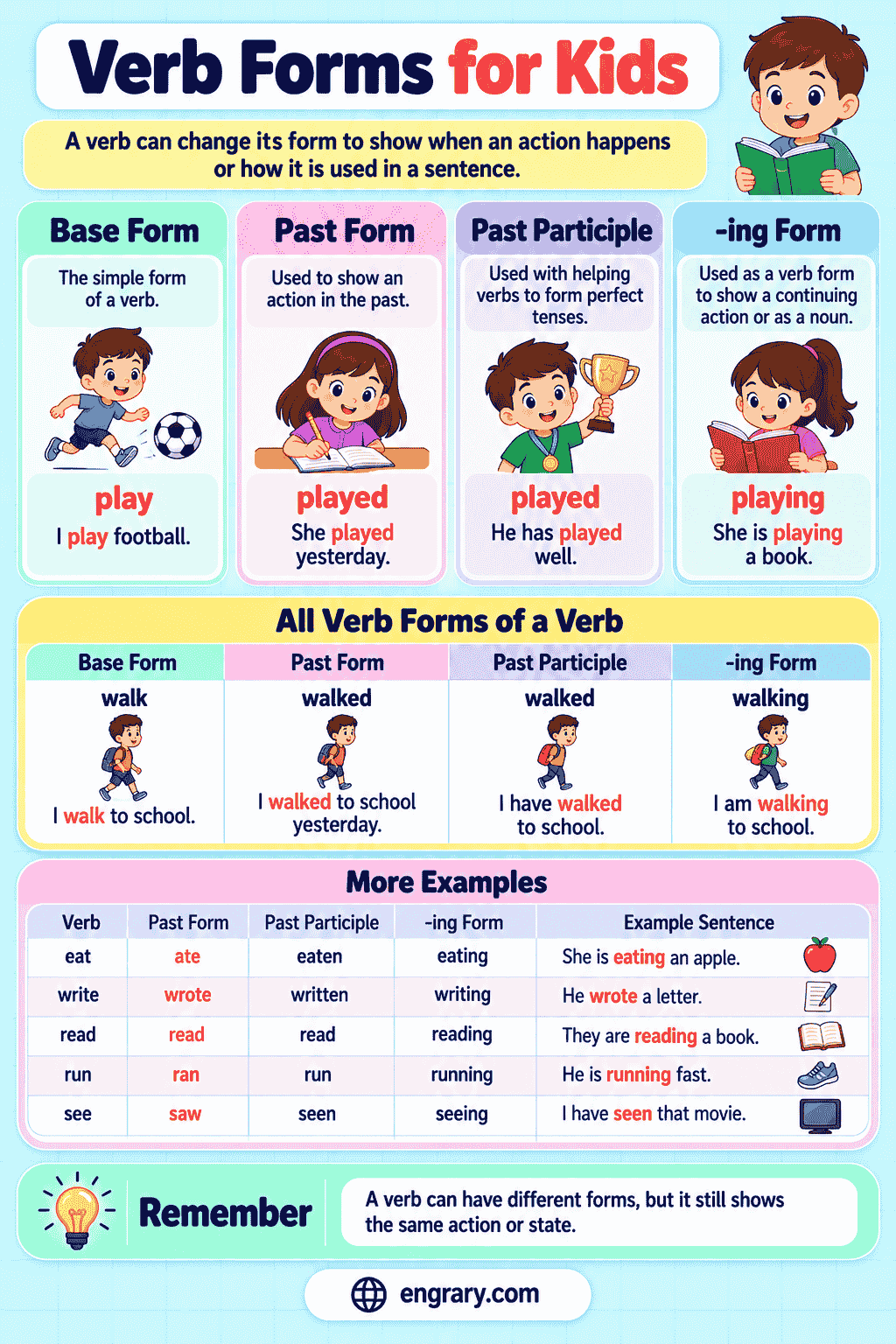
What Are Verb Forms?
A verb form is a version of a verb used in a particular grammatical structure.
For example:
play → plays → played → playing → played
Another:
write → writes → wrote → writing → written
The main idea is:
one verb → several grammatical forms
Verb forms are related to tense, but they are not the same thing. A verb form is the shape of the verb, while a tense or verb structure may use one or more forms together.
The Five Verb Forms at a Glance
English main verbs are commonly described through five forms.
| Verb Form | Play | Write |
|---|---|---|
| Base form | play | write |
| Third-person singular | plays | writes |
| Past form | played | wrote |
| -ing form | playing | writing |
| Past participle | played | written |
The five forms can look very similar in regular verbs but quite different in irregular verbs.
One Verb Across All Five Forms
Looking at several verbs across all five forms makes the pattern easier to see.
| Base | Third Person | Past | -ing | Past Participle |
|---|---|---|---|---|
| play | plays | played | playing | played |
| work | works | worked | working | worked |
| write | writes | wrote | writing | written |
| eat | eats | ate | eating | eaten |
| go | goes | went | going | gone |
| take | takes | took | taking | taken |
| run | runs | ran | running | run |
| speak | speaks | spoke | speaking | spoken |
| see | sees | saw | seeing | seen |
| break | breaks | broke | breaking | broken |
| choose | chooses | chose | choosing | chosen |
| begin | begins | began | beginning | begun |
Regular verbs usually show a clear pattern. Irregular verbs may change more noticeably.
Base Form
The base form is the simplest form of a verb.
Examples:
- play
- read
- write
- go
- eat
- run
- speak
In sentences:
I play outside.
They read every day.
We write stories.
The base form also appears after modal verbs:
Mia can swim.
Noah should study.
We will travel tomorrow.
It also appears in commands:
Open the door.
Sit down.
The same base form can therefore appear in several grammatical structures.
Third-Person Singular Form
The third-person singular form appears mainly in the present simple with he, she, it, or a singular noun.
Examples:
play → plays
read → reads
run → runs
watch → watches
go → goes
study → studies
In sentences:
Mia plays outside.
Noah watches television.
The dog runs quickly.
Ava studies every evening.
Most verbs add -s, but some require -es or a spelling change.
Past Form
The past form is used in simple past structures.
Regular verbs usually add -ed.
play → played
walk → walked
clean → cleaned
help → helped
Irregular verbs may change differently.
go → went
eat → ate
write → wrote
see → saw
run → ran
In sentences:
Mia played yesterday.
Noah went home.
Ava wrote a letter.
We saw the bird.
The past form does not always end in -ed.
-ing Form
The -ing form is built from the base verb.
Examples:
play → playing
read → reading
run → running
write → writing
lie → lying
In sentences:
Mia is playing.
Noah was running.
Ava enjoys reading.
The children are writing.
The -ing form is a verb form, not a tense by itself.
For example:
writing = -ing form
is writing = a larger verb structure
Past Participle
The past participle commonly appears after forms of have and in passive structures.
Regular verbs often use the same spelling for the past and past participle.
play → played
walk → walked
clean → cleaned
Irregular verbs may have a different participle.
write → written
eat → eaten
go → gone
break → broken
see → seen
In sentences:
Mia has written a story.
They have eaten lunch.
Noah has gone home.
The glass was broken.
The past participle and the simple past form should not be treated as the same grammatical form, even when their spelling matches.
Past Form vs Past Participle
This difference is especially important with irregular verbs.
| Past Form | Past Participle |
|---|---|
| She wrote yesterday. | She has written already. |
| He ate lunch. | He has eaten lunch. |
| They went home. | They have gone home. |
| Noah saw the bird. | Noah has seen the bird. |
| Mia played outside. | Mia has played outside. |
For regular verbs:
play → played → played
The past and past participle have the same spelling.
For irregular verbs:
write → wrote → written
The two forms differ.
How Regular and Irregular Verbs Change
Regular and irregular verbs use the same five grammatical form categories, but they build those forms differently.
| Verb Type | Base | Third Person | Past | -ing | Past Participle |
|---|---|---|---|---|---|
| Regular | play | plays | played | playing | played |
| Regular | clean | cleans | cleaned | cleaning | cleaned |
| Regular | help | helps | helped | helping | helped |
| Irregular | write | writes | wrote | writing | written |
| Irregular | go | goes | went | going | gone |
| Irregular | eat | eats | ate | eating | eaten |
| Irregular | take | takes | took | taking | taken |
| Irregular | see | sees | saw | seeing | seen |
Regular verbs usually form the past and past participle with -ed.
Irregular verbs may:
- change completely;
- change only one part;
- keep the same form;
- use different past and past participle forms.
For example:
go → went → gone
run → ran → run
cut → cut → cut
This is why irregular forms often need to be learned individually.
Common Spelling Changes in Verb Forms
Some verbs change spelling when endings are added.
Add -es
Some verbs add -es instead of only -s.
watch → watches
fix → fixes
go → goes
wash → washes
teach → teaches
Change Consonant + y to i
When a consonant comes before y, the y often changes to i before -es or -ed.
study → studies
study → studied
carry → carries
carry → carried
But when a vowel comes before y, keep the y.
play → plays
play → played
Double the Final Consonant
Some short verbs double the final consonant before -ing or -ed.
run → running
stop → stopped
sit → sitting
plan → planned
Drop Final e Before -ing
Many verbs ending in silent e drop it before -ing.
write → writing
make → making
come → coming
take → taking
Change ie to y Before -ing
Verbs ending in ie usually change ie to y before -ing.
lie → lying
die → dying
tie → tying
These spelling changes affect the form, but the verb keeps its core meaning.
See One Verb Change Across Sentences
The five forms become clearer when the same verb appears in different sentences.
Write
I write every day.
Base form
She writes every day.
Third-person singular
She wrote yesterday.
Past form
She is writing now.
-ing form
She has written the letter.
Past participle
Go
They go to school.
Base form
Mia goes to school.
Third-person singular
Mia went yesterday.
Past form
She is going now.
-ing form
She has gone home.
Past participle
These examples show that the same verb changes form according to sentence structure.
Verb Forms vs Verb Tenses
Verb forms and verb tenses are connected, but they are not the same thing.
| Verb Form | Larger Verb Structure |
|---|---|
| writing | is writing |
| written | has written |
| play | play every day |
| played | played yesterday |
The main distinction is:
verb form → the shape of the verb
verb tense or structure → the grammatical pattern that uses one or more forms
For example:
writing is an -ing form.
is writing forms a present continuous structure.
Similarly:
written is a past participle.
has written forms a present perfect structure.
This distinction helps prevent children from calling every verb form a tense.
What Do V1, V2, V3, V4, and V5 Mean?
Some textbooks and learner resources use V1, V2, V3, V4, and V5 as shortcuts.
| Label | Verb Form | Example: Write |
|---|---|---|
| V1 | base form | write |
| V2 | past form | wrote |
| V3 | past participle | written |
| V4 | -ing form | writing |
| V5 | third-person singular | writes |
So:
write → wrote → written → writing → writes
may be shown as:
V1 → V2 → V3 → V4 → V5
These labels are useful for memorizing forms, but they are not universal formal grammar terminology. The grammatical form names are more precise.
Common Verb Form Mistakes
| Mistake | Correct Understanding |
|---|---|
| Every verb has only three forms. | English main verbs are commonly described with five forms. |
| Every past form ends in -ed. | Irregular verbs may change differently. |
| Past and past participle are always identical. | They differ for many irregular verbs. |
| An -ing form is a tense. | It is a verb form used in larger structures. |
| Third-person singular always adds only -s. | Some verbs use -es or spelling changes. |
| Verb forms and verb tenses are the same thing. | Forms are verb shapes; tenses use those forms. |
| Every verb has five different spellings. | Some grammatical forms share the same spelling. |
| V1–V5 is universal grammar terminology. | It is mainly a learner-friendly labeling system. |
For example:
play → played → played
The past and past participle look the same but perform different grammatical roles.
By contrast:
write → wrote → written
The past and past participle have different forms.
FAQs
Regular verbs often use the same -ed form for both the past and past participle. For example, play → played → played.
Different spelling patterns apply. Write drops its final silent e, while run doubles the final consonant before -ing.
-ing is a verb form. It becomes part of a larger tense or verb structure when combined with other verbs, as in is writing.
No. They are common learner-friendly labels, but formal grammar references often use names such as base form, past form, past participle, -ing form, and third-person singular instead.
Start with the base form, past form, and past participle, then connect them with the third-person singular and -ing form. Seeing all five together makes the full pattern easier to remember.
You May Also Like



Leave a Comment