Uncountable nouns help children understand words that English usually treats as masses, substances, ideas, activities, or collections rather than separate items. Learning these nouns also improves sentence accuracy because words such as water, furniture, advice, and information follow different quantity patterns from countable nouns.
You’ll see easy uncountable noun examples grouped by type, along with natural sentence examples and useful quantity phrases. In addition, you’ll learn how some, any, much, a little, and how much work with uncountable nouns, how some nouns change countability with meaning, and which common mistakes to avoid.
What Is an Uncountable Noun?
An uncountable noun names something that English usually treats as a mass, substance, general concept, activity, or collection rather than separate countable units.
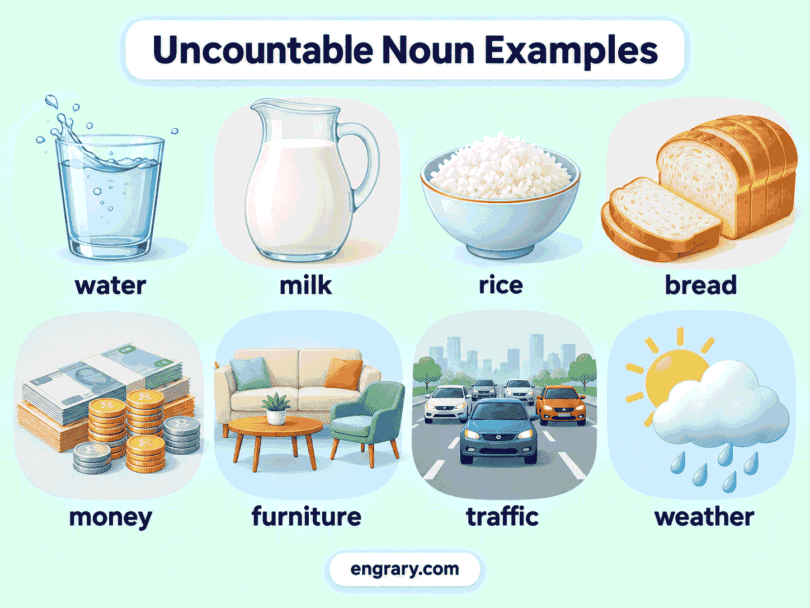
Common examples include:
- water
- rice
- furniture
- information
- advice
- money
- weather
- knowledge
The basic idea is:
uncountable noun → usually not counted directly as one, two, three
For example, we normally say:
some water
rather than:
two waters
when water refers to the substance generally.
Similarly, use:
some information
rather than:
three informations
However, uncountable nouns can still be measured through units, containers, amounts, or portions. For instance, we can say two bottles of water or three pieces of information.
Easy Uncountable Noun Examples
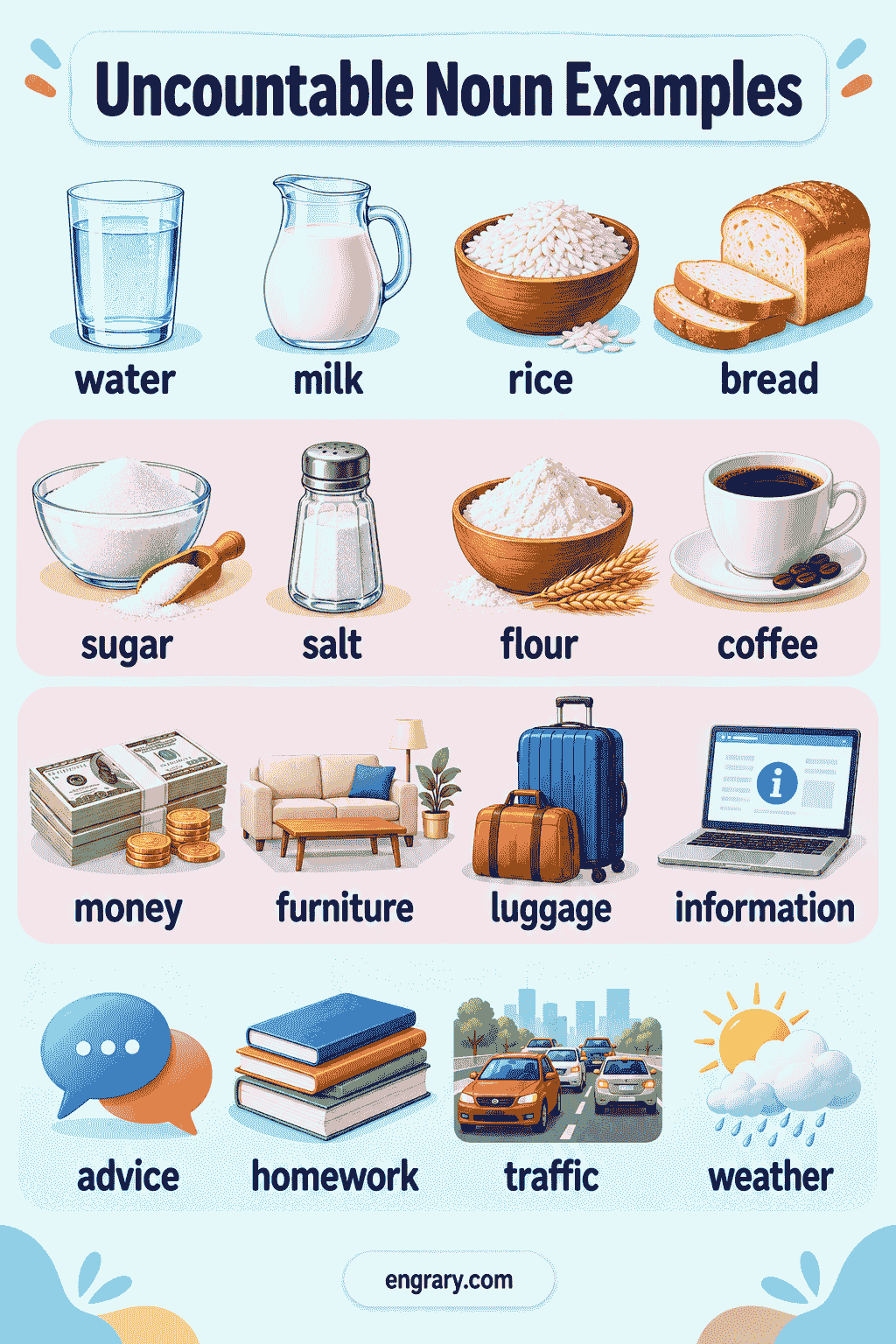
The following table shows common uncountable nouns with their categories and natural example phrases.
| Uncountable Noun | Category | Example Phrase |
|---|---|---|
| water | liquid | some water |
| milk | liquid | some milk |
| rice | food | some rice |
| bread | food | some bread |
| sugar | food | a little sugar |
| salt | food | some salt |
| furniture | collection | new furniture |
| equipment | collection | useful equipment |
| luggage | collection | heavy luggage |
| information | general/abstract | useful information |
| advice | general/abstract | some advice |
| money | quantity | some money |
| weather | natural condition | bad weather |
| homework | activity/work | some homework |
| knowledge | abstract | useful knowledge |
| traffic | general condition | heavy traffic |
| research | activity/work | useful research |
| air | substance | fresh air |
| patience | quality | a little patience |
| luck | abstract | good luck |
These nouns do not normally take ordinary plural endings in their uncountable meanings. Therefore, forms such as furnitures, advices, equipments, and informations are usually incorrect.
Types of Uncountable Nouns
Uncountable nouns appear in several everyday categories. Grouping them by type makes their meanings and usage easier to recognize.
Food and Drinks
Many foods, drinks, and cooking ingredients are uncountable when English treats them as substances or general quantities.
Examples include:
- rice
- bread
- sugar
- salt
- flour
- meat
- cheese
- butter
- milk
- water
- coffee
- tea
- juice
For example, we need some rice for dinner. Meanwhile, there is a little milk in the fridge, and Mia added sugar to her tea.
Similarly, the children drank some juice, while the table still had some bread on it.
However, not every food noun is uncountable. Words such as apple, egg, sandwich, and cookie normally refer to separate countable items.
Materials and Substances
Materials and substances often function as uncountable nouns because English treats them as continuous matter rather than separate units.
Examples include:
- wood
- gold
- iron
- plastic
- glass
- paper
- sand
- mud
- air
- smoke
- oil
For instance, the table is made of wood. By contrast, the ring contains gold, while the floor has some sand on it.
Fresh air entered through the window, and later, smoke filled part of the room.
These nouns can still appear with measurement expressions such as a piece of wood, a sheet of paper, or a litre of oil.
Ideas, Feelings, and Qualities
Many nouns that name general ideas, feelings, or qualities are uncountable.
Examples include:
- information
- advice
- knowledge
- happiness
- honesty
- patience
- courage
- love
- luck
- fun
For example, she gave me useful advice. In addition, his knowledge helped the team, while her patience helped the children finish the task.
We also had great fun at the event.
However, abstract meaning alone does not make a noun uncountable. Words such as idea, plan, question, and decision are abstract but normally countable.
Activities and Work
Several nouns related to activities, study, and work often function as uncountable nouns.
Examples include:
- homework
- work
- research
- training
- travel
- sleep
- help
For example, I finished my homework before dinner. Meanwhile, Sara has a lot of work today, and the team completed useful research.
After a long journey, he needed more sleep. In addition, the new employee received extra training.
Some activity nouns can become countable when their meanings change, so context still matters.
Weather, Nature, and Collections
Weather and nature words often work as uncountable nouns. In addition, English treats several collections as uncountable even though they contain many individual items.
Weather and nature examples:
- weather
- rain
- snow
- fog
- sunshine
- thunder
- lightning
For example, the weather changed quickly. Later, heavy rain covered the road, while thick fog reduced visibility.
Collection and general-group examples:
- furniture
- equipment
- luggage
- baggage
- rubbish
- traffic
The room has new furniture, while the school recently bought useful equipment. Similarly, her luggage was heavy, and morning traffic delayed the bus.
Although these nouns can refer to many things together, they normally do not take standard plural endings.
Uncountable Nouns With Some and Any
Uncountable nouns often work with some and any when the exact amount is not stated.
Use some naturally in many affirmative sentences:
- some water
- some rice
- some information
- some advice
- some furniture
For example, there is some milk in the fridge. We also have some rice for dinner.
Questions and negative sentences often use any:
- any sugar
- any milk
- any information
- any money
For instance, do you have any information about the meeting?
They do not need any furniture for the empty room.
Because these expressions refer to an unspecified quantity, they work naturally with uncountable nouns.
Uncountable Nouns With Much, A Little, and How Much
Uncountable nouns can also appear with quantity expressions such as much and a little.
Examples include:
- much water
- much money
- a little milk
- a little rice
- a little sugar
- a little patience
For example, we do not have much money left. Only a little milk remains in the bottle, while the recipe needs a little sugar.
To ask about quantity, use how much.
For example:
How much water do you need?
To ask about information, you could say:
How much information did you receive?
Another natural question is:
How much sugar should we add?
These forms focus on amount rather than the number of separate items.
Quantity Phrases for Uncountable Nouns
Uncountable nouns are not normally counted directly, but countable units can measure or divide them.
| Uncountable Noun | Quantity Phrase |
|---|---|
| advice | a piece of advice |
| information | a piece of information |
| furniture | a piece of furniture |
| bread | a loaf of bread |
| water | a bottle of water |
| milk | a glass of milk |
| coffee | a cup of coffee |
| rice | a bag of rice |
| chocolate | a bar of chocolate |
| sugar | a kilo of sugar |
The basic pattern is:
countable unit + of + uncountable noun
For example:
water → a bottle of water
advice → a piece of advice
bread → a loaf of bread
Therefore, instead of saying two advices, use two pieces of advice.
Likewise, replace three waters with three bottles of water when referring to three containers.
Uncountable Nouns in Sentences
Uncountable nouns appear naturally in everyday English.
There is some water in the bottle.
We need more rice for dinner.
She gave me useful advice.
New furniture arrived yesterday.
He completed his homework before dinner.
Meanwhile, the weather changed quickly.
Our school bought new equipment.
Her knowledge helped the class.
Unfortunately, we do not have much money.
Heavy traffic delayed the bus.
Fresh air entered through the window.
Finally, a little patience helped solve the problem.
Each highlighted noun functions as an uncountable noun in its sentence. Therefore, the noun refers to an amount, substance, concept, activity, or collection rather than a directly counted set of units.
Countable vs. Uncountable Nouns
Countable and uncountable nouns differ in how English treats quantity.
| Countable Noun | Uncountable Noun |
|---|---|
| apple | rice |
| chair | furniture |
| book | information |
| suitcase | luggage |
| coin | money |
| job | work |
| bottle | water |
A countable noun normally refers to separate units that can be counted directly.
By contrast, an uncountable noun usually refers to a mass, general quantity, concept, activity, or collection.
Compare:
three chairs
but:
some furniture
Similarly:
two books
but:
some information
If an amount must be counted, use a suitable unit:
three pieces of furniture
two pieces of information
Nouns That Can Be Countable or Uncountable
Some nouns change countability when their meanings change.
Glass
As an uncountable noun, glass refers to the material.
As a countable noun, a glass means one drinking container.
For example:
The window is made of glass.
I bought two glasses.
Chocolate
As an uncountable noun, chocolate refers to the food generally.
By contrast, a chocolate can mean one individual piece.
For example:
I like chocolate.
She ate two chocolates.
Paper
As an uncountable noun, paper refers to the material.
However, a paper can mean a document or written work.
For example:
The box contains paper.
The students submitted three papers.
Coffee
As an uncountable noun, coffee refers to the drink generally.
In everyday contexts, a coffee can mean one serving or cup.
For example:
I drink coffee every morning.
We ordered two coffees.
Therefore, countability sometimes depends on the noun’s meaning in a particular sentence.
Common Uncountable Noun Mistakes
Uncountable noun mistakes often involve unnecessary plural endings, incorrect use of a/an, or unsuitable quantity words.
| Incorrect | Correct | Reason |
|---|---|---|
| an advice | some advice / a piece of advice | advice is uncountable |
| two informations | two pieces of information | information is uncountable |
| furnitures | furniture | furniture normally has no plural form |
| equipments | equipment | equipment is uncountable |
| luggages | luggage | luggage is uncountable |
| a homework | some homework | homework is uncountable |
| many money | much money / a lot of money | money is uncountable |
| many traffic | much traffic / heavy traffic | traffic is uncountable |
| a bread | some bread / a loaf of bread | bread is normally uncountable |
| three advices | three pieces of advice | use a countable unit |
For example, two informations is incorrect in ordinary English. Instead, use two pieces of information.
Similarly, avoid furnitures. The normal form is furniture, or use a measured expression such as three pieces of furniture.
Another common error is an advice. A natural alternative is some advice or a piece of advice.
Therefore, the key question is whether English normally treats the noun as separate countable units in that meaning.
FAQs
Common examples include water, milk, rice, bread, furniture, equipment, information, advice, money, weather, homework, knowledge, traffic, and research.
Uncountable nouns do not normally use ordinary plural forms in their uncountable meanings. Therefore, forms such as informations, advices, furnitures, and equipments are usually incorrect. However, some nouns can become countable when their meaning changes.
Normally, a and an do not modify an uncountable noun directly. Instead, use a countable unit, such as a piece of advice, a bottle of water, or a loaf of bread.
Use countable measurement or quantity phrases. For example, say two cups of coffee, three bottles of water, a piece of information, or a kilo of sugar.
Countable nouns normally refer to separate units that can be counted directly, such as three books or five apples. Uncountable nouns, however, usually refer to masses, substances, general concepts, activities, or collections, such as water, rice, information, and furniture.
You May Also Like