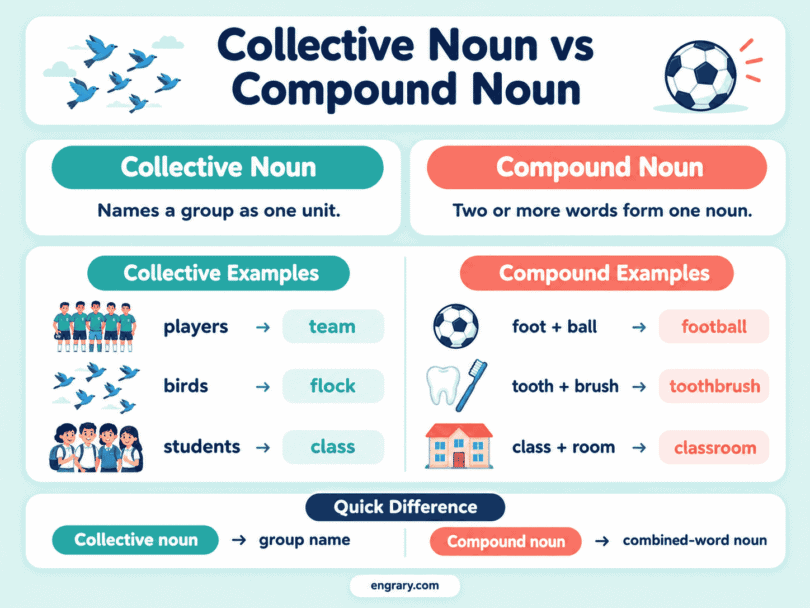
Collective nouns and compound nouns describe different features of nouns. A collective noun focuses on group meaning, while a compound noun focuses on word formation. Understanding that difference helps children classify nouns more accurately.
You’ll learn how collective and compound nouns differ, how compound nouns are formed, why the two categories can overlap, and how to identify them in sentences.

Group Meaning or Word Formation? The Main Difference
A collective noun names a group of people, animals, or things as one unit.
Examples:
- team
- family
- class
- flock
- herd
- crew
A compound noun is formed from two or more words or word elements that work together as one noun.
Examples:
- classroom
- toothbrush
- football
- bus stop
- post office
- mother-in-law
The key contrast is:
collective noun → group meaning
compound noun → combined-word structure
| Feature | Collective Noun | Compound Noun |
|---|---|---|
| Main focus | meaning | formation |
| What it names/shows | a group as one unit | one noun formed from multiple parts |
| Example | team | classroom |
| Example | flock | toothbrush |
| Example | crew | bus stop |
| Can overlap? | yes | yes |
Therefore, collective and compound nouns are not complete opposites.
Collective Nouns Name Groups
Collective nouns give one name to a group.
For example:
team → group of players
class → group of students
flock → group of birds
herd → group of animals
crew → group of workers or sailors
In sentences:
The team won the match.
Our class visited the museum.
A flock crossed the sky.
The crew prepared the ship.
Even though each group contains several members, the collective noun treats the group as one unit.
Compound Nouns Combine Words
Compound nouns are built from two or more words or word elements.
For example:
class + room → classroom
tooth + brush → toothbrush
foot + ball → football
bus + stop → bus stop
The combined parts create one noun with its own meaning.
Compare:
tooth + brush = toothbrush
bed + room = bedroom
school + bag = schoolbag
Therefore, compound nouns are classified by how they are formed rather than by whether they name groups.
Open, Closed, and Hyphenated Compound Nouns
Compound nouns can appear in three common forms.
| Form | Examples |
|---|---|
| Closed | classroom, toothbrush, football, notebook |
| Open | bus stop, post office, dining room, swimming pool |
| Hyphenated | mother-in-law, passer-by, check-in |
A closed compound appears as one written word.
A open compound uses separate words that function together as one noun.
A hyphenated compound joins the parts with one or more hyphens.
So, a compound noun does not have to be written as one word.
Why Collective and Compound Nouns Are Not Opposites
The two labels describe different noun properties.
Collective tells us about meaning.
Compound tells us about structure.
For example:
football team
The phrase has collective meaning because it refers to a group of players. At the same time, it uses multiple words to form one noun expression.
Likewise:
school committee
- group meaning → collective
- multiword structure → compound expression
This means one noun expression can have more than one classification.
Easy Collective and Compound Noun Examples
| Collective Noun | Compound Noun |
|---|---|
| team | football |
| class | classroom |
| flock | birdhouse |
| crew | spacecraft |
| family | farmhouse |
| crowd | marketplace |
| herd | cattle farm |
| committee | school board |
| choir | music room |
| pack | backpack |
These examples are not exact pairs. Instead, they show the main contrast between group meaning and combined-word formation.
For instance, team names a group, while football is formed from two word elements.
Collective Nouns for People, Animals, and Things
Collective nouns can name many kinds of groups.
| Category | Collective Nouns |
|---|---|
| People | team, class, crew, committee, crowd, choir |
| Animals | flock, herd, pack, swarm, shoal |
| Things | bunch, set, collection, bundle, pack |
For example:
A choir sang on stage.
A herd moved across the field.
She carried a bunch of flowers.
The important feature is that each collective noun refers to several members or items as one group.
Compound Nouns by Everyday Use
Compound nouns appear throughout everyday English.
| Use | Compound Nouns |
|---|---|
| Places | classroom, bus stop, post office |
| Objects | toothbrush, notebook, football |
| People | firefighter, bus driver, mother-in-law |
| Home | bedroom, dining room, bookshelf |
| School | schoolbag, classroom, homework |
For example:
The children entered the classroom.
We waited at the bus stop.
She packed her schoolbag.
A firefighter arrived quickly.
Unlike collective nouns, these words do not need to refer to groups.
Collective and Compound Nouns in Sentences
| Sentence | Target Noun | Type |
|---|---|---|
| The team won the game. | team | collective |
| Our class visited the museum. | class | collective |
| She entered the classroom. | classroom | compound |
| I forgot my toothbrush. | toothbrush | compound |
| The crew prepared the ship. | crew | collective |
| We waited at the bus stop. | bus stop | compound |
| A flock crossed the sky. | flock | collective |
| He opened his notebook. | notebook | compound |
The sentence meaning helps identify the noun type.
If the noun names a group, it is collective.
If the noun is formed from multiple words or word elements, it is compound.
Can a Noun Be Both Collective and Compound?
Yes.
Because collective and compound describe different features, one noun expression can fit both categories.
Examples include:
- football team
- school committee
- family group
- student council
Take:
football team
It refers to a group of players, so it has collective meaning.
It is also formed from more than one word, so it has compound structure.
Similarly:
student council
refers to a group and uses two words together as one noun expression.
Therefore, noun categories can overlap.
Collective Noun vs Compound Noun vs Plural Noun
These three categories describe different features.
| Type | Example | Main Idea |
|---|---|---|
| Plural noun | players | more than one individual |
| Collective noun | team | group as one unit |
| Compound noun | football team | noun expression formed from multiple parts |
Another comparison:
| Type | Example |
|---|---|
| Plural noun | students |
| Collective noun | class |
| Compound noun | classroom |
For example:
students names several individual students.
class names the students as one group.
classroom is a compound noun formed from class + room.
How to Identify Collective and Compound Nouns
Use two simple questions.
First, ask:
Does the noun name a group as one unit?
Examples:
- team
- flock
- crew
- herd
If yes, it is collective.
Next, ask:
Is the noun formed from two or more words or word elements?
Examples:
- classroom
- toothbrush
- bus stop
- mother-in-law
If yes, it is compound.
Sometimes both answers can be yes.
For example:
school committee
names a group and uses multiple words together.
Common Mistakes With Collective and Compound Nouns
| Mistake | Correct Understanding |
|---|---|
| Collective and compound nouns are opposites. | They describe different noun properties. |
| Every collective noun is compound. | Team and herd are collective but not compound. |
| Every compound noun names a group. | Toothbrush and classroom do not. |
| Compound nouns must be one word. | They can be closed, open, or hyphenated. |
| A collective noun is the same as a plural noun. | Players is plural; team is collective. |
| One noun can belong to only one category. | A noun expression can be both collective and compound. |
For example, team is collective because it names a group, but it is not compound because it is a single word.
By contrast, toothbrush is compound because it combines word elements, but it does not name a group.
FAQs
A collective noun names a group as one unit, while a compound noun is formed from two or more words or word elements.
Collective noun examples include team, family, class, flock, herd, and crew. Compound noun examples include classroom, toothbrush, football, bus stop, notebook, and mother-in-law.
Yes. Expressions such as football team and school committee can have collective meaning while also using compound structure.
Compound nouns can be closed, open, or hyphenated. Examples include classroom, bus stop, and mother-in-law.
A plural noun names more than one individual, while a collective noun names several members as one group. For example, players is plural, while team is collective.
You May Also Like