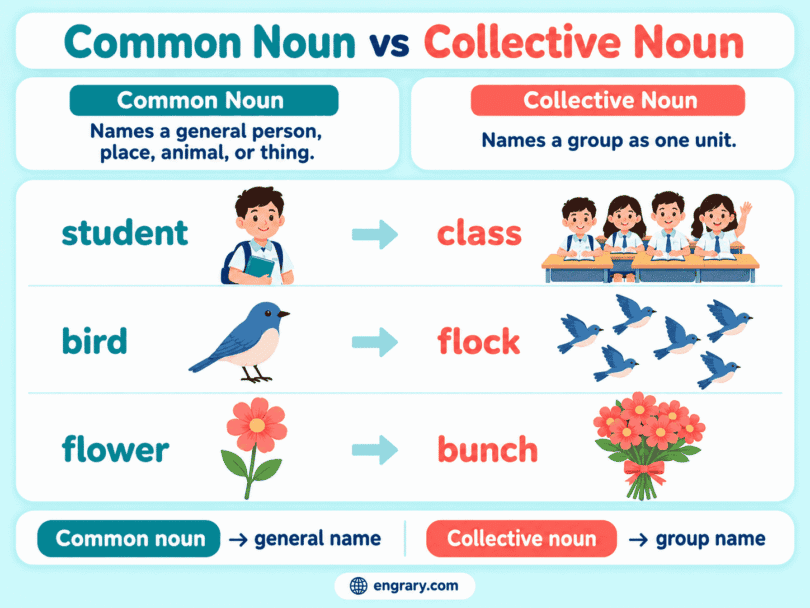
Common nouns and collective nouns describe nouns in different ways. A common noun gives a general name, while a collective noun names a group as one unit. Understanding the difference helps children recognize noun categories more accurately.
You’ll learn how common and collective nouns differ, why one noun can belong to both categories, how individual nouns compare with group nouns, and how collective nouns work in sentences.

General Name or Group Name? The Main Difference
A common noun gives a general name to a person, place, animal, thing, or idea.
Examples:
- student
- bird
- teacher
- book
- city
A collective noun names a group of people, animals, or things as one unit.
Examples:
- team
- flock
- class
- herd
- crowd
The main contrast is:
common noun → general name
collective noun → group name
For example:
player is a common noun.
team is a collective noun.
Similarly:
bird names an animal generally, while flock names a group of birds.
Why a Collective Noun Can Also Be a Common Noun
Common and collective nouns are not complete opposites.
The word common describes whether a noun gives a general rather than a specific name. By contrast, collective describes whether the noun refers to a group.
For example:
team
is a:
- common noun
- collective noun
- singular noun
- countable noun
Likewise, family is both a common noun and a collective noun.
Compare:
team → general name, so it is common
team → names a group, so it is also collective
Therefore, one noun can belong to several grammatical categories at the same time.
Individual Nouns vs Group Nouns
A useful way to understand collective nouns is to compare individual members with group names.
| Individual Noun | Collective Noun |
|---|---|
| player | team |
| student | class |
| singer | choir |
| sailor | crew |
| soldier | army |
| bird | flock |
| sheep | flock |
| cow | herd |
| wolf | pack |
| bee | swarm |
| person | crowd |
For example:
A player scored a goal.
The team celebrated.
The first noun focuses on one member. The second noun names the whole group.
Similarly:
A bird landed on the tree.
A flock crossed the sky.
Common and Collective Nouns for People
Many collective nouns name groups of people.
| Common Noun | Collective Noun |
|---|---|
| player | team |
| student | class |
| singer | choir |
| sailor | crew |
| soldier | army |
| person | crowd |
| member | committee |
| actor | cast |
For example:
The student entered the room.
The class listened quietly.
By contrast, student names an individual generally, while class names a group of students.
Another example:
A singer stepped onto the stage.
The choir began to sing.
Common and Collective Nouns for Animals
Collective nouns often name groups of animals.
| Common Noun | Collective Noun |
|---|---|
| bird | flock |
| sheep | flock |
| cow | herd |
| elephant | herd |
| wolf | pack |
| bee | swarm |
| fish | shoal |
| lion | pride |
For instance:
A cow left the field.
The herd moved toward the river.
Similarly:
A bee landed on the flower.
A swarm gathered near the tree.
Common group words such as flock, herd, pack, and swarm are more useful for beginners than rare traditional collective terms.
Common and Collective Nouns for Things
Collective nouns can also name groups of objects.
| Common Noun | Collective Noun |
|---|---|
| flower | bunch |
| key | bunch |
| card | pack |
| tool | set |
| plate | set |
| book | collection |
For example:
A flower lay on the table.
She carried a bunch of flowers.
Likewise:
One card fell onto the floor.
He opened a pack of cards.
The collective noun names the group rather than one individual item.
Common and Collective Nouns in Sentences
The following examples show both noun types in context.
| Sentence | Common Noun | Collective Noun |
|---|---|---|
| The player joined the team. | player | team |
| A student entered the class. | student | class |
| The bird returned to the flock. | bird | flock |
| A cow left the herd. | cow | herd |
| The singer joined the choir. | singer | choir |
| The sailor returned to the crew. | sailor | crew |
| A bee flew away from the swarm. | bee | swarm |
| The actor joined the cast. | actor | cast |
These sentences show that common and collective nouns can appear together naturally.
Is a Collective Noun Singular or Plural?
A collective noun often has a singular form even though it refers to several members.
Examples:
- team
- family
- class
- committee
- audience
- crew
When the group acts as one unit, a singular verb is common.
For example:
The team is ready.
The class is quiet.
The family lives nearby.
However, some varieties of English, especially British English, may use a plural verb when the individual members are emphasized.
For example:
The team are arguing among themselves.
For beginner use, the simplest rule is:
collective group acting as one unit → singular verb is usually appropriate
Collective Noun vs Plural Noun
A collective noun and a plural noun can both refer to more than one member, but they do so differently.
A plural noun names several individuals.
A collective noun names the group as one unit.
| Plural Noun | Collective Noun |
|---|---|
| players | team |
| students | class |
| singers | choir |
| birds | flock |
| cows | herd |
| sailors | crew |
Compare:
The players are warming up.
The team is warming up.
Similarly:
The birds are flying.
The flock is flying overhead.
The plural noun focuses on the members, while the collective noun focuses on the group.
How to Identify Common and Collective Nouns
A simple two-step check can help.
First, ask:
Does the noun give a general name?
Examples:
- teacher
- bird
- city
- book
- team
If yes, it is a common noun.
Next, ask:
Does the noun name a group as one unit?
Examples:
- team
- class
- flock
- herd
- crowd
If yes, it is also a collective noun.
For example:
bird → common noun
flock → common + collective noun
Likewise:
student → common noun
class → common + collective noun
Common Mistakes With Common and Collective Nouns
| Mistake | Correct Understanding |
|---|---|
| Common and collective nouns are opposites. | They describe different noun features. |
| A collective noun cannot be common. | Many collective nouns are also common nouns. |
| Collective nouns are always plural. | Many have singular form with group meaning. |
| Students and class are the same grammatically. | Students is plural; class is collective. |
| Every animal group needs a rare special name. | Common words such as flock, herd, pack, and group are enough. |
| Collective nouns always take plural verbs. | Agreement depends on meaning and variety of English. |
For example, students is a plural common noun, while class is a collective noun.
Similarly, birds refers to several individual birds, while flock refers to the group.
FAQs
A common noun gives a general name, while a collective noun names a group as one unit. For example, player is a common noun, while team is a collective noun.
Yes. Words such as team, family, class, and crowd are usually common nouns because they are general names and collective nouns because they name groups.
Examples include student → class, player → team, bird → flock, cow → herd, singer → choir, and sailor → crew.
A collective noun is often singular in form even though it refers to several members. For example, team is singular in form and can take a singular verb when the group acts as one unit.
A plural noun names several individuals, while a collective noun names those individuals as one group. For example, players is plural, while team is collective.
You May Also Like