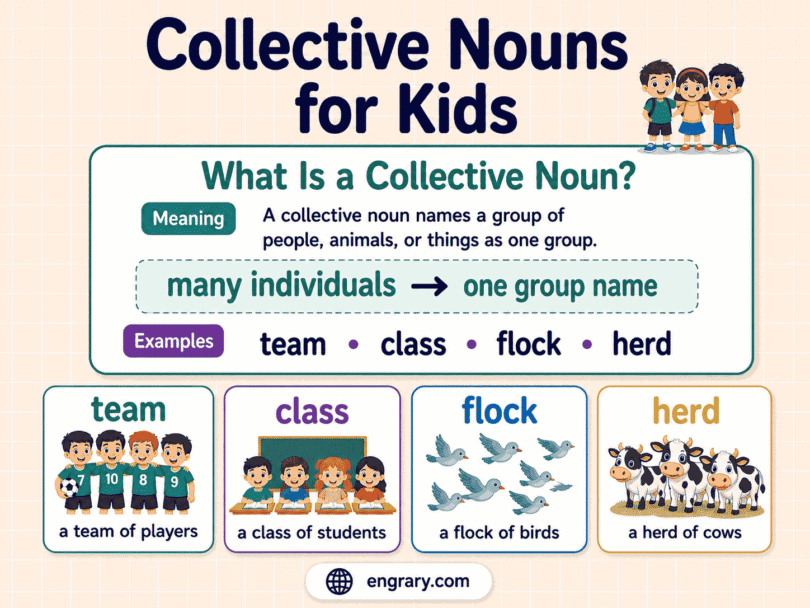
Collective nouns help children name groups of people, animals, and things with a single word. Understanding them makes sentences clearer and helps students build stronger vocabulary, especially when they describe groups such as a team of players, a flock of birds, or a deck of cards.
You’ll learn what collective nouns are, how one noun can represent a whole group, and which collective nouns commonly name people, animals, and things. You’ll also compare collective and plural nouns, learn how collective nouns work with verbs, and practice using them correctly in sentences.
What Is a Collective Noun?
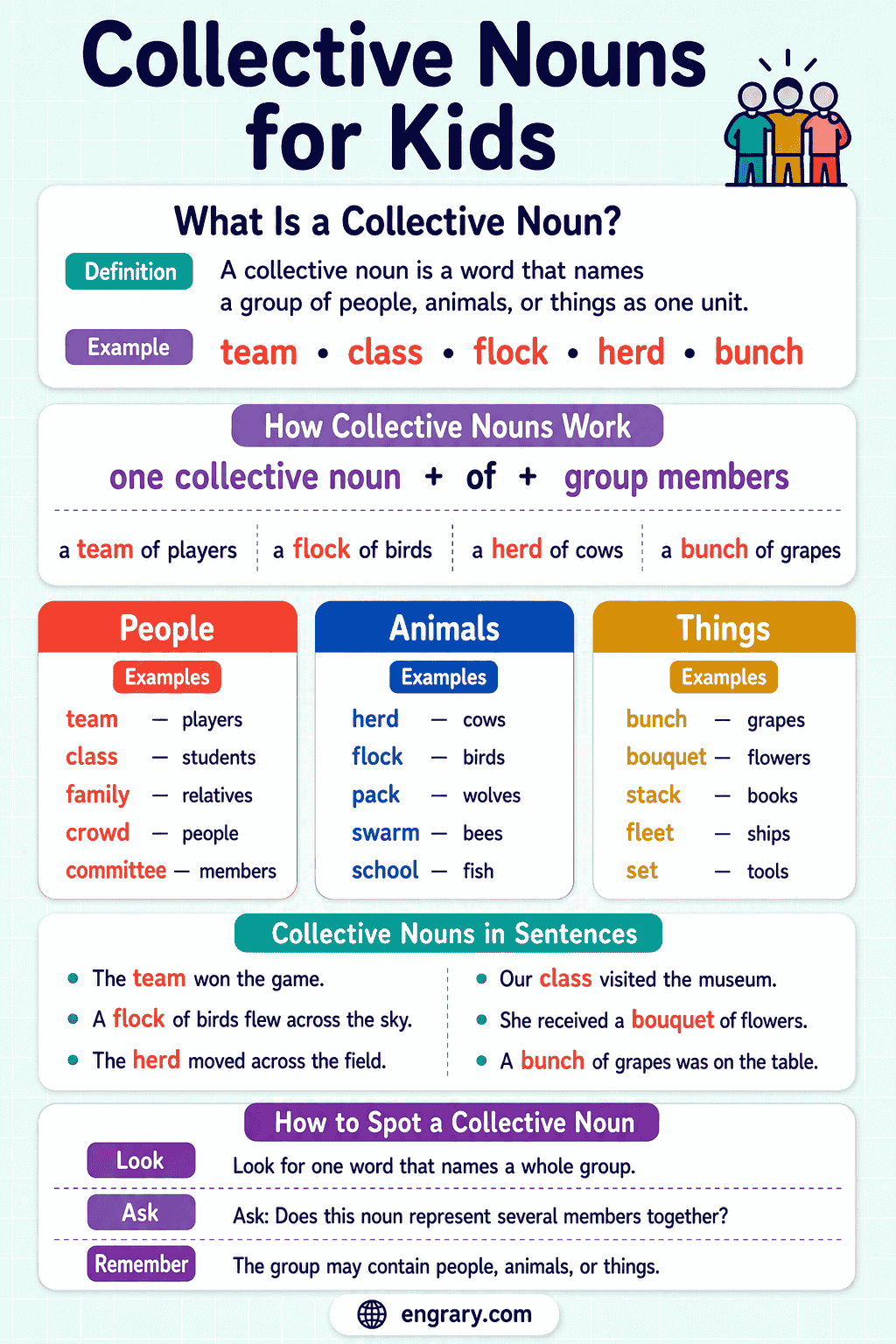
A collective noun is a noun that names a group of people, animals, or things as one group.
For example:
Our team won the game.
The word team refers to several players, but it names them together as one group.
Other common examples include:
- class;
- family;
- crowd;
- flock;
- herd;
- pack;
- bouquet;
- fleet;
- deck.
Collective nouns are useful because we do not always need to name every member of a group separately.
Instead of saying:
All the individual players practiced together.
we can say:
The team practiced together.
How One Word Can Name a Whole Group
A collective noun turns many individual members into one group idea.
For example:
players → team
students → class
singers → choir
birds → flock
wolves → pack
ships → fleet
The individual nouns are usually plural because they name several separate people, animals, or things.
The collective noun names the group itself.
Compare:
The players are practicing.
Here, players is a plural noun.
The team is practicing.
Here, team is a collective noun naming the players as one group.
This idea is the key to understanding collective nouns:
Many members can be named by one group noun.
Common Collective Nouns for Kids
Here are some familiar collective nouns children often see in school, books, and everyday English.
| Members | Collective Noun | Example Phrase |
|---|---|---|
| players | team | a team of players |
| students | class | a class of students |
| singers | choir | a choir of singers |
| people | crowd | a crowd of people |
| birds | flock | a flock of birds |
| cows | herd | a herd of cows |
| wolves | pack | a pack of wolves |
| lions | pride | a pride of lions |
| fish | school | a school of fish |
| bees | swarm | a swarm of bees |
| cards | deck | a deck of cards |
| flowers | bouquet | a bouquet of flowers |
| ships | fleet | a fleet of ships |
| books | stack | a stack of books |
| grapes | bunch | a bunch of grapes |
These examples show that collective nouns can describe many different kinds of groups.
Collective Nouns for People
Many collective nouns name groups of people who live, work, learn, perform, or do something together.
Team
A team is a group of people who play or work together.
Our team practices after school.
A team of players entered the field.
Class
A class is a group of students learning together.
The class is studying science.
A class of students visited the museum.
Family
A family is a group of related people.
My family lives nearby.
The whole family attended the picnic.
Crowd
A crowd is a large group of people gathered in one place.
A crowd waited outside the stadium.
Choir
A choir is a group of singers who perform together.
The choir sang at the school concert.
Crew
A crew is a group of people working together, often on a ship, plane, or project.
The crew prepared the boat.
Audience
An audience is a group of people watching or listening to a performance, speech, or event.
The audience clapped loudly.
Committee
A committee is a group of people chosen to discuss, plan, or make decisions about something.
The committee meets every Friday.
These words name groups, but each group contains individual people.
Collective Nouns for Animals
Animal collective nouns are especially interesting because different kinds of animals often have different group names.
Flock
A flock commonly refers to a group of birds or sheep.
A flock of birds flew across the sky.
We saw a flock of sheep in the field.
Herd
A herd names a group of many large land animals.
Examples include:
- a herd of cows;
- a herd of elephants;
- a herd of deer.
A herd of elephants walked toward the river.
Pack
A pack commonly refers to animals such as wolves or wild dogs.
A pack of wolves moved through the forest.
Pride
A pride is a well-known collective noun for lions.
A pride of lions rested under a tree.
School
A school can name a group of fish swimming together.
A school of fish moved through the water.
Swarm
A swarm often names a large group of flying insects.
A swarm of bees flew near the flowers.
Colony
A colony can describe animals that live together in an organized group.
A colony of ants lived beneath the rock.
Litter
A litter names a group of young animals born to the same mother at one time.
The dog had a litter of puppies.
Troop
A troop can refer to a group of monkeys.
A troop of monkeys moved through the trees.
Some animals have several accepted group names. For children, it is better to learn the most common terms first rather than memorize large lists of unusual traditional names.
Collective Nouns for Things
Collective nouns can also name groups of objects.
Deck
A deck is a set of playing cards.
Noah shuffled a deck of cards.
Bouquet
A bouquet is a group of flowers arranged together.
Mia carried a bouquet of flowers.
Bunch
A bunch can name objects naturally grouped or held together.
Examples include:
- a bunch of grapes;
- a bunch of bananas;
- a bunch of keys.
We bought a bunch of grapes.
Fleet
A fleet is a group of ships or other vehicles operating together.
A fleet of ships sailed across the sea.
Stack
A stack is a group of objects placed one on top of another.
A stack of books sat on the desk.
Set
A set is a group of related things that belong or are used together.
Dad bought a new set of tools.
Collection
A collection is a group of similar things gathered together.
Ava has a collection of stamps.
Pile
A pile is a group of things placed together, often without careful arrangement.
A pile of clothes lay on the chair.
Learning collective nouns for things helps children recognize that collective nouns are not limited to people and animals.
The “A ___ of ___” Pattern
Many collective nouns appear in a useful structure:
a + collective noun + of + plural noun
For example:
- a flock of birds;
- a herd of cows;
- a pack of wolves;
- a school of fish;
- a swarm of bees;
- a choir of singers;
- a deck of cards;
- a bouquet of flowers.
Look at:
A flock of birds flew over the lake.
The collective noun is flock.
The phrase of birds tells us which members belong to the flock.
Another example:
Mia received a bouquet of flowers.
The collective noun is bouquet, while flowers names the individual things in the group.
This pattern can help children recognize collective nouns inside longer sentences.
Collective Nouns vs. Plural Nouns
Collective nouns and plural nouns can both refer to more than one person, animal, or thing, but they work differently.
A plural noun names several individual members.
A collective noun names those members together as one group.
| Plural Noun | Collective Noun |
|---|---|
| players | team |
| students | class |
| singers | choir |
| people | crowd |
| birds | flock |
| wolves | pack |
| cows | herd |
| fish | school |
| ships | fleet |
Compare:
The players are wearing blue shirts.
The word players names the individuals.
The team is wearing blue uniforms.
The word team names the players as one group.
Another example:
The birds flew away.
Birds is plural.
The flock flew away.
Flock is a collective noun.
The difference is not how many members exist. The difference is whether the sentence names the individual members or the group as a whole.
Singular and Plural Collective Nouns
A collective noun can itself be singular or plural.
One group takes a singular collective noun:
- one team;
- one family;
- one class;
- one flock.
More than one group takes a plural collective noun:
- two teams;
- several families;
- three classes;
- many flocks.
Compare:
One team entered the tournament.
Eight teams entered the tournament.
The word team names one group.
The word teams names several different groups.
Another example:
Our family visited the park.
Several families visited the park.
Therefore, it is incorrect to say that collective nouns are always singular. A collective noun is singular when it names one group and plural when it names more than one group.
Subject-Verb Agreement With Collective Nouns
Collective nouns can sometimes cause confusion because one group contains many members.
In standard American English, a singular collective noun usually takes a singular verb when the group acts as one unit.
For example:
The team is ready.
The class is quiet.
Our family lives nearby.
The choir sings every Friday.
Although each group contains several members, the sentence treats the group as one unit.
Plural collective nouns take plural verbs:
The teams are ready.
Several families live nearby.
A useful beginner rule is:
One group → singular collective noun → usually singular verb
More than one group → plural collective noun → plural verb
English usage can vary when speakers emphasize the individual members of a group, and British English often uses collective nouns differently. However, children learning American English should first master the common one-group, singular-verb pattern.
Common Collective Noun Mistakes
The following mistakes often happen when children confuse a group with its individual members.
| Mistake | Better Form | Reason |
|---|---|---|
| A team means many people, so it must be plural. | Team can be singular. | It names one group. |
| The team are ready. | The team is ready. | One team is treated as one unit in basic American English. |
| players = collective noun | team = collective noun | Players names the individuals. |
| a flock of wolves | a pack of wolves | Pack is the common group noun for wolves. |
| a deck of flowers | a bouquet of flowers | Bouquet is the suitable group word. |
| Two team entered. | Two teams entered. | More than one group requires a plural collective noun. |
Some groups can have more than one accepted collective term, especially animals. Therefore, children should focus first on familiar, widely used expressions.
Collective Nouns Practice for Kids
Complete the activities before checking the answer key.
Find and Classify the Collective Noun
Find the collective noun and decide whether it names people, animals, or things.
- The team practiced after school.
- A flock flew across the sky.
- Mia carried a bouquet to her teacher.
- The choir sang beautifully.
- A herd crossed the field.
- Noah shuffled the deck.
- The class visited the library.
- A swarm flew around the flowers.
Match Groups and Collective Nouns
Match each group with the correct collective noun.
- players
- singers
- birds
- wolves
- fish
- cards
- flowers
- ships
Collective nouns:
a. fleet
b. pack
c. flock
d. bouquet
e. team
f. school
g. deck
h. choir
Choose the Correct Collective Noun
Choose the best answer.
- A (team / bouquet) of players entered the field.
- A (pack / deck) of wolves moved through the forest.
- A (choir / herd) of singers performed on stage.
- A (school / fleet) of fish swam near the reef.
- A (bouquet / swarm) of flowers sat on the table.
- A (fleet / class) of ships sailed from the harbor.
- A (herd / deck) of cows grazed in the field.
- A (swarm / team) of bees flew around the hive.
Complete the “A ___ of ___” Phrase
Complete each phrase with the correct collective noun.
- a ______ of birds
- a ______ of wolves
- a ______ of fish
- a ______ of cards
- a ______ of flowers
- a ______ of singers
- a ______ of cows
- a ______ of ships
Collective, Plural, or Singular?
For questions 1–4, decide whether the bold noun is a collective noun or an ordinary plural noun.
- The players practiced outside.
- The team practiced outside.
- The birds flew over the lake.
- The flock flew over the lake.
For questions 5–8, decide whether the collective noun is singular or plural.
- team
- teams
- families
- class
Choose the Correct Verb and Fix Mistakes
Choose the correct verb in questions 1–4.
- The team (is / are) ready.
- The class (is / are) quiet.
- The teams (plays / play) every Saturday.
- Several families (lives / live) nearby.
Rewrite questions 5–8 correctly.
- A flock of wolves moved through the forest.
- Two team entered the competition.
- The choir sing every Friday.
- Mia bought a deck of flowers.
Write Sentences With Collective Nouns
Write:
- one sentence using team;
- one sentence using flock;
- one sentence using pack;
- one sentence using bouquet;
- one sentence with a collective noun for people;
- one sentence with a collective noun for animals;
- one sentence with a collective noun for things.
Answer Key
Find and Classify the Collective Noun
- team — people
- flock — animals
- bouquet — things
- choir — people
- herd — animals
- deck — things
- class — people
- swarm — animals
Match Groups and Collective Nouns
- players — e. team
- singers — h. choir
- birds — c. flock
- wolves — b. pack
- fish — f. school
- cards — g. deck
- flowers — d. bouquet
- ships — a. fleet
Choose the Correct Collective Noun
- team
- pack
- choir
- school
- bouquet
- fleet
- herd
- swarm
Complete the “A ___ of ___” Phrase
- a flock of birds
- a pack of wolves
- a school of fish
- a deck of cards
- a bouquet of flowers
- a choir of singers
- a herd of cows
- a fleet of ships
Collective, Plural, or Singular?
- players — ordinary plural noun
- team — collective noun
- birds — ordinary plural noun
- flock — collective noun
- team — singular
- teams — plural
- families — plural
- class — singular
Choose the Correct Verb and Fix Mistakes
- is
- is
- play
- live
- A pack of wolves moved through the forest.
- Two teams entered the competition.
- The choir sings every Friday.
- Mia bought a bouquet of flowers.
Write Sentences With Collective Nouns
Answers will vary. Possible answers include:
- Our team won the game.
- A flock of birds flew over the lake.
- A pack of wolves moved through the forest.
- Mia carried a bouquet of flowers.
- The choir sang at the concert.
- A herd of cows crossed the field.
- Noah shuffled a deck of cards.
FAQs
A collective noun is one noun that names a group of people, animals, or things. For example, team names a group of players, while flock can name a group of birds.
Common examples include team, class, family, crowd, choir, flock, herd, pack, school, swarm, deck, bouquet, and fleet.
A collective noun can be either. Team is singular because it names one group, while teams is plural because it names more than one group.
A plural noun names several individual members, while a collective noun names those members together as a group. For example, players is plural, while team is collective.
In standard American English, the team is is usually preferred when the team acts as one unit. Other varieties of English may use plural agreement more often in some contexts.
You May Also Like