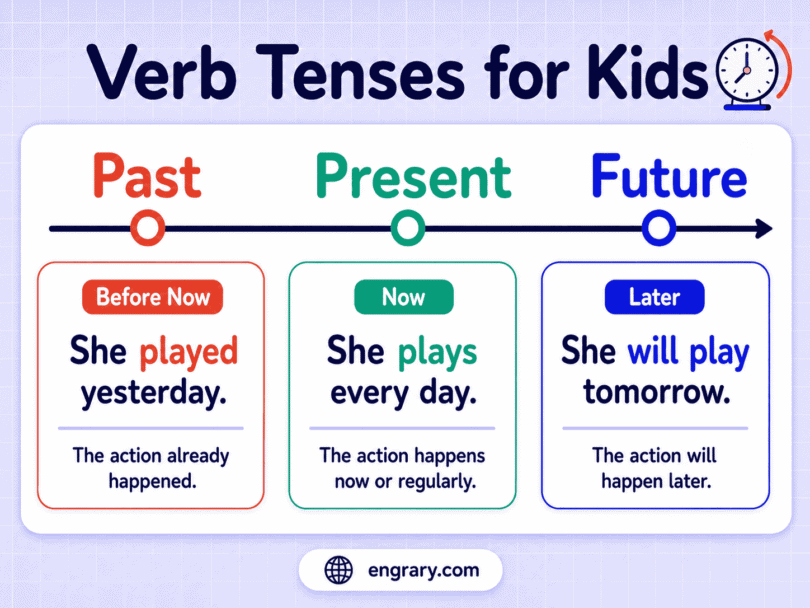
Verb tenses help children understand when an action or state happens. Once students can tell whether something happened in the past, happens in the present, or will happen in the future, they can write clearer sentences and avoid common tense mistakes.
You’ll learn how past, present, and future time work, how simple, progressive, perfect, and perfect progressive forms are organized, and how the commonly taught 12 verb tenses fit together. You’ll also practice identifying tense forms, choosing correct verbs, fixing tense consistency, and writing sentences in different tenses.
What Is Verb Tense?
Verb tense helps show when an action or state happens and how it relates to time.
Compare these sentences:
Mia plays outside every day.
Mia played outside yesterday.
Mia will play outside tomorrow.
The main action is play, but the verb changes to place the action in different time frames.
A simple way to think about tense is:
PAST ← PRESENT → FUTURE
- played → past
- plays → present
- will play → future
However, English verb forms can tell us more than just when something happens. They can also show whether an action is ongoing, completed before another time, or continuing over a period.
Past, Present, and Future Tenses
The easiest way to begin learning verb tenses is to understand the three main time frames.
Present Time
Present forms commonly describe:
- habits;
- routines;
- facts;
- general truths;
- actions happening now when progressive forms are used.
Examples:
Noah reads every night.
Birds fly.
Mia is reading now.
The first two sentences use simple present forms. The third uses present progressive because the action is happening now.
Past Time
Past forms describe actions or states before now.
Examples:
Mia walked home yesterday.
Noah went to the library.
The children were playing outside.
The first two describe completed past actions, while were playing describes an action that was in progress in the past.
Future Time
Future forms refer to time after now.
Examples:
We will visit Grandma tomorrow.
Mia will call later.
The children will be playing at noon.
The common beginner future pattern uses will + base verb, though English can express future time in several other ways too.
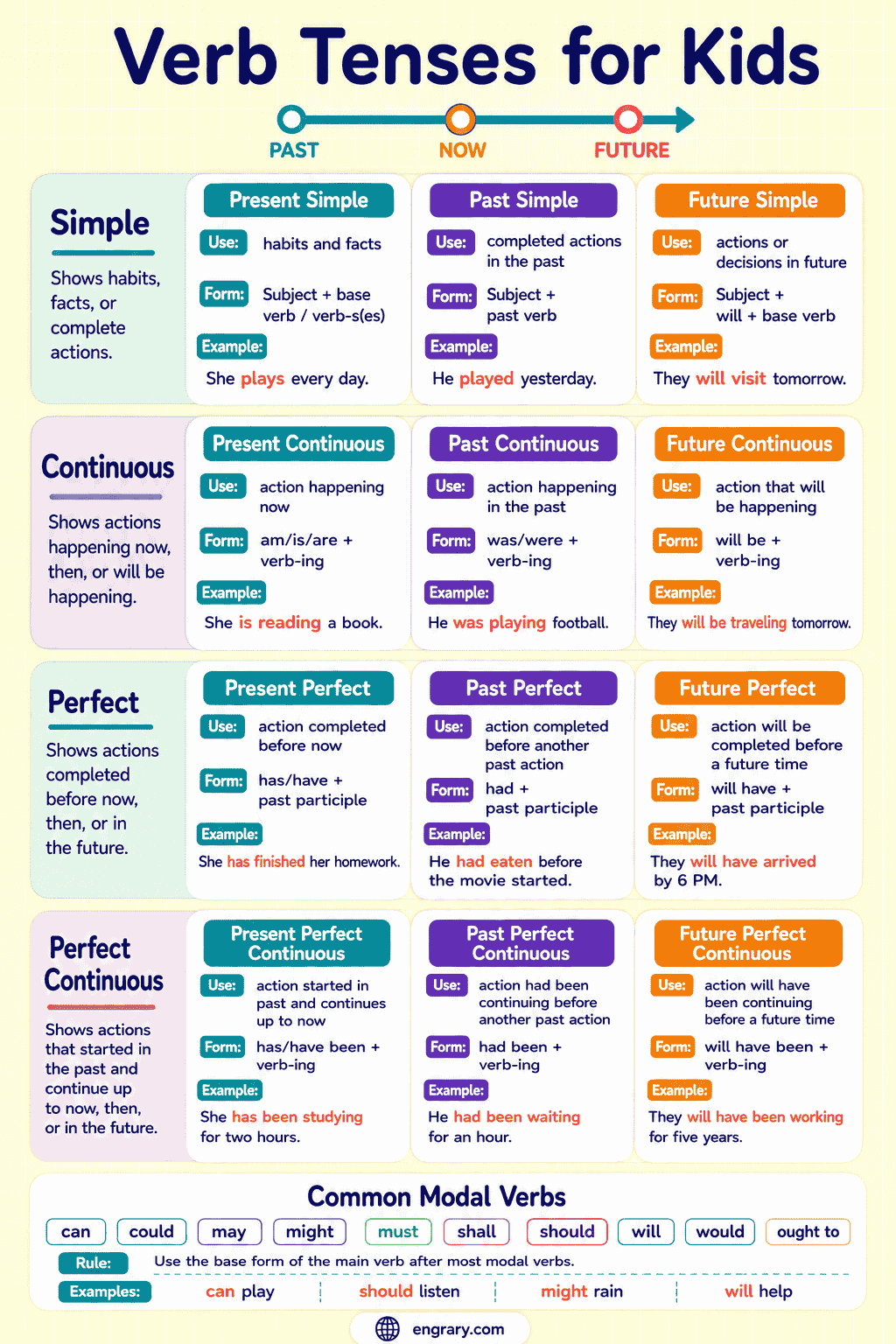
Simple, Progressive, Perfect, and Perfect Progressive Tenses
English lessons commonly organize verb tense forms into four main families:
- simple;
- progressive;
- perfect;
- perfect progressive.
Each family can be connected to present, past, or future time.
| Tense Family | Main Idea | Example |
|---|---|---|
| Simple | habits, facts, or straightforward actions | Mia plays. |
| Progressive | action in progress | Mia is playing. |
| Perfect | action connected to another point in time | Mia has played. |
| Perfect Progressive | action continuing over a period | Mia has been playing. |
Simple Tenses
Simple forms are often used for:
- routines;
- facts;
- completed past actions;
- straightforward future actions.
Examples:
- Mia plays.
- Mia played.
- Mia will play.
Progressive Tenses
Progressive forms show an action in progress around a particular time.
The basic pattern is:
form of be + verb-ing
Examples:
- is playing;
- was playing;
- will be playing.
The terms progressive and continuous are often used for the same family of verb forms.
Perfect Tenses
Perfect forms connect an action or state to another point in time.
Common patterns include:
- has/have + past participle;
- had + past participle;
- will have + past participle.
Examples:
- has finished;
- had finished;
- will have finished.
Perfect tense does not simply mean “finished.” The important idea is the time relationship between one action and another point.
Perfect Progressive Tenses
Perfect progressive forms combine a continuing action with a time relationship.
Examples:
- has been reading;
- had been reading;
- will have been reading.
These forms often emphasize duration or how long something has been happening.
12 Verb Tenses for Kids
English lessons often organize verb forms into 12 commonly taught tenses by combining three time frames with four tense families.
Using the verb play makes the pattern easier to see.
| Time | Simple | Progressive | Perfect | Perfect Progressive |
|---|---|---|---|---|
| Present | I play. | I am playing. | I have played. | I have been playing. |
| Past | I played. | I was playing. | I had played. | I had been playing. |
| Future | I will play. | I will be playing. | I will have played. | I will have been playing. |
This chart gives the big picture.
Children do not need to master every form at once. The most useful starting point is to understand:
- past, present, and future time;
- simple and progressive forms;
- perfect forms;
- perfect progressive forms last.
12 Verb Tense Formulas
The following formulas show how the commonly taught 12 tense forms are built.
| Tense | Basic Formula |
|---|---|
| Simple Present | base verb / verb-s |
| Present Progressive | am/is/are + verb-ing |
| Present Perfect | has/have + past participle |
| Present Perfect Progressive | has/have been + verb-ing |
| Simple Past | past form |
| Past Progressive | was/were + verb-ing |
| Past Perfect | had + past participle |
| Past Perfect Progressive | had been + verb-ing |
| Simple Future | will + base verb |
| Future Progressive | will be + verb-ing |
| Future Perfect | will have + past participle |
| Future Perfect Progressive | will have been + verb-ing |
Helping verbs such as be, have, and will help build many of these forms.
Most Common Verb Tenses for Kids
Children usually learn simple and progressive tenses first because they appear constantly in everyday speech and writing.
Simple Present and Present Progressive
The simple present commonly describes:
- habits;
- routines;
- facts;
- general truths.
Examples:
Mia walks to school every day.
Noah reads before bed.
Water freezes at 32°F.
With many ordinary verbs, he, she, it, and singular noun subjects take a verb ending in -s.
- she reads;
- they read;
- Noah plays;
- the children play.
The present progressive describes an action happening now or around the present time.
Formula:
am/is/are + verb-ing
Examples:
Mia is reading now.
The children are playing outside.
I am writing a story.
A useful comparison is:
Mia reads every night.
habit
Mia is reading now.
happening now
This is one of the most important tense differences for children to understand.
Simple Past and Past Progressive
The simple past commonly describes a completed action before now.
Examples:
Mia walked home yesterday.
Noah went to school.
Regular verbs often use -ed:
- play → played;
- help → helped.
Irregular verbs change differently:
- go → went;
- see → saw;
- eat → ate.
The past progressive describes an action that was in progress at a particular past time.
Formula:
was/were + verb-ing
Examples:
Mia was reading at 7:00.
The children were playing outside.
Compare:
The phone rang.
This is a completed event.
Mia was reading when the phone rang.
The reading was already in progress when the second event happened.
Simple Future
A common beginner future form uses:
will + base verb
Examples:
We will visit the museum tomorrow.
Noah will call later.
Mia will finish her homework tonight.
The main verb stays in its base form after will.
Correct:
Mia will play.
Incorrect:
Mia will plays.
English also uses other structures for future meaning, but will + base verb is the clearest pattern for a general tense overview.
Perfect Tenses
Perfect forms show a relationship between an action and another point in time.
They usually use a form of have plus a past participle.
Present Perfect Tense
Formula:
has/have + past participle
Examples:
Mia has finished her homework.
We have visited that museum before.
The present perfect connects a past action or experience to the present.
Compare:
Mia visited the museum yesterday.
This uses simple past and gives a specific finished past time.
Mia has visited the museum before.
This describes a past experience connected to the present without naming a specific finished time.
Past Perfect Tense
Formula:
had + past participle
Use past perfect when one past action happened before another past event.
Mia had finished her homework before dinner began.
Both events are in the past, but finishing the homework happened first.
A useful memory idea is:
Past perfect often shows the earlier of two past actions.
Another example:
The bus had left before we reached the stop.
Future Perfect Tense
Formula:
will have + past participle
Future perfect describes something expected to be completed before a future time.
Mia will have finished the book by Friday.
We will have arrived by noon.
This form is more advanced, so children only need to understand the basic idea in a general overview.
Perfect Progressive Tenses
Perfect progressive forms often emphasize how long an activity continues or continued.
Present Perfect Progressive
Formula:
has/have been + verb-ing
Mia has been reading for an hour.
The reading began earlier and continues into the present.
Past Perfect Progressive
Formula:
had been + verb-ing
Mia had been reading for an hour before dinner.
The activity continued for a period before another past event.
Future Perfect Progressive
Formula:
will have been + verb-ing
By noon, Mia will have been reading for two hours.
This form emphasizes duration up to a future point.
Perfect progressive forms are more advanced, so younger children do not need to master every detail immediately.
Time Words and Clues for Verb Tenses
Time words can help readers understand when an action happens.
Present-Time Clues
Common examples include:
- every day;
- usually;
- often;
- sometimes;
- always.
Example:
Mia usually walks to school.
Past-Time Clues
Common examples include:
- yesterday;
- last night;
- last week;
- ago.
Example:
Mia walked home yesterday.
Future-Time Clues
Common examples include:
- tomorrow;
- later;
- next week;
- soon.
Example:
Mia will visit us tomorrow.
However, time words are only clues.
The verb form gives stronger grammatical information.
For example:
Tomorrow, we leave at six.
The word tomorrow shows future time even though the verb appears in a present form.
Therefore, children should look at both the verb form and the meaning of the sentence.
How to Identify a Verb Tense
A simple process can help children identify tense forms.
- Find the complete verb or verb phrase.
- Look for helping verbs such as be, have, or will.
- Notice the main verb form.
- Decide whether the sentence relates mainly to present, past, or future time.
- Use time words as extra clues.
Consider:
Mia has been reading for an hour.
First, find the verb phrase:
has been reading
Next, notice:
- has been — helping verbs;
- reading — verb-ing form.
The sentence connects the action to the present and emphasizes duration.
Therefore, the form is present perfect progressive.
Now consider:
The children were playing outside.
- helping verb — were;
- main verb — playing;
- time — past;
- pattern — was/were + verb-ing.
So the tense is past progressive.
Verb Tense Consistency
Tense consistency means keeping verb tense logical throughout a sentence or passage.
Incorrect:
Yesterday, Mia walked to the park and sees a rabbit.
The sentence begins in past time but suddenly changes to present tense.
Correct:
Yesterday, Mia walked to the park and saw a rabbit.
Both actions happened in the past.
However, changing tense is correct when the time changes.
For example:
Mia walked home yesterday, but today she takes the bus.
The tense changes because the sentence moves from yesterday to today.
A useful rule is:
Keep the tense consistent unless the time of the action changes.
Common Verb Tense Mistakes
Children often make tense mistakes when they use the wrong verb form, helping verb, or time pattern.
| Incorrect | Correct | Why? |
|---|---|---|
| Yesterday, Mia walks home. | Yesterday, Mia walked home. | Use past tense for the finished past action. |
| They is playing. | They are playing. | Use are with a plural subject. |
| Noah has went home. | Noah has gone home. | Use the past participle after has. |
| Mia opened the door and walks inside. | Mia opened the door and walked inside. | Keep the past tense consistent. |
| She will plays tomorrow. | She will play tomorrow. | Use the base verb after will. |
| We was waiting. | We were waiting. | Use were with we. |
| He have finished. | He has finished. | Use has with he. |
Another common confusion involves simple present and present progressive.
For a regular habit:
Mia walks to school every day.
For an action happening now:
Mia is walking to school now.
The meaning of the sentence helps determine the best form.
Verb Tenses Practice for Kids
Complete the activities before checking the answer key.
Identify the Time and Tense
Identify the main time frame and tense form.
- Mia plays soccer every Saturday.
- Noah is reading now.
- Ava walked home yesterday.
- The children were playing outside.
- We will visit Grandma tomorrow.
- Mia has finished her homework.
- Noah had left before dinner.
- We will have arrived by noon.
Choose the Correct Verb Form
Choose the correct answer.
- Mia (walk / walks) to school every day.
- Yesterday, Mia (walks / walked) home.
- The children (play / are playing) outside right now.
- Noah (read / reads) every night.
- We (will visit / visited) the museum tomorrow.
- Ava (has finished / finished) her homework already.
- At 7:00 last night, Ben (was reading / read) a book.
- By Friday, Mia (will finish / will have finished) the project.
Simple or Progressive?
Identify each sentence as simple or progressive.
- Mia reads every night.
- Mia is reading now.
- Noah played outside yesterday.
- Noah was playing at noon.
- We will visit tomorrow.
- We will be traveling at 10:00.
Complete the Tense Form
Choose the correct helping verb or verb form.
- Mia ___ reading now.
is / has - They ___ playing outside yesterday at noon.
were / are - Noah has ___ his homework.
finish / finished - We will ___ tomorrow.
leave / left - Mia had ___ before dinner.
eaten / ate - They will have ___ by noon.
arrived / arrive - Ava has been ___.
study / studying - We were ___ when the rain started.
walk / walking
Match the 12 Tenses
Match each sentence to the correct tense name.
- I play.
- I am playing.
- I have played.
- I have been playing.
- I played.
- I was playing.
- I had played.
- I had been playing.
- I will play.
- I will be playing.
- I will have played.
- I will have been playing.
Tense names:
- Simple Present
- Present Progressive
- Present Perfect
- Present Perfect Progressive
- Simple Past
- Past Progressive
- Past Perfect
- Past Perfect Progressive
- Simple Future
- Future Progressive
- Future Perfect
- Future Perfect Progressive
Correct Tense and Consistency Mistakes
Rewrite each sentence correctly.
- Yesterday, Mia walks to school.
- Noah opened the door and walks inside.
- The children is playing outside.
- Ava has went home.
- We will visits Grandma tomorrow.
- Mia was read when the phone rang.
- He have finished his homework.
- They had ate before we arrived.
Write Sentences in Different Tenses
Write:
- one simple present sentence;
- one present progressive sentence;
- one simple past sentence;
- one past progressive sentence;
- one simple future sentence;
- one present perfect sentence;
- one sentence using two consistent past-tense verbs.
Answer Key
Identify the Time and Tense
- present — Simple Present
- present — Present Progressive
- past — Simple Past
- past — Past Progressive
- future — Simple Future
- present — Present Perfect
- past — Past Perfect
- future — Future Perfect
Choose the Correct Verb Form
- walks
- walked
- are playing
- reads
- will visit
- has finished
- was reading
- will have finished
Simple or Progressive?
- simple
- progressive
- simple
- progressive
- simple
- progressive
Complete the Tense Form
- is
- were
- finished
- leave
- eaten
- arrived
- studying
- walking
Match the 12 Tenses
- Simple Present
- Present Progressive
- Present Perfect
- Present Perfect Progressive
- Simple Past
- Past Progressive
- Past Perfect
- Past Perfect Progressive
- Simple Future
- Future Progressive
- Future Perfect
- Future Perfect Progressive
Correct Tense and Consistency Mistakes
- Yesterday, Mia walked to school.
- Noah opened the door and walked inside.
- The children are playing outside.
- Ava has gone home.
- We will visit Grandma tomorrow.
- Mia was reading when the phone rang.
- He has finished his homework.
- They had eaten before we arrived.
Write Sentences in Different Tenses
Answers will vary. Possible answers include:
- Mia reads every night.
- Mia is reading now.
- Mia walked home yesterday.
- Mia was reading at 7:00.
- Mia will visit Grandma tomorrow.
- Mia has finished her homework.
- Mia opened the door and walked inside.
FAQs
Verb tenses are verb forms that help show when an action or state happens and how it relates to time. Children usually begin with past, present, and future time.
The three main time frames are past, present, and future. Past refers to before now, present relates to now or general time, and future refers to after now.
English lessons commonly organize verb forms into 12 tense patterns: four present forms, four past forms, and four future forms. Each group includes simple, progressive, perfect, and perfect progressive forms.
Find the complete verb phrase, look for helping verbs, notice the main verb form, decide whether the sentence relates to past, present, or future time, and use time words as extra clues.
Simple forms often describe habits, facts, or straightforward actions, while progressive forms emphasize an action in progress. For example, Mia reads every night is simple present, while Mia is reading now is present progressive.
You May Also Like