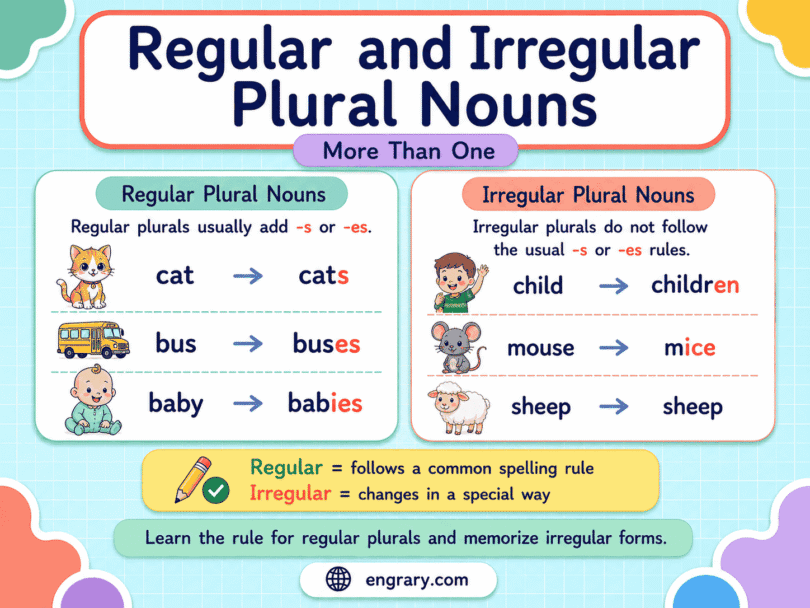
Plural nouns name more than one person, place, animal, thing, or idea. Some plural nouns follow familiar spelling rules, while others change in unusual ways or stay exactly the same.
Learning the difference between regular and irregular plural nouns helps children spell words correctly, recognize common patterns, and use nouns properly in sentences. This guide explains the main rules, important exceptions, common examples, mistakes, and practice activities with answers.
What Are Regular and Irregular Plural Nouns?
A regular plural noun follows a familiar spelling pattern when it changes from singular to plural.
Examples include:
- cat → cats;
- box → boxes;
- baby → babies;
- toy → toys.
An irregular plural noun does not follow the usual plural spelling patterns.
Examples include:
- child → children;
- mouse → mice;
- person → people;
- tooth → teeth;
- sheep → sheep.
A Quick Review of Singular and Plural Nouns
A singular noun names one person, place, animal, thing, or idea.
A plural noun usually names more than one.
| Singular | Plural |
|---|---|
| one book | two books |
| one child | three children |
| one mouse | several mice |
| one sheep | five sheep |
The plural form may follow a regular spelling rule, change irregularly, or stay unchanged.
Regular Plurals Follow Familiar Spelling Rules
Regular plural nouns use recognizable patterns.
For example:
- book becomes books by adding -s;
- box becomes boxes by adding -es;
- baby becomes babies by changing y to i and adding -es;
- key becomes keys by adding -s.
Regular does not mean that every word simply adds -s. It means the noun follows a known spelling rule.
Irregular Plurals Change in Special Ways
Irregular plural nouns do not follow the main productive spelling rules.
They may:
- change one or more vowels;
- use a special ending;
- change into a different form;
- remain unchanged.
Examples:
| Type of Change | Singular | Plural |
|---|---|---|
| vowel change | man | men |
| special ending | child | children |
| different form | person | people |
| no change | deer | deer |
Because irregular plurals are less predictable, children often need to learn them individually or in small groups.
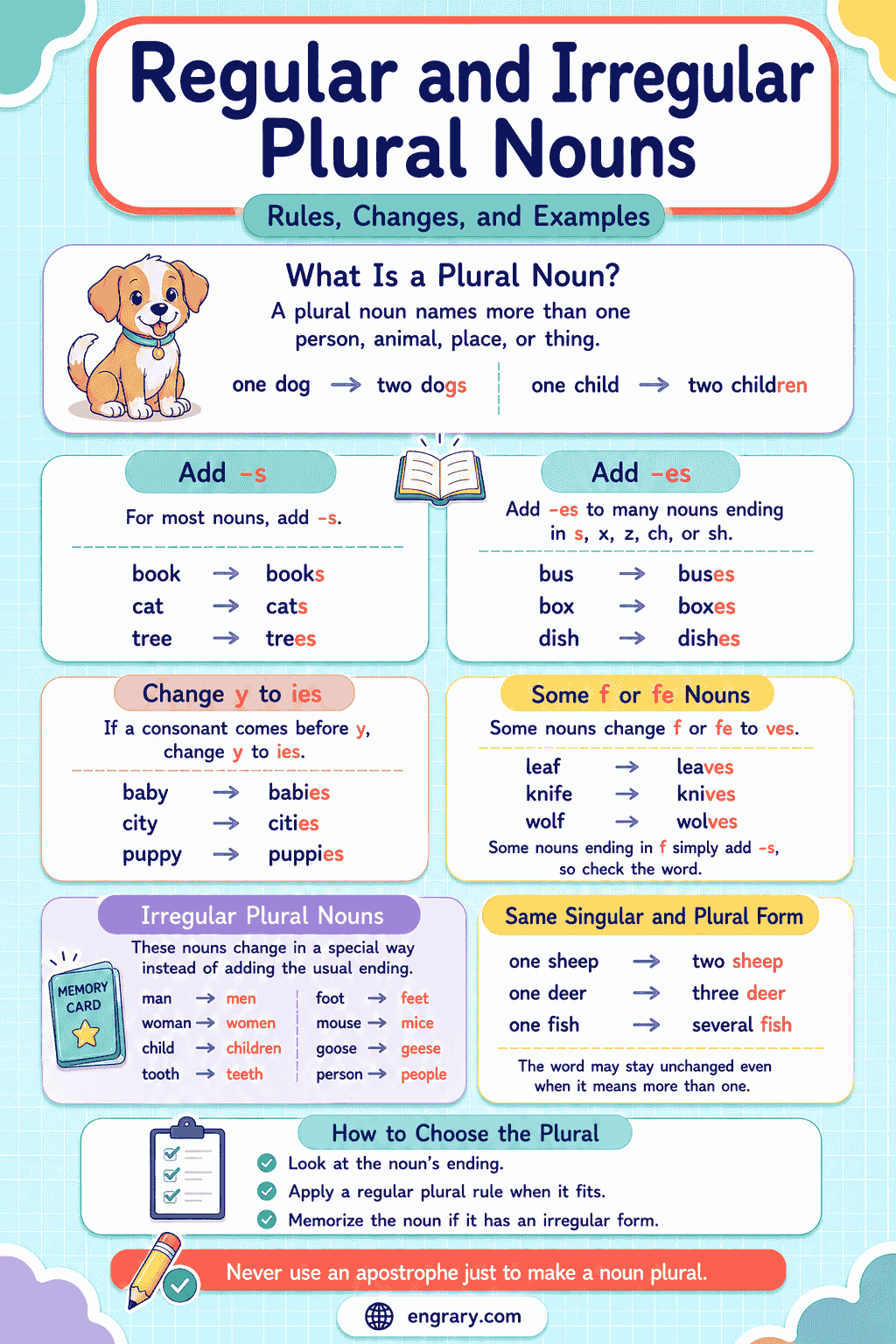
How Regular and Irregular Plurals Are Different
The main difference is whether the noun follows a familiar plural spelling pattern.
| Regular Plural Nouns | Irregular Plural Nouns |
|---|---|
| follow a known spelling rule | do not follow the usual rules |
| often use -s, -es, or -ies | may change vowels or use special forms |
| cat → cats | child → children |
| box → boxes | mouse → mice |
| baby → babies | person → people |
| toy → toys | sheep → sheep |
A useful way to decide is to ask:
- Does the noun follow a familiar plural rule?
- Does it change in an unusual way?
- Does it stay the same?
If the noun follows a recognized spelling rule, it is regular. If it changes unusually or does not change at all, it is irregular.
Regular Plural Noun Rules
Most English nouns form their plurals through a small number of common spelling patterns.
Add -s to Most Nouns
For most singular nouns, add -s.
| Singular | Plural |
|---|---|
| cat | cats |
| book | books |
| chair | chairs |
| tree | trees |
| teacher | teachers |
| idea | ideas |
Examples in sentences:
One cat is sleeping.
Two cats are sleeping.
Another example is:
The teacher reads a book.
The teachers read books.
This is the most common regular plural rule.
Add -es After s, x, z, ch, and sh
Nouns ending in s, x, z, ch, or sh usually add -es.
| Singular | Plural |
|---|---|
| bus | buses |
| box | boxes |
| quiz | quizzes |
| watch | watches |
| dish | dishes |
| brush | brushes |
The extra ending often creates another spoken syllable.
Compare:
- box → boxes;
- dish → dishes;
- watch → watches.
The word quiz doubles its final z before adding -es:
quiz → quizzes
Sentence examples:
- One bus is waiting.
- Three buses are waiting.
- The dish is clean.
- The dishes are clean.
Nouns Ending in Consonant + Y
When a noun ends in a consonant followed by y, change the y to i and add -es.
| Singular | Plural |
|---|---|
| baby | babies |
| city | cities |
| puppy | puppies |
| story | stories |
| lady | ladies |
A simple rule is:
Consonant + y: change the y to i and add es.
Examples:
- The baby is smiling.
- The babies are smiling.
- Mia read one story.
- Mia read several stories.
Nouns Ending in Vowel + Y
When a vowel comes before y, keep the y and add -s.
| Singular | Plural |
|---|---|
| toy | toys |
| key | keys |
| boy | boys |
| day | days |
| monkey | monkeys |
Compare the two patterns:
| Consonant + Y | Vowel + Y |
|---|---|
| baby → babies | toy → toys |
| city → cities | key → keys |
| puppy → puppies | monkey → monkeys |
Children should not write toies or keies. The correct forms are toys and keys.
Plurals of Nouns Ending in F or FE
Some nouns ending in f or fe change to -ves.
| Singular | Plural |
|---|---|
| leaf | leaves |
| wolf | wolves |
| knife | knives |
| wife | wives |
| life | lives |
However, many nouns in this group simply add -s.
| Singular | Plural |
|---|---|
| roof | roofs |
| chef | chefs |
| belief | beliefs |
| cliff | cliffs |
Therefore, the rule is not universal.
A safe child-level explanation is:
Some nouns ending in f or fe change to ves, but others add s. Common forms often need to be learned individually.
Examples in sentences:
- One leaf fell from the tree.
- Several leaves covered the ground.
- The chef prepared lunch.
- Two chefs prepared lunch.
Plurals of Nouns Ending in O
Some nouns ending in o add -es.
| Singular | Plural |
|---|---|
| tomato | tomatoes |
| potato | potatoes |
| hero | heroes |
| echo | echoes |
Others add only -s.
| Singular | Plural |
|---|---|
| piano | pianos |
| photo | photos |
| radio | radios |
| zoo | zoos |
There is no single beginner rule that works for every noun ending in o. Learning familiar examples is the most reliable approach.
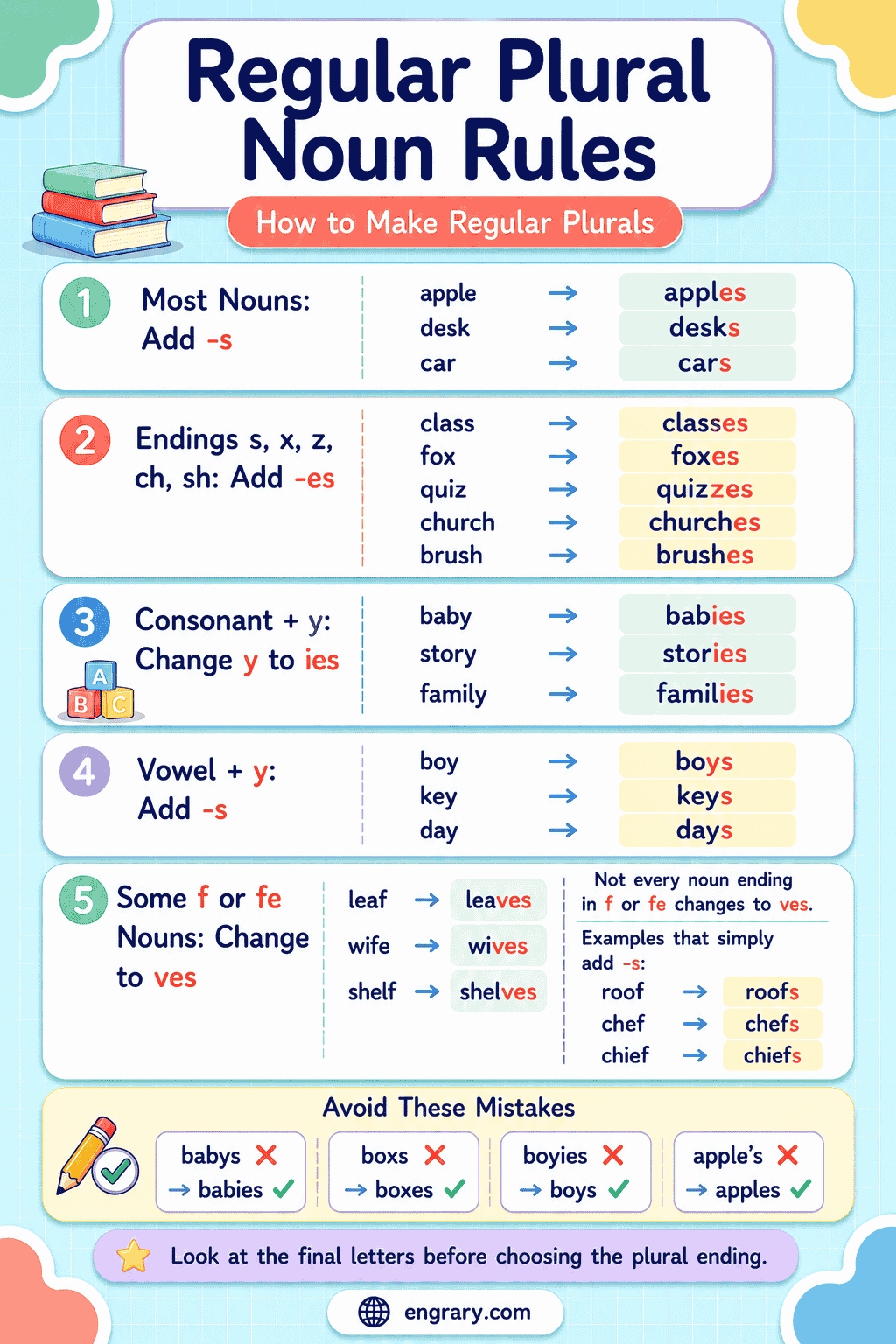
Irregular Plural Nouns
Irregular plural nouns do not follow the usual regular spelling rules. Their forms must often be remembered.
However, some irregular plurals can be grouped by the kind of change they make.
Irregular Plurals With Vowel Changes
Several common irregular nouns change one or more vowels.
| Singular | Plural |
|---|---|
| man | men |
| woman | women |
| foot | feet |
| tooth | teeth |
| goose | geese |
| mouse | mice |
Examples in sentences:
- One man is waiting outside.
- Two men are waiting outside.
- The child lost one tooth.
- The children lost two teeth.
- A goose is near the pond.
- Three geese are near the pond.
These groups can help children remember familiar words, but the patterns should not be applied to every noun.
For example:
- foot becomes feet;
- book does not become beek.
Irregular Plurals With Special Forms
Some nouns use special endings or completely different plural forms.
| Singular | Plural |
|---|---|
| child | children |
| ox | oxen |
| person | people |
Examples:
- One child is reading.
- Several children are reading.
- An ox pulled the cart.
- Two oxen pulled the cart.
- One person entered the room.
- Many people entered the room.
In everyday English, people is the usual plural of person. The form persons may appear in formal, legal, or official language.
Common Irregular Plural Nouns
The following high-frequency forms are useful to learn as complete word pairs.
| Singular | Plural |
|---|---|
| child | children |
| person | people |
| man | men |
| woman | women |
| foot | feet |
| tooth | teeth |
| goose | geese |
| mouse | mice |
| ox | oxen |
Reading and using these words in sentences makes them easier to remember.
Nouns That Stay the Same
Some irregular nouns have the same singular and plural form.
| Singular | Plural |
|---|---|
| one sheep | two sheep |
| one deer | several deer |
| one fish | many fish |
| one aircraft | three aircraft |
| one species | several species |
The surrounding words and verbs show whether the noun is singular or plural.
Compare:
One sheep is grazing.
Five sheep are grazing.
Another example is:
A deer runs across the field.
Two deer run across the field.
Children should not usually write:
- sheeps;
- deers;
- aircrafts.
In everyday English, fish is the usual plural when talking about more than one fish.
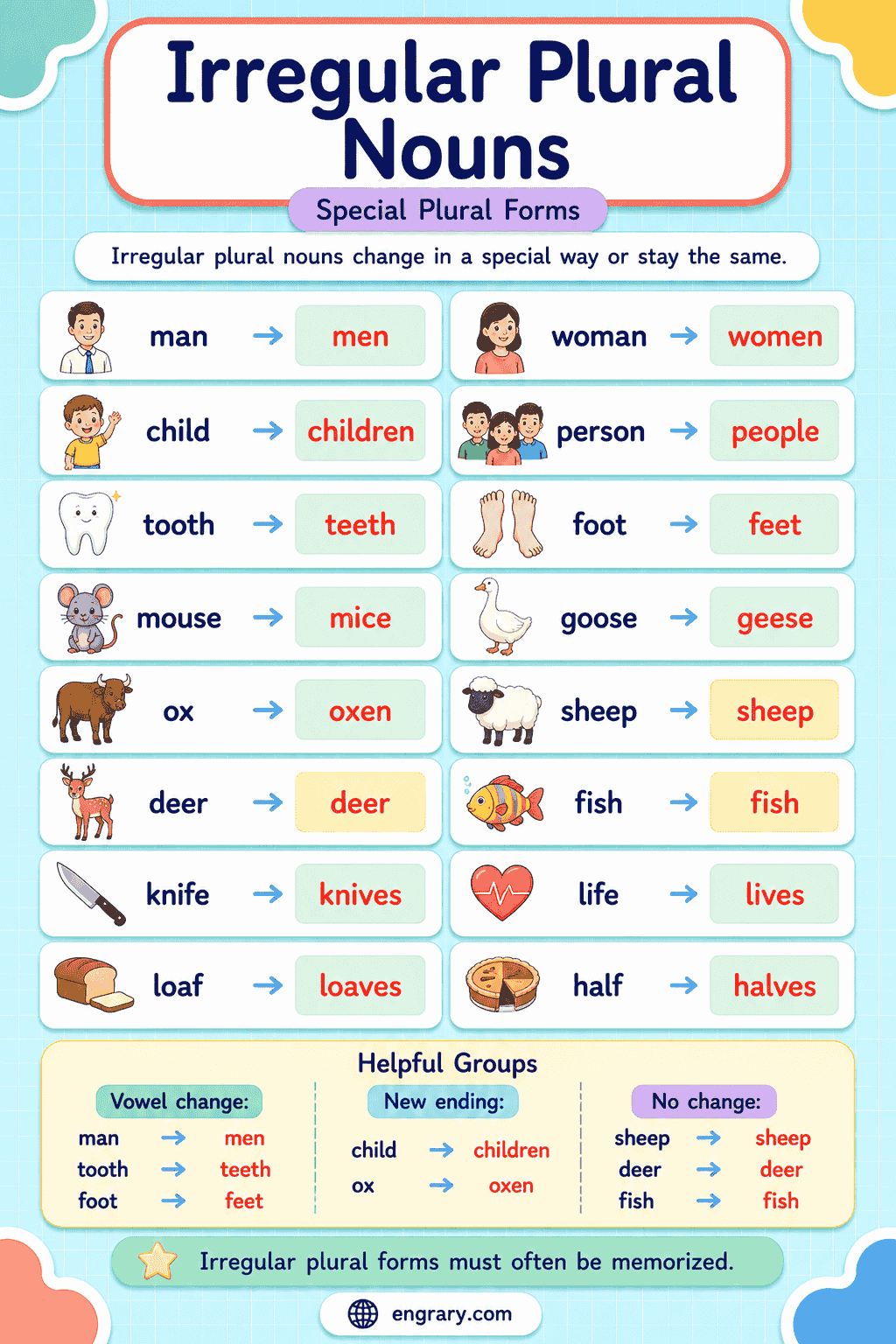
Using Regular and Irregular Plurals in Sentences
Learning plural spelling is important, but children also need to use plural nouns correctly in complete sentences.
Matching Plural Nouns and Verbs
A singular noun usually takes a singular verb, while a plural noun takes a plural verb.
| Singular Sentence | Plural Sentence |
|---|---|
| The child is reading. | The children are reading. |
| The goose has a nest. | The geese have nests. |
| The dog runs quickly. | The dogs run quickly. |
| The deer moves quietly. | The deer move quietly. |
Notice that plural nouns and present-tense verbs often behave differently.
A plural noun may end in -s:
dogs
However, the plural verb often does not:
dogs run
Compare:
- The dog runs.
- The dogs run.
- The student writes.
- The students write.
Changing Nouns and Verbs Together
When a singular noun becomes plural, other words in the sentence may need to change too.
Singular:
The child is holding a toy.
Plural:
The children are holding toys.
Another example:
This goose has a nest.
Plural:
These geese have nests.
A third pair is:
The deer runs through the field.
The deer run through the field.
In the final example, the noun spelling stays the same, but the verb changes.
Changing Plural Nouns Back to Singular
Children should practice changing plural nouns back into their singular forms.
| Plural | Singular |
|---|---|
| cats | cat |
| boxes | box |
| babies | baby |
| leaves | leaf |
| children | child |
| mice | mouse |
| feet | foot |
| sheep | sheep |
Reverse practice helps children understand the original spelling pattern.
Examples:
- stories → story;
- knives → knife;
- tomatoes → tomato;
- people → person;
- geese → goose;
- deer → deer.
When changing a whole sentence, remember to change the verb and nearby words as well.
Plural:
These children are reading books.
Singular:
This child is reading a book.
Common Regular and Irregular Plural Mistakes
| Incorrect | Correct | Explanation |
|---|---|---|
| boxs | boxes | add -es after x |
| babys | babies | consonant + y changes to -ies |
| toies | toys | vowel + y takes -s |
| childs | children | irregular plural |
| mouses | mice | irregular plural |
| sheeps | sheep | the form stays unchanged |
| leafs | leaves | this common noun changes to -ves |
| rooves | roofs | this noun adds -s |
| potatos | potatoes | this noun commonly adds -es |
| photoes | photos | this noun adds -s |
| the children is | the children are | plural noun needs a plural verb |
| the deer runs | the deer run | plural meaning requires a plural verb |
Plural Nouns Do Not Usually Need Apostrophes
An apostrophe does not normally make a noun plural.
Correct:
- cats;
- boxes;
- babies;
- children.
Incorrect when simply meaning more than one:
- cat’s;
- box’s;
- baby’s;
- child’s.
Compare:
- cats — more than one cat;
- cat’s bowl — the bowl belonging to one cat.
Possessive nouns use apostrophes, but ordinary plural nouns usually do not.
Regular and Irregular Plural Nouns Practice
Complete the activities before checking the answer key.
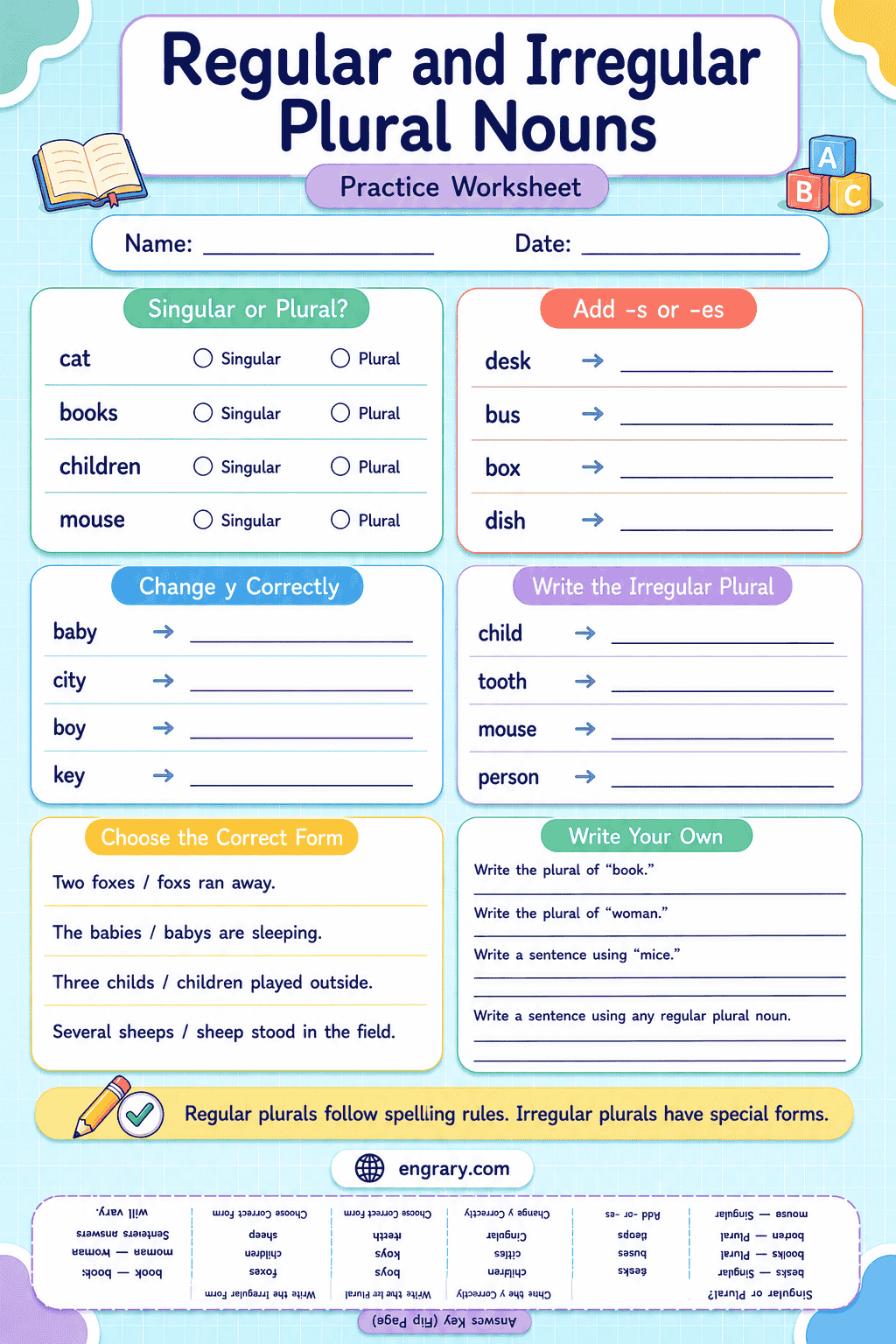
Identify Regular and Irregular Plurals
Write regular, irregular, or unchanged.
- cats
- boxes
- children
- mice
- sheep
- babies
- teeth
- deer
- keys
- people
Regular or Irregular Plural?
Choose the correct answer.
- books
a. regular
b. irregular - geese
a. regular
b. irregular - cities
a. regular
b. irregular - children
a. regular
b. irregular - toys
a. regular
b. irregular - feet
a. regular
b. irregular
Add -s or -es
Write the plural form.
- cat
- dish
- box
- tree
- brush
- quiz
- teacher
- watch
Apply the Y Rules
Write the plural form.
- baby
- toy
- city
- key
- puppy
- monkey
- story
- boy
Complete F, FE, and O Plurals
Write the correct plural form.
- leaf
- roof
- knife
- chef
- tomato
- photo
- wolf
- piano
Match Irregular Singular and Plural Forms
Match each singular noun with its plural.
- child
- mouse
- tooth
- foot
- goose
- person
a. feet
b. people
c. geese
d. children
e. teeth
f. mice
Sort Regular, Irregular, and Unchanged Plurals
Sort these words into three groups:
- cats;
- children;
- sheep;
- boxes;
- mice;
- deer;
- babies;
- teeth;
- aircraft;
- keys;
- people;
- dishes.
Groups:
- regular plurals;
- irregular plurals;
- unchanged plurals.
Complete Plural Nouns in Sentences
Choose the correct noun.
- Two child / children are playing.
- The box / boxes are on the shelf.
- Several mouse / mice ran away.
- Three baby / babies are sleeping.
- Five sheep / sheeps are near the fence.
- The woman / women are talking.
- Two photo / photos are on the wall.
- The goose / geese are swimming.
Match Plural Nouns With the Correct Verbs
Choose the correct verb.
- The children is / are reading.
- The dog runs / run quickly.
- The dogs runs / run quickly.
- The geese has / have nests.
- One deer moves / move quietly.
- Two deer moves / move quietly.
- The baby sleeps / sleep.
- The babies sleeps / sleep.
Change Regular and Irregular Nouns to Plural
Write the plural form.
- book
- dish
- baby
- child
- mouse
- foot
- sheep
- tomato
- key
- person
Change Plural Nouns to Singular
Write the singular form.
- books
- boxes
- cities
- leaves
- children
- mice
- feet
- geese
- deer
- people
Use Regular and Irregular Plurals in Sentences
Change each singular sentence to plural.
- The child is holding a toy.
- The goose has a nest.
- This baby is sleeping.
- The mouse runs under the table.
Change each plural sentence to singular.
- The children are reading books.
- These boxes are open.
- The geese have nests.
- Two deer run across the field.
Correct Plural Noun Mistakes
Rewrite each sentence correctly.
- Two childs are playing.
- The boxs are heavy.
- Three babys are sleeping.
- We saw four mouses.
- Five sheeps were near the barn.
- The toies are on the floor.
- Two photoes are in the album.
- The children is reading.
Edit a Paragraph With Plural Nouns
Correct the plural noun and verb mistakes.
Two childs carried three boxs into the room. The boxs had book, toies, and photoes inside. Several mouses was hiding near the wall, while two sheeps was standing outside. The children puts the item on the tables.
Write Regular and Irregular Plural Sentences
Write:
- one sentence with a regular plural ending in -s;
- one sentence with a regular plural ending in -es;
- one sentence with a plural ending in -ies;
- one sentence with an irregular plural;
- one sentence with an unchanged plural;
- one singular sentence and its plural version.
Regular and Irregular Plural Nouns Answer Key
Identify Regular and Irregular Plurals
- regular
- regular
- irregular
- irregular
- unchanged
- regular
- irregular
- unchanged
- regular
- irregular
Regular or Irregular Plural?
- a. regular
- b. irregular
- a. regular
- b. irregular
- a. regular
- b. irregular
Add -s or -es
- cats
- dishes
- boxes
- trees
- brushes
- quizzes
- teachers
- watches
Apply the Y Rules
- babies
- toys
- cities
- keys
- puppies
- monkeys
- stories
- boys
Complete F, FE, and O Plurals
- leaves
- roofs
- knives
- chefs
- tomatoes
- photos
- wolves
- pianos
Match Irregular Singular and Plural Forms
- child — d. children
- mouse — f. mice
- tooth — e. teeth
- foot — a. feet
- goose — c. geese
- person — b. people
Sort Regular, Irregular, and Unchanged Plurals
Regular plurals
- cats;
- boxes;
- babies;
- keys;
- dishes.
Irregular plurals
- children;
- mice;
- teeth;
- people.
Unchanged plurals
- sheep;
- deer;
- aircraft.
Complete Plural Nouns in Sentences
- children
- boxes
- mice
- babies
- sheep
- women
- photos
- geese
Match Plural Nouns With the Correct Verbs
- are
- runs
- run
- have
- moves
- move
- sleeps
- sleep
Change Regular and Irregular Nouns to Plural
- books
- dishes
- babies
- children
- mice
- feet
- sheep
- tomatoes
- keys
- people
Change Plural Nouns to Singular
- book
- box
- city
- leaf
- child
- mouse
- foot
- goose
- deer
- person
Use Regular and Irregular Plurals in Sentences
- The children are holding toys.
- The geese have nests.
- These babies are sleeping.
- The mice run under the tables.
- The child is reading a book.
- This box is open.
- The goose has a nest.
- One deer runs across the field.
Correct Plural Noun Mistakes
- Two children are playing.
- The boxes are heavy.
- Three babies are sleeping.
- We saw four mice.
- Five sheep were near the barn.
- The toys are on the floor.
- Two photos are in the album.
- The children are reading.
Edit a Paragraph With Plural Nouns
Corrected paragraph:
Two children carried three boxes into the room. The boxes had books, toys, and photos inside. Several mice were hiding near the wall, while two sheep were standing outside. The children put the items on the tables.
Write Regular and Irregular Plural Sentences
Sample answers:
- The cats are sleeping.
- The dishes are clean.
- The puppies are playing.
- The children are reading.
- Three deer are near the trees.
- The child has a book.
The children have books.
Other answers are acceptable when the plural nouns and verbs are correct.
FAQs
Regular plural nouns follow familiar spelling rules, such as cat → cats and box → boxes. Irregular plural nouns change in unusual ways or stay the same, such as child → children and sheep → sheep.
No. Many regular plurals add -s, but others follow patterns such as adding -es or changing consonant + y to -ies. For example, dish → dishes and baby → babies are regular forms.
These groups contain several patterns and exceptions. Some nouns change to -ves or add -es, while others simply add -s. Common examples usually need to be learned individually.
They are commonly treated as irregular because their singular and plural forms are the same. The surrounding words and verbs reveal whether they name one or more than one.
Children can learn them in small groups, match singular and plural pairs, use them in sentences, and review common forms such as children, mice, feet, teeth, geese, and people.
You May Also Like
- Singular and Plural Nouns for Kids
- Plural Noun Rules
- Irregular Plural Nouns
- Nouns for Kids
- Subject-Verb Agreement
- Possessive Nouns for Kids
- Common and Proper Nouns
- Countable and Uncountable Nouns
- Spelling Rules for Kids
- Noun Worksheets