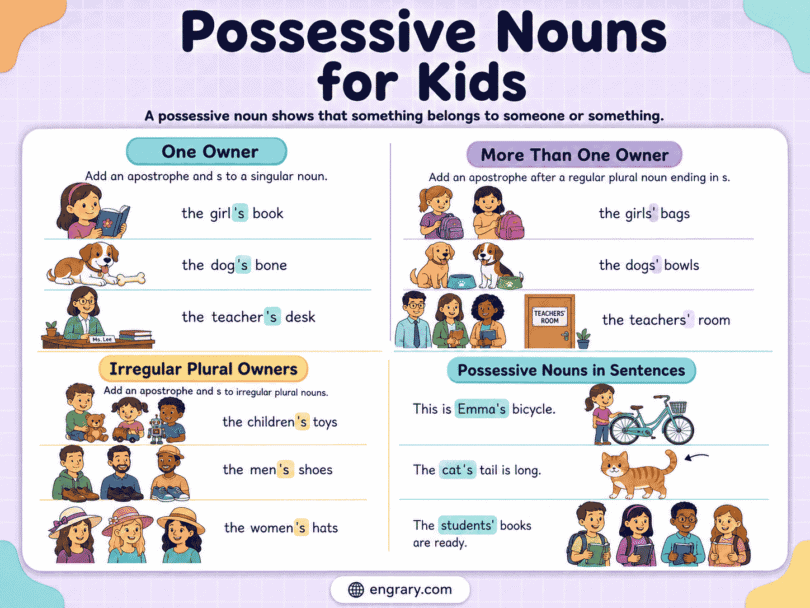
Possessive nouns show that a person, animal, place, or thing owns, has, or is connected to something. They usually use an apostrophe, so learning where to place that apostrophe is an important grammar skill.
The easiest way to form possessive nouns is to find the owner first. Then decide whether the owner is singular or plural before adding ’s or an apostrophe.
What Is a Possessive Noun?
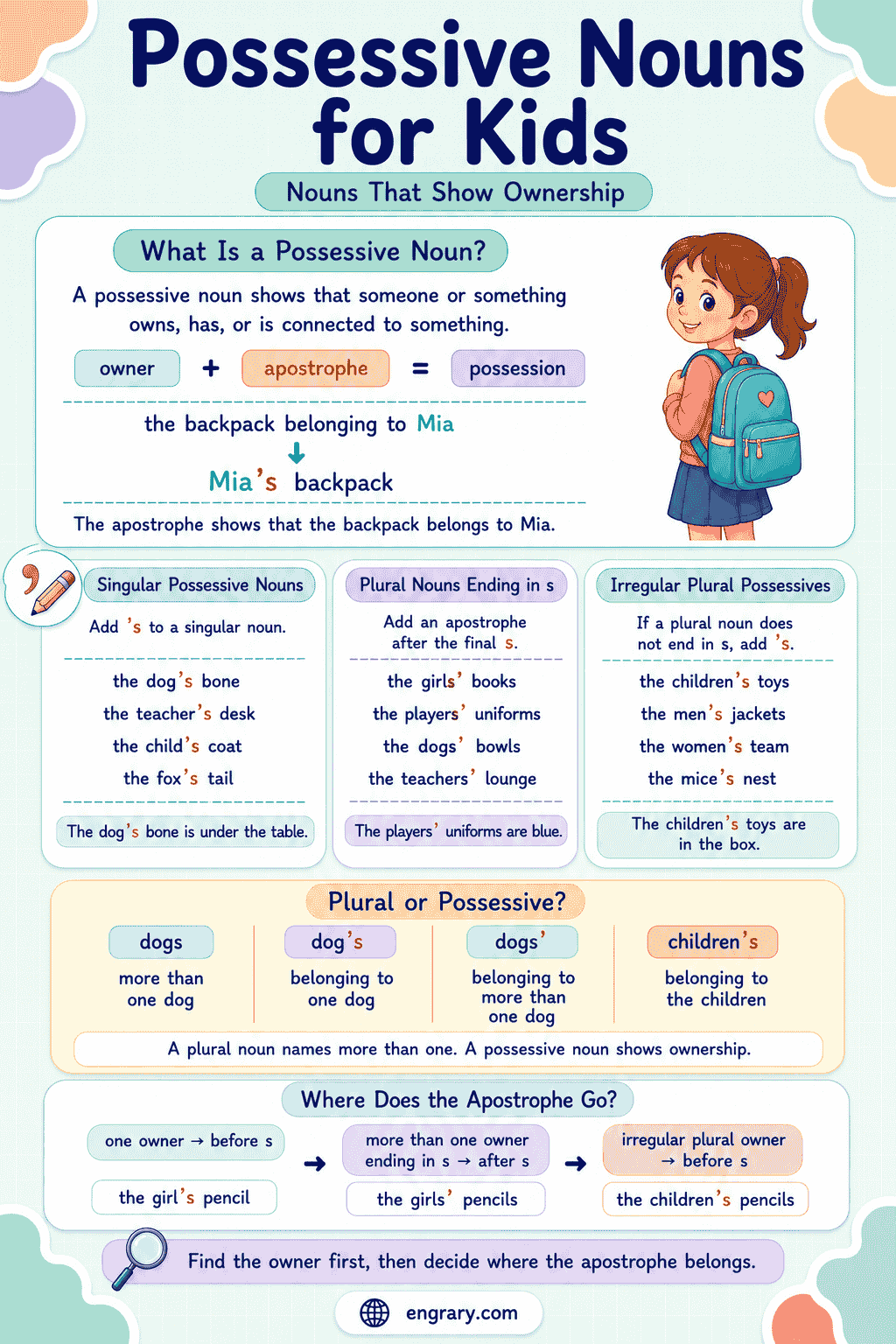
A possessive noun shows ownership, belonging, a relationship, or another close connection.
Examples:
- the girl’s backpack;
- the dog’s collar;
- the school’s library;
- Noah’s brother;
- today’s lesson.
In each example, the possessive noun tells us who or what is connected to the next word.
A Quick Review of Nouns
A noun is a word that names a:
- person;
- place;
- animal;
- thing;
- idea.
Examples include:
| Noun Type | Example |
|---|---|
| person | teacher |
| place | school |
| animal | rabbit |
| thing | backpack |
| idea | friendship |
A noun becomes possessive when it shows ownership, belonging, or connection.
Ownership, Relationships, and Connection
Possessive nouns do more than show literal ownership.
| Meaning | Example |
|---|---|
| ownership | Mia’s bicycle |
| belonging | the dog’s bowl |
| relationship | Noah’s sister |
| part of something | the bird’s wing |
| connection | the school’s principal |
| time | tomorrow’s lesson |
For example, Noah does not own his sister. The phrase Noah’s sister shows a family relationship.
Similarly, a tree does not own its branches. The phrase the tree’s branches shows that the branches are part of the tree.
Find the Owner First
Before adding an apostrophe, find the person, animal, place, or thing that owns or is connected to something.
Consider:
the collar belonging to the dog
The owner is dog. Because there is one dog, add ’s:
the dog’s collar
Another example is:
the projects belonging to the students
The owners are students. Because students is plural and already ends in s, add only an apostrophe:
the students’ projects
Use this simple process:
- Find the owner.
- Decide whether the owner is singular or plural.
- Add the correct possessive ending.
How Possessive Nouns Are Formed
The possessive ending depends on the number and form of the owner.
The Three Main Possessive Rules
| Type of Owner | Rule | Example |
|---|---|---|
| one owner | add ’s | girl’s backpack |
| plural owner ending in s | add only ’ | girls’ backpacks |
| irregular plural owner not ending in s | add ’s | children’s backpacks |
These three rules cover most possessive nouns children will use.
Where the Apostrophe Goes
The apostrophe is added to the owner, not to the item that is owned.
In this phrase:
the teacher’s book
- owner: teacher;
- connected item: book.
Therefore, the apostrophe belongs in teacher’s, not book.
In this phrase:
the teachers’ books
- owners: teachers;
- connected items: books.
Because teachers is already plural and ends in s, the apostrophe comes after the final s.
Singular Possessive Nouns
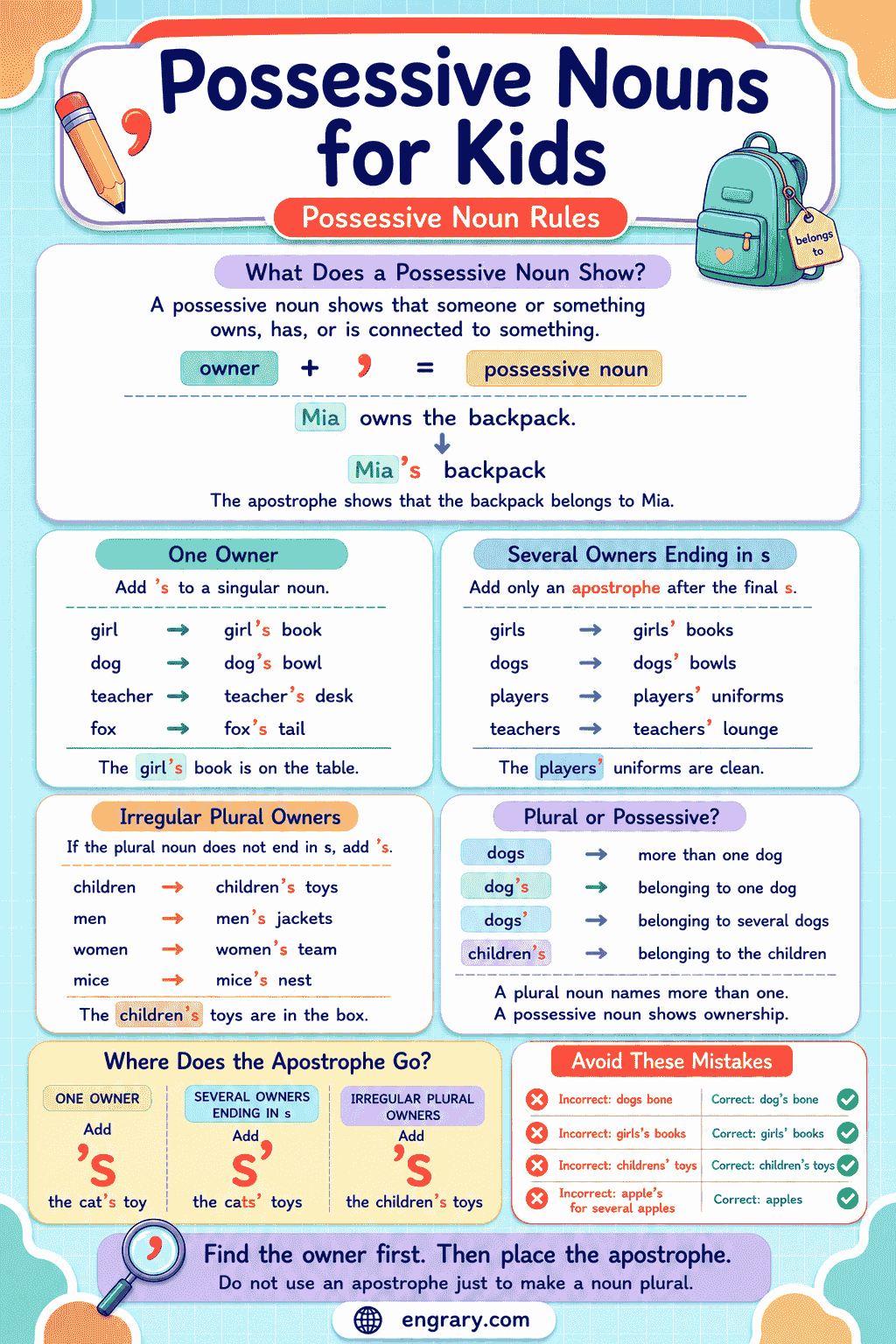
A singular possessive noun shows that one person, animal, place, or thing owns or is connected to something.
Add ’s to a Singular Noun
To make most singular nouns possessive, add an apostrophe and s.
| Singular Noun | Possessive Form |
|---|---|
| girl | girl’s |
| dog | dog’s |
| teacher | teacher’s |
| school | school’s |
| child | child’s |
Examples in sentences:
- The girl’s backpack is blue.
- The dog’s collar is red.
- The teacher’s desk is near the window.
- The school’s playground is large.
- The child’s lunch is ready.
Notice that the thing connected to the owner may be singular or plural.
- the girl’s book;
- the girl’s books.
The owner is still one girl, so the possessive form remains girl’s.
Possessive Nouns Ending in S
A singular noun that already ends in s usually still takes ’s.
| Singular Noun | Possessive Form |
|---|---|
| class | class’s |
| bus | bus’s |
| princess | princess’s |
| boss | boss’s |
Examples:
- The class’s project is complete.
- The bus’s door is open.
- The princess’s crown is gold.
- The boss’s office is upstairs.
For a clear child-level rule, remember:
If the noun is singular, add ’s.
Some published style guides use a different form for certain names ending in s, but ’s is the clearest and most consistent rule for young learners.
Making Names Possessive
Names become possessive in the same way as other singular nouns.
| Name | Possessive Form |
|---|---|
| Ava | Ava’s |
| Noah | Noah’s |
| James | James’s |
| Carlos | Carlos’s |
Examples:
- Ava’s notebook is on the desk.
- Noah’s backpack is green.
- James’s bicycle is outside.
- Carlos’s jacket is wet.
Keep the capital letter in the name and add the possessive ending.
Plural Possessive Nouns
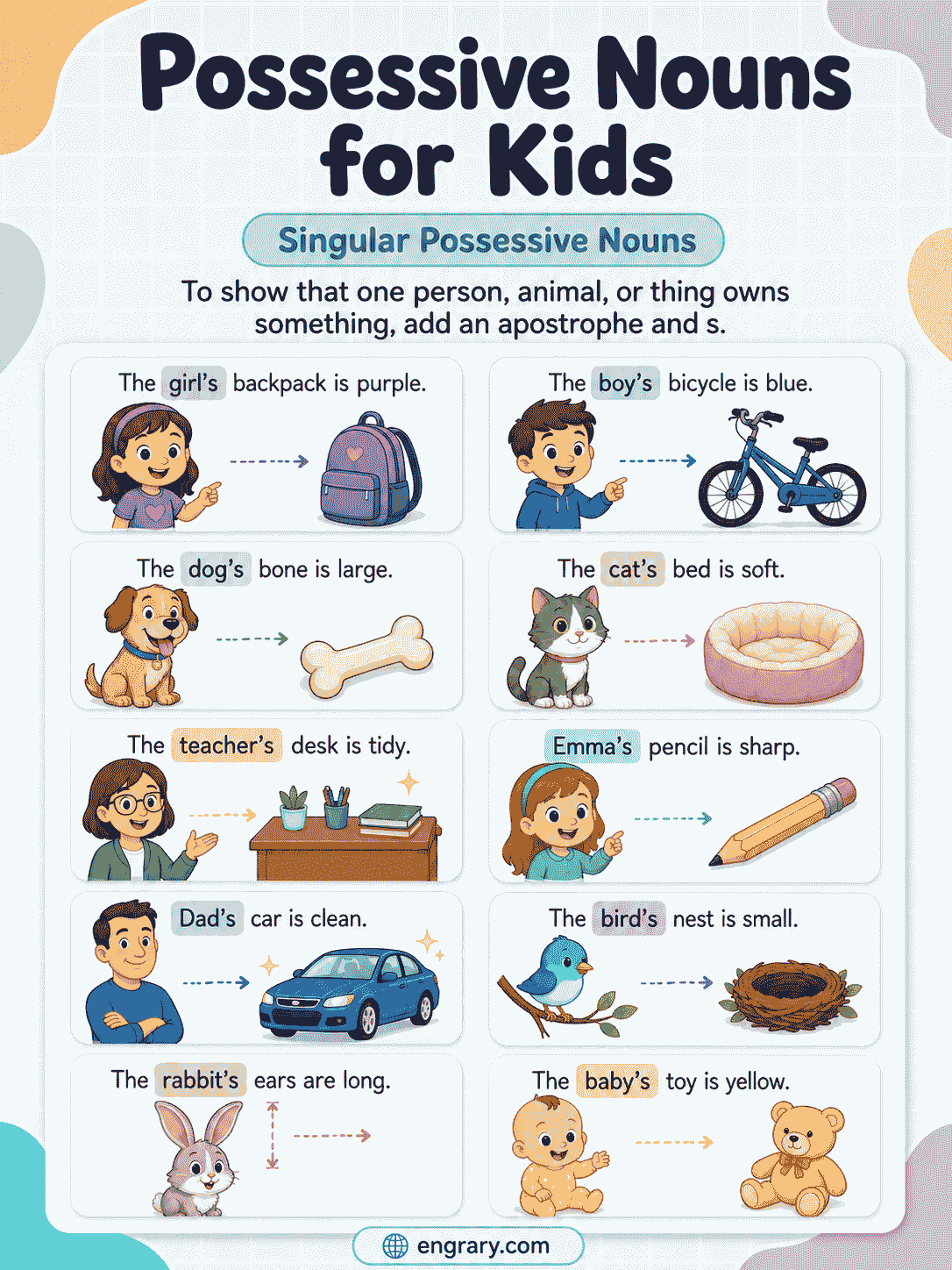
A plural possessive noun shows that more than one person, animal, place, or thing owns or is connected to something.
The correct ending depends on whether the plural noun already ends in s.
Plural Nouns That Already End in S
Most regular plural nouns end in s. To make them possessive, add only an apostrophe after the final s.
| Plural Noun | Possessive Form |
|---|---|
| girls | girls’ |
| dogs | dogs’ |
| teachers | teachers’ |
| students | students’ |
| players | players’ |
Examples:
- The girls’ backpacks are on the floor.
- The dogs’ bowls are outside.
- The teachers’ meeting begins at three.
- The students’ projects are displayed.
- The players’ uniforms are clean.
Do not add another s after a regular plural noun.
Incorrect:
the dogs’s bowls
Correct:
the dogs’ bowls
Irregular Plural Possessives
Some plural nouns do not end in s. These irregular plurals become possessive by adding ’s.
| Irregular Plural | Possessive Form |
|---|---|
| children | children’s |
| men | men’s |
| women | women’s |
| people | people’s |
| mice | mice’s |
Examples:
- The children’s toys are in the box.
- The men’s coats are wet.
- The women’s team won the game.
- The people’s voices filled the room.
- The mice’s nest was hidden.
Do not write childrens’ because children is already plural and does not end in s.
Correct:
children’s books
Incorrect:
childrens’ books

How Apostrophe Placement Changes Meaning
Apostrophe placement tells the reader whether there is one owner or more than one.
One Owner Versus Several Owners
Compare:
| Meaning | Possessive Phrase |
|---|---|
| one girl owns a backpack | the girl’s backpack |
| several girls own backpacks | the girls’ backpacks |
| one child owns a toy | the child’s toy |
| several children own toys | the children’s toys |
The number of the item does not decide where the apostrophe goes. The number of owners does.
Compare:
- the girl’s books — one girl, several books;
- the girls’ book — several girls, one shared book;
- the girls’ books — several girls, several books.
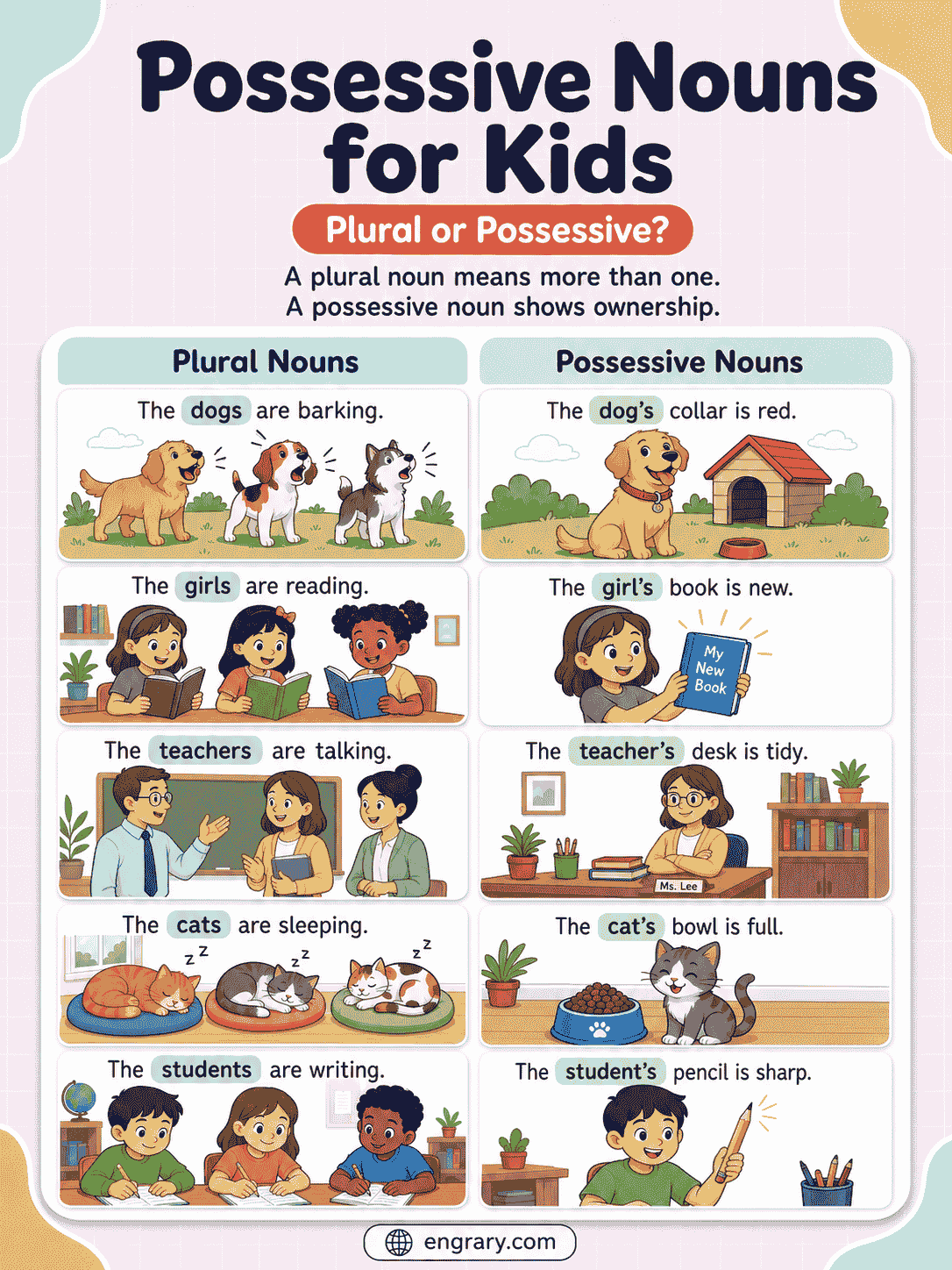
Dogs, Dog’s, and Dogs’
These three forms have different meanings.
| Form | Meaning |
|---|---|
| dogs | more than one dog |
| dog’s | belonging to one dog |
| dogs’ | belonging to more than one dog |
Examples:
- The dogs are barking.
- The dog’s collar is red.
- The dogs’ collars are red.
An ordinary plural does not need an apostrophe.
Incorrect:
We saw three dog’s.
Correct:
We saw three dogs.
Possessive Nouns in Sentences
Possessive nouns can appear before another noun or at the end of a sentence.
Possessive Nouns Before Other Nouns
A possessive noun often comes directly before the person, place, animal, or thing connected to it.
Examples:
- Mia’s backpack;
- the dog’s bone;
- the teachers’ lounge;
- the children’s books.
In sentences:
- Mia’s backpack is on the chair.
- The dog’s bone is under the table.
- The teachers’ lounge is upstairs.
- The children’s books are on the shelf.
The possessive noun acts like a describing word because it tells whose item or connection is being discussed.
Possessive Nouns Used Alone
A possessive noun can appear without repeating the connected item.
Compare:
This is Mia’s backpack.
This backpack is Mia’s.
Both sentences mean that the backpack belongs to Mia.
More examples:
- The blue bicycle is Noah’s.
- That desk is the teacher’s.
- These coats are the children’s.
- The red bowls are the dogs’.
The missing noun is understood from the sentence.
Turning Belonging Phrases Into Possessives
Possessive nouns can make phrases shorter and more natural.
| Longer Phrase | Possessive Phrase |
|---|---|
| the collar belonging to the dog | the dog’s collar |
| the toys belonging to the children | the children’s toys |
| the books belonging to the students | the students’ books |
| the branches of the tree | the tree’s branches |
| the lesson for today | today’s lesson |
When rewriting, identify the owner or connection first. Then apply the correct possessive rule.

Other Possessive Noun Patterns
Most children should master singular and plural possessives first. Afterward, they can learn a few additional patterns.
Compound Possessive Nouns
A compound noun contains more than one word. Add the possessive ending to the final word of the complete noun.
Examples:
- mother-in-law → mother-in-law’s;
- school bus driver → school bus driver’s;
- sister-in-law → sister-in-law’s.
In sentences:
- My mother-in-law’s recipe is delicious.
- The school bus driver’s seat is empty.
- My sister-in-law’s coat is blue.
Do not add an apostrophe to every word in the compound noun.
Shared and Separate Possession
When two people share one item, add the possessive ending to the final name only.
Ava and Mia’s project
This means Ava and Mia share one project.
More examples:
- Noah and Liam’s room;
- Mom and Dad’s car;
- Ben and Ava’s dog.
When two people own separate items, make both names possessive.
Ava’s and Mia’s projects
This means Ava has a project and Mia has a different project.
Compare:
| Shared Possession | Separate Possession |
|---|---|
| Ava and Mia’s project | Ava’s and Mia’s projects |
| Noah and Liam’s room | Noah’s and Liam’s rooms |
| Ben and Ava’s dog | Ben’s and Ava’s dogs |
The meaning of the sentence determines which pattern is needed.
Common Possessive Noun Confusions
Apostrophes can also appear in contractions, so children need to use meaning rather than looking only at the punctuation.
Plural Noun or Possessive Noun?
A plural noun names more than one. A possessive noun shows ownership or connection.
| Form | Use |
|---|---|
| cats | more than one cat |
| cat’s | belonging to one cat |
| cats’ | belonging to several cats |
Examples:
- The cats are sleeping.
- The cat’s bed is soft.
- The cats’ beds are soft.
Do not add an apostrophe simply because a word ends in s.
Possessive Noun or Contraction?
An apostrophe with s may show possession, or it may replace missing letters in a contraction.
Possessive:
The dog’s collar is blue.
Here, dog’s shows that the collar belongs to the dog.
Contraction:
The dog’s sleeping.
Here, dog’s means dog is.
Another example:
Noah’s finished his work.
In this sentence, Noah’s means Noah has.
Use this test:
Can the apostrophe form be expanded to is or has?
If it can, the word is a contraction.
- Mia’s running. → Mia is running.
- Noah’s finished. → Noah has finished.
- Mia’s backpack → cannot mean Mia is backpack, so it is possessive.
Its Versus It’s
Its shows possession or connection.
The dog wagged its tail.
It’s means it is or it has.
It’s sleeping.
It’s been raining.
Compare:
- The bird opened its wings.
- It’s flying over the tree.
Although its shows possession, it does not use an apostrophe. It is a possessive form of the pronoun it, not a possessive noun.
A Brief Note About Possessive Pronouns
Possessive nouns and possessive pronouns are related, but they are not the same.
Possessive noun:
Ava’s book
Possessive pronoun:
The book is hers.
Common possessive pronouns include:
- mine;
- yours;
- hers;
- ours;
- theirs.
These words do not take apostrophes.
Incorrect:
- her’s;
- our’s;
- their’s.
Correct:
- hers;
- ours;
- theirs.
Common Possessive Noun Mistakes
| Incorrect | Correct | Explanation |
|---|---|---|
| the girls backpack | the girl’s backpack or the girls’ backpack | the meaning decides the number of owners |
| three cat’s | three cats | ordinary plurals do not need apostrophes |
| the dogs’s bowls | the dogs’ bowls | add only an apostrophe to a plural ending in s |
| the childrens’ toys | the children’s toys | irregular plurals take ’s |
| James bicycle | James’s bicycle | a singular name needs ’s |
| the book’s of the students | the students’ books | add the possessive ending to the owner |
| Its raining | It’s raining | it’s means it is |
| The bird hurt it’s wing | The bird hurt its wing | possessive its has no apostrophe |
| The pencil is her’s | The pencil is hers | possessive pronouns do not take apostrophes |
| Ava’s and Mia project | Ava and Mia’s project | one shared item takes possession on the final name |
Always check the sentence’s meaning before correcting the apostrophe.
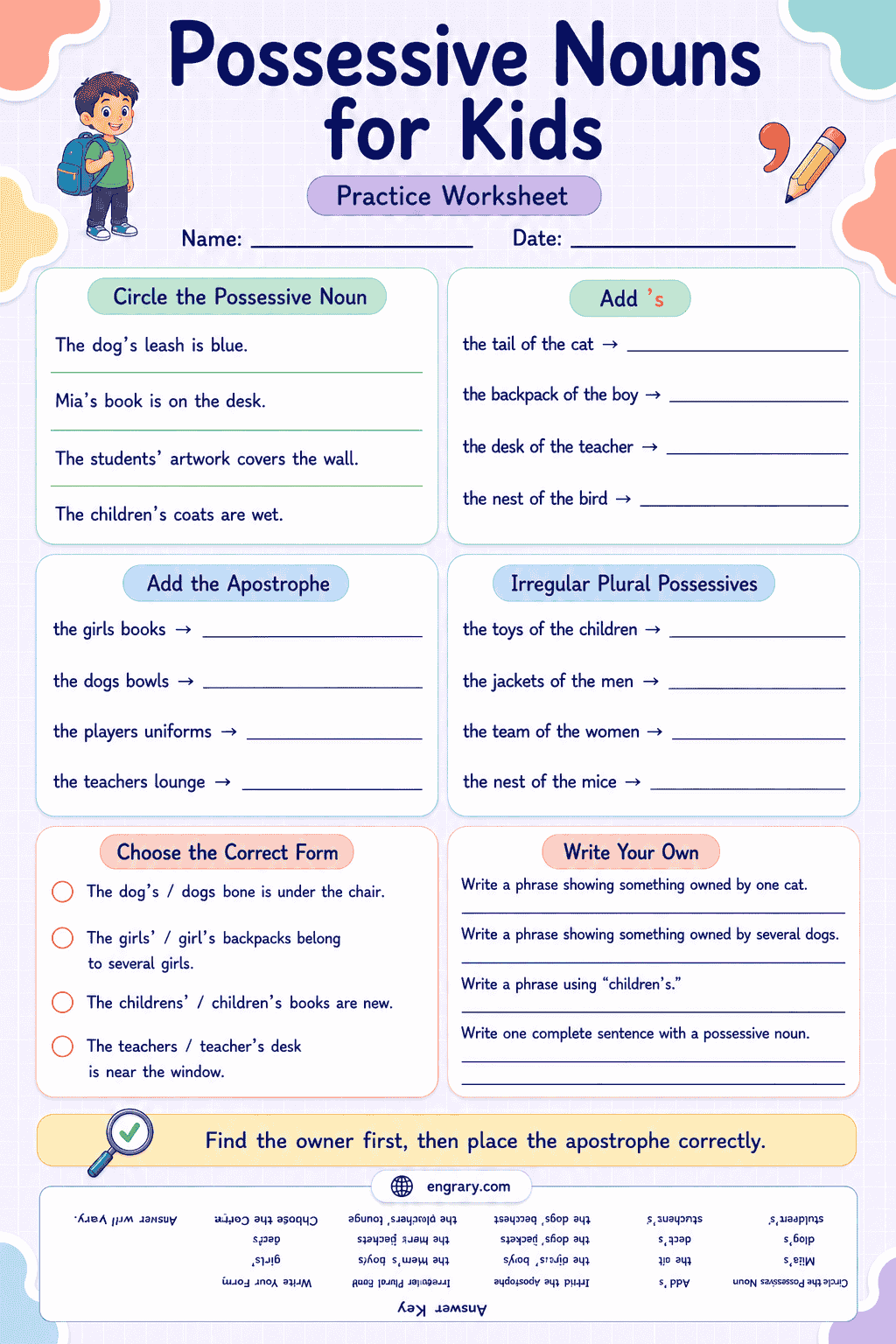
Possessive Nouns Practice for Kids
Complete the activities before checking the answer key.
Who Owns It?
Identify the owner and the connected item.
- the dog’s collar
- Mia’s backpack
- the teachers’ lounge
- the children’s toys
- the tree’s branches
- today’s lesson
One Owner or More Than One Owner?
Write one owner or more than one owner.
- the girl’s notebook
- the girls’ notebooks
- the child’s lunch
- the children’s lunches
- the dog’s bowl
- the dogs’ bowls
- the teacher’s desk
- the teachers’ desks
Add the Apostrophe Correctly
Write the correct possessive form.
- the collar of the dog
- the projects of the students
- the books of the children
- the bicycle of James
- the meeting of the teachers
- the nest of the mice
- the playground of the school
- the uniforms of the players
Dogs, Dog’s, or Dogs’?
Choose the correct form.
- The ___ are barking.
dogs / dog’s / dogs’ - The ___ collar is red.
dogs / dog’s / dogs’ - The ___ bowls are outside.
dogs / dog’s / dogs’ - We saw three ___.
dogs / dog’s / dogs’ - One ___ tail was muddy.
dogs / dog’s / dogs’ - The two ___ toys were under the table.
dogs / dog’s / dogs’
Rewrite the Phrase With a Possessive Noun
Rewrite each phrase.
- the backpack belonging to Ava
- the toys belonging to the children
- the room used by the teachers
- the door of the bus
- the branches of the trees
- the coats belonging to the women
Choose the Correct Possessive Form
- The girl’s / girls’ backpack belongs to one girl.
- The girl’s / girls’ backpacks belong to three girls.
- The child’s / children’s toys belong to several children.
- The dog’s / dogs’ bowl belongs to one dog.
- The dog’s / dogs’ bowls belong to two dogs.
- The teacher’s / teachers’ meeting includes all the teachers.
- The student’s / students’ desk belongs to one student.
- The student’s / students’ projects belong to the whole class.
Possessive or Contraction?
Write possessive or contraction.
- Mia’s backpack is blue.
- Mia’s running to school.
- The dog’s bone is missing.
- The dog’s sleeping under the table.
- Noah’s finished his homework.
- Noah’s notebook is open.
- The teacher’s desk is near the door.
- The teacher’s reading a story.
Choose Its or It’s
- ___ raining outside.
- The dog wagged ___ tail.
- ___ been a long day.
- The bird opened ___ wings.
- The robot moved ___ arms.
- ___ time to leave.
- The tree lost ___ leaves.
- ___ getting dark.
Fix Missing and Misplaced Apostrophes
Rewrite each phrase or sentence correctly.
- the girls backpack belongs to one girl
- the dogs’s bowls
- the childrens’ books
- James bicycle is new
- We saw four bird’s
- The cat hurt it’s paw
- Its snowing outside
- The pencil is her’s
Is the Item Shared or Separate?
Write shared or separate.
- Ava and Mia’s project
- Ava’s and Mia’s projects
- Noah and Liam’s room
- Noah’s and Liam’s rooms
- Ben and Ava’s dog
- Ben’s and Ava’s dogs
Edit a Paragraph With Possessive Nouns
Correct the possessive, plural, and contraction mistakes.
Mia and Ava’s backpacks were beside the teachers desk. Mias backpack had a picture of a fox, while Avas had stars. The girls books were inside their bags. “Its time for class,” said the teacher. One of the students pencil’s rolled under the desk.
Write Singular and Plural Possessives
Write:
- one sentence with a singular possessive noun;
- one sentence with a regular plural possessive noun;
- one sentence with an irregular plural possessive noun;
- one sentence with a possessive name;
- one sentence with a possessive noun used alone;
- one pair showing shared and separate possession.
Possessive Nouns Practice Answer Key
Who Owns It?
- owner: dog; connected item: collar
- owner: Mia; connected item: backpack
- owners: teachers; connected place: lounge
- owners: children; connected items: toys
- owner: tree; connected parts: branches
- connection: today; connected item: lesson
One Owner or More Than One Owner?
- one owner
- more than one owner
- one owner
- more than one owner
- one owner
- more than one owner
- one owner
- more than one owner
Add the Apostrophe Correctly
- the dog’s collar
- the students’ projects
- the children’s books
- James’s bicycle
- the teachers’ meeting
- the mice’s nest
- the school’s playground
- the players’ uniforms
Dogs, Dog’s, or Dogs’?
- dogs
- dog’s
- dogs’
- dogs
- dog’s
- dogs’
Rewrite the Phrase With a Possessive Noun
- Ava’s backpack
- the children’s toys
- the teachers’ room
- the bus’s door
- the trees’ branches
- the women’s coats
Choose the Correct Possessive Form
- girl’s
- girls’
- children’s
- dog’s
- dogs’
- teachers’
- student’s
- students’
Possessive or Contraction?
- possessive
- contraction
- possessive
- contraction
- contraction
- possessive
- possessive
- contraction
Choose Its or It’s
- It’s
- its
- It’s
- its
- its
- It’s
- its
- It’s
Fix Missing and Misplaced Apostrophes
- The girl’s backpack belongs to one girl.
- the dogs’ bowls
- the children’s books
- James’s bicycle is new.
- We saw four birds.
- The cat hurt its paw.
- It’s snowing outside.
- The pencil is hers.
Is the Item Shared or Separate?
- shared
- separate
- shared
- separate
- shared
- separate
Edit a Paragraph With Possessive Nouns
Corrected paragraph:
Mia’s and Ava’s backpacks were beside the teacher’s desk. Mia’s backpack had a picture of a fox, while Ava’s had stars. The girls’ books were inside their bags. “It’s time for class,” said the teacher. One of the students’ pencils rolled under the desk.
In the first sentence, Mia’s and Ava’s backpacks shows that each girl has a separate backpack. In the fourth sentence, It’s means It is.
Write Singular and Plural Possessives
Sample answers:
- The rabbit’s ears are long.
- The teachers’ books are on the shelf.
- The children’s lunches are ready.
- Noah’s jacket is blue.
- The red bicycle is Ava’s.
- Shared: Mia and Ava’s project is complete.
Separate: Mia’s and Ava’s projects are complete.
Other answers are acceptable when the apostrophes and meanings are correct.
FAQs
A possessive noun shows ownership, belonging, a relationship, or another connection. For example, the dog’s collar shows that the collar belongs to one dog.
Add an apostrophe and s to a singular noun. For example, girl becomes girl’s, and teacher becomes teacher’s.
If a plural noun already ends in s, add only an apostrophe, as in students’ books. If an irregular plural does not end in s, add ’s, as in children’s books.
Dogs means more than one dog. Dog’s shows possession by one dog, while dogs’ shows possession by more than one dog.
Replace ’s with is or has. If the sentence still makes sense, it is a contraction. If it shows ownership or connection, it is possessive.
You May Also Like
- Nouns for Kids
- Singular and Plural Nouns for Kids
- Regular and Irregular Plural Nouns
- Apostrophes for Kids
- Contractions for Kids
- Possessive Pronouns
- Proper Nouns
- Compound Nouns
- Subject-Verb Agreement
- Punctuation for Kids