Nouns help children name the people, places, animals, things, ideas, and feelings they talk about every day. Once children can recognize nouns, they can build clearer sentences and understand other grammar topics more easily.
You’ll find 100 easy noun examples grouped into familiar categories, followed by simple examples of common, proper, concrete, abstract, singular, plural, collective, possessive, countable, and uncountable nouns. In addition, sentence examples and common mistakes will help children recognize how nouns work in everyday English.

What Is a Noun?
A noun is a word that names a person, place, animal, thing, idea, feeling, quality, or state.
For example:
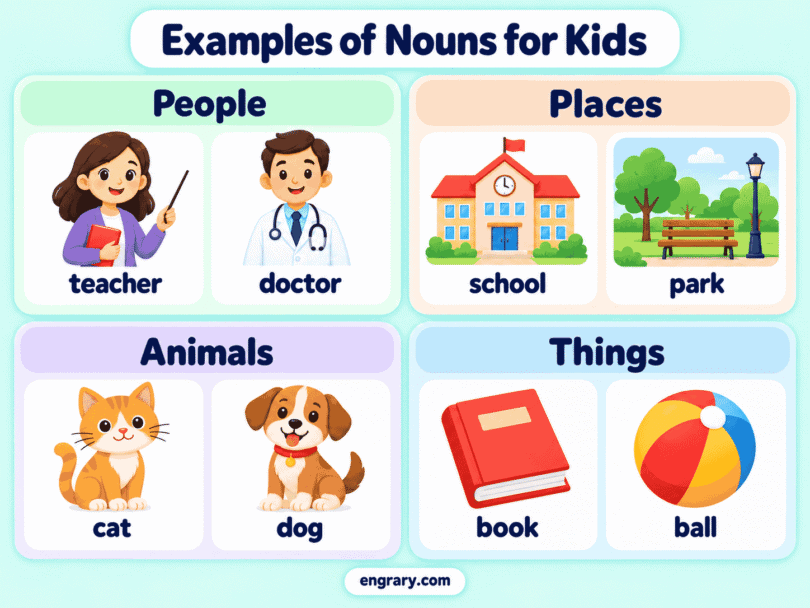
teacher → person
school → place
dog → animal
book → thing
happiness → feeling
Therefore, nouns can name both things we can see and touch and things we can only think about or feel.
100 Easy Noun Examples for Kids
The following table contains exactly 100 unique noun examples. They are grouped into people, places, animals, things, and ideas or feelings so children can recognize them easily.
| Noun | What It Names |
|---|---|
| teacher | person |
| doctor | person |
| student | person |
| child | person |
| parent | person |
| farmer | person |
| driver | person |
| nurse | person |
| artist | person |
| singer | person |
| chef | person |
| pilot | person |
| friend | person |
| neighbor | person |
| firefighter | person |
| baker | person |
| carpenter | person |
| dancer | person |
| coach | person |
| scientist | person |
| school | place |
| park | place |
| library | place |
| hospital | place |
| market | place |
| city | place |
| village | place |
| beach | place |
| garden | place |
| classroom | place |
| office | place |
| farm | place |
| museum | place |
| airport | place |
| station | place |
| restaurant | place |
| hotel | place |
| zoo | place |
| playground | place |
| theater | place |
| dog | animal |
| cat | animal |
| rabbit | animal |
| bird | animal |
| horse | animal |
| lion | animal |
| elephant | animal |
| butterfly | animal |
| frog | animal |
| turtle | animal |
| monkey | animal |
| zebra | animal |
| giraffe | animal |
| dolphin | animal |
| whale | animal |
| shark | animal |
| cow | animal |
| goat | animal |
| sheep | animal |
| parrot | animal |
| book | thing |
| pencil | thing |
| chair | thing |
| table | thing |
| phone | thing |
| bag | thing |
| cup | thing |
| toy | thing |
| clock | thing |
| bicycle | thing |
| computer | thing |
| bottle | thing |
| camera | thing |
| key | thing |
| box | thing |
| plate | thing |
| spoon | thing |
| lamp | thing |
| basket | thing |
| ball | thing |
| happiness | feeling |
| love | feeling |
| courage | quality |
| honesty | quality |
| kindness | quality |
| fear | feeling |
| freedom | idea |
| patience | quality |
| friendship | idea |
| hope | feeling |
| anger | feeling |
| joy | feeling |
| sadness | feeling |
| knowledge | idea |
| wisdom | quality |
| trust | idea |
| peace | idea |
| fun | feeling |
| luck | idea |
| respect | quality |
These examples show that nouns do much more than name physical objects. In fact, words such as courage, friendship, knowledge, and respect are nouns even though we cannot touch them.
Examples of Nouns by What They Name
Children often learn nouns by grouping them according to what they name. This simple approach helps connect grammar with familiar vocabulary.
People
Nouns for people can name occupations, relationships, roles, or individuals.
Examples include:
- teacher
- doctor
- nurse
- farmer
- pilot
- baker
- friend
- scientist
For example, the teacher opened the book. Meanwhile, a doctor entered the room, and two scientists discussed their work.
Places
Place nouns name locations where people live, work, visit, study, or travel.
Examples include:
- school
- library
- park
- hospital
- city
- village
- museum
- airport
For instance, Mia visited the library after school. Later, her family drove to the airport.
Animals
Animal names are also nouns.
Examples include:
- dog
- rabbit
- elephant
- butterfly
- turtle
- lion
- dolphin
- parrot
For example, a rabbit ran across the garden. Nearby, a parrot sat on a branch.
Things
Thing nouns name objects that people can usually see, touch, carry, use, or own.
Examples include:
- book
- pencil
- chair
- phone
- bicycle
- camera
- lamp
- ball
For instance, the book is on the table. In addition, Mia placed her camera inside the bag.
Ideas and Feelings
Nouns can also name ideas, emotions, qualities, and states.
Examples include:
- happiness
- courage
- kindness
- friendship
- hope
- honesty
- patience
- freedom
For example, her kindness helped everyone. Similarly, the child showed great courage during the difficult moment.
These nouns do not name physical objects; however, they still function as nouns because they name ideas, feelings, or qualities.
Common and Proper Noun Examples
A common noun gives a general name, while a proper noun gives the specific name of a person, place, organization, day, month, or other unique subject.
| Common Noun | Proper Noun |
|---|---|
| girl | Emma |
| boy | Noah |
| city | London |
| river | Nile |
| month | January |
| country | Canada |
| ocean | Pacific Ocean |
| school | Greenfield School |
For example, city is a general name. By contrast, London names one specific city.
Similarly, month is a common noun, while January is a proper noun.
Proper nouns normally begin with capital letters.
Concrete and Abstract Noun Examples
Concrete and abstract nouns differ according to what they name.
A concrete noun names something we can experience through one or more senses. An abstract noun, however, names an idea, feeling, quality, or state.
| Concrete Noun | Abstract Noun |
|---|---|
| apple | happiness |
| dog | courage |
| table | honesty |
| flower | love |
| bell | freedom |
| book | knowledge |
| child | patience |
| gift | kindness |
For example, we can see and touch a book, so it is concrete. By contrast, knowledge is an abstract noun because it names an idea rather than a physical object.
Not every abstract noun is uncountable. For instance, idea and question are abstract but countable.
Singular and Plural Noun Examples
A singular noun names one person, place, animal, thing, or idea. A plural noun, by contrast, usually names more than one.
| Singular | Plural |
|---|---|
| cat | cats |
| book | books |
| box | boxes |
| city | cities |
| child | children |
| mouse | mice |
| leaf | leaves |
| sheep | sheep |
For example:
one cat → three cats
one city → several cities
one child → four children
Some plural nouns add -s or -es, while others use spelling changes or irregular forms. However, detailed plural rules belong to a separate plural-noun lesson.
Collective Noun Examples
A collective noun names a group of people, animals, or things as one unit.
Common examples include:
- team
- class
- family
- crowd
- group
- herd
- flock
- audience
Useful phrases include:
a team of players
a class of students
a herd of elephants
a flock of birds
For example, the team practiced after school. Meanwhile, a flock of birds crossed the sky.
Collective nouns help speakers refer to a whole group with one noun.
Possessive Noun Examples
A possessive noun shows ownership, relationship, or another connection.
Examples include:
- girl’s bag
- teacher’s desk
- dog’s collar
- mother’s phone
- parents’ car
- children’s toys
For example:
The girl’s bag is blue.
The teacher’s desk is near the window.
The children’s toys are on the floor.
Apostrophe placement changes according to the noun form. However, full possessive rules belong to a dedicated possessive-noun lesson.
Countable and Uncountable Noun Examples
A countable noun refers to separate units that English normally counts directly. An uncountable noun usually refers to a mass, amount, substance, concept, activity, or collection.
| Countable Noun | Uncountable Noun |
|---|---|
| apple | rice |
| chair | furniture |
| book | information |
| coin | money |
| bottle | water |
| question | advice |
For example:
three apples
but:
some rice
Similarly:
two chairs
but:
some furniture
Therefore, countability depends on how English treats a noun in a particular meaning.
Nouns in Sentences
Nouns can perform different roles in everyday sentences. The following examples include people, places, animals, things, ideas, proper nouns, plural nouns, collective nouns, possessives, and uncountable nouns.
The teacher opened the window.
Mia visited the library after school.
A rabbit ran across the garden.
Three children played outside.
Her kindness helped the new student.
Our team won the game.
The girl’s bag is under the chair.
Emma lives in London.
New furniture arrived yesterday.
Several books are on the desk.
A dog chased the ball.
His courage impressed the class.
Because nouns can name many kinds of subjects, they appear in almost every type of sentence.
Can a Noun Belong to More Than One Type?
Yes. Noun categories describe different features, so one noun can belong to several noun types at the same time.
For example:
teacher
- common noun
- concrete noun
- countable noun
- singular noun
London
- proper noun
- concrete noun
- singular noun
happiness
- common noun
- abstract noun
- usually uncountable noun
children
- common noun
- concrete noun
- countable noun
- plural noun
Therefore, noun types are not always separate boxes. Instead, different labels can describe different grammatical features of the same noun.
Common Noun Mistakes for Kids
Children often make noun mistakes when they apply one simple idea to every noun.
| Mistake | Correct Understanding |
|---|---|
| A noun only names a thing. | A noun can name a person, place, animal, thing, idea, feeling, quality, or state. |
| Every noun is physical. | Abstract nouns name ideas, feelings, qualities, and states. |
| Every noun belongs to only one type. | One noun can belong to several noun categories. |
| Proper nouns use lowercase letters. | Proper nouns normally begin with capital letters. |
| Every plural noun adds -s. | Some plurals change differently, such as child → children. |
| Furniture must be plural because it names many items. | Furniture is normally an uncountable noun. |
For example, happiness is still a noun even though we cannot touch it. Likewise, London is both a noun and a proper noun because it names a specific place.
Another common misunderstanding involves plural nouns. Although cats simply adds -s, children forms its plural irregularly.
FAQs
Easy noun examples include teacher, doctor, school, park, dog, cat, book, pencil, happiness, kindness, and friendship. These words name people, places, animals, things, ideas, feelings, or qualities.
For beginner learning, nouns can be grouped as words that name people, places, animals, things, and ideas or feelings. For example, teacher names a person, park names a place, dog names an animal, book names a thing, and happiness names a feeling.
A common noun gives a general name, such as city, girl, or river. A proper noun gives a specific name, such as London, Emma, or Nile, and normally begins with a capital letter.
Yes. For example, teacher can be a common, concrete, countable, and singular noun at the same time. Different noun types describe different features of the word.
Children commonly learn about common, proper, concrete, abstract, singular, plural, collective, possessive, countable, and uncountable nouns. Each type describes a different feature or use of a noun.
You May Also Like