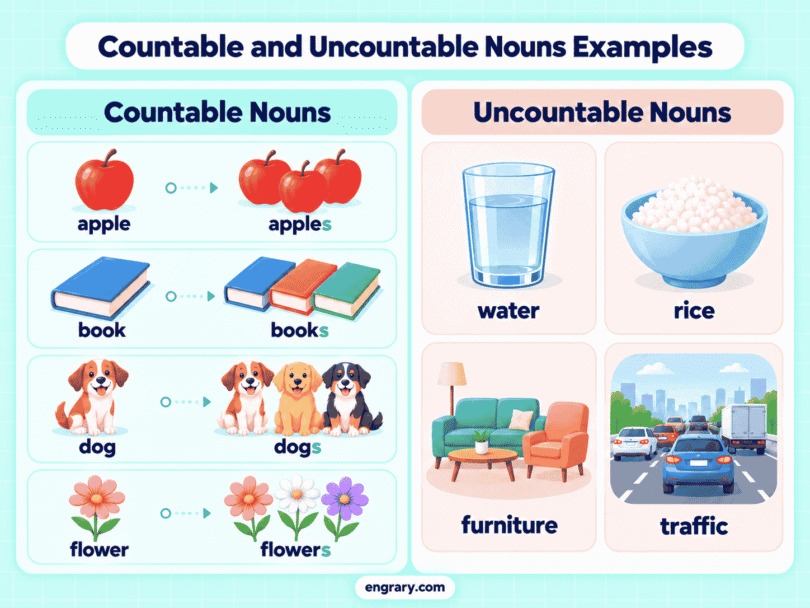
Countable and uncountable nouns help learners understand how English expresses number and quantity. Because countable nouns refer to separate units while uncountable nouns often refer to masses, substances, activities, concepts, or collections, recognizing the difference improves grammar, vocabulary, and sentence accuracy.
You’ll find more than 300 countable and uncountable noun examples organized for easy reference. In addition, the article covers nouns that can belong to both groups depending on meaning, useful quantity phrases, sentence examples, key comparisons, and common mistakes.

What Are Countable and Uncountable Nouns?
A countable noun refers to something English normally treats as separate units.
For example:
one book
three books
one child
four children
An uncountable noun, by contrast, refers to something English usually treats as a mass, amount, substance, activity, concept, or collection.
For example:
some water
some information
some furniture
some advice
The basic distinction is:
countable noun → separate units
uncountable noun → mass, quantity, concept, activity, substance, or collection
However, countability can sometimes change with meaning. For instance, coffee is usually uncountable when it names the drink generally, while a coffee can mean one serving.
Quick Countable and Uncountable Noun Examples
The following examples show the main contrast before the larger reference lists.
| Countable Noun | Uncountable Noun |
|---|---|
| apple | rice |
| book | information |
| chair | furniture |
| suitcase | luggage |
| coin | money |
| job | work |
| bottle | water |
| idea | advice |
| car | traffic |
| machine | equipment |
| student | homework |
| tree | wood |
| question | knowledge |
| cookie | bread |
| ring | gold |
For example, we can say three chairs, whereas furniture normally appears as some furniture or three pieces of furniture.
Similarly, two books is natural, while two informations is not. Instead, use two pieces of information.
Countable Nouns Examples
Countable nouns can normally use numbers directly and usually have singular and plural forms. The following list contains familiar examples from everyday English.
| Countable Noun | Plural Form | Category |
|---|---|---|
| teacher | teachers | person |
| doctor | doctors | person |
| student | students | person |
| child | children | person |
| parent | parents | person |
| farmer | farmers | person |
| driver | drivers | person |
| artist | artists | person |
| singer | singers | person |
| friend | friends | person |
| nurse | nurses | person |
| pilot | pilots | person |
| chef | chefs | person |
| worker | workers | person |
| player | players | person |
| neighbor | neighbors | person |
| customer | customers | person |
| manager | managers | person |
| writer | writers | person |
| dancer | dancers | person |
| dog | dogs | animal |
| cat | cats | animal |
| bird | birds | animal |
| rabbit | rabbits | animal |
| horse | horses | animal |
| cow | cows | animal |
| goat | goats | animal |
| elephant | elephants | animal |
| tiger | tigers | animal |
| lion | lions | animal |
| frog | frogs | animal |
| butterfly | butterflies | animal |
| parrot | parrots | animal |
| turtle | turtles | animal |
| monkey | monkeys | animal |
| zebra | zebras | animal |
| giraffe | giraffes | animal |
| shark | sharks | animal |
| whale | whales | animal |
| dolphin | dolphins | animal |
| city | cities | place |
| school | schools | place |
| park | parks | place |
| house | houses | place |
| room | rooms | place |
| shop | shops | place |
| village | villages | place |
| street | streets | place |
| hospital | hospitals | place |
| library | libraries | place |
| garden | gardens | place |
| market | markets | place |
| office | offices | place |
| farm | farms | place |
| beach | beaches | place |
| hotel | hotels | place |
| restaurant | restaurants | place |
| station | stations | place |
| airport | airports | place |
| museum | museums | place |
| book | books | object |
| chair | chairs | object |
| pencil | pencils | object |
| phone | phones | object |
| bag | bags | object |
| table | tables | object |
| bottle | bottles | object |
| cup | cups | object |
| clock | clocks | object |
| toy | toys | object |
| computer | computers | object |
| camera | cameras | object |
| key | keys | object |
| box | boxes | object |
| plate | plates | object |
| spoon | spoons | object |
| door | doors | object |
| window | windows | object |
| lamp | lamps | object |
| basket | baskets | object |
| desk | desks | object |
| notebook | notebooks | object |
| brush | brushes | object |
| watch | watches | object |
| ticket | tickets | object |
| apple | apples | food |
| banana | bananas | food |
| orange | oranges | food |
| egg | eggs | food |
| cookie | cookies | food |
| sandwich | sandwiches | food |
| tomato | tomatoes | food |
| potato | potatoes | food |
| carrot | carrots | food |
| grape | grapes | food |
| lemon | lemons | food |
| mango | mangoes | food |
| peach | peaches | food |
| strawberry | strawberries | food |
| burger | burgers | food |
| cake | cakes | food |
| onion | onions | food |
| bean | beans | food |
| cucumber | cucumbers | food |
| pear | pears | food |
| car | cars | vehicle |
| bus | buses | vehicle |
| bicycle | bicycles | vehicle |
| train | trains | vehicle |
| airplane | airplanes | vehicle |
| boat | boats | vehicle |
| truck | trucks | vehicle |
| motorcycle | motorcycles | vehicle |
| van | vans | vehicle |
| taxi | taxis | vehicle |
| ship | ships | vehicle |
| ferry | ferries | vehicle |
| scooter | scooters | vehicle |
| helicopter | helicopters | vehicle |
| tram | trams | vehicle |
| shirt | shirts | clothing |
| shoe | shoes | clothing |
| hat | hats | clothing |
| jacket | jackets | clothing |
| sock | socks | clothing |
| glove | gloves | clothing |
| dress | dresses | clothing |
| skirt | skirts | clothing |
| belt | belts | clothing |
| cap | caps | clothing |
| coat | coats | clothing |
| sweater | sweaters | clothing |
| scarf | scarves | clothing |
| tie | ties | clothing |
| boot | boots | clothing |
| hammer | hammers | tool |
| saw | saws | tool |
| drill | drills | tool |
| wrench | wrenches | tool |
| screwdriver | screwdrivers | tool |
| ladder | ladders | tool/item |
| rope | ropes | item |
| bucket | buckets | item |
| knife | knives | tool |
| spade | spades | tool |
| flower | flowers | plant |
| tree | trees | plant |
| plant | plants | plant |
| seed | seeds | plant |
| leaf | leaves | plant |
| branch | branches | plant |
| rose | roses | plant |
| tulip | tulips | plant |
| sunflower | sunflowers | plant |
| daisy | daisies | plant |
| idea | ideas | abstract |
| question | questions | communication |
| answer | answers | communication |
| problem | problems | abstract |
| decision | decisions | abstract |
| plan | plans | abstract |
| dream | dreams | abstract |
| mistake | mistakes | abstract |
| story | stories | communication |
| message | messages | communication |
| letter | letters | communication |
| emails | communication | |
| task | tasks | work |
| job | jobs | work |
| meeting | meetings | event |
Because these nouns are countable, numbers can modify them directly:
three teachers
five apples
two buses
four questions
Likewise, singular forms can normally use a or an, as in a teacher, a bus, an apple, or an idea.
Uncountable Nouns Examples
Uncountable nouns do not normally take ordinary plural endings in their uncountable meanings. Instead, they often appear with words such as some, much, a little, or suitable measurement expressions.
| Uncountable Noun | Category | Natural Example |
|---|---|---|
| water | liquid | some water |
| milk | liquid | some milk |
| rice | food | some rice |
| bread | food | some bread |
| sugar | food | a little sugar |
| salt | food | some salt |
| flour | food | some flour |
| meat | food | some meat |
| cheese | food | some cheese |
| butter | food | some butter |
| tea | drink | some tea |
| juice | drink | some juice |
| oil | substance | some oil |
| honey | food | some honey |
| jam | food | some jam |
| yogurt | food | some yogurt |
| cream | food | some cream |
| pasta | food | some pasta |
| cereal | food | some cereal |
| soup | food | some soup |
| wood | material | some wood |
| gold | material | some gold |
| iron | material | some iron |
| steel | material | some steel |
| plastic | material | some plastic |
| glassware | collection | some glassware |
| sand | substance | some sand |
| mud | substance | some mud |
| air | substance | fresh air |
| smoke | substance | thick smoke |
| dust | substance | some dust |
| soil | substance | rich soil |
| clay | material | some clay |
| silver | material | some silver |
| copper | material | some copper |
| wool | material | some wool |
| cotton | material | some cotton |
| leather | material | some leather |
| rubber | material | some rubber |
| concrete | material | some concrete |
| information | abstract/general | useful information |
| advice | abstract/general | some advice |
| knowledge | abstract | useful knowledge |
| happiness | feeling | great happiness |
| honesty | quality | complete honesty |
| patience | quality | a little patience |
| courage | quality | great courage |
| love | feeling | much love |
| luck | abstract | good luck |
| fun | abstract | great fun |
| freedom | abstract | greater freedom |
| justice | abstract | social justice |
| peace | abstract | lasting peace |
| anger | feeling | intense anger |
| beauty | quality | natural beauty |
| confidence | quality | more confidence |
| education | abstract | good education |
| intelligence | quality | great intelligence |
| progress | abstract | steady progress |
| evidence | abstract | strong evidence |
| homework | activity/work | some homework |
| work | activity | a lot of work |
| research | activity | useful research |
| training | activity | extra training |
| travel | activity | international travel |
| sleep | activity/state | enough sleep |
| help | activity/support | some help |
| exercise | activity | regular exercise |
| employment | activity/state | full employment |
| shopping | activity | online shopping |
| reading | activity | daily reading |
| writing | activity | creative writing |
| swimming | activity | regular swimming |
| cooking | activity | home cooking |
| learning | activity | lifelong learning |
| practice | activity | regular practice |
| business | activity | international business |
| trade | activity | global trade |
| transport | general system | public transport |
| communication | activity | clear communication |
| weather | natural condition | bad weather |
| rain | weather | heavy rain |
| snow | weather | deep snow |
| fog | weather | thick fog |
| sunshine | weather | bright sunshine |
| thunder | weather | loud thunder |
| lightning | weather | frequent lightning |
| heat | condition | intense heat |
| cold | condition | extreme cold |
| wind | weather | strong wind |
| humidity | condition | high humidity |
| traffic | general condition | heavy traffic |
| furniture | collection | new furniture |
| equipment | collection | useful equipment |
| luggage | collection | heavy luggage |
| baggage | collection | extra baggage |
| rubbish | collection | household rubbish |
| garbage | collection | household garbage |
| machinery | collection | heavy machinery |
| collection | some mail | |
| money | quantity | some money |
| cash | quantity | enough cash |
| wealth | abstract/quantity | great wealth |
| poverty | condition | extreme poverty |
| energy | quantity | more energy |
| electricity | substance/energy | enough electricity |
| power | energy | electrical power |
| fuel | substance | enough fuel |
| gas | substance | natural gas |
| petrol | fuel | some petrol |
| diesel | fuel | some diesel |
| steam | substance | hot steam |
| oxygen | substance | enough oxygen |
| hydrogen | substance | hydrogen gas |
| carbon | substance | carbon content |
| pollution | condition | air pollution |
| noise | general sound | too much noise |
| music | art/general | some music |
| news | information | good news |
| mathematics | subject | advanced mathematics |
| physics | subject | modern physics |
| chemistry | subject | organic chemistry |
| biology | subject | marine biology |
| history | subject | world history |
| geography | subject | physical geography |
| economics | subject | basic economics |
| politics | subject | national politics |
| literature | subject | English literature |
| grammar | subject | English grammar |
| vocabulary | language | useful vocabulary |
| software | technology | new software |
| hardware | technology | computer hardware |
| data | information | useful data |
| technology | general field | modern technology |
| infrastructure | collection/system | public infrastructure |
| accommodation | general provision | suitable accommodation |
| transportation | general system | public transportation |
| clothing | collection | warm clothing |
| footwear | collection | suitable footwear |
| jewelry | collection | gold jewelry |
These nouns usually keep one form in their uncountable meanings. Therefore, standard learner English normally uses furniture, not furnitures, and equipment, not equipments.
Likewise, information does not normally become informations. Instead, use pieces of information when separate units must be counted.
Nouns That Can Be Countable or Uncountable
Some nouns change countability according to meaning. Therefore, forcing every noun permanently into only one group can produce inaccurate explanations.
| Noun | Countable Use | Uncountable Use |
|---|---|---|
| coffee | two coffees = two servings | coffee = the drink generally |
| chocolate | three chocolates = three pieces | chocolate = the food generally |
| paper | two papers = documents | paper = material |
| glass | three glasses = containers | glass = material |
| experience | two experiences = events | experience = knowledge gained |
| time | three times = occasions | time = general duration |
| light | two lights = lamps/sources | light = illumination |
| hair | three hairs = individual strands | hair = hair generally |
| chicken | two chickens = birds | chicken = meat |
| fish | three fish = individual animals | fish = food/material in some uses |
| stone | three stones = individual rocks | stone = material |
| sound | several sounds = separate noises | sound = general acoustic phenomenon |
| space | three spaces = separate areas | space = available room generally |
| truth | several truths = individual facts | truth = truth generally |
| memory | several memories = remembered events | memory = ability to remember |
| fire | two fires = separate incidents | fire = the phenomenon/material effect |
| language | three languages = systems | language = communication generally |
| difficulty | several difficulties = problems | difficulty = degree of challenge |
| success | several successes = achievements | success = general achievement |
| failure | several failures = unsuccessful events | failure = general lack of success |
| hope | several hopes = individual wishes | hope = general feeling |
| fear | several fears = specific concerns | fear = general emotion |
| pleasure | several pleasures = enjoyable things | pleasure = enjoyment generally |
| interest | several interests = hobbies/topics | interest = attention or curiosity |
| sport | several sports = different activities | sport = activity in general |
For example:
I drink coffee every morning.
We ordered two coffees.
Likewise:
The table is made of glass.
We bought four glasses.
As these examples show, meaning determines the noun’s countability in many cases.
Countable and Uncountable Noun Forms
Countable nouns normally have singular and plural forms.
| Singular | Plural |
|---|---|
| book | books |
| city | cities |
| box | boxes |
| child | children |
| leaf | leaves |
| mouse | mice |
Uncountable nouns, however, normally remain unchanged in their uncountable meanings.
Correct:
some furniture
some advice
useful information
Avoid:
furnitures
advices
informations
Therefore, plural form is one useful clue, although meaning ultimately determines countability.
A and An vs. Some
Singular countable nouns can normally use a or an. By contrast, uncountable nouns often use some when the amount is unspecified.
| Countable | Uncountable |
|---|---|
| a book | some information |
| a chair | some furniture |
| an apple | some rice |
| an idea | some advice |
| a bottle | some water |
For instance:
I bought a book.
Meanwhile, Sara found some information.
Similarly:
He ate an apple.
We still have some rice.
Because a/an refers to one unit, it does not normally modify an uncountable noun directly.
Many vs. Much
Use many with plural countable nouns.
Use much with uncountable nouns.
| Countable | Uncountable |
|---|---|
| many books | much information |
| many students | much homework |
| many cars | much traffic |
| many coins | much money |
| many questions | much advice |
For example, the library has many books. However, we do not have much information yet.
In everyday affirmative sentences, a lot of often sounds more natural with uncountable nouns. Therefore, a lot of homework is usually more conversational than much homework.
A Few vs. A Little
Use a few with plural countable nouns, whereas a little works with uncountable nouns.
| Countable | Uncountable |
|---|---|
| a few books | a little information |
| a few apples | a little rice |
| a few students | a little patience |
| a few chairs | a little water |
| a few coins | a little money |
For example, I bought a few books. Meanwhile, we still have a little water.
The contrast is:
a few + plural countable noun
a little + uncountable noun
How Many vs. How Much
Use how many when asking about countable nouns. By contrast, how much asks about an uncountable amount.
| Countable Question | Uncountable Question |
|---|---|
| How many books do you have? | How much information do you have? |
| How many apples are left? | How much rice is left? |
| How many chairs do we need? | How much furniture do we need? |
| How many coins are there? | How much money is there? |
| How many students came? | How much homework did they receive? |
The first column asks for numbers of separate units. Meanwhile, the second column asks about amounts.
Quantity Phrases for Uncountable Nouns
Although uncountable nouns are not normally counted directly, a countable unit can measure them.
| Uncountable Noun | Quantity Phrase |
|---|---|
| advice | a piece of advice |
| information | a piece of information |
| furniture | a piece of furniture |
| equipment | a piece of equipment |
| bread | a loaf of bread |
| water | a bottle of water |
| milk | a glass of milk |
| coffee | a cup of coffee |
| rice | a bag of rice |
| chocolate | a bar of chocolate |
| sugar | a kilo of sugar |
| paper | a sheet of paper |
Therefore:
three advices ✗
becomes:
three pieces of advice ✓
Similarly:
two informations ✗
becomes:
two pieces of information ✓
The number applies to the countable unit rather than directly to the uncountable noun.
Countable and Uncountable Nouns in Sentences
The following sentences show both noun types in natural contexts.
Three students entered the classroom.
Mia bought four apples.
Several boats crossed the lake.
The teacher asked two questions.
We need some rice for dinner.
Sara gave me useful advice.
Heavy traffic delayed the bus.
The office has new furniture.
Our school bought additional equipment.
They carried heavy luggage.
Meanwhile, I drink coffee every morning.
Later, we ordered two coffees.
The final pair shows why context matters: coffee can function as uncountable when referring to the drink generally and as countable when referring to separate servings.
Common Countable and Uncountable Noun Mistakes
Learners often apply countable patterns to uncountable nouns or use the wrong singular and plural form.
| Incorrect | Correct | Reason |
|---|---|---|
| two book | two books | plural countable form required |
| one apples | one apple | singular form follows one |
| an advice | some advice / a piece of advice | advice is uncountable |
| two informations | two pieces of information | information is uncountable |
| furnitures | furniture | furniture is normally uncountable |
| equipments | equipment | equipment is normally uncountable |
| luggages | luggage | luggage is normally uncountable |
| many money | much money / a lot of money | money is uncountable |
| a homework | some homework | homework is uncountable |
| three child | three children | child has an irregular plural |
For example, two book needs the plural form two books.
By contrast, adding a plural ending does not fix an uncountable noun. Therefore, two informations should become two pieces of information, not two informations.
FAQs
Countable examples include book, apple, chair, student, coin, suitcase, and car. Uncountable examples include information, rice, furniture, money, luggage, water, advice, and traffic.
A countable noun normally refers to separate units and can often use numbers and plural forms, such as one book, two books. An uncountable noun usually refers to a mass, quantity, concept, activity, or collection, such as some water or some information.
Use many with plural countable nouns, as in many books or many students. Use much with uncountable nouns, as in much information or much money.
Yes. Some nouns change countability with meaning. For example, glass can mean a material, while a glass means a drinking container. Similarly, coffee can mean the drink generally, while a coffee can mean one serving.
Use a countable unit or quantity phrase. For example, say two bottles of water, three pieces of information, a loaf of bread, or four cups of coffee.
You May Also Like