Singular and plural nouns show whether we mean one countable person, place, animal, thing, or idea, or more than one. Learning the difference helps children use noun forms, determiners, verbs, and pronouns correctly.
You’ll learn the main singular-to-plural rules, irregular forms, unchanged plurals, sentence agreement, and common mistakes. In addition, the article explains how nearby words change with noun number and why some nouns do not have ordinary singular and plural forms.

Singular and Plural Nouns: The Main Difference
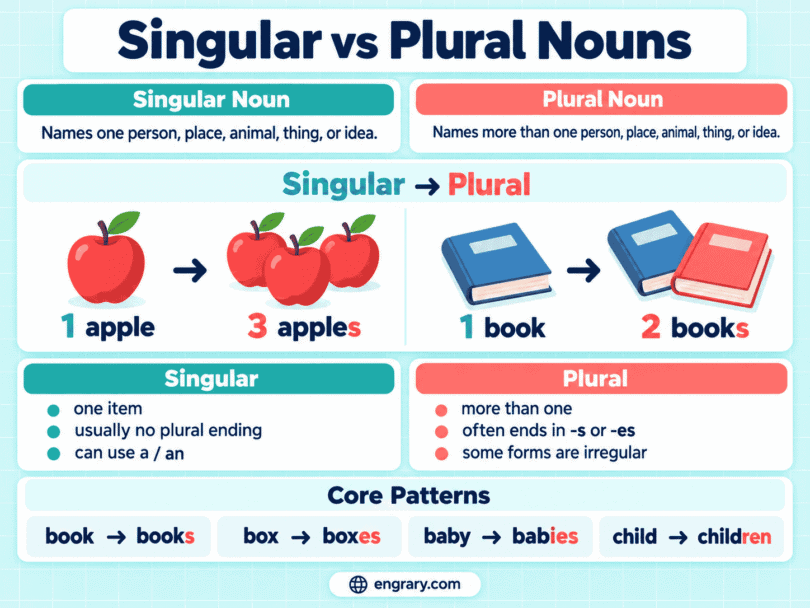
A singular countable noun names one person, place, animal, thing, or idea.
Examples:
- one cat
- one book
- one child
- one city
A plural noun usually names more than one.
Examples:
- two cats
- three books
- four children
- several cities
The basic contrast is:
singular → one
plural → more than one
For example:
one dog → two dogs
one box → three boxes
one child → four children
What Changes From Singular to Plural?
Changing a noun from singular to plural can affect more than the noun ending.
| Singular | Plural |
|---|---|
| a book | books |
| this apple | these apples |
| that child | those children |
| the dog is sleeping | the dogs are sleeping |
| it is outside | they are outside |
Therefore, noun number can affect:
- noun form
- articles
- demonstratives
- verbs
- pronouns
For example:
This child is reading.
becomes:
These children are reading.
Similarly:
The dog is outside.
becomes:
The dogs are outside.
Common Singular-to-Plural Rules
Most countable nouns follow a few common plural patterns.
Add -s
For many nouns, simply add -s.
| Singular | Plural |
|---|---|
| book | books |
| chair | chairs |
| dog | dogs |
| apple | apples |
| teacher | teachers |
| car | cars |
For example:
one book
three books
Add -es
Many nouns ending in s, x, ch, or sh take -es.
| Singular | Plural |
|---|---|
| bus | buses |
| box | boxes |
| watch | watches |
| dish | dishes |
| class | classes |
| brush | brushes |
For instance:
one box
two boxes
Change Y to IES
When a noun ends in a consonant + y, change y to ies.
| Singular | Plural |
|---|---|
| baby | babies |
| city | cities |
| story | stories |
| party | parties |
| family | families |
However, when a vowel comes before y, usually add -s.
| Singular | Plural |
|---|---|
| boy | boys |
| toy | toys |
| key | keys |
| day | days |
Therefore, y → ies does not apply to every noun ending in y.
Singular and Plural Nouns With F, FE, and O
Some nouns ending in -f or -fe change to -ves in the plural.
| Singular | Plural |
|---|---|
| leaf | leaves |
| knife | knives |
| wife | wives |
| wolf | wolves |
| life | lives |
However, this pattern is not universal.
| Singular | Plural |
|---|---|
| roof | roofs |
| chef | chefs |
| chief | chiefs |
Some nouns ending in -o take -es:
| Singular | Plural |
|---|---|
| tomato | tomatoes |
| potato | potatoes |
| hero | heroes |
By contrast, others simply add -s:
| Singular | Plural |
|---|---|
| photo | photos |
| piano | pianos |
| radio | radios |
Because these patterns contain exceptions, many forms need to be learned individually.
Irregular Singular and Plural Nouns
Irregular nouns do not form their plurals by simply adding -s or -es.
| Singular | Plural |
|---|---|
| child | children |
| person | people |
| man | men |
| woman | women |
| mouse | mice |
| goose | geese |
| tooth | teeth |
| foot | feet |
For example:
one child
three children
Similarly:
one mouse
two mice
Since these nouns follow irregular patterns, learners usually need to remember them as singular-plural pairs.
Nouns With the Same Singular and Plural Form
Some nouns do not change when they become plural.
| Singular | Plural |
|---|---|
| sheep | sheep |
| deer | deer |
| fish | fish |
| species | species |
| series | series |
Context often shows whether the noun is singular or plural.
Compare:
The sheep is eating.
The sheep are eating.
In the first sentence, sheep is singular. In the second, it is plural.
Therefore, a noun does not always need a visible spelling change to become plural.
A and An With Singular Nouns
Use a or an with singular countable nouns.
Examples:
- a book
- a chair
- a dog
- an apple
- an egg
- an idea
Plural nouns do not normally use a or an.
Correct:
a book
books
Incorrect:
a books
Therefore, a/an is a useful clue that a countable noun is singular.
This and That vs These and Those
Demonstratives change according to noun number.
| Singular | Plural |
|---|---|
| this book | these books |
| that chair | those chairs |
| this child | these children |
| that city | those cities |
The pattern is:
this / that → singular
these / those → plural
For example:
This box is heavy.
These boxes are heavy.
Similarly:
That child is quiet.
Those children are quiet.
Is and Are With Singular and Plural Nouns
Singular and plural nouns often require different verb forms.
Use is with many singular subjects:
The dog is outside.
The child is reading.
Use are with plural subjects:
The dogs are outside.
The children are reading.
Compare:
| Singular | Plural |
|---|---|
| The cat is sleeping. | The cats are sleeping. |
| This box is heavy. | These boxes are heavy. |
| That child is quiet. | Those children are quiet. |
Therefore, the noun and verb should agree in number.
Singular and Plural Nouns in Sentences
Sentence pairs show how several parts of a sentence can change together.
| Singular Sentence | Plural Sentence |
|---|---|
| A cat is sleeping. | The cats are sleeping. |
| This box is heavy. | These boxes are heavy. |
| That city is busy. | Those cities are busy. |
| One child is reading. | Three children are reading. |
| The mouse ran away. | The mice ran away. |
| A teacher is speaking. | The teachers are speaking. |
These examples show changes in noun form, determiners, and verb agreement.
Singular and Plural Pronoun Agreement
Pronouns should also match the noun number.
Singular:
The dog is hungry. It is barking.
Plural:
The dogs are hungry. They are barking.
Another example:
The child is reading. She is quiet.
The children are reading. They are quiet.
The basic pattern is:
singular noun → singular pronoun
plural noun → plural pronoun
However, pronoun choice also depends on meaning and context.
Plural Nouns vs Possessive Nouns
Plural nouns and possessive nouns are different.
A plural noun shows more than one.
A possessive noun shows ownership, relationship, or connection.
| Form | Meaning |
|---|---|
| dogs | more than one dog |
| dog’s | belonging to one dog |
| dogs’ | belonging to several dogs |
| teachers | more than one teacher |
| teacher’s | belonging to one teacher |
| teachers’ | belonging to several teachers |
Compare:
The dogs are barking.
The dog’s collar is red.
The dogs’ bowls are outside.
Therefore, do not add an apostrophe simply to make a noun plural.
Not Every Noun Has a Normal Singular-Plural Pair
Countable nouns normally have singular and plural forms. However, many uncountable nouns do not use ordinary plural forms in their usual meanings.
Examples include:
- water
- furniture
- information
- advice
- rice
- equipment
For example:
some water
not normally:
waters
when referring to water as a substance generally.
Likewise:
some information
not:
informations
Therefore, it is more accurate to say:
countable nouns normally have singular and plural forms
rather than:
every noun has singular and plural forms
Common Singular and Plural Noun Mistakes
| Incorrect | Correct | Reason |
|---|---|---|
| two book | two books | plural form needed |
| one apples | one apple | singular after one |
| a books | a book | a/an takes a singular noun |
| this books | these books | plural demonstrative needed |
| those child | those children | noun must match plural determiner |
| the dogs is | the dogs are | plural subject needs plural verb |
| childs | children | irregular plural |
| sheeps | sheep | plural form stays the same |
| dog’s are barking | dogs are barking | apostrophe does not form a plural |
| informations | information | information is normally uncountable |
For example, two book is incorrect because a number greater than one normally requires a plural countable noun.
Similarly, this books should become these books because the demonstrative must match the plural noun.
In addition, dog’s are barking incorrectly uses an apostrophe. The plural form is simply dogs.
FAQs
A singular countable noun names one person, place, animal, thing, or idea, while a plural noun usually names more than one.
Many nouns add -s or -es, while some change y to ies, some use other spelling changes, and irregular nouns use forms such as child → children.
Common examples include child → children, person → people, mouse → mice, tooth → teeth, and foot → feet.
Examples include sheep, deer, fish, species, and series.
A plural noun shows more than one, while a possessive noun shows ownership or another relationship. For example, dogs is plural, whereas dog’s is possessive.
You May Also Like