Countable and uncountable nouns affect how we talk about number and quantity in English. Children need to know whether they can say three books, a chair, or many apples, or whether they need forms such as some water, much information, or a piece of advice.
This article explains the difference through direct comparisons rather than separate noun lessons. You’ll learn how numbers, plural forms, a/an, some, any, many, much, a few, a little, how many, and how much change according to noun countability.

Countable or Uncountable? The Core Difference
The easiest way to understand countability is to ask how English treats the noun.
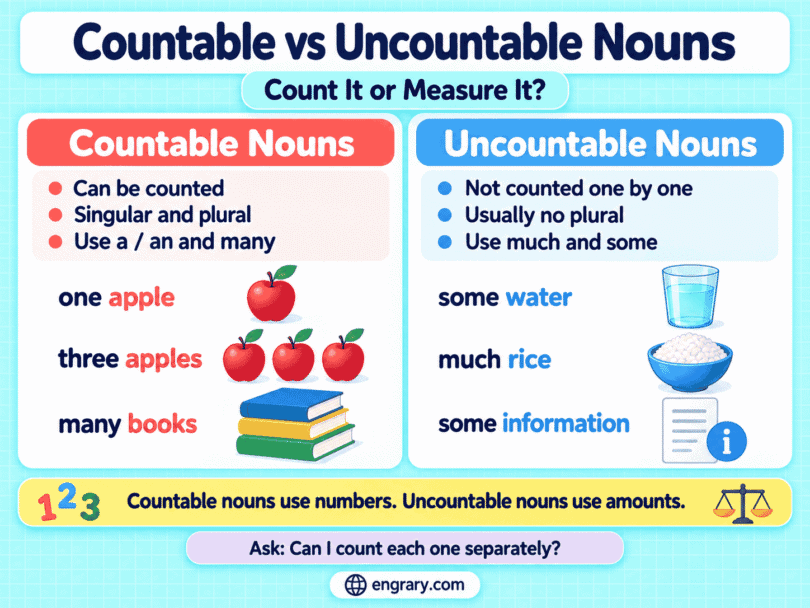
A countable noun refers to separate units that we can normally count directly.
For example:
one book
two books
three chairs
four apples
An uncountable noun, however, refers to something English usually treats as a mass, amount, substance, concept, activity, or collection.
For example:
some water
some rice
some furniture
some information
The basic contrast is:
countable → number of separate units
uncountable → amount or quantity
For instance, we can count books directly:
one book
two books
five books
By contrast, we do not normally count information directly as:
two informations
Instead, we use:
two pieces of information
Quick Comparison at a Glance
The following table shows the main differences.
| Feature | Countable Nouns | Uncountable Nouns |
|---|---|---|
| Main idea | separate units | amount, mass, concept, or collection |
| Number use | three books | not normally three informations |
| Singular form | a book | information |
| Plural form | books | usually no ordinary plural |
| A/An | a chair | not a furniture |
| Large quantity | many chairs | much furniture |
| Small quantity | a few chairs | a little furniture |
| Question form | how many chairs? | how much furniture? |
| Example | apple | rice |
This comparison gives a useful rule, but meaning still matters. Some nouns can change countability depending on how they are used.
How English Treats Number and Quantity
Countable nouns focus on how many units there are.
For example:
three students
five apples
two chairs
several questions
Uncountable nouns focus more often on how much of something there is.
For example:
some water
a little rice
much information
enough money
Therefore, countability is not simply about whether something exists physically.
Consider these two nouns:
idea → countable
furniture → uncountable
An idea is abstract, yet we can say:
three ideas
Furniture is physical, but we do not normally say:
three furnitures
Instead:
three pieces of furniture
This shows that countability is a grammatical feature of how English treats a noun.
When You Can Use a Number Directly
Numbers can normally appear directly before countable nouns.
Examples:
- one apple
- two books
- three students
- four chairs
- five questions
- six cars
After a number greater than one, the noun normally takes a plural form.
Compare:
one book
two books
Likewise:
one child
three children
However, uncountable nouns usually cannot follow numbers directly in their uncountable meanings.
Avoid:
two waters
three informations
four furnitures
when referring to the substances or categories generally.
Instead, use a countable unit.
Why Some Nouns Need a Quantity Unit
Uncountable nouns can still be measured or divided, but English usually counts the unit, not the noun itself.
For example:
| Uncountable Noun | Natural Quantity Phrase |
|---|---|
| water | a bottle of water |
| advice | a piece of advice |
| information | a piece of information |
| furniture | a piece of furniture |
| bread | a loaf of bread |
| coffee | a cup of coffee |
| rice | a bag of rice |
| milk | a glass of milk |
| paper | a sheet of paper |
| chocolate | a bar of chocolate |
The pattern is:
number + countable unit + of + uncountable noun
For example:
three bottles of water
two pieces of advice
four cups of coffee
Therefore, an uncountable noun is not impossible to measure. It simply is not normally counted directly in that meaning.
Choosing A, An, Some, and Any
Singular countable nouns can normally use a or an.
Examples:
a book
a chair
a student
an apple
an egg
an idea
By contrast, a/an does not normally modify an uncountable noun directly.
Incorrect:
an advice
a furniture
an information
Better:
some advice
some furniture
some information
A countable unit also works:
a piece of advice
a piece of furniture
a piece of information
Some With Both Noun Types
Some can work with plural countable nouns:
some books
some chairs
some students
It can also work with uncountable nouns:
some water
some money
some rice
Any With Both Noun Types
Similarly, any often appears with plural countable nouns and uncountable nouns in questions and negative sentences.
Do you have any questions?
We do not have any chairs.
Is there any milk?
She does not have any information.
The important difference is that countable nouns use a plural form when appropriate, while uncountable nouns usually keep the same form.
Many or Much?
Use many with plural countable nouns.
Examples:
many books
many students
many cars
many questions
Use much with uncountable nouns.
Examples:
much information
much money
much traffic
much homework
Compare:
| Countable | Uncountable |
|---|---|
| many books | much information |
| many students | much homework |
| many cars | much traffic |
| many coins | much money |
In everyday affirmative sentences, a lot of often sounds more natural than much.
For example:
She has a lot of homework.
We have a lot of information.
The phrase a lot of also works with plural countable nouns:
There are a lot of students outside.
A Few or A Little?
Use a few with plural countable nouns.
Examples:
a few books
a few apples
a few students
a few chairs
Use a little with uncountable nouns.
Examples:
a little water
a little milk
a little sugar
a little patience
The contrast is simple:
a few → plural countable
a little → uncountable
For example:
I bought a few apples.
Meanwhile, we still have a little rice.
How Many or How Much?
Use how many when asking about countable nouns.
Use how much when asking about uncountable nouns.
| Countable Question | Uncountable Question |
|---|---|
| How many books do you have? | How much information do you have? |
| How many apples are left? | How much rice is left? |
| How many chairs do we need? | How much furniture do we need? |
| How many coins are there? | How much money is there? |
| How many students came? | How much homework did they receive? |
In other words:
how many → number
how much → amount
Everyday Countable and Uncountable Pairs
Some everyday noun pairs make the distinction easier to see.
| Countable Noun | Uncountable Noun |
|---|---|
| apple | rice |
| chair | furniture |
| book | information |
| coin | money |
| suitcase | luggage |
| bottle | water |
| job | work |
| question | advice |
| student | homework |
| car | traffic |
| machine | equipment |
| idea | knowledge |
For example:
three chairs
but:
some furniture
Similarly:
two books
but:
some information
The nouns may relate to similar topics, yet English treats their quantity differently.
Countable and Uncountable Nouns in Real Sentences
The difference becomes clearer when both types appear in natural sentences.
| Countable Sentence | Uncountable Sentence |
|---|---|
| I bought three apples. | I bought some rice. |
| We need two chairs. | We need some furniture. |
| She read two books. | She found useful information. |
| He has several coins. | He has some money. |
| They packed two suitcases. | They carried heavy luggage. |
| She asked three questions. | She gave useful advice. |
| Four cars passed us. | Heavy traffic delayed us. |
| The workers repaired two machines. | The company bought new equipment. |
The countable sentences focus on separate units. By contrast, the uncountable sentences focus on an amount, collection, or general quantity.
Nouns That Change Meaning With Countability
Some nouns can be countable in one meaning and uncountable in another.
This is important because a noun does not always belong permanently to one group.
| Noun | Uncountable Use | Countable Use |
|---|---|---|
| coffee | coffee as a drink generally | a coffee = one serving |
| chocolate | chocolate as food | a chocolate = one piece |
| glass | glass as a material | a glass = drinking container |
| paper | paper as a material | a paper = document or written work |
| experience | experience as knowledge gained | an experience = one event |
| time | time as duration | a time = an occasion |
For example:
I drink coffee every morning.
Here, coffee is uncountable.
However:
We ordered two coffees.
Now, coffees means two servings.
Likewise:
The window is made of glass.
but:
We bought four glasses.
Therefore, meaning and context can change countability.
Tricky Nouns Learners Often Get Wrong
Some common nouns cause mistakes because learners expect them to behave like countable nouns.
Advice
Incorrect:
an advice
two advices
Better:
some advice
a piece of advice
two pieces of advice
Information
Incorrect:
an information
three informations
Better:
some information
a piece of information
three pieces of information
Furniture
Incorrect:
furnitures
Better:
furniture
or:
pieces of furniture
Equipment
Incorrect:
equipments
Better:
equipment
or:
pieces of equipment
Homework
Incorrect:
a homework
Better:
some homework
Luggage
Incorrect:
luggages
Better:
luggage
These nouns may refer to multiple things or amounts, but English normally treats them as uncountable.
A Simple Way to Check a Noun
When you are unsure, ask a few practical questions.
Can I naturally place a number directly before it?
three books ✓
three informations ✗
Can it normally have a singular and plural form?
chair → chairs ✓
furniture → furnitures ✗
Can I use a or an directly before it?
a book ✓
an advice ✗
Would how many sound natural?
How many books? ✓
How many information? ✗
If the noun works naturally with direct numbers, singular/plural forms, a/an, and how many, it is probably countable.
If it works more naturally with some, much, a little, how much, or a quantity unit, it is probably uncountable in that meaning.
However, always consider context because some nouns can work both ways.
Common Errors and Better Forms
The following table brings together some of the most frequent countability mistakes.
| Incorrect | Better Form | Why |
|---|---|---|
| two book | two books | plural countable form needed |
| one apples | one apple | singular follows one |
| an advice | some advice / a piece of advice | advice is uncountable |
| two informations | two pieces of information | information is uncountable |
| furnitures | furniture | furniture is normally uncountable |
| equipments | equipment | equipment is normally uncountable |
| many money | much money / a lot of money | money is uncountable |
| a homework | some homework | homework is uncountable |
| much books | many books | books are countable |
| a few water | a little water | water is uncountable |
The key is not simply to memorize isolated rules. Instead, notice whether English treats the noun as separate units or as an amount, mass, concept, activity, or collection.
FAQs
Countable nouns refer to separate units that can normally be counted directly, such as one book, two books. Uncountable nouns usually refer to amounts, substances, concepts, activities, or collections, such as water, information, and furniture.
Countable examples include book, apple, chair, student, coin, and idea. Uncountable examples include water, rice, information, furniture, money, advice, and homework.
Uncountable nouns normally do not take ordinary plural forms in their uncountable meanings. Therefore, forms such as informations, furnitures, and advices are usually incorrect. However, some nouns become countable when their meanings change.
Yes. For example, coffee is usually uncountable when it refers to the drink generally, but a coffee can mean one serving. Similarly, glass can refer to a material or to one drinking container.
Use a countable unit or measurement phrase. For example, say two bottles of water, three pieces of information, a loaf of bread, or four cups of coffee.
You May Also Like