
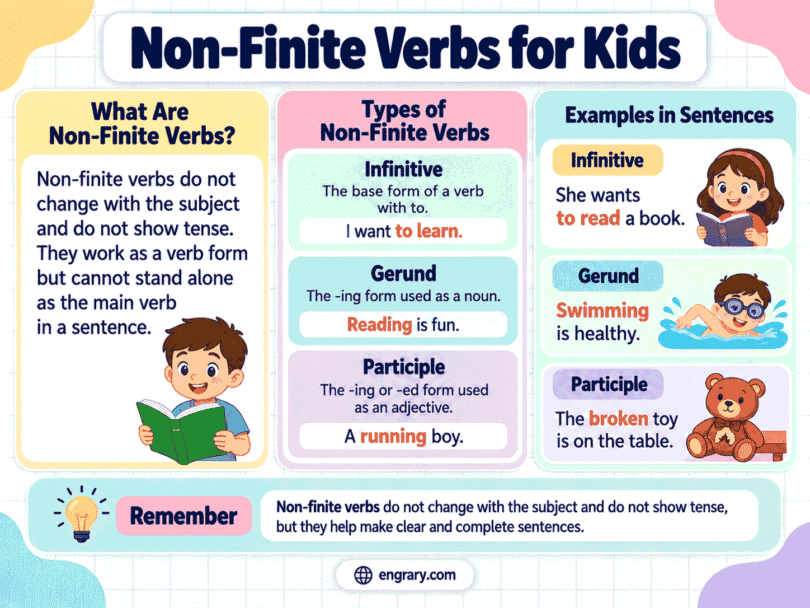
A sentence can contain several verb forms, but not every verb carries tense. Non-finite verbs such as to read, swimming, and written depend on another verb or the sentence context rather than showing tense or subject agreement by themselves.
You’ll learn the main non-finite forms, how they differ from finite verbs, where they appear in sentences, how gerunds and participles fit in, and how to identify each form correctly.
What Makes a Verb Non-Finite?
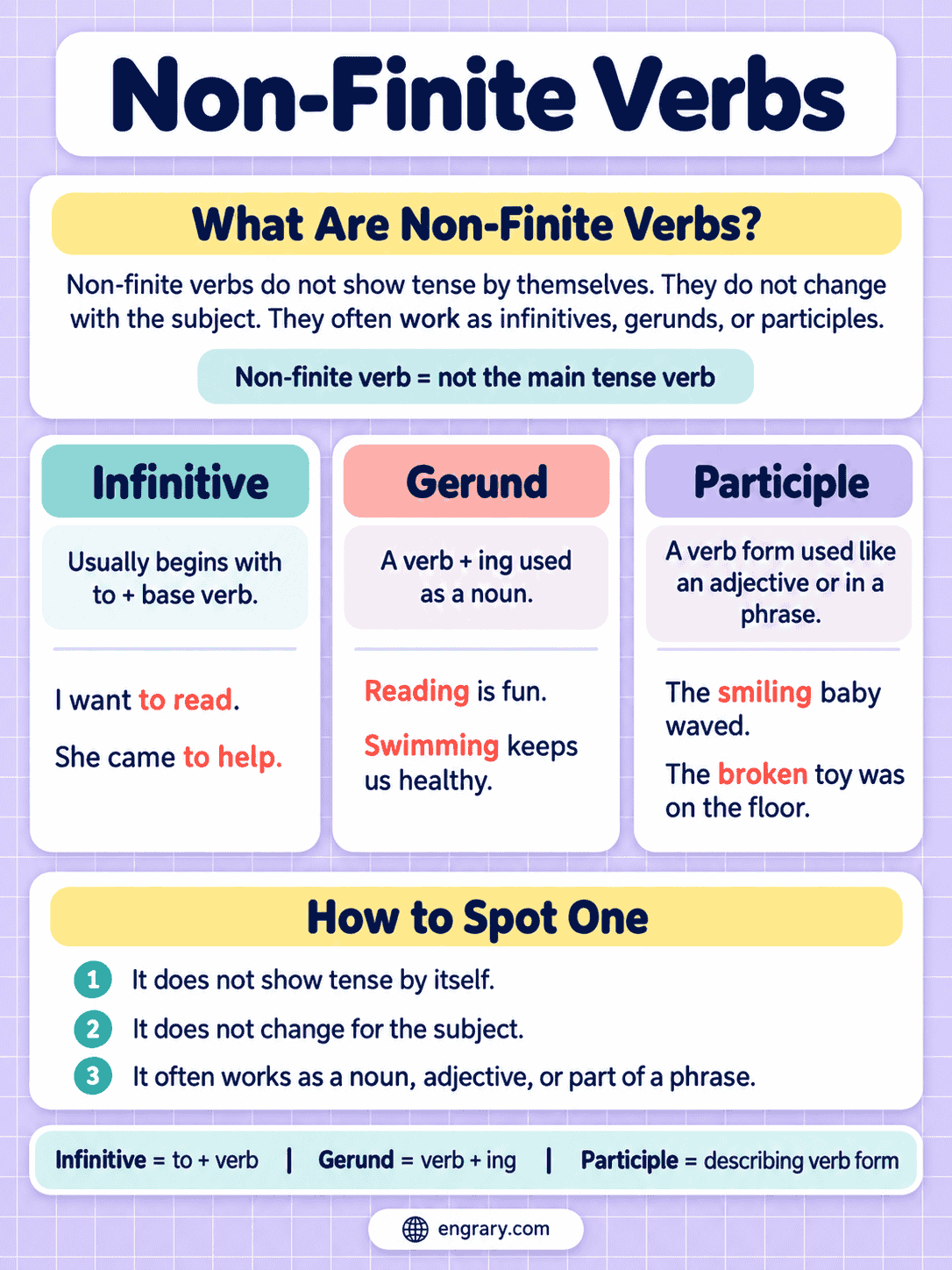
A non-finite verb is a verb form that does not independently show tense or subject agreement.
Examples:
Mia wants to read.
Noah can swim.
They are playing.
We have finished.
In each sentence, another verb carries the tense or finite grammatical role.
The key idea is:
non-finite verb → does not independently show tense or change with the subject
The Main Types of Non-Finite Verbs
Non-finite verbs commonly appear in four forms.
| Non-Finite Form | Example |
|---|---|
| To-infinitive | to read |
| Bare infinitive | read |
| -ing form | reading |
| Past participle | written |
These forms behave differently in sentences, but none independently carries tense.
For example:
Mia wants to read.
Noah can read.
Mia is reading.
Noah has written a story.
Finite vs Non-Finite Verbs
Finite and non-finite verbs perform different grammatical jobs.
| Finite Verb | Non-Finite Verb |
|---|---|
| shows tense | does not independently show tense |
| can show subject agreement | does not change for person or number |
| helps anchor a finite clause | depends on another finite structure or context |
| plays | to play |
| is | playing |
| went | gone |
| has | finished |
Compare:
Mia plays outside.
plays = finite
Mia likes to play outside.
to play = non-finite
Another:
They have finished.
have = finite
finished = non-finite
The difference depends on grammatical function, not simply on what the word looks like.
To-Infinitives
A to-infinitive uses:
to + base verb
Examples:
Mia wants to read.
Noah decided to leave.
We hope to win.
Ava plans to study.
Dad needs to work.
The children want to play.
In:
Mia wants to read.
wants = finite
to read = non-finite
In:
Noah decided to leave.
decided = finite
to leave = non-finite
The to-infinitive remains unchanged even when the subject or tense changes.
Compare:
I want to read.
She wants to read.
They wanted to read.
The finite verb changes, but to read stays the same.
Bare Infinitives
A bare infinitive is the base form without to.
It often appears after modal auxiliary verbs.
Examples:
Mia can swim.
We must leave.
Noah should study.
They may come later.
Ava will help.
Dad could drive.
In:
Mia can swim.
can = finite
swim = non-finite bare infinitive
In:
Noah should study.
should = finite
study = non-finite bare infinitive
This shows why not every infinitive begins with to.
-ing Forms
An -ing form can function as a non-finite verb.
Examples:
She is reading.
They are playing.
We were waiting.
Swimming is fun.
Noah enjoys drawing.
Ava likes painting.
In:
She is reading.
is = finite
reading = non-finite
In:
They were playing.
were = finite
playing = non-finite
The -ing form does not independently carry tense.
Past Participles
Past participles are another common non-finite form.
Examples:
They have finished.
Noah has written a story.
The window was broken.
We had left early.
Mia has eaten lunch.
Dad had built the shelf.
In:
They have finished.
have = finite
finished = non-finite past participle
In:
Noah has written a story.
has = finite
written = non-finite past participle
A past participle may look similar to a past-tense form, so sentence structure matters.
Compare:
She finished yesterday.
finished = finite past verb
She has finished.
has = finite
finished = non-finite past participle
Why Non-Finite Forms Stay Unchanged
Non-finite forms do not change to show tense or subject agreement by themselves.
Compare:
I want to play.
She wants to play.
They wanted to play.
The finite verb changes:
want → wants → wanted
The non-finite form stays:
to play
Another:
I can swim.
She can swim.
They can swim.
The form swim remains unchanged.
Now compare finite verbs:
I play.
She plays.
The finite form can change with the subject, while the non-finite form stays the same.
Where Non-Finite Verbs Appear in Sentences
Non-finite verbs can appear in several common positions.
| Position | Example |
|---|---|
| after another verb | Mia wants to leave. |
| after a modal | Noah can swim. |
| after an auxiliary | Ava is drawing. |
| after have | Dad has finished. |
| as an -ing form at the start | Swimming is fun. |
| in a shortened clause | Walking home, Mia saw a dog. |
This variety is one reason non-finite forms appear so often in English.
Finite and Non-Finite Forms Together
A sentence can contain both finite and non-finite verbs.
| Sentence | Finite Verb | Non-Finite Verb |
|---|---|---|
| She wants to swim. | wants | to swim |
| They decided to leave. | decided | to leave |
| She is reading. | is | reading |
| They have finished. | have | finished |
| Noah can swim. | can | swim |
| Ava will be waiting. | will | be, waiting |
| Dad has written a letter. | has | written |
| We were studying. | were | studying |
A longer verb phrase may contain several non-finite forms.
For example:
They may have been working.
Finite verb:
may
Non-finite forms:
have, been, working
Only the finite verb carries the clause’s finite grammatical role.
How Gerunds and Participles Fit In
Traditional grammar often gives different names to -ing forms depending on their job.
Compare:
Swimming is fun.
Traditional grammar may call swimming a gerund because it appears in a noun-like position.
Now:
She is swimming.
Traditional grammar may call swimming a present participle because it appears in a verb phrase.
Both are -ing forms, and both are non-finite.
Past participles include forms such as:
- written
- broken
- eaten
- played
- finished
- gone
For this topic, the most important point is that these forms do not independently show tense or subject agreement.
Examples of Each Non-Finite Form in Sentences
| Sentence | Non-Finite Form | Type |
|---|---|---|
| Mia wants to read. | to read | to-infinitive |
| Noah can swim. | swim | bare infinitive |
| Ava is drawing. | drawing | -ing form |
| They have finished. | finished | past participle |
| We hope to win. | to win | to-infinitive |
| She should study. | study | bare infinitive |
| The children are playing. | playing | -ing form |
| Dad has written a letter. | written | past participle |
| Swimming is fun. | swimming | -ing form |
| They decided to stay. | to stay | to-infinitive |
| Mia may come later. | come | bare infinitive |
| Noah was sleeping. | sleeping | -ing form |
| We had eaten already. | eaten | past participle |
| Ava plans to travel. | to travel | to-infinitive |
| Dad will drive tomorrow. | drive | bare infinitive |
| Mia enjoys painting. | painting | -ing form |
| They have gone home. | gone | past participle |
| Noah hopes to improve. | to improve | to-infinitive |
| We must wait. | wait | bare infinitive |
| Ava kept smiling. | smiling | -ing form |
The sentence structure helps identify which non-finite form is being used.
How to Identify a Non-Finite Verb
Start by finding all the verb forms in the sentence.
Then ask:
- Which verb carries the tense?
- Which verb changes with the subject?
- Is another form an infinitive?
- Is there an -ing form?
- Is there a past participle?
- Is a modal followed by a base-form verb?
Example:
She has been singing.
Verb forms:
has, been, singing
Finite verb:
has
Non-finite forms:
been, singing
Another:
Mia wants to leave.
Finite:
wants
Non-finite:
to leave
Another:
Noah can swim.
Finite:
can
Non-finite:
swim
The best method is to identify which verb carries the tense first. The remaining verb forms can then be checked for non-finite use.
Common Non-Finite Verb Mistakes
| Mistake | Correct Understanding |
|---|---|
| Every verb in a sentence is finite. | A sentence can contain finite and non-finite forms. |
| Every -ing form is finite. | -ing forms are typically non-finite. |
| Every -ed form is past tense. | It may be a non-finite past participle. |
| All infinitives begin with to. | Bare infinitives also exist. |
| Non-finite verbs independently show tense. | Their time meaning comes from context or a finite verb. |
| Every base form is non-finite. | A base form can be finite or non-finite depending on use. |
| Gerunds and present participles use different forms. | Both use the -ing form, although their sentence roles differ. |
For example:
I play every day.
Here, play is finite.
But:
I can play today.
Here, play is non-finite.
Likewise:
She finished yesterday.
Here, finished is finite.
But:
She has finished.
Here, finished is a non-finite past participle.
FAQs
Yes. In They may have been working, have, been, and working are non-finite forms, while may is finite.
No. An -ing word must still be functioning as a verb form or related verbal form in the sentence. Its grammatical job depends on context.
A bare infinitive used after a modal or similar structure is non-finite. For example, swim is non-finite in Mia can swim.
Yes. Compare She finished yesterday, where finished is finite, with She has finished, where finished is a non-finite past participle.
Look for the verb that changes according to tense or subject agreement. In a verb phrase such as has been singing, has carries the finite role.
You May Also Like



Leave a Comment