Abstract nouns help children name feelings, qualities, states, ideas, and relationships that they cannot experience as physical objects. Learning common examples makes it easier to recognize words such as happiness, honesty, courage, friendship, and freedom in reading and writing.
You’ll see easy abstract noun examples with meanings, categories, and sentences. You’ll also compare abstract and concrete nouns, learn how abstract nouns form from adjectives, verbs, and nouns, review common endings and mistakes, and practice using them correctly.
What Is an Abstract Noun?
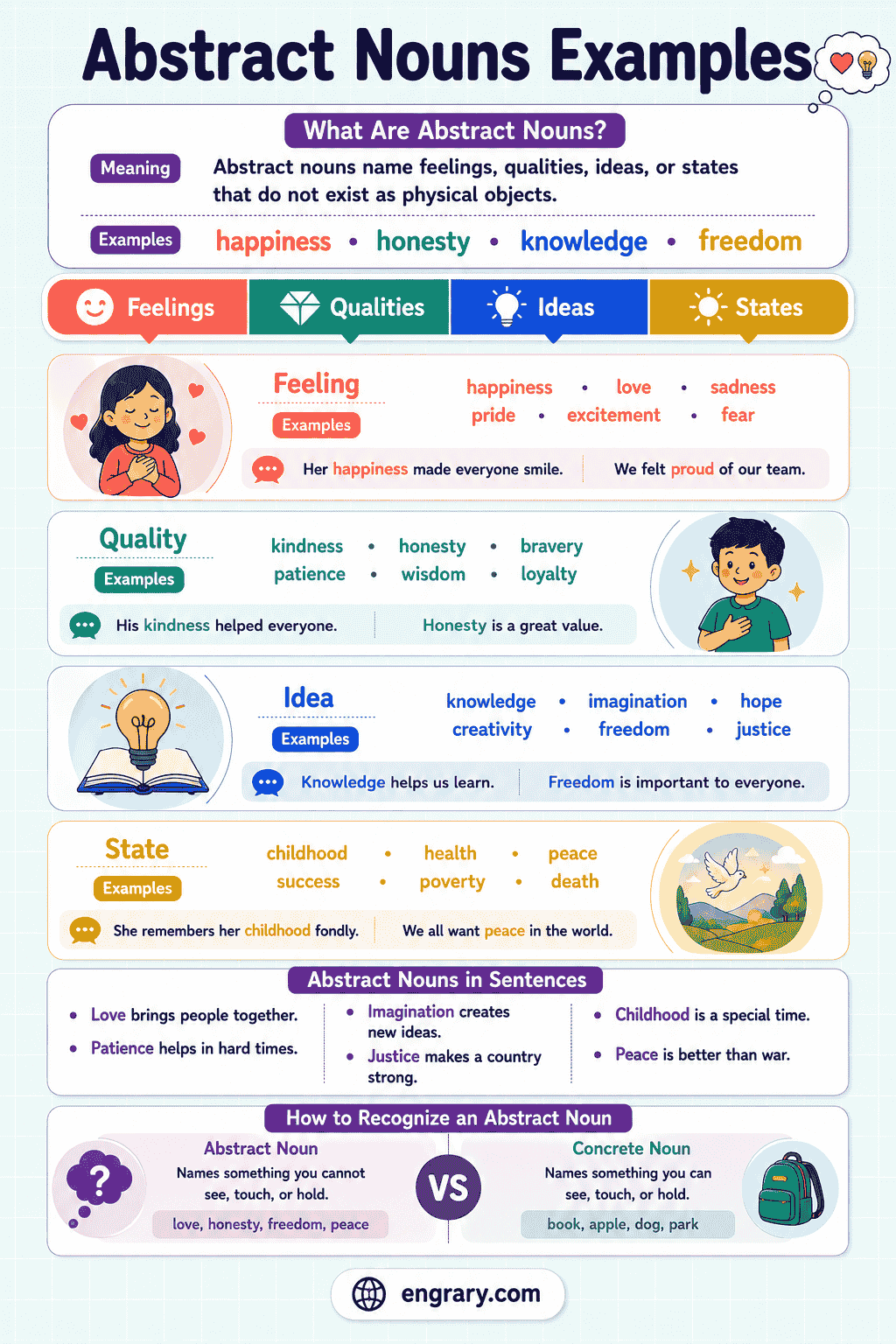
An abstract noun names a feeling, quality, state, idea, concept, or relationship that does not exist as a physical object we can directly experience through the five senses.
Common examples include:
- happiness
- courage
- honesty
- kindness
- patience
- freedom
- friendship
- knowledge
- curiosity
- peace
For example:
Mia showed kindness to the new student.
The word kindness names a quality rather than a physical person or object.
Another example is:
The firefighter showed courage during the rescue.
Here, courage names a personal quality.
A simple distinction is:
abstract noun → feeling, quality, state, idea, concept, or relationship
Easy Abstract Noun Examples
The following table gives common abstract nouns with their categories and simple meanings.
| Abstract Noun | Category | Simple Meaning |
|---|---|---|
| love | feeling | strong care or affection |
| happiness | feeling/state | being happy |
| sadness | feeling | being unhappy or sorrowful |
| anger | feeling | strong displeasure |
| fear | feeling | feeling afraid |
| hope | feeling/state | expectation that something good may happen |
| courage | quality | ability to face difficulty bravely |
| honesty | quality | being truthful |
| kindness | quality | being caring and helpful |
| patience | quality | ability to wait calmly |
| freedom | state/idea | being free |
| friendship | relationship | connection between friends |
| knowledge | idea/state | information and understanding |
| wisdom | quality | good judgment based on knowledge and experience |
| beauty | quality | the quality of being beautiful |
| trust | relationship/state | belief in someone’s honesty or reliability |
| respect | quality/attitude | consideration for someone or something |
| curiosity | quality | desire to learn or know more |
| confidence | quality/state | belief in one’s abilities |
| peace | state | absence of conflict or disturbance |
These nouns do not name physical objects. Instead, they name things we understand, feel, experience, or recognize mentally.
Common Abstract Nouns With Meanings
Some abstract nouns appear frequently in everyday English. Understanding their meanings can make them easier to identify and use.
Kindness
Kindness is the quality of being caring, helpful, and considerate toward others. Mia showed kindness by helping her classmate.
Courage
Courage is the ability to face fear, difficulty, or danger bravely. The firefighter showed courage during the rescue.
Patience
Patience is the ability to wait or deal with difficulty calmly. Learning a new skill requires patience.
Honesty
Honesty is the quality of being truthful and sincere. The teacher appreciated Noah’s honesty.
Freedom
Freedom is the state of being free from unnecessary control or restriction. The people valued their freedom.
Friendship
Friendship is a relationship between people who care about and support one another. Their friendship lasted for many years.
Knowledge
Knowledge is information and understanding gained through learning or experience. Reading increases knowledge.
Curiosity
Curiosity is the desire to learn, discover, or understand something. Her curiosity encouraged her to ask questions.
Confidence
Confidence is belief in one’s abilities or judgment. Regular practice increased her confidence.
Peace
Peace is a state without conflict or serious disturbance. The agreement brought peace to the community.
Wisdom
Wisdom is the ability to use knowledge and experience to make good decisions. Her grandmother shared useful wisdom.
Trust
Trust is belief in someone’s honesty, reliability, or ability. Good communication can strengthen trust between friends.
Common Types of Abstract Nouns
Abstract nouns can be grouped according to what they name. These categories help students recognize patterns among common examples.
Feelings and Emotions
Feelings and emotions describe internal experiences.
Common examples include:
- happiness
- sadness
- anger
- fear
- joy
- love
- excitement
- disappointment
Mia felt happiness after hearing the good news.
His fear decreased after the storm ended.
The result caused disappointment.
Qualities and Character Traits
These abstract nouns name personal qualities or characteristics.
Examples include:
- honesty
- kindness
- courage
- patience
- bravery
- loyalty
- generosity
- confidence
Her honesty earned the teacher’s trust.
Noah showed patience while waiting.
The firefighter acted with courage.
Ideas and Concepts
Some abstract nouns name ideas or concepts that people understand mentally.
Examples include:
- freedom
- truth
- knowledge
- peace
- justice
- equality
Everyone deserves respect and fair treatment.
Reading increases knowledge.
The class discussed the meaning of freedom.
States and Conditions
Abstract nouns can also name states or conditions.
Examples include:
- childhood
- safety
- loneliness
- health
- independence
- poverty
The children stayed inside for safety.
Her independence increased as she learned new skills.
Good food and exercise can support health.
Relationships and Life Experiences
Some abstract nouns describe relationships, stages of life, or experiences.
Examples include:
- friendship
- trust
- teamwork
- leadership
- childhood
- experience
Their friendship became stronger over time.
Good teamwork helped the group finish the project.
Her experience helped her solve the problem efficiently.
Abstract Nouns in Sentences
Abstract nouns appear naturally in everyday speech and writing. The bold words below name feelings, qualities, states, ideas, or relationships.
Kindness
Her kindness helped the new student feel welcome.
Courage
The firefighter showed courage during the rescue.
Patience
Learning a new skill requires patience.
Freedom
The citizens valued their freedom.
Friendship
Their friendship lasted for many years.
Knowledge
Reading increases knowledge.
Curiosity
Her curiosity encouraged her to ask more questions.
Honesty
The teacher appreciated Noah’s honesty.
Confidence
Practice increased her confidence.
Peace
The agreement brought peace to the community.
Wisdom
Her grandmother shared valuable wisdom.
Trust
Clear communication helped build trust.
Respect
Students should show respect to one another.
Hope
The family maintained hope during the difficult period.
Generosity
His generosity helped several families.
Abstract Nouns vs. Concrete Nouns
Abstract nouns and concrete nouns differ in what they name.
A concrete noun names something that we can physically perceive.
An abstract noun names a feeling, quality, state, idea, concept, or relationship.
The pairs below are comparison examples, not exact opposites.
| Concrete Noun | Abstract Noun |
|---|---|
| friend | friendship |
| child | childhood |
| flower | beauty |
| soldier | courage |
| smile | happiness |
| person | honesty |
My friend arrived early.
Friend names a physical person, so it is concrete.
Their friendship lasted for years.
Friendship names a relationship, so it is abstract.
The flower grew beside the wall.
A flower is physically perceivable.
Its beauty impressed the visitors.
Beauty names a quality, so it is abstract.
The soldier entered the room.
Soldier names a person.
The soldier showed courage.
Courage names a quality.
A smile is something we can see, while happiness names an internal feeling.
The key difference is:
concrete noun → physically perceivable
abstract noun → feeling, quality, state, idea, concept, or relationship
How Abstract Nouns Are Formed
Many abstract nouns develop from adjectives, verbs, or other nouns. Studying these patterns can help children recognize and build new words.
From Adjectives
Some adjectives change into abstract nouns.
| Base Word | Abstract Noun |
|---|---|
| kind | kindness |
| happy | happiness |
| brave | bravery |
| honest | honesty |
| patient | patience |
| beautiful | beauty |
For example:
kind → kindness
happy → happiness
brave → bravery
The base words kind, happy, and brave are adjectives. Their related forms kindness, happiness, and bravery are abstract nouns.
From Verbs
Some verbs form related abstract nouns.
| Verb | Abstract Noun |
|---|---|
| decide | decision |
| educate | education |
| achieve | achievement |
| move | movement |
| know | knowledge |
| grow | growth |
For example:
decide → decision
achieve → achievement
grow → growth
The verb names an action, while the abstract noun can name the result, process, idea, or state connected with that action.
From Nouns
Some nouns form related abstract nouns that name relationships, stages, or roles.
| Base Noun | Abstract Noun |
|---|---|
| friend | friendship |
| child | childhood |
| leader | leadership |
| member | membership |
For example:
friend → friendship
child → childhood
leader → leadership
The new noun changes the meaning from a person to a relationship, stage, or quality connected with that person.
Common Abstract Noun Endings
Certain endings often appear in abstract nouns.
| Ending | Example |
|---|---|
| -ness | kindness |
| -ity | curiosity |
| -tion | education |
| -ment | achievement |
| -ship | friendship |
| -hood | childhood |
These endings can help students recognize possible abstract nouns. However, the word’s meaning still determines its noun type.
For example:
kindness names a quality.
friendship names a relationship.
childhood names a stage of life.
Common Abstract Noun Mistakes
Several common errors can make abstract nouns confusing.
| Mistake | Better Explanation |
|---|---|
| A smile is abstract because it shows happiness. | A smile is visible; happiness names an abstract feeling. |
| Kind is an abstract noun. | Kind is usually an adjective; kindness is the abstract noun. |
| Abstract nouns are only feelings. | They can also name qualities, states, ideas, concepts, and relationships. |
| Every feeling-related word is abstract. | Classification depends on what the noun itself names. |
| A physical sign of a feeling is the same as the feeling. | The sign may be concrete, while the feeling itself is abstract. |
For example, a smile is visible and therefore concrete in its usual physical meaning. Happiness, however, names an internal feeling.
Similarly, kind usually functions as an adjective, while kindness is the abstract noun.
Abstract Noun Practice
Complete the activities before checking the answer key.
Find the Abstract Noun
Find the abstract noun or nouns in each sentence.
- Her kindness helped the new student.
- Noah showed courage during the competition.
- Their friendship lasted for years.
- Reading increases knowledge.
- The family maintained hope.
- Patience helped Mia finish the task.
Match Abstract Nouns With Their Meanings
Match each noun with its correct meaning.
Courage
Bravery when facing difficulty.
Patience
The ability to wait calmly.
Kindness
The quality of being caring and helpful.
Freedom
The state of being free.
Curiosity
The desire to learn or know more.
Identify the Type of Abstract Noun
Classify each noun as a feeling, quality, state, idea, or relationship.
- happiness
- honesty
- freedom
- knowledge
- friendship
- courage
- fear
- peace
Concrete or Abstract?
Classify each noun.
- friend
- friendship
- flower
- beauty
- child
- childhood
- soldier
- courage
Form the Abstract Noun
Write the abstract noun related to each base word.
- kind
- brave
- happy
- friend
- child
- decide
- achieve
- honest
Write Sentences With Abstract Nouns
Write:
- one sentence using a feeling;
- one sentence using a quality;
- one sentence using a state;
- one sentence using an idea;
- one sentence using a relationship.
Answer Key
Find the Abstract Noun
- kindness
- courage
- friendship
- knowledge
- hope
- patience
Match Abstract Nouns With Their Meanings
- courage — bravery when facing difficulty
- patience — the ability to wait calmly
- kindness — the quality of being caring and helpful
- freedom — the state of being free
- curiosity — the desire to learn or know more
Identify the Type of Abstract Noun
- happiness — feeling
- honesty — quality
- freedom — state
- knowledge — idea
- friendship — relationship
- courage — quality
- fear — feeling
- peace — state
Concrete or Abstract?
- friend — concrete
- friendship — abstract
- flower — concrete
- beauty — abstract
- child — concrete
- childhood — abstract
- soldier — concrete
- courage — abstract
Form the Abstract Noun
- kind → kindness
- brave → bravery
- happy → happiness
- friend → friendship
- child → childhood
- decide → decision
- achieve → achievement
- honest → honesty
Write Sentences With Abstract Nouns
Answers will vary. Possible answers include:
Mia felt happiness after hearing the news.
The firefighter showed courage.
Everyone values freedom.
Reading increases knowledge.
Their friendship lasted for years.
FAQs
Common abstract noun examples include happiness, courage, honesty, kindness, patience, freedom, friendship, knowledge, curiosity, confidence, trust, and peace.
Common types include feelings and emotions, qualities and character traits, states and conditions, ideas and concepts, and relationships or life experiences.
Concrete nouns name things that we can physically perceive, while abstract nouns name feelings, qualities, states, ideas, concepts, or relationships. For example, friend is concrete, while friendship is abstract.
Many abstract nouns form from adjectives, verbs, or other nouns. Examples include kind → kindness, decide → decision, and friend → friendship.
Abstract nouns function like other nouns in sentences. For example, Her honesty earned the teacher’s trust and Learning requires patience both use abstract nouns naturally.
You May Also Like