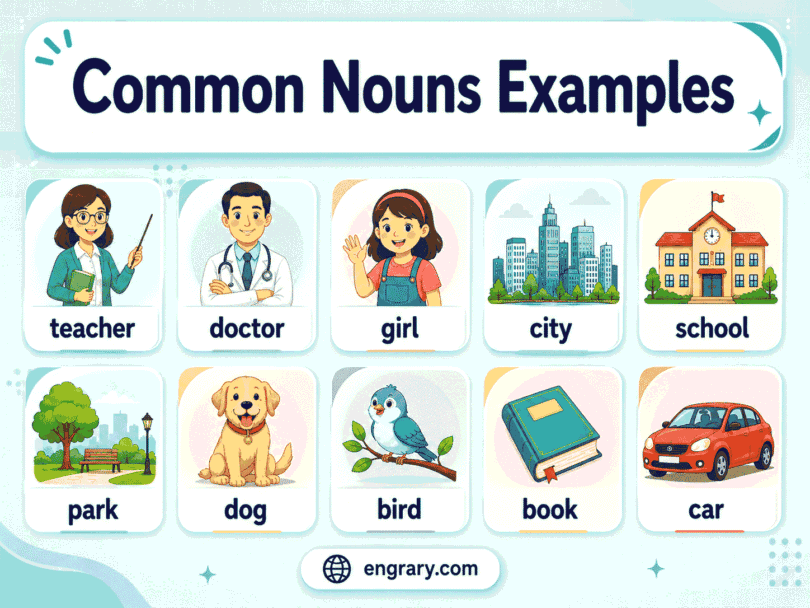
Common nouns help children name people, places, animals, objects, foods, materials, feelings, and ideas in a general way. Learning common nouns also makes it easier to distinguish general names such as teacher or city from specific proper names such as Ms. Green or London.
You’ll see easy common noun examples with meanings, categories, and sentence use. You’ll also learn how common nouns differ from proper nouns, how capitalization works, how common nouns can be concrete, abstract, countable, or uncountable, and which common mistakes to avoid.

What Is a Common Noun?
A common noun gives a general name for a person, animal, place, object, substance, feeling, quality, idea, or other thing.
Examples include:
- teacher
- city
- dog
- book
- water
- kindness
For example:
The teacher explained the lesson.
The word teacher can refer to any teacher, so it is a common noun.
Compare:
teacher → Ms. Green
Teacher gives a general name, while Ms. Green identifies one specific teacher.
A simple rule is:
common noun → general name
Easy Common Noun Examples
The following table gives familiar examples from several categories.
| Common Noun | Category | Simple Meaning |
|---|---|---|
| teacher | person | someone who teaches |
| doctor | person | someone who treats sick or injured people |
| child | person | a young person |
| student | person | someone who studies |
| city | place | a large populated area |
| school | place | a place where students learn |
| park | place | a public outdoor area |
| library | place | a place with books and learning resources |
| dog | animal | a common domestic animal |
| cat | animal | a common domestic animal |
| bird | animal | an animal with feathers and wings |
| rabbit | animal | a small animal with long ears |
| book | object | a written or printed work |
| chair | object | a seat for one person |
| pencil | object | a tool used for writing or drawing |
| phone | object | a device used for communication |
| apple | food | a type of fruit |
| water | substance | a liquid people drink |
| wood | material | material that comes from trees |
| kindness | quality | being caring and helpful |
These examples show that common nouns can name both physical things and nonphysical ideas or qualities.
Common Nouns With Meanings
Selected examples become easier to understand when their meanings and uses appear together.
Teacher
A teacher is a person who helps students learn. The word teacher can refer to any person with that role.
River
A river is a natural stream of water that flows across land. River does not identify one particular river.
Library
A library is a place where people can read, study, or use books and other learning materials. The noun library gives a general place name.
Rabbit
A rabbit is a small animal with long ears and strong back legs. Rabbit names the animal type rather than one individual rabbit.
Book
A book is a written or printed work made up of pages. The noun book can refer to any book.
Pencil
A pencil is a tool used for writing or drawing. Pencil names a general kind of object.
Water
Water is a liquid that people use for drinking, cooking, washing, and many other purposes. Water is a common noun and usually an uncountable noun.
Wood
Wood is a natural material that comes from trees. People use it for furniture, buildings, tools, and many other objects.
Happiness
Happiness is a feeling or state of being happy. It is a common noun because it names the feeling generally.
Kindness
Kindness is the quality of being caring and helpful toward others. Kindness is both a common noun and an abstract noun.
Courage
Courage is the quality of facing fear or difficulty bravely. The noun names a quality rather than a specific person or thing.
Friendship
Friendship is a relationship between people who care about and support one another. It functions as a common and abstract noun.
Types of Common Nouns
Common nouns appear in many everyday categories. Some name physical people, places, animals, or objects, while others name ideas, qualities, or feelings.
People
Common nouns for people describe them generally by role, age, relationship, occupation, or type.
Examples include:
- teacher
- doctor
- child
- mother
- father
- student
- farmer
- driver
- artist
- singer
The doctor spoke to the family.
The student opened the book.
A farmer worked in the field.
None of these nouns identifies one particular person.
Places
Common place nouns name locations generally.
Examples include:
- city
- school
- park
- library
- hospital
- beach
- market
- street
- village
- garden
The children played in the park.
The library closes in the evening.
We walked through the market.
Words such as park, library, and market can refer to many different places.
Animals
Common animal nouns name species or types rather than individual animals.
Examples include:
- dog
- cat
- bird
- horse
- rabbit
- frog
- elephant
- butterfly
The rabbit sat near the fence.
A bird landed on the branch.
The horse ran across the field.
A personal animal name such as Bruno or Luna would be a proper noun instead.
Objects and Everyday Things
Many everyday object names are common nouns.
Examples include:
- book
- chair
- pencil
- phone
- bag
- table
- bottle
- spoon
- clock
- toy
Mia opened the book.
The clock hung above the door.
Noah placed the bottle on the table.
These words name general types of objects rather than specific named objects.
Food, Drinks, and Materials
Common nouns can also name foods, liquids, and materials.
Examples include:
- apple
- bread
- milk
- rice
- water
- wood
- cotton
- glass
Noah ate an apple.
We need more water.
The table is made of wood.
Some of these nouns are countable, such as apple, while others are usually uncountable, such as water and rice.
Ideas, Feelings, and Qualities
Common nouns do not only name physical things. They can also name abstract feelings, qualities, ideas, and relationships.
Examples include:
- happiness
- courage
- honesty
- kindness
- friendship
- freedom
- knowledge
- patience
Her kindness helped the new student.
Learning requires patience.
The firefighter showed courage.
These nouns are common because they name general concepts, and abstract because the concepts are not physical objects.
Common Nouns in Sentences
Common nouns appear naturally in everyday speech and writing.
Teacher
The teacher explained the lesson.
City
The city has several parks.
Rabbit
The rabbit sat under the tree.
Book
Mia opened the book.
Library
The children visited the library.
Apple
Noah ate an apple after lunch.
Water
We need more water.
Wood
The chair is made of wood.
Kindness
Her kindness helped the new student.
Courage
The firefighter showed courage.
Phone
Mia placed the phone on the desk.
Garden
The children worked in the garden.
Bird
A bird landed on the fence.
Milk
The child drank milk with breakfast.
Friendship
Their friendship lasted for many years.
These sentences show that common nouns can function naturally across many categories.
Common Nouns vs. Proper Nouns
Common nouns and proper nouns differ in specificity.
A common noun gives a general name.
A proper noun gives a specific name.
| Common Noun | Proper Noun |
|---|---|
| girl | Emma |
| teacher | Ms. Green |
| city | London |
| country | Canada |
| river | Amazon River |
| day | Monday |
| month | January |
| company |
The city has many buildings.
London has many buildings.
The first sentence uses a general place word. The second names one particular city.
Another example is:
The teacher entered the classroom.
Ms. Green entered the classroom.
Here, teacher names the occupation generally, while Ms. Green identifies a particular person.
Capitalization of Common Nouns
Common nouns normally remain lowercase unless they begin a sentence.
Correct:
The teacher entered the room.
Incorrect:
The Teacher entered the room.
The word remains common because it still names the occupation generally.
However:
Teacher entered the room.
Here, the capital letter appears because Teacher begins the sentence. Its noun type has not changed.
Compare:
city → common noun
London → proper noun
Specific naming determines whether a noun is common or proper. Capitalization reflects that distinction; it does not create it.
Concrete and Abstract Common Nouns
A common noun can also belong to another noun category.
| Common Noun | Concrete or Abstract? |
|---|---|
| dog | concrete |
| book | concrete |
| water | concrete |
| city | concrete |
| happiness | abstract |
| courage | abstract |
| friendship | abstract |
| kindness | abstract |
Dog is common because it names an animal generally and concrete because a dog is physically perceivable.
Happiness is common because it names a feeling generally and abstract because the feeling itself is not a physical object.
The categories describe different features of the same noun.
Countable and Uncountable Common Nouns
Common nouns can also be countable or uncountable.
Countable Common Nouns
Examples include:
- book
- chair
- dog
- apple
- student
We can say:
one book
two books
three books
Uncountable Common Nouns
Examples include:
- water
- rice
- sand
- information
- milk
We usually do not count these nouns directly in their general meanings.
For example:
We need more water.
She gave me some information.
The term common tells us that the noun gives a general name, while countable or uncountable describes how English expresses number or quantity.
Family Words and Titles
Some family words and titles use lowercase when they function as general common nouns but may take capitals when they function like names.
My mom is cooking.
Here, mom names a family relationship generally.
I asked Mom for help.
Here, Mom functions like the person’s name.
Similarly:
my dad
I asked Dad.
Titles show a similar contrast.
The doctor entered the room.
Here, doctor gives a general job name.
Dr. Khan entered the room.
Here, the title and name identify a particular person.
Another example is:
The principal spoke to the class.
Principal Hudson spoke to the class.
General family roles and job titles usually remain lowercase. Name-like uses and titles directly attached to specific names take capitals.
Seasons and School Subjects
Names of seasons and general school subjects usually function as common nouns.
Examples include:
- spring
- summer
- autumn
- winter
- history
- math
- science
- geography
I enjoy winter.
Mia studies history and science.
However, these words can appear inside specific names:
the Winter Olympics
World History
Language names differ because English treats them as proper nouns:
- English
- Urdu
- French
- Spanish
Mia studies English at school.
Common Nouns Inside Proper Names
A common noun can form part of a longer proper name.
Examples include:
Amazon River
Oxford University
Central Park
Pacific Ocean
The words river, university, park, and ocean are common when used alone.
The river is wide.
Here, river gives a general name.
The Amazon River is wide.
Here, Amazon River forms the full specific name.
Similarly:
The park is crowded.
Central Park is crowded.
The common word remains part of the category meaning, while the complete expression identifies one specific place.
Common Mistakes With Common Nouns
Several common mistakes involve confusing general nouns with specific names or misunderstanding overlapping noun categories.
| Mistake or Incorrect Idea | Better Explanation |
|---|---|
| teacher is proper because it names a person | Teacher names people with that occupation generally, so it is common. |
| city is proper because cities have names | City is common; a specific name such as London is proper. |
| happiness cannot be common because it is abstract | A noun can be both common and abstract. |
| winter should always be capitalized | Season names are usually common nouns and lowercase. |
| River is always proper | River alone is common; Amazon River is proper. |
| every physical noun is a proper noun | Physical existence does not determine common/proper status. |
| capitalizing a common noun makes it proper | Meaning and naming function determine the noun type. |
The most reliable question is:
Does this noun give a general name or an exact specific name?
If it gives a general name, it functions as a common noun.
FAQs
Common noun examples include teacher, doctor, city, school, park, dog, rabbit, book, chair, apple, water, wood, happiness, courage, and kindness.
A common noun gives a general name, while a proper noun gives a specific name. For example, city is common, while London is proper.
Common nouns usually begin with lowercase letters, but they use a capital letter when they start a sentence. That sentence-position capitalization does not change the noun into a proper noun.
Yes. Dog and book are common concrete nouns, while happiness and kindness are common abstract nouns.
Yes. Common nouns such as book, chair, and apple are countable, while water, rice, and information are usually uncountable.
You May Also Like