Possessive nouns and possessive pronouns both show ownership, relationship, or connection, but they do it in different ways. A possessive noun names the owner directly, while a possessive pronoun replaces a possessive noun phrase and stands alone.
You’ll learn how forms such as Emma’s book compare with hers, how my/mine, her/hers, our/ours, and their/theirs differ, why possessive pronouns do not take apostrophes, and how to avoid common mistakes.

Name the Owner or Replace the Phrase? The Main Difference
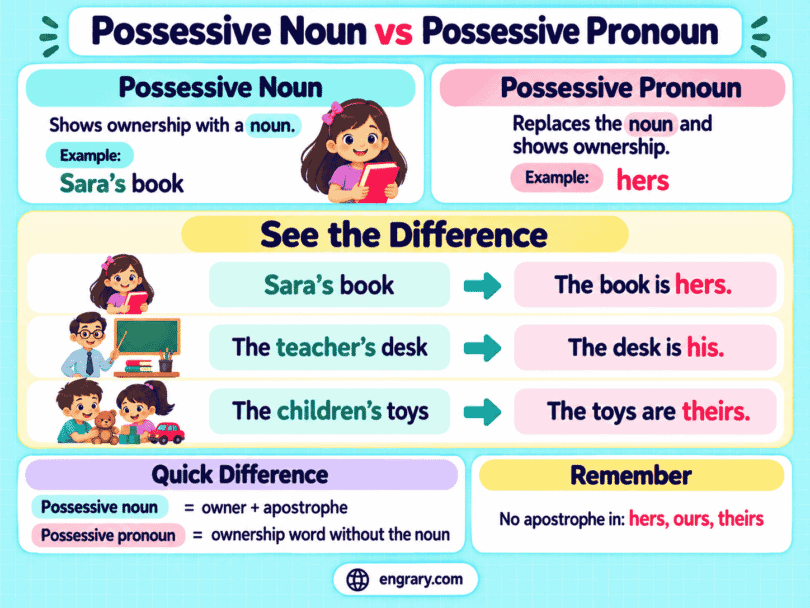
The easiest way to understand the difference is to compare the two forms directly.
| Possessive Noun Phrase | Possessive Pronoun |
|---|---|
| Emma’s book | hers |
| Noah’s bag | his |
| the children’s toys | theirs |
| our classroom | ours |
| your seat | yours |
The basic contrast is:
possessive noun → names the owner
possessive pronoun → replaces the possessive noun phrase
For example:
This is Emma’s book.
This book is hers.
Both sentences express possession, but the second avoids repeating the owner and the noun phrase.
Possessive Nouns Identify the Owner
A possessive noun shows ownership, relationship, association, or another connection by naming the owner.
Examples include:
- Emma’s bag
- teacher’s desk
- dog’s collar
- students’ books
- children’s toys
For example:
The teacher’s desk is near the window.
The dog’s collar is red.
The children’s toys are on the floor.
In each case, the possessive noun tells us directly who or what the relationship belongs to.
Possessive Pronouns Stand Alone
A possessive pronoun replaces a possessive noun phrase and can stand alone.
Common possessive pronouns are:
- mine
- yours
- his
- hers
- ours
- theirs
Compare:
This is my book.
This book is mine.
That is her bag.
That bag is hers.
These are their seats.
These seats are theirs.
The possessive pronoun replaces the possessive expression instead of appearing directly before a noun.
Possessive Noun to Possessive Pronoun Examples
The following table shows how possessive noun phrases can be replaced by possessive pronouns.
| Possessive Expression | Possessive Pronoun |
|---|---|
| Emma’s pencil | hers |
| Noah’s bicycle | his |
| my notebook | mine |
| your chair | yours |
| our classroom | ours |
| their house | theirs |
| the children’s toys | theirs |
For example:
This is Noah’s bicycle.
The bicycle is his.
Similarly:
These are the children’s toys.
The toys are theirs.
The correct pronoun depends on the owner, not on the object being possessed.
My vs Mine, Her vs Hers, Their vs Theirs
This is one of the most important differences to learn.
| Before a Noun | Stands Alone |
|---|---|
| my | mine |
| your | yours |
| his | his |
| her | hers |
| our | ours |
| their | theirs |
Compare:
my book
The book is mine.
her pencil
The pencil is hers.
our classroom
The classroom is ours.
their house
The house is theirs.
The first forms come before nouns, while the second forms stand alone.
Therefore:
my book ✓
mine book ✗
and:
her bag ✓
hers bag ✗
Possessive Nouns and Pronouns in Sentences
Sentence pairs make the difference clear.
Emma’s bag is blue.
The blue bag is hers.
Noah’s bicycle is outside.
The bicycle is his.
The children’s toys are on the floor.
The toys are theirs.
Our classroom is upstairs.
The upstairs classroom is ours.
Your seat is near the window.
The seat near the window is yours.
These pairs show that possessive pronouns can replace longer possessive expressions when the meaning is already clear.
How Possessive Pronouns Avoid Repetition
Possessive pronouns help make sentences shorter and smoother.
Compare:
My bag is black. Your bag is blue.
Better:
My bag is black. Yours is blue.
Another example:
Emma’s desk is near the window. Noah’s desk is near the door.
Better:
Emma’s desk is near the window. His is near the door.
Similarly:
Our classroom is large. Their classroom is smaller.
Better:
Our classroom is large. Theirs is smaller.
Possessive pronouns are useful when the possessed noun has already been mentioned or is obvious from context.
Why Possessive Pronouns Do Not Take Apostrophes
Possessive pronouns do not use apostrophes.
Correct:
- yours
- hers
- ours
- theirs
Incorrect:
- your’s
- her’s
- our’s
- their’s
This is an important difference from possessive nouns.
Compare:
Emma’s book
apostrophe used
hers
no apostrophe
Likewise:
the students’ classroom
apostrophe used
theirs
no apostrophe
The apostrophe rules for possessive nouns do not apply to possessive pronouns.
Possessive Pronoun vs Possessive Determiner
Possessive determiners and possessive pronouns are closely related, but they do not work in the same position.
A possessive determiner comes before a noun.
Examples:
- my book
- your chair
- his bicycle
- her bag
- our house
- their classroom
A possessive pronoun stands alone.
Examples:
- mine
- yours
- his
- hers
- ours
- theirs
Compare:
That is her bag.
The bag is hers.
Similarly:
This is our classroom.
The classroom is ours.
The difference is:
possessive determiner → before a noun
possessive pronoun → replaces the noun phrase
Singular and Plural Possessive Nouns vs Pronouns
Possessive nouns can show one owner or several owners.
| Possessive Noun | Meaning | Possible Pronoun |
|---|---|---|
| girl’s bag | one girl | hers |
| girls’ bags | several girls | theirs |
| boy’s bicycle | one boy | his |
| boys’ bicycles | several boys | theirs |
| children’s toys | several children | theirs |
For example:
The girl’s bag is blue.
The bag is hers.
By contrast:
The girls’ bags are blue.
The bags are theirs.
The noun form shows whether the owner is singular or plural, while the pronoun depends on who the owners are.
How to Choose the Correct Possessive Form
Use a simple check.
Ask:
Do I want to name the owner directly?
Use a possessive noun:
Emma’s book
the children’s toys
Next ask:
Is the owner already clear, and can I leave out the possessed noun?
Use a possessive pronoun:
hers
theirs
Also check whether the word comes before a noun.
Before a noun:
my book
her bag
their house
Standing alone:
mine
hers
theirs
The quick rule is:
name the owner → possessive noun
place before a noun → possessive determiner
stand alone → possessive pronoun
Common Possessive Noun and Pronoun Mistakes
| Incorrect | Correct | Reason |
|---|---|---|
| This bag is her’s. | This bag is hers. | possessive pronouns take no apostrophe |
| That car is our’s. | That car is ours. | no apostrophe |
| These books are their’s. | These books are theirs. | no apostrophe |
| This is mine book. | This is my book. | mine does not come before a noun |
| The bag is her. | The bag is hers. | standalone possessive form needed |
| This is Emma book. | This is Emma’s book. | possessive noun needs apostrophe |
| The children toys are outside. | The children’s toys are outside. | irregular plural possessive takes ’s |
| The dog hurt it’s leg. | The dog hurt its leg. | its is possessive; it’s means it is or it has |
For example, her’s is incorrect because possessive pronouns never take an apostrophe.
Similarly, mine book is incorrect because mine stands alone. Before a noun, use my.
FAQs
A possessive noun names the owner directly, while a possessive pronoun replaces a possessive noun phrase. For example, Emma’s book uses a possessive noun, while hers is a possessive pronoun.
Possessive noun examples include teacher’s desk, dog’s collar, students’ books, and children’s toys. Possessive pronouns include mine, yours, his, hers, ours, and theirs.
My comes before a noun, as in my book. Mine stands alone, as in The book is mine.
No. Write yours, hers, ours, and theirs, not your’s, her’s, our’s, or their’s.
Use a possessive pronoun when the owner and possessed object are already clear and repeating the full phrase is unnecessary. For example, This is Emma’s bag can become This bag is hers.
You May Also Like