Sentences do different jobs. Some give information, some ask questions, some tell people what to do, and others express strong feelings. Learning these jobs helps children understand grammar and add variety to their writing.
The four main sentence types are declarative, interrogative, imperative, and exclamatory. Children may also know them as statements, questions, commands, and exclamations.
What Are Sentence Types?
Sentence types are groups based on what sentences do.
A sentence may:
- give information;
- ask a question;
- give a command or request;
- express strong feeling.
The sentence’s main purpose is the best clue to its type. Punctuation helps confirm the answer, but children should not rely on punctuation alone.
For example:
Close the door!
Although this sentence ends with an exclamation mark, it is imperative because it tells someone what to do.
What Makes a Complete Sentence?
A complete sentence communicates a complete thought.
Most complete sentences:
- begin with a capital letter;
- contain a subject and a verb;
- make sense by themselves;
- end with suitable punctuation.
Example:
The puppy is sleeping.
This sentence gives a complete idea.
Incomplete:
Because the puppy is sleeping.
This group of words leaves the reader waiting for more information.
Imperative sentences are slightly different because their subject is often understood rather than written.
Open your notebook.
The understood subject is you. Therefore, the command still expresses a complete thought.
Sentence Types by Purpose
This article focuses on sentence types by purpose:
- declarative;
- interrogative;
- imperative;
- exclamatory.
Sentences can also be grouped by structure:
- simple;
- compound;
- complex;
- compound-complex.
These are two separate systems.
Consider:
The dog barked.
This sentence is:
- declarative by purpose because it gives information;
- simple by structure because it contains one complete clause.
A sentence can belong to one category in each system.
Two Names for Each Sentence Type
Children may encounter formal grammar names and simpler classroom names.
| Child-Friendly Name | Formal Grammar Name |
|---|---|
| statement | declarative sentence |
| question | interrogative sentence |
| command or request | imperative sentence |
| exclamation | exclamatory sentence |
Both sets of names describe the same four sentence purposes.
The Four Sentence Types at a Glance
| Sentence Type | Main Purpose | Common Ending | Example |
|---|---|---|---|
| Declarative | gives information | period | The library opens at nine. |
| Interrogative | asks a direct question | question mark | When does the library open? |
| Imperative | gives a command, request, or direction | period or exclamation mark | Please open the door. |
| Exclamatory | expresses strong feeling | exclamation mark | What a wonderful surprise! |
Identify Purpose Before Punctuation
Use this simple method:
- Does the sentence give information?
- Does it ask for an answer?
- Does it tell someone to do something?
- Does it mainly express strong feeling?
After identifying the purpose, check whether the punctuation supports it.
Compare:
Stop running!
This sentence is imperative because it gives a command.
What an exciting race!
By contrast, this sentence is exclamatory because it expresses strong feeling.
Both end with exclamation marks, but their purposes are different.

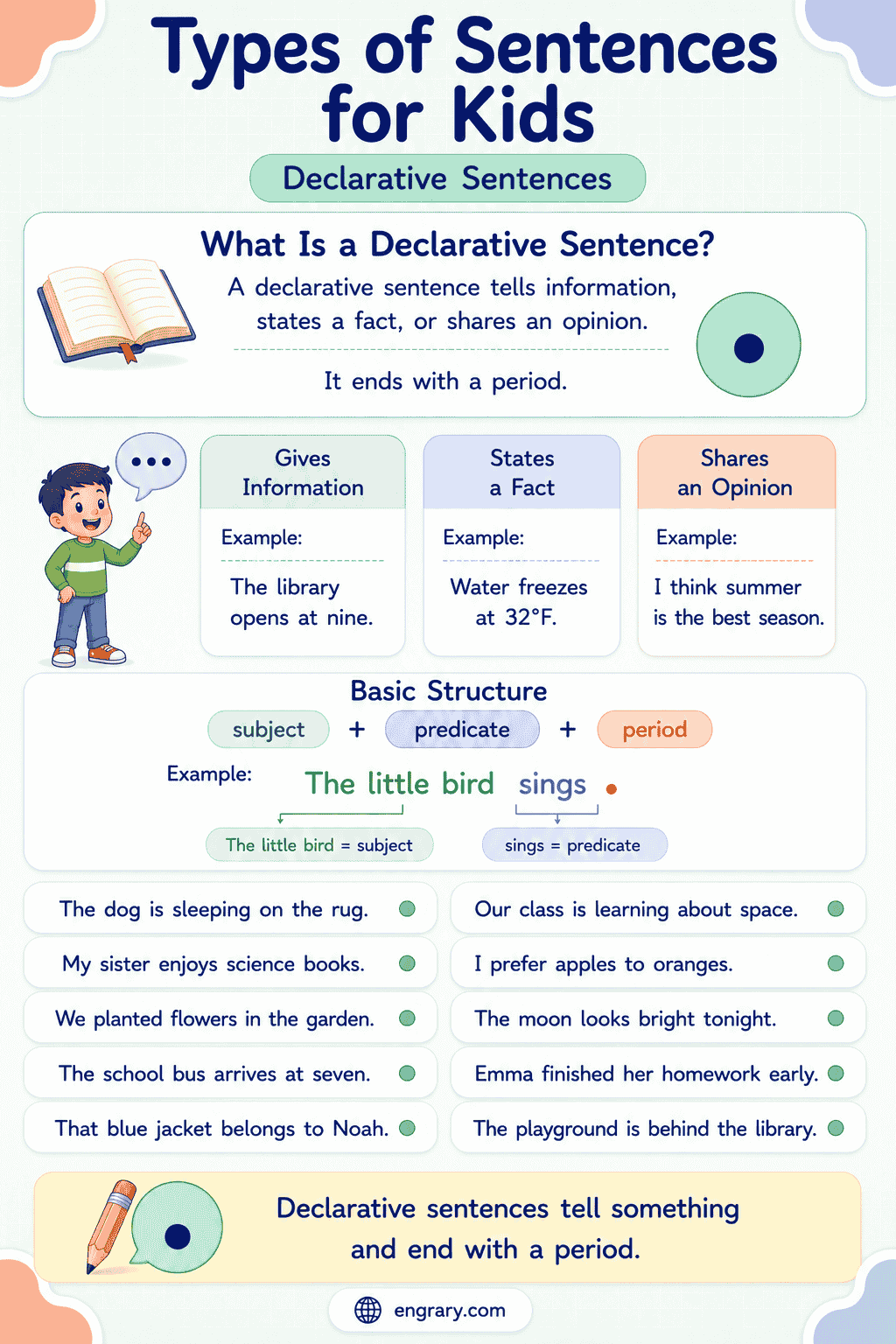
Declarative Sentences
A declarative sentence gives information. It may state a fact, express an opinion, describe something, or explain an idea.
Declarative sentences usually end with periods.
Examples:
- The sun is shining.
- Mia enjoys mystery books.
- Our class visited the museum.
- The bus does not stop here.
What Does a Declarative Sentence Do?
A declarative sentence tells the reader something.
It may answer questions such as:
- What happened?
- What is something like?
- What does someone think?
- What is true or untrue?
Examples:
The puppy slept beside the couch.
I think this story is funny.
The store is not open today.
Each sentence provides information instead of asking, commanding, or expressing strong emotion.
Facts, Opinions, and Explanations
Facts and opinions can both be declarative sentences.
Fact
Earth travels around the sun.
Opinion
Summer is the best season.
The difference between a fact and an opinion does not change the sentence type. Both give information.
Declarative sentences may also explain ideas:
Plants need sunlight because it helps them make food.
They can describe people, places, or things:
The old bridge stretches across the river.
Positive and Negative Statements
A positive declarative sentence states that something is true or happens.
Noah plays soccer after school.
A negative declarative sentence states that something is not true or does not happen.
Noah does not play soccer on Sundays.
More examples include:
- The library is open.
- The library is not open.
- We saw the parade.
- We did not see the parade.
- Ava likes spinach.
- Ava does not like spinach.
Negative wording does not change the sentence type. These sentences remain declarative because they give information.
Interrogative Sentences
An interrogative sentence asks a direct question.
It usually ends with a question mark.
Examples:
- Where is your backpack?
- Did you finish your homework?
- Would you like milk or juice?
- Who opened the window?
What Does an Interrogative Sentence Do?
An interrogative sentence asks for information, confirmation, or a choice.
For example:
Is the door locked?
The speaker wants confirmation.
Why is the sky dark?
Here, the speaker wants an explanation.
Would you like apples or grapes?
This question asks the listener to choose.
Yes-or-No, Information, and Choice Questions
Interrogative sentences commonly appear in three forms.
Yes-or-no questions
These can usually be answered with yes or no.
- Are you ready?
- Did the bus arrive?
- Can Mia swim?
Information questions
These ask for specific details.
- Where do you live?
- Why is the baby crying?
- How did you solve the problem?
Choice questions
These offer two or more options.
- Would you like milk or juice?
- Should we walk or ride?
- Do you prefer the red shirt or the blue shirt?
All three forms are interrogative because they directly ask for an answer.
Common Question Words
| Question Word | What It Usually Asks About |
|---|---|
| who | a person |
| what | a thing, action, or idea |
| when | time |
| where | place |
| why | reason |
| how | manner or process |
| which | a choice |
Examples:
- Who is at the door?
- What are you reading?
- When does the movie begin?
- Where did you put the keys?
- Why are the leaves falling?
- How did you build that model?
- Which book would you like?
Questions may also begin with helping verbs:
- Is the dog sleeping?
- Did you finish?
- Can we leave now?
- Have they arrived?
Direct and Reported Questions
A direct question asks something directly and ends with a question mark.
Where is the library?
A reported question tells what someone asked.
Ava asked where the library was.
The reported question ends with a period because the sentence as a whole gives information.
Compare:
- What time does the game begin?
- Noah asked what time the game began.
In this pair, only the first sentence is interrogative in form.

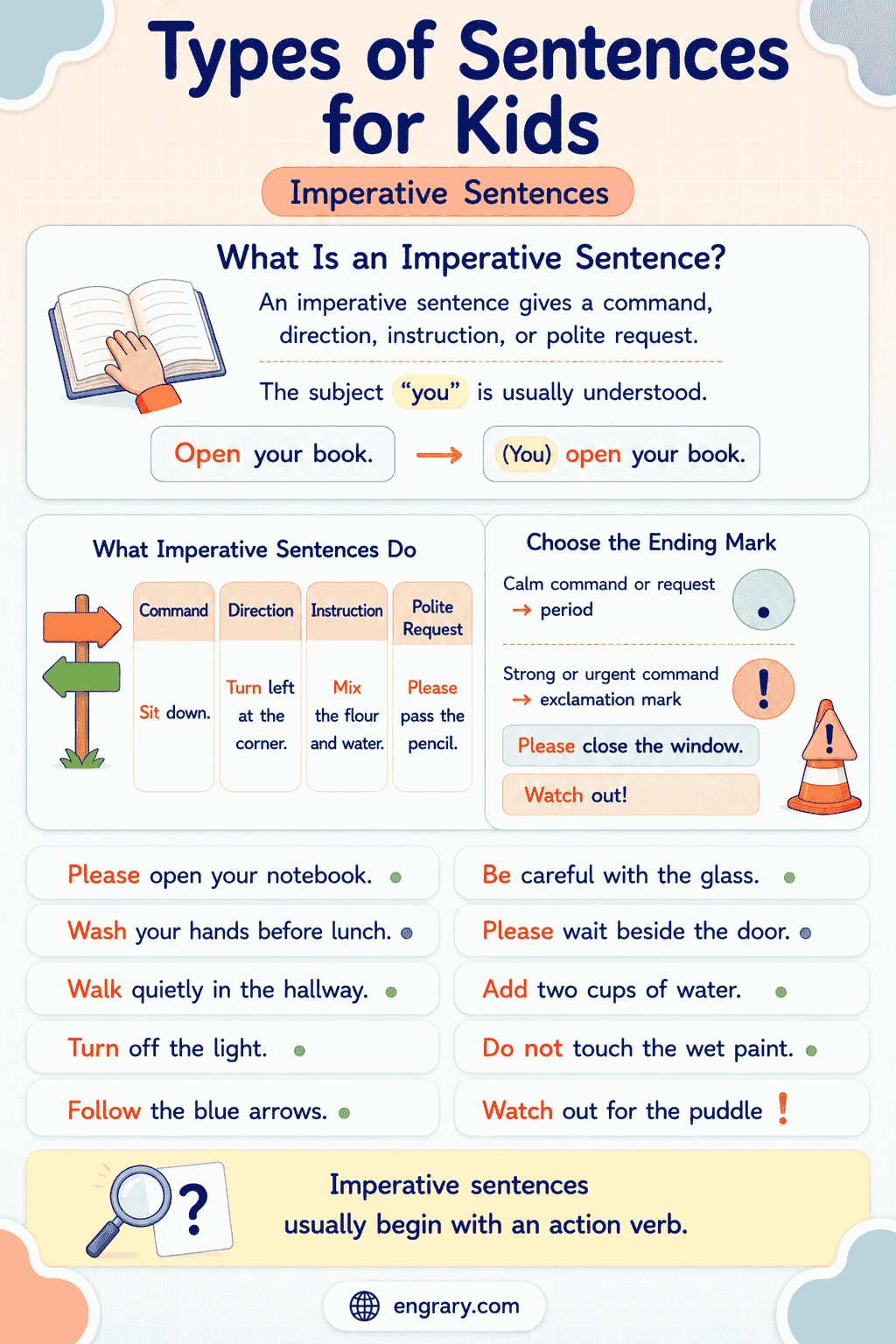
Imperative Sentences
An imperative sentence tells someone to do or not do something.
It may give:
- a command;
- a request;
- an instruction;
- a direction;
- advice;
- a warning;
- an invitation.
Imperative sentences may end with periods or exclamation marks.
Examples:
- Close the window.
- Please pass the crayons.
- Mix the flour and water.
- Turn left at the corner.
- Watch your step!
- Have a seat.
What Does an Imperative Sentence Do?
An imperative sentence directs a person to take action.
Compare:
The window is open.
This sentence is declarative because it gives information.
Close the window.
The second sentence is imperative because it tells someone what to do.
Depending on its wording and punctuation, an imperative can sound calm, polite, helpful, or urgent.
The Hidden Subject You in Commands
Most imperative sentences do not show a written subject.
Open your notebook.
The understood meaning is that you should open the notebook.
More examples:
- Sit down.
Hidden subject: you - Please wait here.
Hidden subject: you - Turn off the light.
Hidden subject: you
This hidden subject explains why commands are complete sentences even when no subject appears on the page.
Types of Imperative Sentences
| Purpose | Example |
|---|---|
| command | Put the toy away. |
| request | Please help me carry this box. |
| instruction | Add two cups of water. |
| direction | Turn right at the corner. |
| advice | Remember to drink enough water. |
| warning | Stay away from the wet floor! |
| invitation | Come join us for lunch. |
Although their tones differ, all these sentences direct someone to act.
Commands, Requests, Instructions, and Warnings
A command directly tells someone what to do.
Clean your room.
A request sounds more polite.
Please clean your room.
An instruction explains a step in a process.
Place the paper on the table.
Meanwhile, a warning alerts someone to possible danger.
Watch out!
Each example is imperative because it directs the listener.
Negative Commands
A negative imperative sentence tells someone not to do something.
Examples:
- Do not run in the hallway.
- Do not touch the wet paint.
- Never share your password.
- Please do not open the box.
- Do not feed the animals.
These sentences remain imperative because they direct behavior.
Periods and Exclamation Marks in Commands
A calm command, request, or instruction usually ends with a period.
- Walk quietly.
- Please close the gate.
- Stir the mixture slowly.
An urgent command or warning often ends with an exclamation mark.
- Stop!
- Watch out!
- Get away from the edge!
Therefore, an exclamation mark does not automatically make a sentence exclamatory. The main purpose still matters.
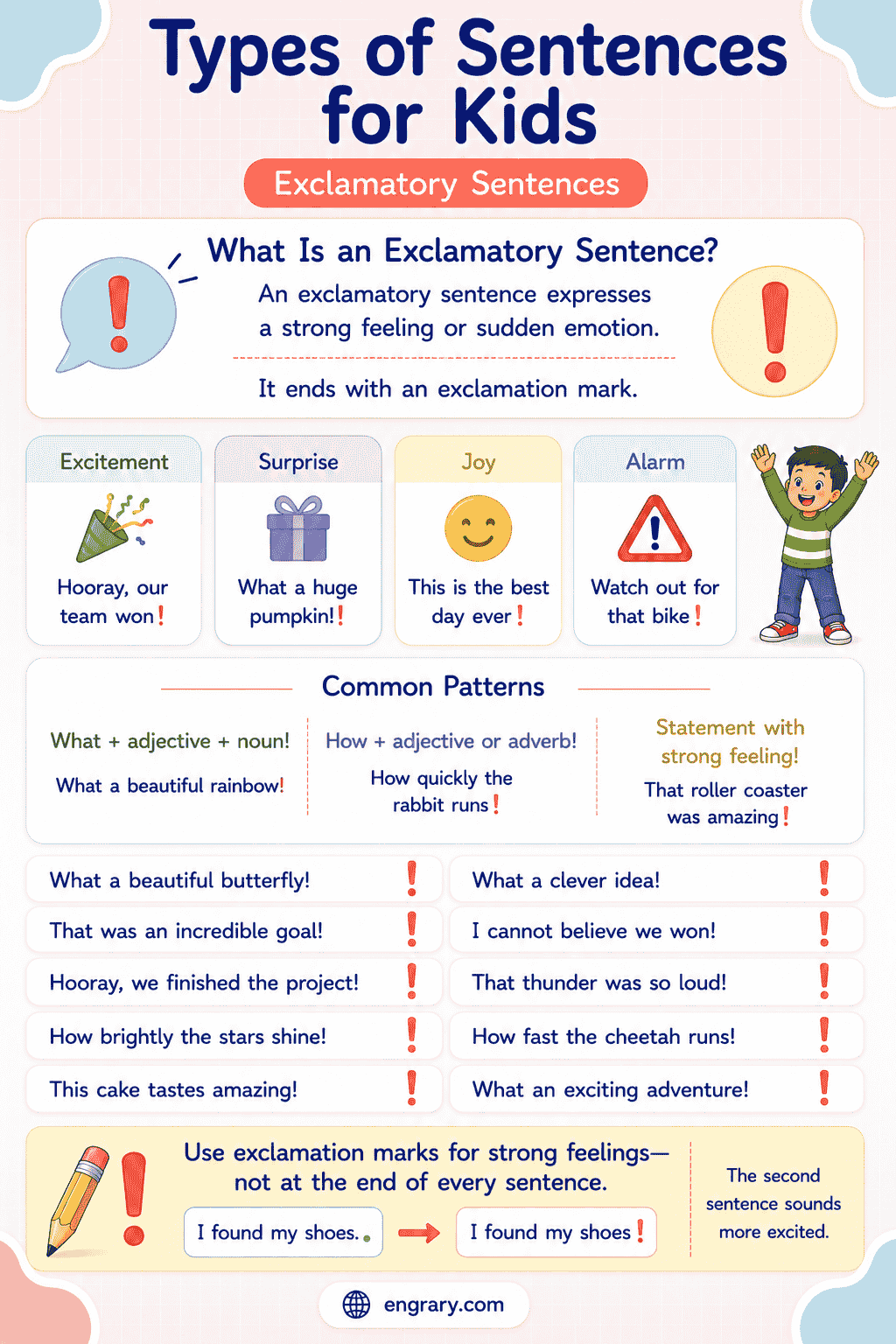
Exclamatory Sentences
An exclamatory sentence expresses strong feeling.
It may show:
- excitement;
- joy;
- surprise;
- amazement;
- fear;
- anger;
- disappointment.
Exclamatory sentences end with exclamation marks.
Examples:
- That was an incredible game!
- I cannot believe we won!
- What a beautiful rainbow!
- How brightly the stars shine!
What Does an Exclamatory Sentence Do?
An exclamatory sentence communicates a strong reaction.
Compare:
The fireworks are beautiful.
This declarative sentence calmly gives information.
The fireworks are beautiful!
In elementary school grammar, the second sentence is commonly treated as exclamatory because it expresses stronger feeling.
Another comparison is:
The puppy is small.
What a tiny puppy that is!
The second sentence emphasizes amazement or affection.
Exclamatory Sentences With What and How
Many exclamatory sentences begin with what or how.
What pattern
- What a beautiful day!
- What an exciting game!
- What a clever idea!
- What enormous waves those are!
How pattern
- How brightly the stars shine!
- How quickly the horse runs!
- How peaceful the garden looks!
- How loudly the thunder crashed!
These are exclamations rather than questions, even though they begin with words that may also introduce questions.
Compare:
- What a beautiful garden! — exclamatory
- What is growing in the garden? — interrogative
Common Strong-Feeling Patterns
Exclamatory sentences do not always begin with what or how.
They may resemble statements while expressing strong emotion.
- We finally won!
- This cake tastes amazing!
- I cannot believe the show is over!
- That storm was terrifying!
- You did it!
The wording, context, and exclamation mark work together to show the feeling.
How to Tell Sentence Types Apart
Some sentence types look similar. Therefore, children should compare their purposes instead of relying only on punctuation.
Declarative or Exclamatory?
A declarative sentence calmly gives information.
The roller coaster is tall.
An exclamatory sentence communicates stronger feeling.
That roller coaster is incredibly tall!
Although both sentences describe the ride, the second expresses amazement.
Question or Polite Request?
Some interrogative sentences are used to make polite requests.
Could you close the window?
This sentence is interrogative in grammatical form because it is written as a question.
Please close the window.
This sentence is imperative because it directly tells the listener what action to take.
In everyday conversation, both sentences may be requests. However, school grammar activities usually classify them according to grammatical form.
Imperative or Exclamatory?
Both imperative and exclamatory sentences may end with exclamation marks.
Imperative:
Stop running!
The sentence gives a command.
Exclamatory:
What an exciting race!
The sentence expresses strong feeling.
Ask:
Is the sentence telling someone what to do, or is it mainly showing emotion?
A Brief Note About Interjections
An interjection is a short reaction word or phrase.
Wow!
An exclamatory sentence is a complete sentence expressing strong feeling.
That is an amazing painting!
A sentence may contain both:
Wow! That is an amazing painting!
Here, Wow! is an interjection, while the following sentence is exclamatory.
Changing One Sentence Type Into Another
Changing sentence types helps children understand how purpose affects word order, verbs, wording, and punctuation.
One Idea in Four Sentence Types
Consider the idea of an open door.
| Sentence Type | Example |
|---|---|
| declarative | The door is open. |
| interrogative | Is the door open? |
| imperative | Open the door. |
| exclamatory | The door is wide open! |
Now consider a hungry puppy.
| Sentence Type | Example |
|---|---|
| declarative | The puppy is hungry. |
| interrogative | Is the puppy hungry? |
| imperative | Feed the puppy. |
| exclamatory | The puppy is so hungry! |
Changing the sentence type may require:
- changing word order;
- adding a helping verb;
- removing the written subject;
- changing the main verb;
- adjusting punctuation;
- revising the wording to fit the new purpose.
Using Sentence Types in Writing
Writers choose sentence types based on what they want readers to know, think, feel, or do.
Choosing the Right Sentence Type
| Writing Purpose | Useful Sentence Type |
|---|---|
| give information | declarative |
| ask for information | interrogative |
| give a direction | imperative |
| express strong feeling | exclamatory |
Writers do not need equal numbers of all four types. Instead, each sentence should fit its purpose.
Using Sentence Variety in a Paragraph
A paragraph made only of declarative sentences may sound repetitive.
We went to the fair. We saw a tall ride. We bought tickets. The ride moved quickly.
A more varied version is:
We went to the fair on Saturday. Have you ever seen such a tall ride? “Wait for me!” Mia called. What an exciting afternoon it was!
The revised paragraph includes:
- a declarative sentence;
- an interrogative sentence;
- an imperative sentence;
- an exclamatory sentence.
Sentence variety can make writing more lively, although every sentence should still sound natural.
Using Sentence Types in Dialogue
Conversations often include all four types.
“Where is my backpack?” Noah asked.
“Check beside the desk,” Ava replied.
“It is under the chair,” Mia said.
“What a strange place to leave it!” Noah exclaimed.
The dialogue contains:
- an interrogative sentence;
- an imperative sentence;
- a declarative sentence;
- an exclamatory sentence.
Different purposes make the conversation sound realistic.
Avoiding Too Many Exclamation Marks
Exclamation marks should show real excitement, surprise, fear, or urgency.
Overused:
We went to the park! We sat on a bench! We ate lunch! Then we walked home!
Improved:
We went to the park and ate lunch on a bench. Suddenly, a bright red balloon floated above the trees!
The revised version saves the exclamation mark for the most surprising detail.
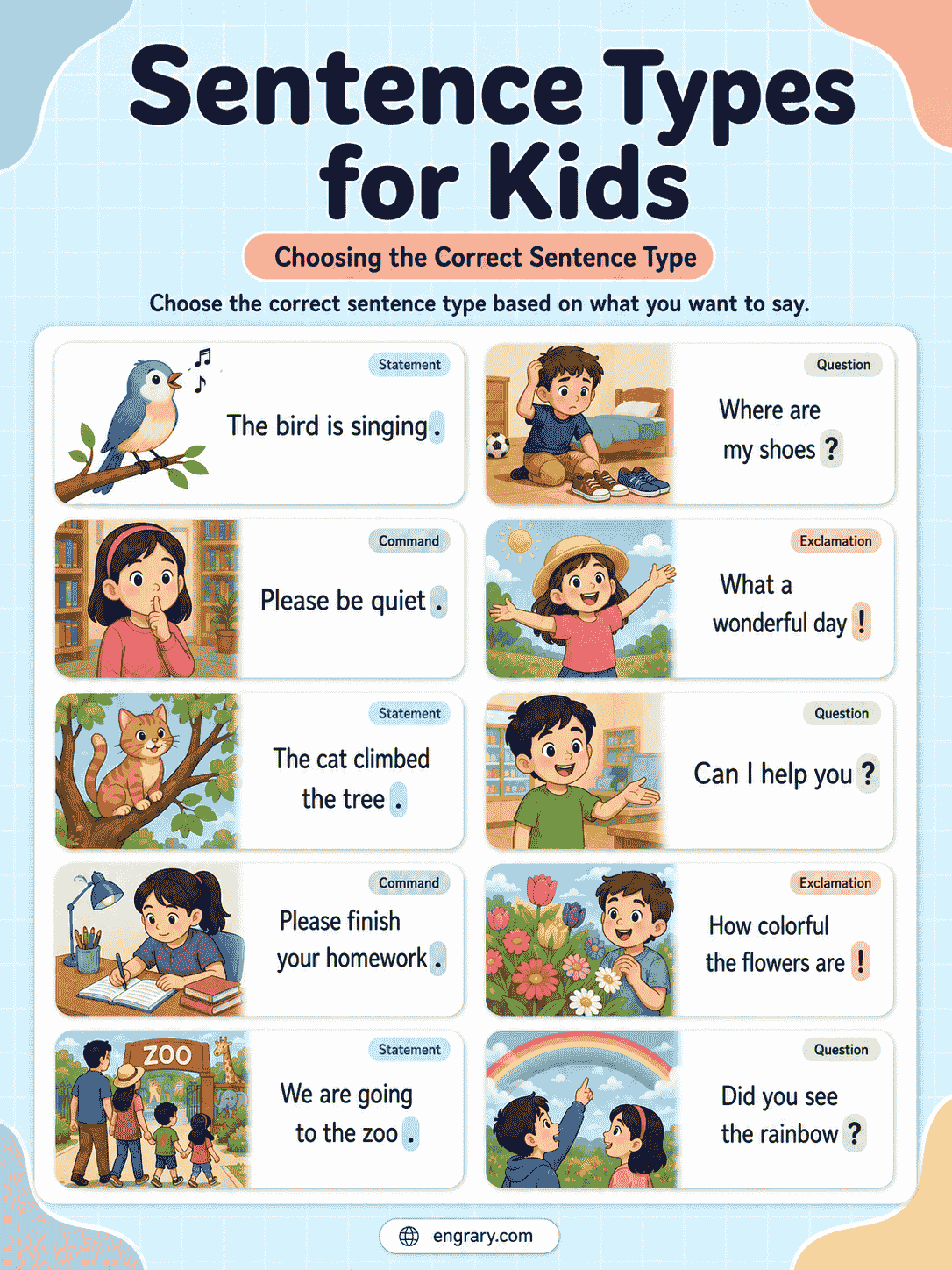
Common Sentence-Type Mistakes
| Mistake | Better Understanding |
|---|---|
| Classifying only by punctuation | Identify the sentence’s purpose first. |
| Calling every sentence with an exclamation mark exclamatory | A forceful command may still be imperative. |
| Thinking commands have no subject | The subject you is usually understood. |
| Adding a question mark after a reported question | Reported questions usually end with periods. |
| Forgetting a question mark after a direct question | Direct questions normally need question marks. |
| Confusing sentence purpose with sentence structure | Purpose and structure are separate systems. |
| Thinking negative sentences form a separate type | A negative sentence can still be declarative, interrogative, or imperative. |
| Using too many exclamation marks | Reserve them for strong feeling or urgency. |
| Changing punctuation without changing purpose | Word order and wording may also need to change. |
| Writing an incomplete thought | Make sure the sentence communicates a complete idea. |
Sentence Types Practice for Kids
Complete each activity before checking the answer key.
Match the Two Names
Match each child-friendly name with its formal grammar name.
- statement
- question
- command or request
- exclamation
a. interrogative
b. exclamatory
c. declarative
d. imperative
Statement, Question, Command, or Exclamation?
Write statement, question, command, or exclamation.
- The school bus arrives at eight.
- Where did you put your shoes?
- Please close the gate.
- What an enormous pumpkin!
- Noah does not like mushrooms.
- Stop touching the wet paint!
- Did Ava finish the project?
- What an amazing movie!
Identify the Sentence Purpose
Write the purpose of each sentence:
- gives information;
- asks for information;
- directs someone;
- expresses strong feeling.
- The library closes at six.
- Where can I find this book?
- Place the papers on my desk.
- What a wonderful performance!
- We did not see the parade.
- Why is the baby crying?
Add the Correct Ending Punctuation
Add a period, question mark, or exclamation mark.
- The dog is sleeping ___
- Where is my notebook ___
- Please wait beside the door ___
- What an exciting game ___
- Stop ___
- The store is not open today ___
Find the Hidden You
Identify the understood subject in each imperative sentence.
- Sit beside the window.
- Please carry this box.
- Do not run in the hallway.
- Turn left at the next corner.
- Remember to bring your folder.
Command or Exclamation?
Write imperative or exclamatory.
- Stop running!
- What a fast runner!
- Watch out!
- That race was incredible!
- Put the ball down!
- How quickly the horse moves!
Question or Polite Request?
Classify each sentence by its grammatical form. Write interrogative or imperative.
- Could you close the window?
- Please close the window.
- Would you carry this bag?
- Carry this bag, please.
- Can you pass the salt?
- Please pass the salt.
Change One Idea Into Four Sentence Types
Use the idea the room is quiet.
Write:
- one declarative sentence;
- one interrogative sentence;
- one imperative sentence;
- one exclamatory sentence.
Correct Sentence-Type Mistakes
Rewrite each sentence correctly.
- where is the bus stop.
- Please turn off the light?
- what a beautiful rainbow.
- do not touch the glass?
- Ava asked where the library was?
- the puppy is sleeping
Revise a Repetitive Paragraph
Rewrite this paragraph by adding at least one question, command, or exclamation.
We arrived at the beach. The waves were large. We placed our towels on the sand. We walked toward the water.
Write All Four Sentence Types
Choose one topic, such as school, pets, sports, weather, or a trip.
Write:
- one declarative sentence;
- one interrogative sentence;
- one imperative sentence;
- one exclamatory sentence.
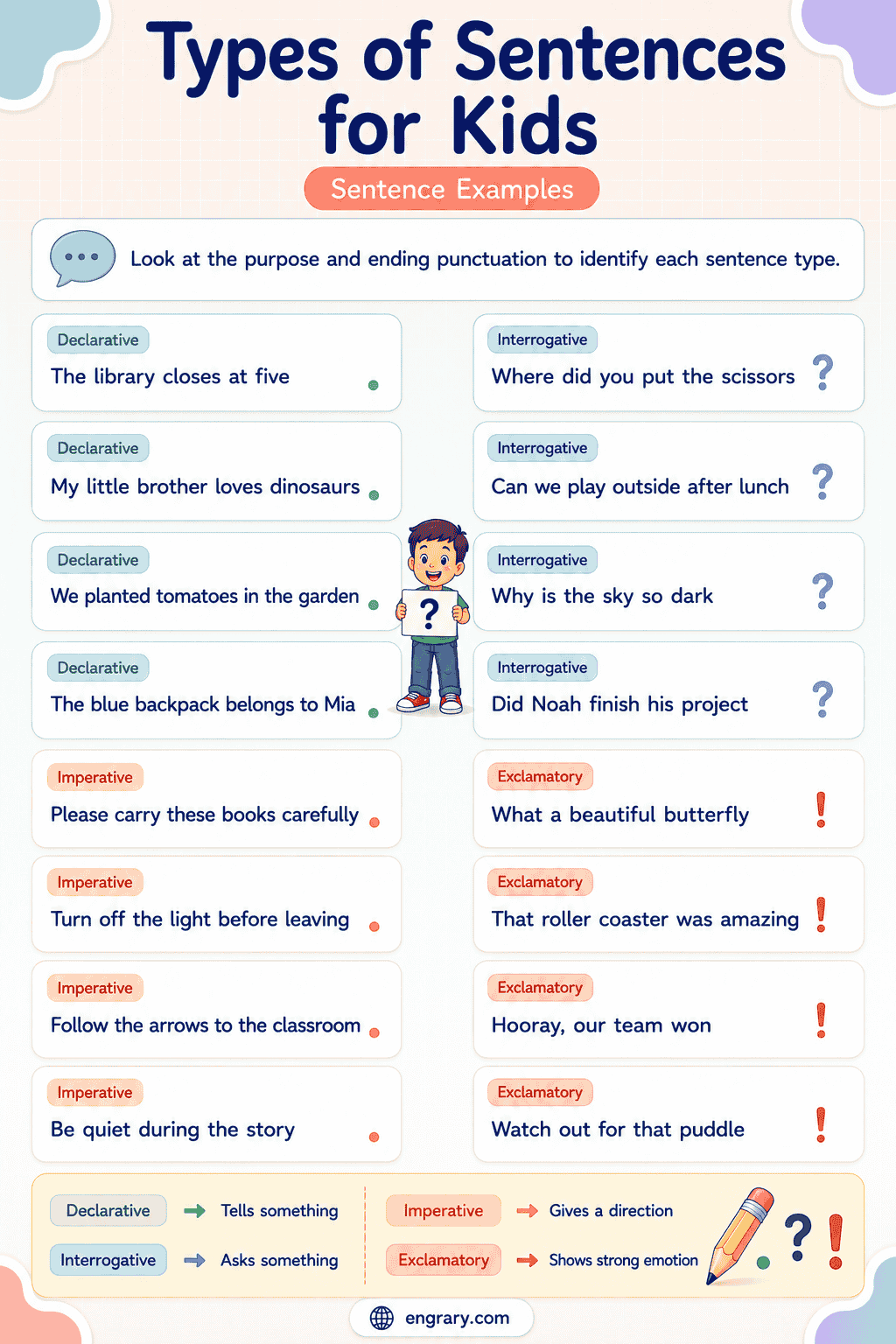
Sentence Types Practice Answer Key
Match the Two Names
- statement — c. declarative
- question — a. interrogative
- command or request — d. imperative
- exclamation — b. exclamatory
Statement, Question, Command, or Exclamation?
- statement
- question
- command
- exclamation
- statement
- command
- question
- exclamation
Identify the Sentence Purpose
- gives information
- asks for information
- directs someone
- expresses strong feeling
- gives information
- asks for information
Add the Correct Ending Punctuation
- The dog is sleeping.
- Where is my notebook?
- Please wait beside the door.
- What an exciting game!
- Stop!
- The store is not open today.
Find the Hidden You
The understood subject in every sentence is you.
- Sit beside the window. — hidden subject: you
- Please carry this box. — hidden subject: you
- Do not run in the hallway. — hidden subject: you
- Turn left at the next corner. — hidden subject: you
- Remember to bring your folder. — hidden subject: you
Command or Exclamation?
- imperative
- exclamatory
- imperative
- exclamatory
- imperative
- exclamatory
Question or Polite Request?
- interrogative
- imperative
- interrogative
- imperative
- interrogative
- imperative
Change One Idea Into Four Sentence Types
Sample answers:
- The room is quiet.
- Is the room quiet?
- Keep the room quiet.
- This room is so quiet!
Other answers are acceptable when they match the required purpose and use suitable punctuation.
Correct Sentence-Type Mistakes
- Where is the bus stop?
- Please turn off the light.
- What a beautiful rainbow!
- Do not touch the glass.
- Ava asked where the library was.
- The puppy is sleeping.
Revise a Repetitive Paragraph
Sample answer:
We arrived at the beach and saw enormous waves. “Place the towels beside the umbrella,” Dad said. Have you ever seen the ocean look so wild? What an exciting day it was!
Other revisions are acceptable when they add sentence variety naturally.
Write All Four Sentence Types
Sample topic: weather
- Dark clouds are gathering.
- Will it rain this afternoon?
- Bring your umbrella.
- What a powerful storm this is!
Other answers are acceptable when each sentence matches the required type.

FAQs
The four sentence types are declarative, interrogative, imperative, and exclamatory. They are also called statements, questions, commands, and exclamations.
First, decide what the sentence does. It may give information, ask something, direct someone, or express strong feeling. Then check the punctuation.
Yes. An urgent command such as Stop running! is imperative even though it ends with an exclamation mark.
The subject is usually the understood word you. In Close the door, the listener is the person being told to act.
Purpose describes what a sentence does, while structure describes how its clauses are arranged. A sentence can be declarative by purpose and simple by structure.
You May Also Like
- Sentence Structure for Kids
- Simple Sentences for Kids
- Compound Sentences for Kids
- Complex Sentences for Kids
- Declarative Sentences
- Interrogative Sentences
- Imperative Sentences
- Exclamatory Sentences
- Interjections for Kids
- Punctuation for Kids
- Question Words for Kids
- Subject and Predicate for Kids