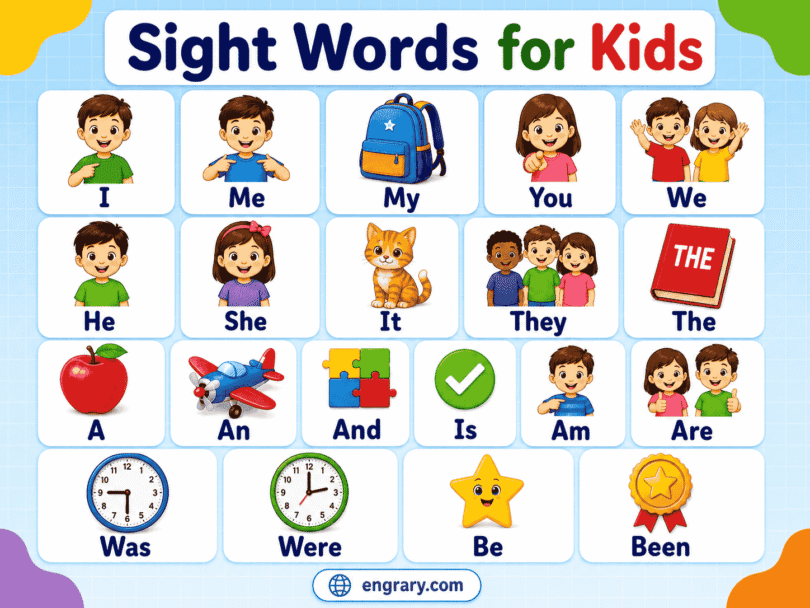
Sight words for kids are common reading words that children learn to recognize quickly. These words appear often in early books, classroom charts, worksheets, flashcards, and simple sentences, so learning them helps children read with more confidence.
Many sight words are short words like the, and, I, you, see, go, is, in, to, and my. Some are easy to sound out, while others are tricky and need extra practice. This guide includes sight word lists, picture-friendly words, meanings, level-based lists, Dolch and Fry examples, sentences, practice steps, flashcard ideas, games, and worksheets.
What Are Sight Words?
Sight words are words children can recognize quickly by sight. When a child sees a word like the, you, or said, they should be able to read it without stopping for a long time.
Some sight words follow simple letter sounds. For example, can, in, and at are easy to sound out. Other words are trickier because one part of the word does not sound the way children expect. Words like said, was, one, and two often need more review.
Young readers build sight word knowledge through repeated reading, spelling, writing, sentence practice, and short daily review. Over time, these words become familiar, and children can read them more smoothly in books and sentences.
Sight Words vs High-Frequency Words
Sight words and high-frequency words are closely connected, but they do not mean exactly the same thing. Many parents and teachers use both terms when helping children learn early reading words.
| Term | Meaning | Example |
|---|---|---|
| Sight words | Words a child can recognize quickly by sight | the, you, said |
| High-frequency words | Words that appear often in reading | and, to, is |
| Tricky words | Words that may not follow simple sound patterns | one, two, was |
| Easy-to-read words | Common words that can be sounded out more easily | in, at, can |
| Learned words | Words children know after repeated practice | see, go, come |
Why Sight Words Are Important for Kids
Sight words help kids read more smoothly. When children recognize common words quickly, they do not need to pause and sound out every word on the page.
These words also improve reading fluency. A child who knows words like the, and, is, to, you, my, see, go, and said can read short sentences faster and with better understanding.
Sight words support writing too. Children use them in journal writing, spelling practice, captions, simple stories, classroom answers, and worksheets. For example, a child who knows I, can, see, and the can write sentences like I can see the dog.
Common Sight Words for Kids
Common sight words are useful for preschool, kindergarten, first grade, and early reading practice. These words work well for flashcards, word walls, worksheets, sentence writing, and daily reading review.
- I
- a
- am
- an
- and
- are
- at
- be
- big
- can
- come
- do
- down
- for
- go
- has
- have
- he
- here
- in
- is
- it
- like
- little
- look
- me
- my
- no
- not
- of
- on
- one
- play
- said
- see
- she
- so
- that
- the
- there
- they
- this
- to
- two
- up
- was
- we
- where
- with
- you
- your
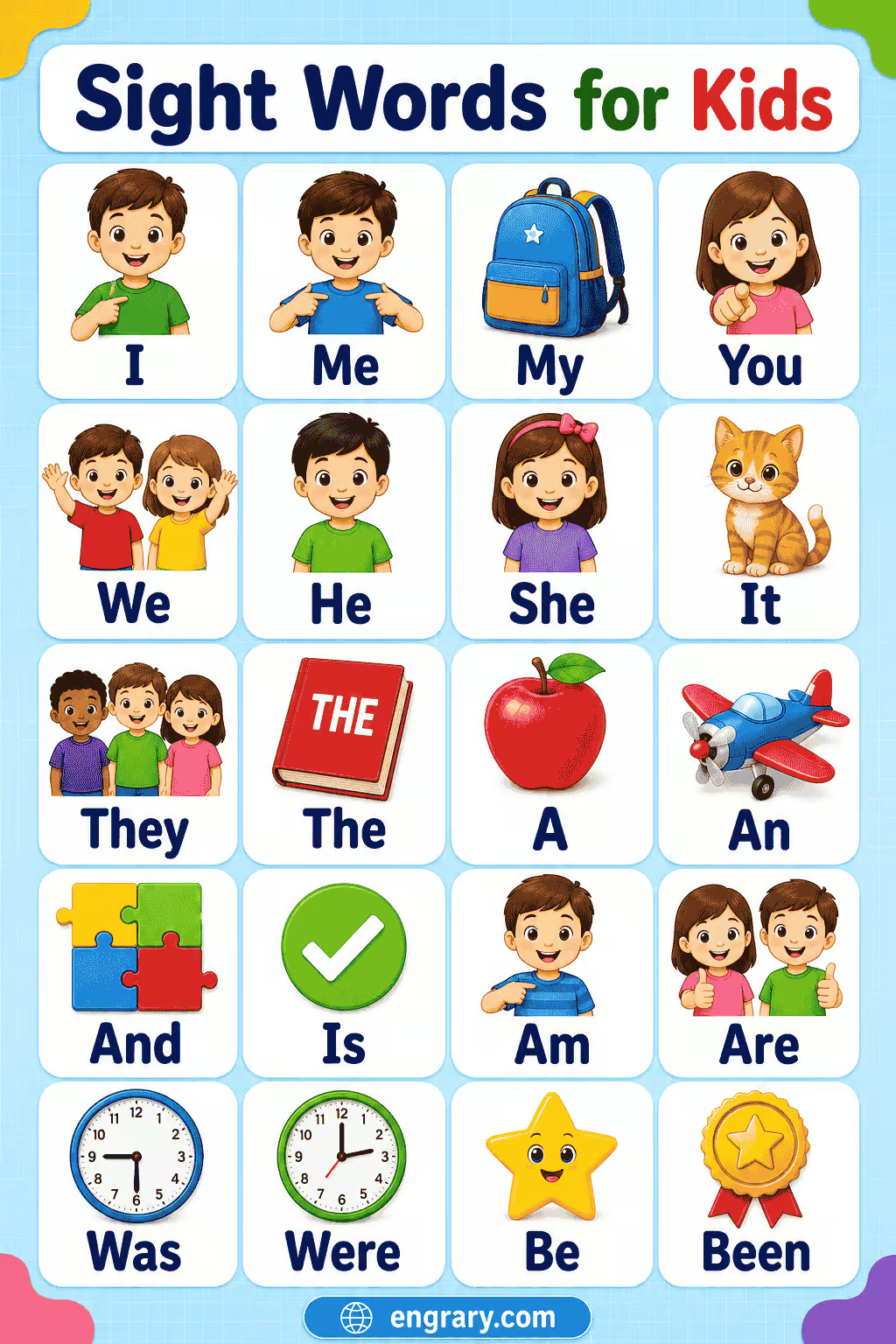
Sight Words with Pictures
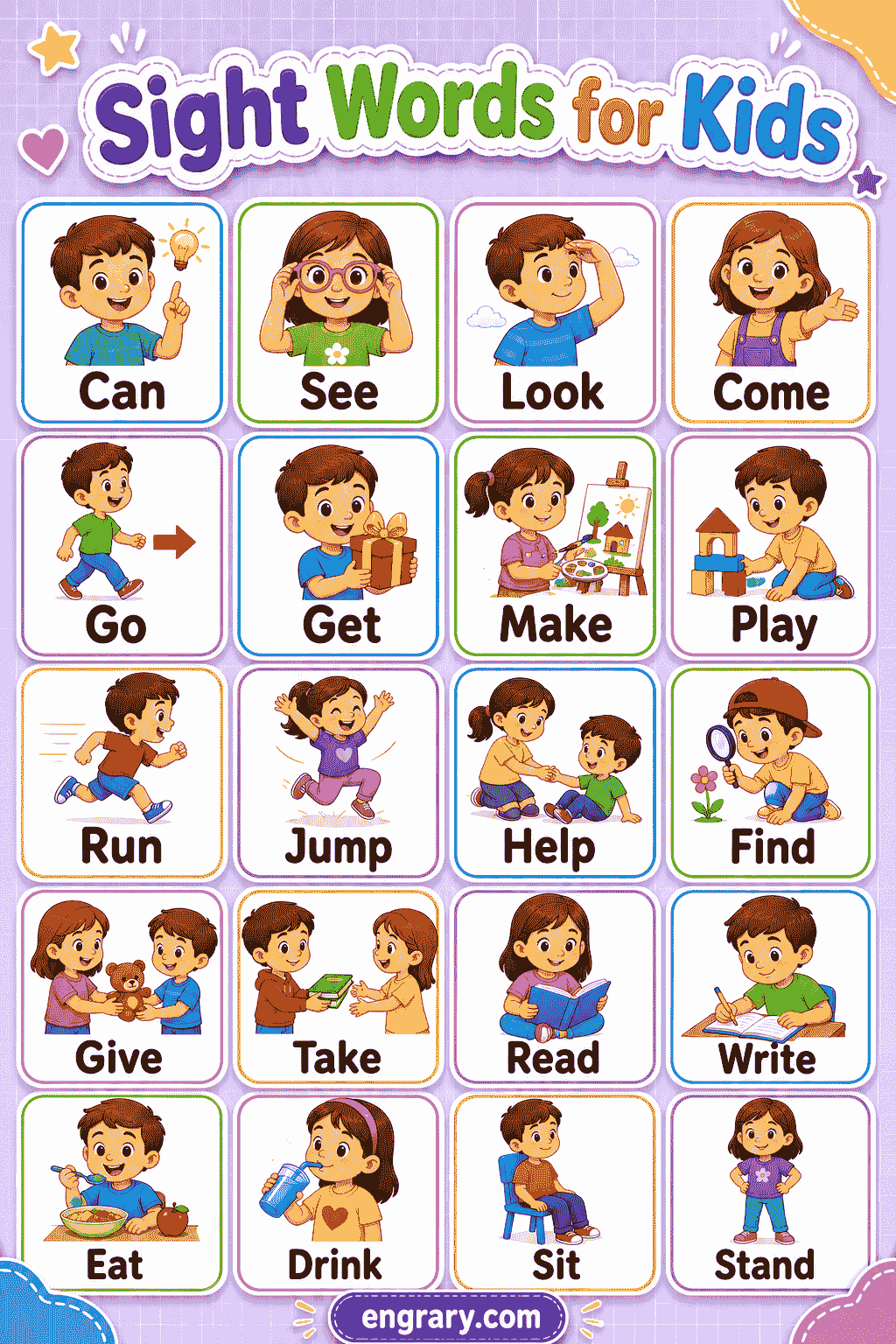
Sight words with pictures help children connect common reading words with simple people, actions, places, and classroom scenes. Some sight words are abstract, so picture support works best with words that can be shown through actions, directions, people, or simple examples.
These picture-friendly early reading words are useful for flashcards, posters, worksheets, and classroom displays.
- I
- you
- we
- he
- she
- see
- go
- come
- look
- play
- run
- jump
- up
- down
- here
- there
- my
- your
- big
- little
Sight Words and Meanings for Kids
Simple meanings help children understand sight words instead of only memorizing them. Short explanations also make it easier for kids to use the words in sentences.
- I — a word used when talking about yourself
- you — a word used when talking to another person
- we — a word for you and one or more other people
- he — a word for a boy or man
- she — a word for a girl or woman
- it — a word for a thing, animal, or idea
- the — a word used before a noun
- and — a word used to join words or ideas
- is — a word that tells what someone or something is
- are — a word used with more than one person or thing
- can — a word that means able to do something
- see — to look at something with your eyes
- go — to move from one place to another
- come — to move toward someone or something
- look — to use your eyes to notice something
- here — in this place
- there — in that place
- where — a word used to ask about a place
- said — spoke or told something
- was — a word that tells about the past
- have — to own, hold, or get something
- like — to enjoy something
- with — together or beside someone or something
- because — a word used to give a reason
Beginner Sight Words for Kids
Beginner sight words should be short, common, and easy to use in simple sentences. These words are a good starting point for preschool and kindergarten readers.
- I
- a
- am
- is
- in
- it
- on
- to
- the
- and
- can
- see
- go
- my
- we
- me
- he
- she
- up
- no
Simple beginner sentences:
- I am Sam.
- I can see.
- We go up.
- My dog is big.
- She can run.
- He is here.
- The cat is on the mat.
- You can come with me.
Easy-to-Read and Tricky Sight Words
Some sight words are easy to read because the letters match the sounds. Other sight words are tricky because part of the word may not sound the way children expect.
Easy-to-read sight words:
- in
- at
- on
- can
- up
- it
- am
- an
- not
- big
- red
- sit
- and
- run
Tricky sight words:
- said
- was
- one
- two
- they
- where
- come
- some
- have
- does
- could
- would
- should
- because
Sight Words by Level
Sight words can be grouped by level so children learn them in a clear order. Start with short and common words, then move to longer and trickier words.
Preschool Sight Words
Preschool sight words should be very simple and easy to recognize.
- I
- a
- am
- me
- my
- go
- up
- no
- see
- we
- can
- it
Kindergarten Sight Words
Kindergarten sight words help children read short books, simple sentences, and classroom word cards.
- the
- and
- to
- in
- is
- it
- you
- he
- she
- was
- are
- for
- on
- said
- play
First Grade Sight Words
First grade sight words include more high-frequency words that children see in early reading books.
- about
- after
- again
- because
- could
- from
- have
- many
- said
- their
- there
- where
- when
- were
- would
Second Grade Sight Words
Second grade sight words can be longer and more useful for reading fluency, comprehension, and writing.
- always
- around
- before
- does
- first
- found
- goes
- made
- right
- should
- these
- those
- upon
- use
- write
Dolch Sight Words
Dolch sight words are common words used in early reading practice. Many teachers use Dolch word lists to help children recognize words that appear often in books.
The Dolch list is often used in early elementary classrooms because it focuses on common service words and early reading words.
Examples of Dolch sight words:
- the
- and
- to
- said
- you
- come
- here
- where
- little
- down
- look
- see
- help
- jump
- play
Fry Sight Words
Fry sight words are high-frequency words that appear often in reading. The Fry list is usually grouped by hundreds, starting with the most common words.
The Fry list is broader and is often used for reading fluency across several grade levels.
Examples of Fry sight words:
- the
- of
- and
- a
- to
- in
- is
- you
- that
- it
- he
- was
- for
- on
- are
Sight Words with Sentences
Sight words with sentences help kids understand how words work in real reading. Short sentences are best for early learners.
- I — I like my book.
- a — I see a cat.
- am — I am happy.
- and — Mom and Dad can come.
- can — I can jump.
- see — We see a bird.
- go — I go to school.
- my — My bag is red.
- we — We play outside.
- you — You are kind.
- he — He can run.
- she — She has a doll.
- the — The dog is big.
- is — It is sunny.
- in — The ball is in the box.
- on — The book is on the desk.
- said — Mom said yes.
- was — It was cold.
- where — Where is my hat?
- come — Come here, please.
- look — Look at the fish.
- here — My pencil is here.
- there — The park is there.
- they — They are playing.
- with — I read with my friend.
How to Practice Sight Words
A simple practice routine helps children remember sight words without pressure. Short daily practice works better than one long lesson.
- See the word.
- Say the word.
- Spell the word aloud.
- Read the word in a sentence.
- Write the word.
- Use the word in a new sentence.
- Review the word again later.
Sight Words Chart
A sight words chart helps children review words by type, level, and use.
| Group | Example Sight Words | Best Use |
|---|---|---|
| Beginner Words | I, a, am, is, in | First reading practice |
| Action Words | go, come, see, look, play | Sentence building |
| People Words | I, you, we, he, she | Simple speaking and writing |
| Place Words | here, there, where | Question practice |
| Tricky Words | said, was, one, two | Extra review |
| Preschool Words | I, a, me, my, go | Early word cards |
| Kindergarten Words | the, and, to, you, said | Beginner books |
| First Grade Words | because, could, many, where | Reading fluency |
| Second Grade Words | always, before, should, write | Longer sentences |
Printable Sight Words List for Kids
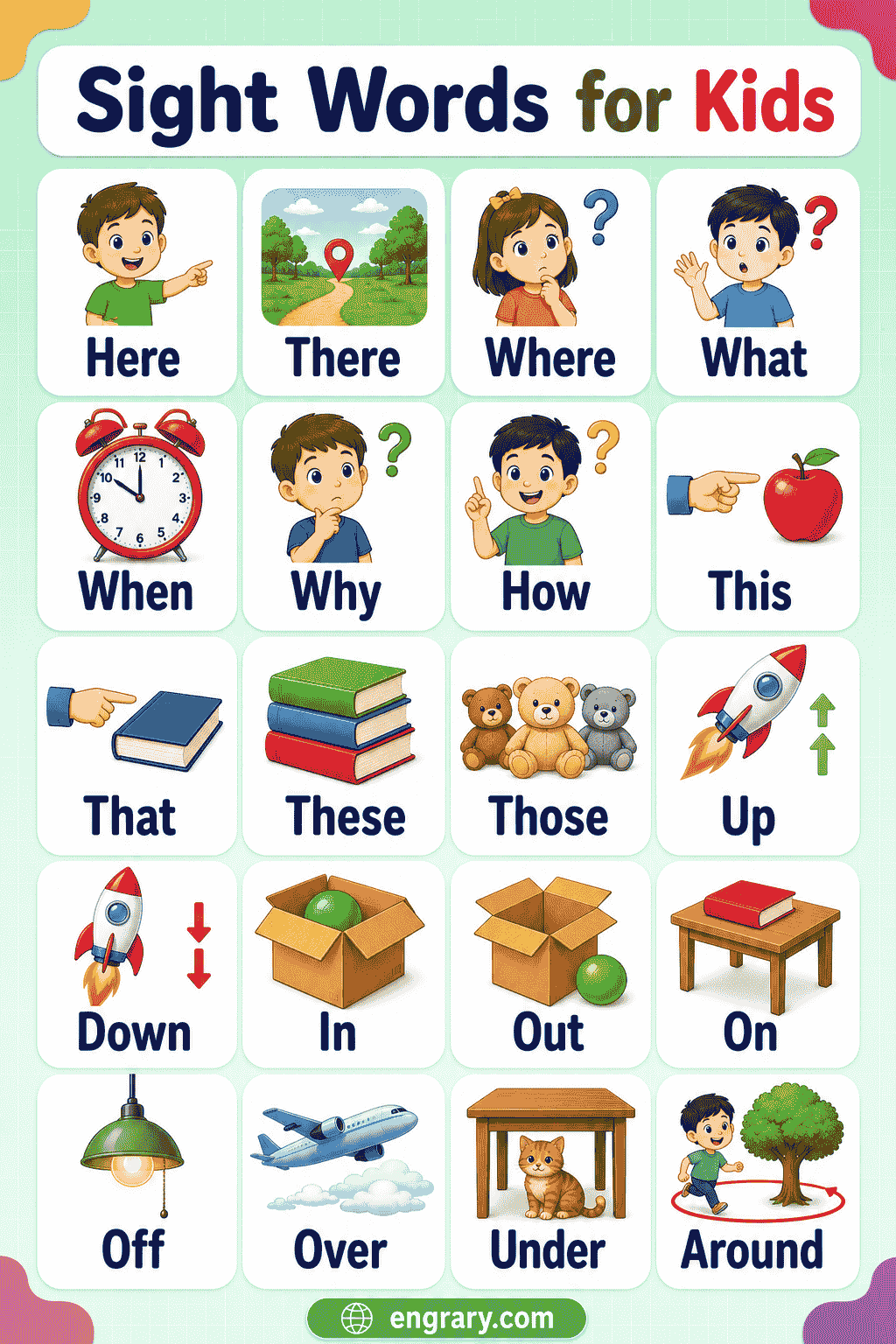
This printable-style sight words list can be used for flashcards, word walls, reading practice, spelling review, and worksheets.
- I
- a
- am
- an
- and
- are
- at
- be
- big
- can
- come
- do
- down
- for
- go
- has
- have
- he
- here
- in
- is
- it
- like
- little
- look
- me
- my
- no
- not
- of
- on
- one
- play
- said
- see
- she
- so
- that
- the
- there
- they
- this
- to
- two
- up
- was
- we
- where
- with
- you
- your
- about
- after
- again
- because
- could
- first
- from
- many
- should
- these
- would
- write
Sight Word Flashcards and Practice Ideas
Sight word flashcards help kids read words quickly and clearly. Use a small set of cards at one time so children do not feel overwhelmed.
- Put 5 sight words on cards.
- Read each word aloud.
- Ask the child to repeat the word.
- Mix the cards and read them again.
- Add one short sentence for each word.
- Keep tricky words in the review pile.
- Add new cards only when older words are familiar.
- Use picture support for action words like go, come, see, look, play, run, and jump.
- Place learned words on a word wall.
- Review old words for a few minutes each day.
- Let the child choose one word and write it in a sentence.
- Use different cards for easy words and tricky words.
Sight Word Games and Activities
Games make sight word practice more active and enjoyable for kids. They also help children read, speak, spell, and use words in a fun way.
- Sight word match — Match two cards with the same word.
- Read and clap — Read a word, then clap for each letter.
- Find the word — Look for a sight word in a book or worksheet.
- Word wall hunt — Find and read words from a classroom word wall.
- Sight word bingo — Listen for a word and cover it on a bingo board.
- Build the word — Make the word with letter tiles.
- Write and read — Write a word, then read it aloud.
- Sentence card game — Put a sight word into a short sentence.
- Jump to the word — Place word cards on the floor and jump to the correct one.
- Roll and read — Roll a die and read the word in that number spot.
- Color the word — Color a sight word every time it appears.
- Partner practice — One child shows a card, and the other reads it.
Sight Word Worksheet Ideas
Sight word worksheets help children practice reading, writing, spelling, and word recognition.
- Trace the sight word.
- Write the sight word three times.
- Circle the sight word in a sentence.
- Match the sight word with the same word.
- Fill in the missing sight word.
- Read and color the sight word.
- Cut and paste the correct word.
- Choose the sight word that completes the sentence.
- Sort easy words and tricky words.
- Build a sentence using the sight word.
- Find the word in a short passage.
- Write a new sentence with the word.
- Match the sight word to a simple picture or action.
- Put sight words in ABC order.
- Read a short passage and underline the sight words.
Common Mistakes When Teaching Sight Words
Sight word practice works better when children read, spell, write, and use words in sentences. Avoid these common mistakes:
- Teaching too many sight words at once
- Asking kids to memorize words without reading them in sentences
- Skipping review after a child learns a word
- Using only worksheets without oral reading practice
- Ignoring sounds and letters when a word can be sounded out
- Giving tricky words too early
- Moving to new words before old words are familiar
- Practicing words only in isolation
- Not letting children write the words
- Using long lists that feel overwhelming
- Treating every high-frequency word as fully irregular
- Forgetting to practice words inside real books
- Making practice too long or stressful
How to Teach Sight Words to Kids
Start with a small group of common words like I, a, am, is, in, it, on, to, the, and, can, see, go, my, and we. Show each word clearly, say it aloud, spell it, read it in a short sentence, and ask the child to write it. Use flashcards, word walls, picture support, sentence strips, and simple books so children see the same words many times.
Teach sight words through reading, not memorization alone. When a word is easy to sound out, help the child connect the letters and sounds. When possible, help children notice the regular letter sounds first, then explain only the tricky part of the word. Short daily practice with reading, writing, speaking, games, and review works better than one long lesson.
FAQs
Sight words for kids are common words children learn to recognize quickly while reading. Examples include the, and, I, you, see, go, is, in, to, my, said, and where.
High-frequency words are words that appear often in reading. Sight words are words a child can recognize quickly by sight after enough practice. Many high-frequency words become sight words for young readers.
Good beginner sight words include I, a, am, is, in, it, on, to, the, and, can, see, go, my, we, me, he, she, up, and no.
Kids can practice sight words by reading flashcards, saying the word, spelling it aloud, writing it, reading it in a sentence, playing matching games, using word walls, and reviewing words often.
No. Kids should not memorize sight words only. They should read the words in sentences, connect letters and sounds when possible, notice tricky parts, write the words, and review them often through books, games, and short daily practice.
You May Also Like