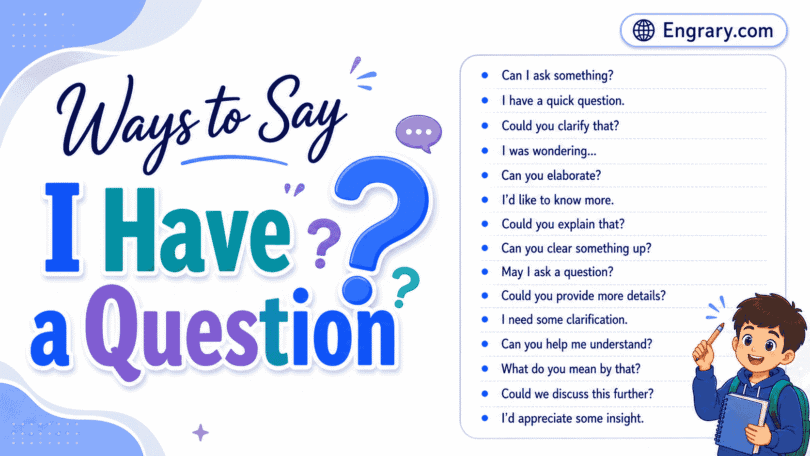
“I have a question” is a common English phrase used when you want to ask for information, clarification, or help. While it is clear and correct, other phrases may sound more polite, professional, or natural depending on the situation.
Whether you’re speaking in a meeting, writing an email, talking to a teacher, or chatting with a friend, choosing the right alternative can improve your communication. This guide covers polite, professional, and casual ways to say “I have a question” with simple examples for everyday situations.
“I Have a Question” Meaning
“I have a question” means you want to ask something or get more information. You can use it when you need an answer, explanation, confirmation, or clarification.
The phrase is not rude by itself. It is clear and easy to understand. However, in professional messages or polite conversations, it often sounds better when you add context.
Example: I have a question about the deadline.
This sounds clearer than only saying “I have a question.” When you add the topic, the listener knows what your question is about. This makes your message more helpful and less abrupt.
Best Alternatives to “I Have a Question” by Situation
| Situation | Better Phrase |
|---|---|
| General question | I have a quick question. |
| Polite request | May I ask a question? |
| Professional message | I have a quick question about this. |
| I wanted to ask about… | |
| Workplace chat | Quick question. |
| Meeting | Before we move on, can I ask something? |
| Classroom | May I ask a question? |
| Clarification | Could you clarify one point? |
| Help understanding | Could you help me understand this? |
| Confirmation | Could you confirm one detail? |
| Casual conversation | Can I ask you something? |
| Formal situation | I would like to ask a question. |
| Customer service | I have a question about my order. |
| Follow-up | I have a follow-up question. |
| Non-urgent question | When you have a moment, could I ask something? |
For most everyday situations, “I have a quick question” is one of the safest choices. It sounds natural, polite, and less demanding than only saying “I have a question.”
“I Have a Question” vs Similar Phrases
“I have a question” is direct and clear, but similar phrases can sound softer, more professional, or more specific. Use this comparison to choose the best phrase.
| Phrase | Best Use |
|---|---|
| I have a question. | General and direct |
| I have a quick question. | Softer and lighter |
| I have one question. | Specific and focused |
| May I ask a question? | Polite or classroom use |
| Could I ask something? | Natural and polite |
| Can I ask you something? | Casual conversation |
| Could I ask for clarification? | Professional or academic use |
| I have a follow-up question. | After an explanation |
| I wanted to ask about… | Emails and polite messages |
| Could you confirm one detail? | Checking information |
Direct vs Polite Ways to Ask a Question
Some phrases are clear but too direct for professional or polite situations. A softer phrase often sounds better.
| Direct Phrase | Polite Phrase |
|---|---|
| I have a question. | May I ask a question? |
| Question? | Could I ask something? |
| I don’t get it. | Could you explain this part? |
| Explain this. | Could you help me understand this? |
| Answer this. | Could you clarify this for me? |
| I need answers. | I’d like to ask about this. |
| Tell me this. | Could you confirm one detail? |
| I’m confused. | I’m not sure I understand. |
In professional English, softer phrases usually sound better because they show respect for the other person’s time and position.
When “I Have a Question” Sounds Natural in English
“I have a question” sounds natural when you want to ask for information, clarification, or help. It works well in classrooms, meetings, customer service conversations, and everyday discussions.
The phrase is clear and polite, but it often sounds more natural when you add the topic. For example, “I have a question about the project” is more specific than simply saying “I have a question.”
Examples:
- I have a question about the homework.
- I have a question about the deadline.
- I have a question regarding my order.
- I have a question about the next step.
Polite Ways to Say “I Have a Question”
Use these phrases when you want to ask something in a respectful and natural way.
May I ask a question?
This is polite and works well in classrooms, meetings, and formal conversations.
Example: May I ask a question?
Could I ask something?
This sounds polite and natural in many situations.
Example: Could I ask something?
Could I ask you a question?
This is polite and slightly more personal.
Example: Could I ask you a question?
Do you mind if I ask a question?
This is polite when you want permission before asking.
Example: Do you mind if I ask a question?
I have a quick question.
This sounds friendly and less demanding than “I have a question.”
Example: I have a quick question.
I have one question.
This tells the listener your question is specific.
Example: I have one question.
I wanted to ask something.
This sounds softer than “I have a question.”
Example: I wanted to ask something.
I have something I’d like to ask.
This is polite and clear.
Example: I have something I’d like to ask.
Could I check something with you?
This is useful when you want to confirm or verify something.
Example: Could I check something with you?
When you have a moment, could I ask something?
This is polite when the question is not urgent.
Example: When you have a moment, could I ask something?
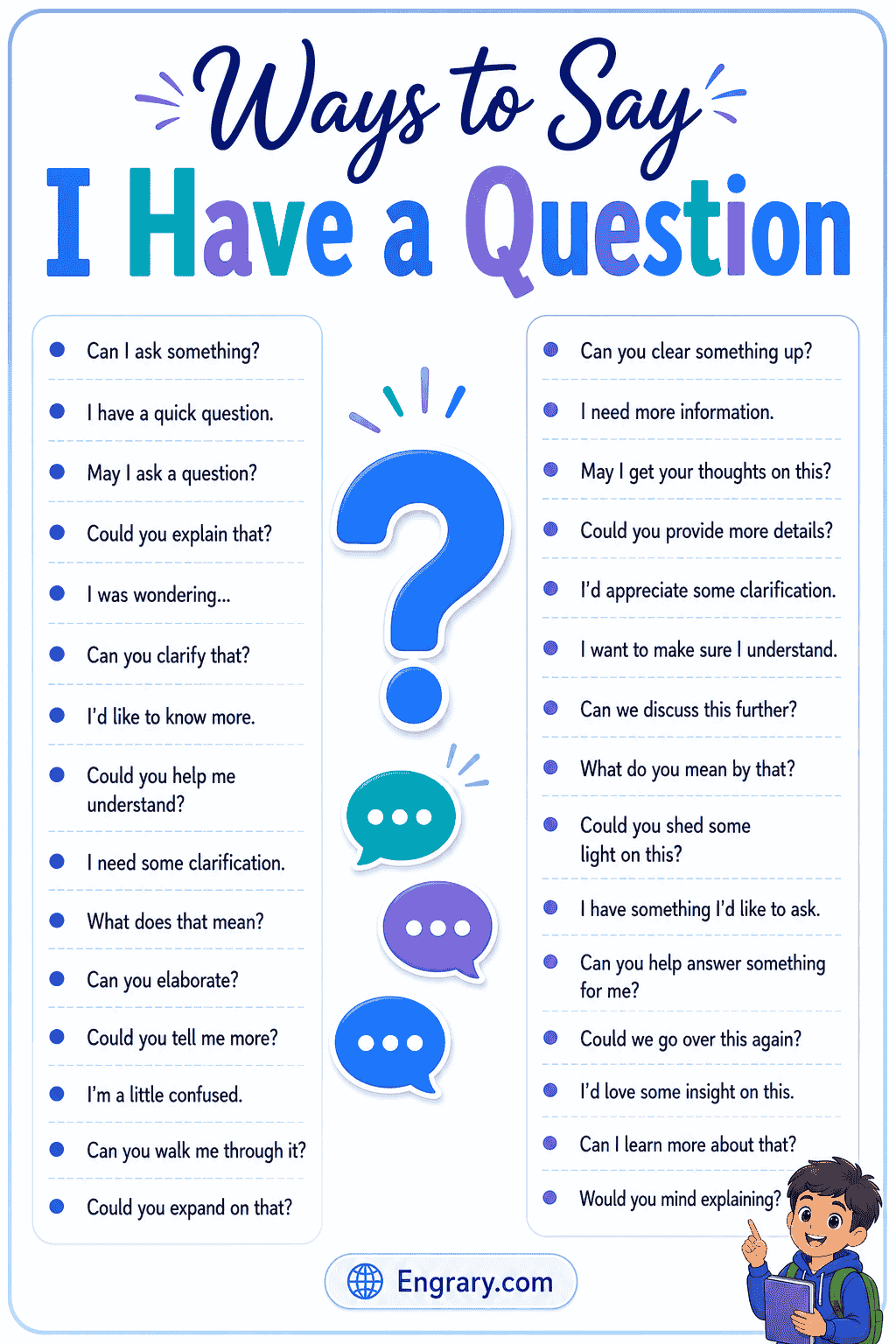
Professional Ways to Say “I Have a Question”
Use these phrases at work, with clients, in meetings, or when speaking to managers and coworkers.
I have a quick question about this.
This is one of the most natural professional phrases.
Example: I have a quick question about this.
Could I ask for clarification?
Use this when something is unclear.
Example: Could I ask for clarification?
Could you clarify one point?
This is professional and specific.
Example: Could you clarify one point?
I wanted to ask about the timeline.
This works well when asking about schedules or deadlines.
Example: I wanted to ask about the timeline.
Could you confirm one detail?
Use this when you need to check information.
Example: Could you confirm one detail?
I have one question before we move forward.
This is useful before making a decision or continuing a task.
Example: I have one question before we move forward.
I’d like to ask about the next step.
This sounds professional and clear.
Example: I’d like to ask about the next step.
I was wondering if you could help me understand this.
This is polite and professional.
Example: I was wondering if you could help me understand this.
Could I check one thing before we continue?
This works well in meetings and discussions.
Example: Could I check one thing before we continue?
I have a follow-up question.
Use this after someone has already explained something.
Example: I have a follow-up question.
Email Phrases for Asking a Question
In emails, it is usually better to be polite, clear, and specific. Instead of writing only “I have a question,” mention the topic.
I have a quick question about…
This is simple and professional.
Example: I have a quick question about the report.
I wanted to ask about…
This sounds polite and natural in emails.
Example: I wanted to ask about the schedule.
I was wondering if…
This is softer and less direct.
Example: I was wondering if the file is ready.
Could you clarify…?
Use this when something needs explanation.
Example: Could you clarify the next step?
Could you confirm…?
Use this when you need to check a detail.
Example: Could you confirm the meeting time?
When you have a chance, could you let me know…?
This is polite for non-urgent questions.
Example: When you have a chance, could you let me know?
I’d like to ask about…
This sounds professional and clear.
Example: I’d like to ask about the invoice.
Could you help me understand…?
This is useful when you need an explanation.
Example: Could you help me understand this section?
I have one question regarding…
This is formal and specific.
Example: I have one question regarding the contract.
Would you be able to explain…?
This is polite and professional.
Example: Would you be able to explain the process?
Workplace Chat Phrases for Asking a Quick Question
Use these phrases in Slack, Teams, WhatsApp, or quick work messages. They are short, natural, and easy to understand.
Quick question.
This is short and common in workplace chats.
Example: Quick question.
I have a quick question.
This sounds friendly and clear.
Example: I have a quick question.
Can I ask something?
This is casual but polite.
Example: Can I ask something?
Could I check something with you?
Useful when you need confirmation.
Example: Could I check something with you?
One quick question.
This shows the question should be short.
Example: One quick question.
Can I ask about this?
This is simple and natural.
Example: Can I ask about this?
Do you have a second for a question?
This is polite when someone may be busy.
Example: Do you have a second for a question?
When you have a moment, can I ask something?
This is good for non-urgent questions.
Example: When you have a moment, can I ask something?
Could you help me with one thing?
This is useful when you need help.
Example: Could you help me with one thing?
Can I run something by you?
This is natural in workplace English.
Example: Can I run something by you?
Meeting Phrases for Asking a Question
In meetings, it is important to ask without sounding like you are interrupting. These phrases help you enter the conversation politely.
Before we move on, can I ask something?
This is useful before the topic changes.
Example: Before we move on, can I ask something?
I have a question about the last point.
This is clear and meeting-friendly.
Example: I have a question about the last point.
Could I ask a follow-up question?
Use this after someone gives an explanation.
Example: Could I ask a follow-up question?
Could you clarify the next step?
This is professional and specific.
Example: Could you clarify the next step?
I have one question before we continue.
This is useful before moving forward.
Example: I have one question before we continue.
May I ask something about the proposal?
This is polite and formal.
Example: May I ask something about the proposal?
Could you explain that point further?
Use this when you need more detail.
Example: Could you explain that point further?
I’d like to ask about the timeline.
This is useful for deadlines and planning.
Example: I’d like to ask about the timeline.
Can we pause for one question?
This works when the meeting is moving quickly.
Example: Can we pause for one question?
Could we go back to that point?
Use this when the topic has moved on.
Example: Could we go back to that point?
Classroom Phrases for Asking a Question
Students often need polite ways to ask teachers, tutors, or classmates for help. These phrases are simple and respectful.
May I ask a question?
This is polite and common in classrooms.
Example: May I ask a question?
I have a question about the lesson.
This clearly tells the teacher what your question is about.
Example: I have a question about the lesson.
Could you explain this part?
Use this when one part is unclear.
Example: Could you explain this part?
I’m not sure I understand.
This is honest and polite.
Example: I’m not sure I understand.
Could you go over this again?
Use this when you need repetition or review.
Example: Could you go over this again?
Can I ask about the example?
This is natural during a lesson.
Example: Can I ask about the example?
I have a question about the homework.
This is clear and specific.
Example: I have a question about the homework.
Could you show another example?
Use this when one example is not enough.
Example: Could you show another example?
Could you explain it more simply?
This is helpful for difficult topics.
Example: Could you explain it more simply?
Can I check my understanding?
This is useful when you want to confirm.
Example: Can I check my understanding?
Customer Service Phrases for Asking a Question
Use these phrases when contacting support about orders, accounts, bookings, refunds, payments, or services.
I have a question about my order.
This is clear and direct.
Example: I have a question about my order.
I have a question about my account.
Useful for account-related support.
Example: I have a question about my account.
Could you help me with a question?
This is polite and simple.
Example: Could you help me with a question?
Could you clarify the charge?
Use this for billing or payment questions.
Example: Could you clarify the charge?
I wanted to ask about my booking.
This is polite for travel, hotels, or appointments.
Example: I wanted to ask about my booking.
Could you confirm my appointment?
Useful when checking time or date.
Example: Could you confirm my appointment?
I have a question about the refund.
Clear and specific.
Example: I have a question about the refund.
Could you explain the policy?
Use this when rules are unclear.
Example: Could you explain the policy?
Can you help me understand this fee?
A polite way to ask about charges.
Example: Can you help me understand this fee?
I’d like to ask about the delivery.
Useful for shipping or order updates.
Example: I’d like to ask about the delivery.
Ways to Ask for Clarification
Use these phrases when one point is unclear. These are useful in emails, meetings, classrooms, and professional conversations.
Could you clarify something for me?
A polite phrase for unclear information.
Example: Could you clarify something for me?
I need a little clarification.
This is clear and professional.
Example: I need a little clarification.
I’m unclear about one point.
This is specific and polite.
Example: I’m unclear about one point.
I’m not sure I understand this part.
This is natural and learner-friendly.
Example: I’m not sure I understand this part.
Could you explain what you mean?
Use this when the meaning is unclear.
Example: Could you explain what you mean?
Could you help me understand this?
This sounds polite and respectful.
Example: Could you help me understand this?
Could you walk me through this?
Use this when you need step-by-step help.
Example: Could you walk me through this?
Could you make this clearer?
This is direct but still polite.
Example: Could you make this clearer?
Ways to Ask for Help Understanding Something
These phrases are useful when the whole idea, process, or instruction feels difficult.
Could you help me understand this?
A polite phrase for asking for help.
Example: Could you help me understand this?
I’m having trouble understanding this.
This sounds honest and clear.
Example: I’m having trouble understanding this.
Could you explain this in a simpler way?
Use this when the explanation is too complex.
Example: Could you explain this in a simpler way?
Could you give me an example?
Helpful when examples make things clearer.
Example: Could you give me an example?
Could you show me how this works?
Useful for processes or tools.
Example: Could you show me how this works?
I’m not following this part.
Natural when you are confused.
Example: I’m not following this part.
Could you break this down for me?
Use this when you need a simpler explanation.
Example: Could you break this down for me?
Could you explain the main idea?
Useful for lessons, reports, or instructions.
Example: Could you explain the main idea?
Ways to Ask a Quick Question Without Sounding Demanding
A quick question can still sound demanding if your tone is too direct. Add soft words like “quick,” “when you have a moment,” or “could I” to sound more polite.
I have a quick question about this.
This is short, polite, and useful.
Example: I have a quick question about this.
Could I ask one quick thing?
This sounds friendly and light.
Example: Could I ask one quick thing?
When you have a moment, could I ask something?
This is polite and not pushy.
Example: When you have a moment, could I ask something?
Could I quickly check something?
Useful when you need confirmation.
Example: Could I quickly check something?
I wanted to check one thing.
This sounds soft and professional.
Example: I wanted to check one thing.
Do you have a minute for a quick question?
Good when someone may be busy.
Example: Do you have a minute for a quick question?
Could I ask about one detail?
This is specific and polite.
Example: Could I ask about one detail?
I just wanted to ask about this.
A softer casual or email phrase.
Example: I just wanted to ask about this.
Casual Ways to Say “I Have a Question”
Use these phrases with friends, family, classmates, or people you know well.
Can I ask you something?
A natural casual phrase.
Example: Can I ask you something?
I’ve got a question.
Casual and common.
Example: I’ve got a question.
Quick question.
Short and casual.
Example: Quick question.
I was wondering…
Soft and natural.
Example: I was wondering…
Can I ask something real quick?
Very casual and conversational.
Example: Can I ask something real quick?
I have something to ask you.
Natural and simple.
Example: I have something to ask you.
Mind if I ask something?
Casual and friendly.
Example: Mind if I ask something?
Can I ask about that?
Useful in casual conversations.
Example: Can I ask about that?
Phrases That Can Sound Too Direct or Awkward
Some phrases are understandable, but they can sound rude, demanding, or unnatural in the wrong situation.
| Avoid | Better |
|---|---|
| Question? | Could I ask something? |
| I need answers. | I have a question about this. |
| Answer this. | Could you clarify this? |
| Explain. | Could you explain this part? |
| I don’t get it. | I’m not sure I understand. |
| This makes no sense. | Could you clarify this? |
| Tell me now. | When you have a moment, could you explain? |
| I have doubts. | I have some questions. |
Use the better phrases when speaking to teachers, clients, managers, coworkers, customer service agents, or people you do not know well.
Common Mistakes with “I Have a Question”
One common mistake is saying only “Question?” in a professional chat. It is too short and can sound abrupt. “Could I ask something?” or “I have a quick question” sounds better.
Another mistake is saying “I don’t get it” in formal situations. This is common in casual speech, but it may sound too blunt at work or in class. “I’m not sure I understand” sounds more polite.
Some learners also use “I have doubts” when they mean they have questions. In English, “I have doubts” often means you feel uncertain or suspicious. If you simply want to ask something, say “I have a question” or “I have some questions.”
Another mistake is asking for help without saying what the question is about. A message like “I have a question about the invoice” is much clearer than only “I have a question.”
Also, avoid asking vague questions without context. Instead of saying “I have a question,” say “I have a question about the next step.” This helps the other person understand what you need.
Real-Life Examples for Work and Daily Conversations
Workplace chat
A: I sent the file.
B: I have a quick question.
Email
A: Please review the update.
B: I wanted to ask about the deadline.
Meeting
A: Let’s move to the next topic.
B: Before we move on, can I ask something?
Classroom
A: This is the formula.
B: Could you explain this part?
Customer service
A: How can I help?
B: I have a question about my order.
Casual conversation
A: I changed my plan.
B: Can I ask you something?
Clarification
A: Submit it through the portal.
B: Could you clarify the next step?
Follow-up question
A: That is how the process works.
B: I have a follow-up question.
How to Ask a Question Politely in English
Choose a phrase that matches the situation. In casual conversations, “Can I ask you something?” works well, while “Could I ask a quick question?” sounds more professional.
Adding context makes your question clearer. Instead of saying “I have a question,” try “I have a question about the schedule.” Using words like “could,” “may,” and “would” can also make your request sound more polite and respectful.
Summary
Summary
“I have a question” is a useful English phrase, but alternatives like “May I ask a question?”, “Could I ask something?”, and “I have a quick question” can sound more natural depending on the situation.
The best phrase depends on who you are speaking to and what you need. Choosing the right alternative can help you sound more polite, professional, and confident in English.
FAQs
Another way to say “I have a question” is “I have a quick question.” You can also say “May I ask something?”, “Could I ask a question?”, or “I wanted to ask about…”
You can say “May I ask a question?” or “Could I ask something about this?” These phrases sound polite because they ask permission before the question.
A professional way to ask a question is “I have a quick question about this” or “Could you clarify one point?” In emails, you can say “I wanted to ask about…” or “Could you confirm one detail?”
No, “I have a question” is not rude. However, it can sound abrupt if used alone in formal writing. Add context, such as “I have a question about the deadline.”
Instead of “I don’t understand,” you can say “I’m not sure I understand,” “Could you clarify this?”, or “Could you explain this part?” These phrases sound more polite and helpful.
You May Also Like