
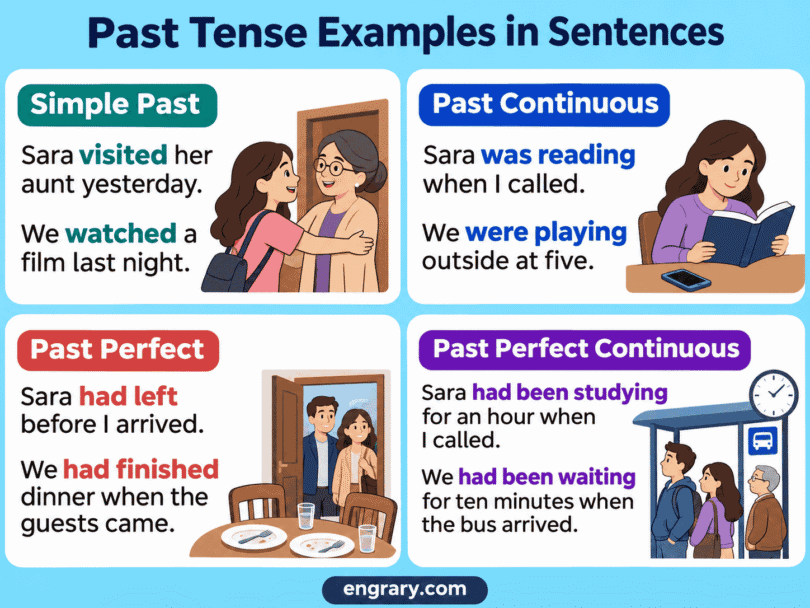
Past tense examples in sentences show how English describes earlier actions, experiences, and situations. For example, “Sara cooked dinner yesterday” describes a completed action, while “Sara was cooking when I arrived” shows an action underway at a particular past moment.
This guide includes 100 numbered examples across the simple past, past continuous, past perfect, and past perfect continuous. Along the way, you will learn sentence patterns, negatives, questions, and short answers. Comparison tables and common corrections also explain how to choose the right form.
Everyday Past Tense Examples Across the Four Forms
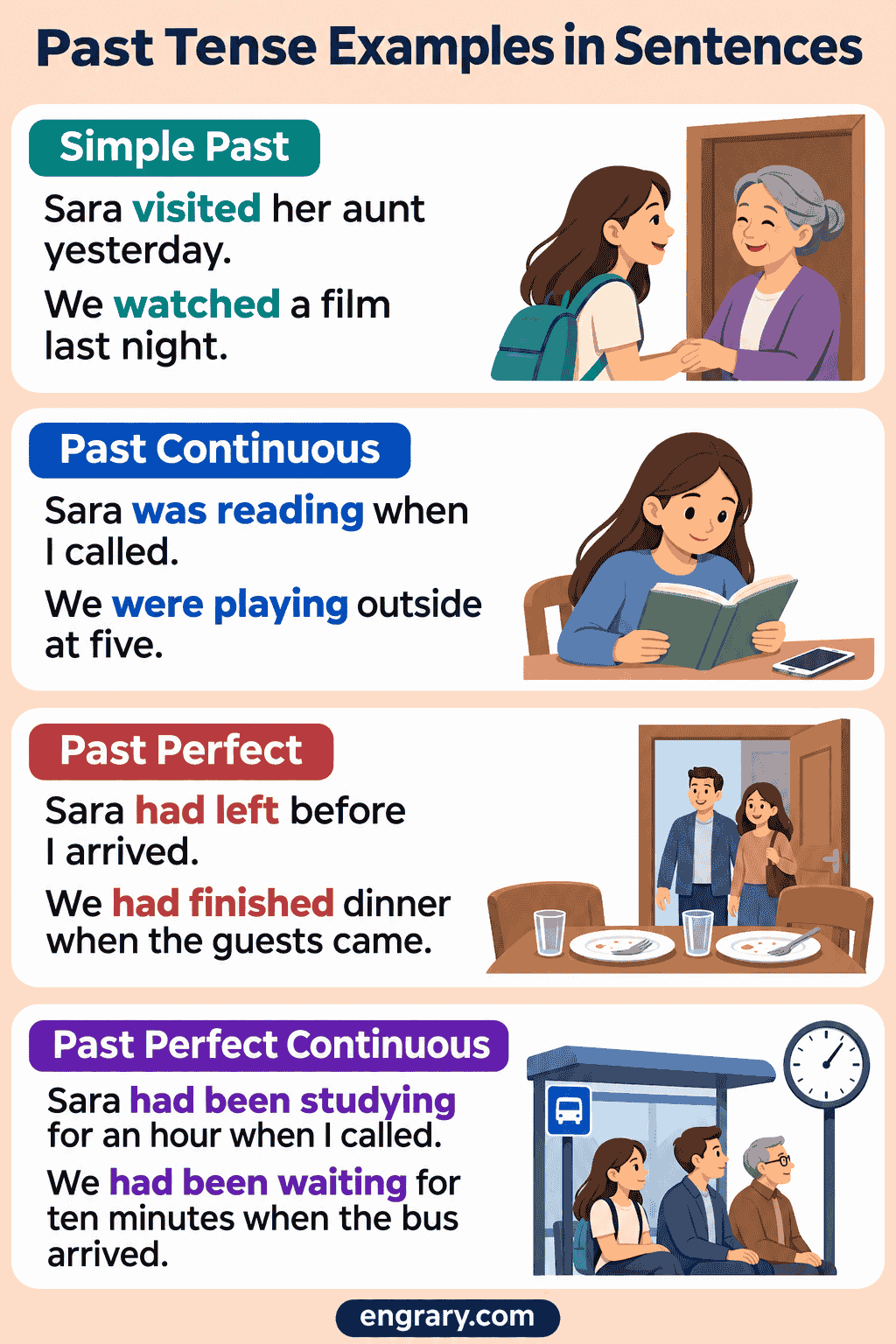
First, compare these four sentences about the same evening. Each form highlights a different part of the past timeline.
| No. | Form | Example | Meaning |
|---|---|---|---|
| 1 | Simple past | We ate dinner at seven. | A completed past action |
| 2 | Past continuous | Sara was cooking when I arrived at six. | An action underway at a past moment |
| 3 | Past perfect | She had chopped the vegetables before I arrived. | An action completed before another past event |
| 4 | Past perfect continuous | She had been preparing the meal for an hour when I arrived. | Activity continuing over time before a past event |
Before exploring more examples, notice three useful verb terms. The base verb is the basic form, such as go. Its past form is went, and its past participle is gone. Regular verbs often share the same past form and past participle, as in work–worked–worked.
Simple Past Tense Examples in Sentences
The simple past describes completed actions, past habits, and past states. Usually, the sentence or surrounding conversation makes the past time clear.
| Sentence type | Pattern with most verbs | Pattern with be |
|---|---|---|
| Affirmative | Subject + past form | Subject + was/were |
| Negative | Subject + did not + base verb | Subject + was/were + not |
| Yes/no question | Did + subject + base verb? | Was/Were + subject? |
Use was with I, he, she, it, and singular nouns. Use were with you, we, they, and plural nouns.
Affirmative Sentences
- I walked to school yesterday.
- Aisha bought fresh bread this morning.
- We visited our grandparents last Sunday.
- Omar finished his homework before dinner.
- The children played cricket after school.
- My brother lost his keys on the bus.
- She opened the door and switched on the light.
- They lived near the river when they were young.
- I cycled to college every day that summer.
- The classroom was quiet during the test.
- You were very patient with the children yesterday.
- Our train arrived ten minutes late.
For past habits, you can also use used to + base verb. For example, sentence 13 can become “I used to cycle to college every day.” This construction describes a former habit; it is not a fifth past tense form. It can also describe former states, such as living in a particular place.
Negative Sentences
After didn’t, use the base verb. However, with be, use wasn’t or weren’t directly.
- I didn’t watch television last night.
- She didn’t bring her notebook to class yesterday.
- We didn’t go to the market on Friday.
- The shop didn’t open until ten yesterday.
- He wasn’t at home when I called.
- The streets weren’t busy early this morning.
Questions and Short Answers
- Did you finish the report yesterday? — Yes, I did. / No, I didn’t.
- Did Mariam call you last night? — Yes, she did. / No, she didn’t.
- Were the children tired after the trip? — Yes, they were. / No, they weren’t.
- Where did you buy that bag?
- Why was the shop closed yesterday?
- Who opened the window during the lesson?
In sentence 28, who is the subject—the person who performed the action. Therefore, this ordinary affirmative subject question does not need did.
Past Continuous Tense Examples in Sentences
The past continuous, also called the past progressive, describes activity underway at a past moment. It also supplies background details or shows two activities happening at the same time.
| Sentence type | Structure |
|---|---|
| Affirmative | Subject + was/were + verb-ing |
| Negative | Subject + was/were + not + verb-ing |
| Yes/no question | Was/Were + subject + verb-ing? |
Affirmative Sentences
- I was reading a novel at nine last night.
- She was making tea when the doorbell rang.
- We were waiting for the bus when it started to rain.
- The children were drawing while their teacher arranged the books.
- Omar was washing the dishes while Aisha was drying them.
- The sun was shining when we left the house.
- My father was driving home at six yesterday evening.
- They were staying with relatives while their house underwent repairs.
- I was looking for my glasses when you called.
- The baby was sleeping during our conversation.
- Several customers were standing outside when the shop opened.
- She was studying in Lahore at that time.
Negative Sentences
- I wasn’t using my phone when the teacher entered.
- He wasn’t listening when I explained the directions.
- We weren’t expecting visitors that evening.
- The children weren’t playing outside when the storm began.
- It wasn’t raining when we started our walk.
- You weren’t wearing a jacket when I saw you.
Questions and Short Answers
- Were you working at eight last night? — Yes, I was. / No, I wasn’t.
- Was she waiting outside when you arrived? — Yes, she was. / No, she wasn’t.
- Were they watching the match when the power went out? — Yes, they were. / No, they weren’t.
- What were you carrying when I saw you?
- Where was he going when you met him?
- Why were the children laughing during the lesson?
Notice how when often introduces an event within an ongoing activity. Meanwhile, while often links activities that overlap. However, these words do not automatically require a particular tense; the intended meaning determines the form.
Past Perfect Tense Examples in Sentences
The past perfect looks back from a past reference point to an earlier action or state. As a result, it helps explain what had already happened before a later event.
| Sentence type | Structure |
|---|---|
| Affirmative | Subject + had + past participle |
| Negative | Subject + had not + past participle |
| Yes/no question | Had + subject + past participle? |
Affirmative Sentences
- The train had left before we reached the station.
- I had finished my homework by the time my cousin arrived.
- She had saved enough money before she bought the laptop.
- We had booked our tickets before the prices increased.
- He had forgotten his password, so he couldn’t sign in.
- The children had eaten lunch before the trip began.
- Aisha had read the book before she watched the film.
- They had known each other for years before they became colleagues.
- I had visited Karachi twice before I moved there.
- The rain had stopped by the time we left the office.
- She had packed six boxes by noon.
- We had been neighbors for a decade before he moved away.
Although sentence 64 contains had been, it is not continuous. Here, been is the past participle of be, and no verb-ing follows it.
Negative Sentences
- I hadn’t seen the message when you called.
- She hadn’t finished the report by five o’clock.
- We hadn’t met the new manager before Monday’s meeting.
- He hadn’t brought any cash, so he paid by card.
- The guests hadn’t arrived when we finished setting the table.
- They hadn’t visited a museum before their school trip.
Questions and Short Answers
- Had you eaten before the meeting started? — Yes, I had. / No, I hadn’t.
- Had she left when you reached the office? — Yes, she had. / No, she hadn’t.
- Had they booked a room before they traveled? — Yes, they had. / No, they hadn’t.
- What had he said before the argument began?
- Where had you put the keys before you went outside?
- Why had she changed her plans before the trip?
However, an earlier action does not always require past perfect. When before or after already makes the sequence clear, simple past can also work. Past perfect adds emphasis to the earlier completion or helps remove ambiguity.
Past Perfect Continuous Tense Examples in Sentences
The past perfect continuous, also called the past perfect progressive, emphasizes activity leading up to a past moment. Often, it highlights duration or explains a past result.
| Sentence type | Structure |
|---|---|
| Affirmative | Subject + had been + verb-ing |
| Negative | Subject + had not been + verb-ing |
| Yes/no question | Had + subject + been + verb-ing? |
Affirmative Sentences
- I had been studying for two hours when the lights went out.
- She had been packing boxes for three hours by noon.
- We had been waiting for forty minutes when the bus finally arrived.
- He was tired because he had been carrying heavy bags.
- The streets were wet because it had been raining all morning.
- They had been practicing together for months before the concert.
- Aisha had been working at the school for five years when she became headteacher.
- I had been looking for my wallet for half an hour when I found it.
- The children had been playing outside, so their shoes were muddy.
- My brother had been learning to drive for several weeks before his first test.
- We had been discussing the problem for an hour when the manager joined us.
- She had been sleeping for only twenty minutes when the alarm rang.
Negative Sentences
- I hadn’t been sleeping well before I changed my evening routine.
- He hadn’t been working there long when the company moved offices.
- We hadn’t been waiting for more than five minutes when the taxi arrived.
- She hadn’t been feeling well in the days before the exam.
- The team hadn’t been practicing regularly before the coach introduced a new schedule.
- They hadn’t been living in the city for long when we met them.
Questions and Short Answers
- Had you been waiting long when the clinic opened? — Yes, I had. / No, I hadn’t.
- Had she been working all night before the presentation? — Yes, she had. / No, she hadn’t.
- Had they been traveling for several hours when their car broke down? — Yes, they had. / No, they hadn’t.
- How long had you been studying English before you joined the course?
- What had he been doing before he hurt his back?
- Why had the dog been barking before you went outside?
However, duration alone does not require a continuous form. With stative verbs such as know, use had known, as in sentence 60. These verbs describe states rather than activities in their usual meanings.
Differences Between Past Tense Forms in Sentences
Small changes in the verb phrase can change the timeline or emphasis. The following comparisons explain those differences; examples outside the numbered list provide supporting illustrations.
Simple Past and Past Continuous
| Simple past | Past continuous | Difference |
|---|---|---|
| I read a novel last night. | I was reading a novel at nine last night. | The first presents a past reading event; the second focuses on activity underway at nine. |
| She made tea when I arrived. | She was making tea when I arrived. | The first can suggest that making tea followed my arrival; the second places it in progress at my arrival. |
Simple Past and Past Perfect
| Simple past | Past perfect | Difference |
|---|---|---|
| When we reached the station, the train left. | The train had left before we reached the station. | The first places departure at or just after our arrival; the second places it earlier. |
| After I finished my homework, I called my cousin. | After I had finished my homework, I called my cousin. | Both establish the same order; past perfect emphasizes prior completion. |
Past Perfect and Past Perfect Continuous
| Past perfect | Past perfect continuous | Difference |
|---|---|---|
| She had packed six boxes by noon. | She had been packing boxes for three hours by noon. | The first emphasizes the completed quantity; the second emphasizes time spent on the activity. |
| He had carried all the bags upstairs before lunch. | He was tired because he had been carrying heavy bags. | The first emphasizes completion; the second explains a result through earlier activity. |
The continuous form does not tell us by itself whether an activity continued afterward. Instead, the surrounding context supplies that information.
Simple Past and Present Perfect
| Simple past | Present perfect | Difference |
|---|---|---|
| I visited Karachi twice last year. | I have visited Karachi twice so far. | Last year is a finished period; so far extends up to now. |
| She finished the report yesterday. | She has finished the report, so it is ready now. | The first names a finished past time; the second emphasizes a present result. |
Although present perfect can describe earlier events, it belongs to the present tense system because it connects them to the present.
Common Time Expressions in Past Tense Sentences
Time expressions help establish the timeline. However, they act as clues rather than automatic tense rules.
| Expression | Typical role | Example reference |
|---|---|---|
| Yesterday, last Sunday, ago | Locates an event in a finished past period | Sentence 5: walked to school yesterday |
| At nine, at that moment | Identifies a particular past point | Sentence 29: was reading at nine |
| When | Connects events or establishes a reference point | Sentence 30: was making tea when the doorbell rang |
| While | Connects overlapping situations or activities | Sentence 33: was washing while Aisha was drying |
| Before, after | Establishes event order | Sentence 59: had read the book before watching the film |
| Already, by the time | Highlights prior completion in a suitable past context | Sentence 54: had finished by the time a cousin arrived |
| For | Gives a length of time | Sentence 79: had been waiting for forty minutes |
| Since | Gives a starting point | Since Monday; since six o’clock |
| All morning | Describes activity across a period | Sentence 81: had been raining all morning |
For example, for can accompany a completed past situation, a state before another past event, or an ongoing activity. Therefore, choose the tense according to meaning rather than the time expression alone.
Common Contractions in Past Tense Sentences
Contractions make everyday speech and informal writing sound natural. In more formal writing, full forms may fit better.
| Contraction | Full form | Example phrase |
|---|---|---|
| Didn’t | Did not | Didn’t watch |
| Wasn’t | Was not | Wasn’t listening |
| Weren’t | Were not | Weren’t playing |
| Hadn’t | Had not | Hadn’t finished |
| She’d finished | She had finished | Had + past participle |
| She’d finish | She would finish | Would + base verb |
Notice that ’d can mean had or would. The following verb pattern usually helps you identify the meaning. Also, affirmative short answers normally retain the full auxiliary: Yes, she had, rather than Yes, she’d.
Past Tense Examples in a Short Paragraph
Here are the four opening examples together as a short story:
Sara was cooking when I arrived at six. She had chopped the vegetables before I arrived. She had been preparing the meal for an hour when I arrived. We ate dinner at seven.
First, was cooking sets the scene at six. Next, had chopped looks back to an earlier completed action, while had been preparing explains the duration of the preparation. Finally, ate moves the story forward to seven.
Common Mistakes in Past Tense Sentences
When checking a sentence, look at the helping verb first. Then check the form that follows it.
| Incorrect or incomplete | Correct | Explanation |
|---|---|---|
| She didn’t went yesterday. | She didn’t go yesterday. | Use the base verb after didn’t. |
| Did you saw him? | Did you see him? | Did already carries the past tense. |
| They was waiting. | They were waiting. | Use were with they. |
| I was watch television. | I was watching television. | Continuous forms require verb-ing. |
| He had went before noon. | He had gone before noon. | Use the past participle after had. |
| She had working for hours when I arrived. | She had been working for hours when I arrived. | Past perfect continuous requires had been. |
| They had been knowing each other for years before the trip. | They had known each other for years before the trip. | Know normally takes a simple form. |
| I had finished my homework. — No past reference point is clear from the context. | I had finished my homework before my cousin arrived. | Supply a past reference point when the context does not already provide one. |
| I have seen him yesterday. | I saw him yesterday. | Use simple past with the finished time yesterday. |
An isolated past perfect sentence is not automatically incorrect. If the earlier conversation establishes the past reference point, you do not need to repeat it.
Frequently Asked Questions
What are the four past tense forms in English?
The four forms commonly taught in English grammar are simple past, past continuous, past perfect, and past perfect continuous. They describe past events and states from different viewpoints, including completion, progress, earlier timing, and duration.
How do I make a past tense sentence negative?
For most simple past verbs, use didn’t + base verb. With be, use wasn’t or weren’t. For the other forms, place not after the first helping verb: was not working, had not finished, or had not been waiting.
When should I use was or were instead of did?
Use was/were for the past of be, including descriptions, locations, and past continuous forms. In contrast, use did to form simple past negatives and questions with most other verbs. Thus, “Were you tired?” describes a state, while “Did you work?” asks about an action.
What is the difference between past perfect and past perfect continuous?
Past perfect often emphasizes an earlier completion, result, or state. Past perfect continuous emphasizes an earlier activity, frequently its duration or its connection to a later past result. However, verbs such as know usually take past perfect even when duration matters.
Can a sentence contain more than one past tense form?
Yes. Different clauses can describe different parts of a timeline. For example, sentence 30 combines was making with rang to show an ongoing activity and an event that happened during it.
You May Also Like


Leave a Comment