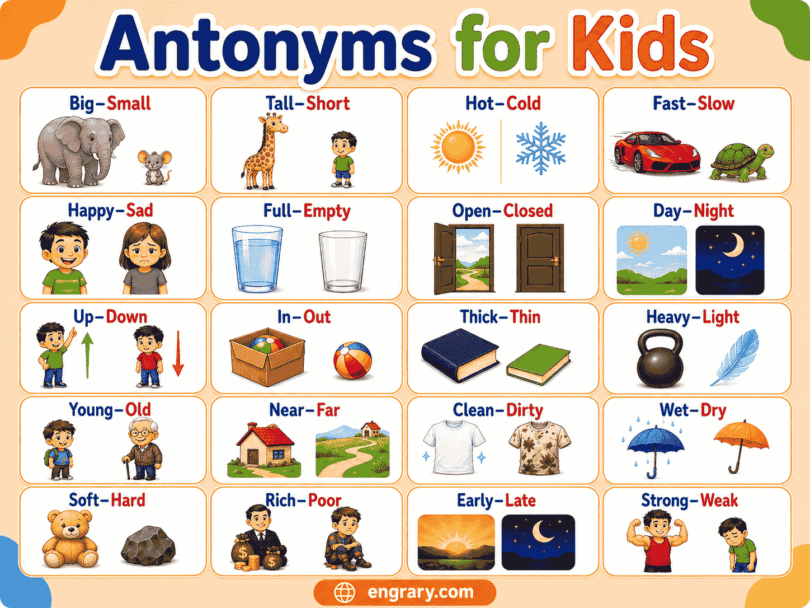
Antonyms for kids are words that have opposite meanings. They help children compare ideas, describe differences, and understand words more clearly. Words like big and small, hot and cold, happy and sad, fast and slow, and open and closed are antonyms.
Kids use antonyms when they read, write, describe pictures, answer questions, compare objects, and build vocabulary. This guide explains antonyms in a simple way with opposite word pairs, meanings, sentence practice, charts, games, worksheets, and teaching tips.

What Are Antonyms?
Antonyms are words with opposite meanings. They show how two words are different from each other.
- big — small
- hot — cold
- happy — sad
- fast — slow
- up — down
- in — out
- open — closed
- full — empty
- clean — dirty
- old — new
- near — far
- hard — soft
- loud — quiet
- light — dark
- strong — weak
- early — late
- first — last
- safe — dangerous
- same — different
- awake — asleep
In the sentence The cup is full, the word empty is the antonym of full. The words full and empty have opposite meanings.
Antonyms as Opposite Words
Antonyms are often called opposite words for kids. This makes the idea easier to understand because antonyms show two different meanings.
- day — night
- near — far
- wet — dry
- hard — soft
- loud — quiet
- light — dark
- good — bad
- right — wrong
- start — finish
- begin — end
- inside — outside
- above — below
- front — back
- first — last
- same — different
- awake — asleep
- early — late
- safe — dangerous
- smooth — rough
- kind — unkind
- polite — rude
- useful — useless
- possible — impossible
- careful — careless
Opposite Words for Kids
Opposite words for kids should be simple, visual, and easy to understand. Young learners can begin with pairs they can see, act out, draw, or compare.
- big — small
- tall — short
- hot — cold
- happy — sad
- fast — slow
- up — down
- in — out
- on — off
- open — closed
- full — empty
- clean — dirty
- wet — dry
- hard — soft
- loud — quiet
- light — dark
- old — new
- near — far
- front — back
- left — right
- awake — asleep
- early — late
- first — last
- heavy — light
- thick — thin
- smooth — rough
- safe — dangerous
- kind — unkind
- strong — weak
- rich — poor
- healthy — sick
- true — false
- empty — full
- push — pull
- win — lose

Why Antonyms Are Important for Kids
Antonyms help kids understand word meanings more clearly. When children learn that hot is the opposite of cold, they understand both words better.
Antonyms also help children compare people, animals, places, things, feelings, actions, time, and position. They are useful in reading, writing, speaking, picture description, and classroom practice.
- vocabulary building
- reading comprehension
- sentence writing
- picture description
- comparison skills
- classroom worksheets
- word wall practice
- speaking practice
- early grammar lessons
- ESL vocabulary learning
- story writing
- matching activities
- opposite word games
- listening practice
- visual learning
- writing contrast
- understanding directions
- describing emotions
- comparing objects
- explaining differences
Antonyms vs Synonyms
Antonyms and synonyms both show relationships between words. An antonym gives the opposite meaning, while a synonym gives the same or a similar meaning.
| Term | Meaning | Examples |
|---|---|---|
| Antonyms | Words with opposite meanings | big — small |
| Synonyms | Words with the same or similar meaning | big — large |
| Antonym Pair | Two words that mean the opposite | happy — sad |
| Synonym Pair | Two words that mean almost the same | happy — glad |
| Kid-Friendly Idea | Antonyms are opposite words | hot — cold |
- Fast and slow are antonyms.
- Fast and quick are synonyms.
- Good and bad are antonyms.
- Good and nice are synonyms.
- Loud and quiet are antonyms.
- Loud and noisy are synonyms.
- Small and big are antonyms.
- Small and little are synonyms.
Antonyms vs Homonyms and Homophones
Antonyms, homonyms, and homophones can be confusing for kids. The easiest difference is that antonyms are about opposite meaning.
| Term | Meaning | Examples |
|---|---|---|
| Antonyms | Words with opposite meanings | hot — cold |
| Homonyms | Words that sound or look the same but have different meanings | bat, bat |
| Homophones | Words that sound the same but have different spellings and meanings | to, two, too |
| Main Difference | Antonyms show opposite meanings | full — empty |
| Kid-Friendly Tip | Antonyms help compare two different ideas | up — down |
- Hot and cold are antonyms.
- Open and closed are antonyms.
- Bat can mean an animal or a sports tool.
- To, two, and too sound the same but mean different things.
- Right and write sound the same but mean different things.
- See and sea sound the same but mean different things.
Common Antonyms Kids Use Every Day
Common antonyms are opposite word pairs children hear and use often at home, in school, during play, and while reading.
- big — small
- tall — short
- long — short
- hot — cold
- warm — cool
- happy — sad
- fast — slow
- quick — slow
- up — down
- in — out
- on — off
- open — closed
- full — empty
- clean — dirty
- wet — dry
- hard — soft
- loud — quiet
- light — dark
- bright — dark
- old — new
- young — old
- near — far
- front — back
- left — right
- day — night
- early — late
- first — last
- good — bad
- right — wrong
- true — false
- easy — hard
- rich — poor
- kind — unkind
- brave — scared
- strong — weak
- heavy — light
- thick — thin
- smooth — rough
- safe — dangerous
- inside — outside
- above — below
- over — under
- same — different
- awake — asleep
- empty — full
- push — pull
- come — go
- win — lose
- remember — forget
Antonyms with Pictures
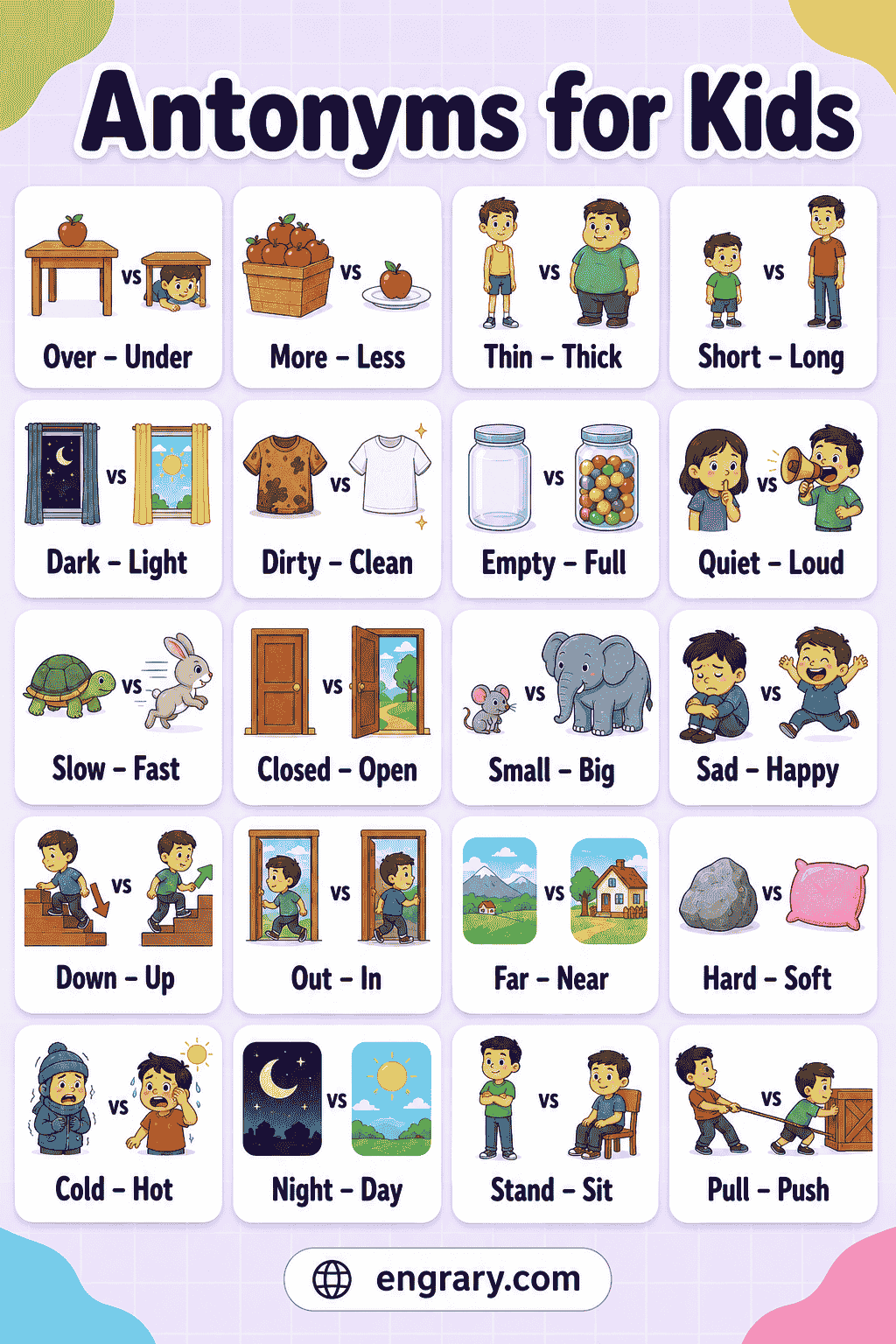
Antonyms with pictures help children understand opposite meanings quickly. These pairs work well for flashcards, posters, worksheets, picture cards, classroom displays, and visual vocabulary lessons.
- big — small
- tall — short
- hot — cold
- happy — sad
- fast — slow
- up — down
- in — out
- open — closed
- full — empty
- clean — dirty
- wet — dry
- hard — soft
- loud — quiet
- light — dark
- old — new
- near — far
- front — back
- day — night
- heavy — light
- strong — weak
- inside — outside
- above — below
- young — old
- safe — dangerous
Antonyms and Meanings for Kids
Short meanings help children understand opposite word pairs clearly.
- Big — small means large and little.
- Tall — short means high and not high.
- Hot — cold means very warm and not warm.
- Happy — sad means feeling good and feeling unhappy.
- Fast — slow means quick and not quick.
- Up — down means high and low.
- In — out means inside and outside.
- Open — closed means not shut and shut.
- Full — empty means filled and not filled.
- Clean — dirty means not messy and not clean.
- Wet — dry means covered with water and not wet.
- Hard — soft means firm and gentle to touch.
- Loud — quiet means making much sound and little sound.
- Light — dark means bright and not bright.
- Old — new means not new and not old.
- Near — far means close and not close.
- Good — bad means nice or correct and not good.
- Right — wrong means correct and not correct.
- Easy — hard means simple and difficult.
- Heavy — light means weighing a lot and not weighing much.
- Safe — dangerous means not harmful and not safe.
- Strong — weak means powerful and not strong.
- Early — late means before time and after time.
- First — last means at the beginning and at the end.
- Same — different means alike and not alike.
Easy Antonyms for Beginners
Easy antonyms are simple opposite word pairs that young learners can understand quickly. These are useful for preschool, kindergarten, first grade, ESL lessons, flashcards, and worksheets.
- big — small
- tall — short
- hot — cold
- happy — sad
- fast — slow
- up — down
- in — out
- on — off
- open — closed
- full — empty
- clean — dirty
- wet — dry
- hard — soft
- loud — quiet
- light — dark
- old — new
- near — far
- good — bad
- right — wrong
- easy — hard
- heavy — light
- day — night
- early — late
- first — last
- inside — outside
- above — below
- awake — asleep
- safe — dangerous
- kind — unkind
- strong — weak
- smooth — rough
- rich — poor
- young — old
- true — false
- empty — full
- push — pull
- win — lose
Antonym Pairs for Kids
Antonym pairs help kids learn two opposite words together. Start with visual pairs before moving to feeling, action, time, quality, and abstract pairs.
- big — small
- huge — tiny
- tall — short
- long — short
- wide — narrow
- thick — thin
- deep — shallow
- heavy — light
- hot — cold
- warm — cool
- happy — sad
- excited — bored
- brave — scared
- calm — nervous
- kind — unkind
- friendly — unfriendly
- fast — slow
- quick — slow
- rapid — gradual
- early — late
- up — down
- in — out
- inside — outside
- above — below
- front — back
- left — right
- top — bottom
- near — far
- open — closed
- full — empty
- clean — dirty
- wet — dry
- hard — soft
- loud — quiet
- light — dark
- bright — dark
- old — new
- young — old
- good — bad
- right — wrong
- true — false
- easy — hard
- rich — poor
- safe — dangerous
- strong — weak
- first — last
- same — different
- awake — asleep
- remember — forget
- buy — sell
- come — go
Antonyms by Age and Grade Level
Antonyms by age and grade level help teachers and parents choose opposite word pairs that match a child’s learning stage.
Preschool Antonyms
Preschool antonyms should be simple, visual, and easy to act out or show with pictures.
- big — small
- tall — short
- hot — cold
- happy — sad
- fast — slow
- up — down
- in — out
- on — off
- open — closed
- full — empty
- clean — dirty
- wet — dry
- loud — quiet
- day — night
- old — new
- awake — asleep
- hard — soft
- light — dark
- good — bad
- near — far
Kindergarten Antonyms
Kindergarten antonyms can include daily words, picture words, classroom words, and simple comparison pairs.
- long — short
- wide — narrow
- hard — soft
- light — dark
- near — far
- front — back
- left — right
- good — bad
- right — wrong
- easy — hard
- heavy — light
- early — late
- first — last
- inside — outside
- above — below
- same — different
- safe — dangerous
- kind — unkind
- strong — weak
- empty — full
- young — old
- smooth — rough
- true — false
- push — pull
First Grade Antonyms
First grade antonyms can support reading, writing, sentence practice, and vocabulary growth.
- brave — scared
- strong — weak
- rich — poor
- healthy — sick
- careful — careless
- polite — rude
- smooth — rough
- beautiful — ugly
- quiet — noisy
- early — late
- true — false
- correct — incorrect
- empty — full
- cloudy — sunny
- push — pull
- buy — sell
- remember — forget
- enter — exit
- arrive — leave
- win — lose
- agree — disagree
- include — exclude
- possible — impossible
- useful — useless
- honest — dishonest
- patient — impatient

Opposite Words by Category
Category lists help children learn antonyms by meaning and use. These groups are useful for reading, writing, worksheets, word walls, classroom games, and vocabulary review.
Size Antonyms
Size antonyms compare how big, small, tall, short, wide, narrow, thick, thin, deep, or shallow something is.
- big — small
- huge — tiny
- tall — short
- long — short
- wide — narrow
- thick — thin
- deep — shallow
- large — little
- giant — mini
- heavy — light
- high — low
- broad — narrow
- fat — thin
- oversized — undersized
- full-sized — mini-sized
Feeling Antonyms
Feeling antonyms compare emotions and moods.
- happy — sad
- excited — bored
- brave — scared
- calm — nervous
- proud — ashamed
- kind — unkind
- cheerful — gloomy
- glad — upset
- relaxed — worried
- friendly — unfriendly
- hopeful — hopeless
- pleased — disappointed
- joyful — miserable
- confident — unsure
- patient — impatient
Speed Antonyms
Speed antonyms compare how fast or slow something moves or happens.
- fast — slow
- quick — slow
- speedy — sluggish
- rapid — gradual
- hurried — relaxed
- early — late
- sudden — slow
- prompt — delayed
- brisk — lazy
- racing — crawling
- swift — slow
- instant — delayed
- rushed — calm
- speedy — slow-moving
- hasty — careful
Temperature Antonyms
Temperature antonyms compare how hot, cold, warm, cool, boiling, or freezing something is.
- hot — cold
- warm — cool
- boiling — freezing
- heated — chilled
- sunny — icy
- burning — frozen
- fiery — frosty
- mild — harsh
- summer-like — winter-like
- warmest — coldest
- heated — cooled
- steaming — icy
- hot — chilly
- warm — cold
- tropical — freezing
Position Antonyms
Position antonyms compare where something is.
- up — down
- in — out
- inside — outside
- above — below
- over — under
- front — back
- left — right
- near — far
- top — bottom
- high — low
- here — there
- forward — backward
- before — after
- first — last
- center — edge
Appearance Antonyms
Appearance antonyms compare how someone or something looks.
- clean — dirty
- neat — messy
- beautiful — ugly
- bright — dark
- shiny — dull
- plain — fancy
- new — old
- smooth — rough
- colorful — colorless
- fresh — stale
- tidy — untidy
- pretty — unattractive
- clear — cloudy
- light — dark
- polished — dusty
Action Antonyms
Action antonyms compare opposite actions.
- open — close
- push — pull
- come — go
- enter — exit
- start — stop
- begin — end
- buy — sell
- give — take
- remember — forget
- win — lose
- rise — fall
- sit — stand
- laugh — cry
- arrive — leave
- build — break
Quality Antonyms
Quality antonyms compare what something is like.
- good — bad
- right — wrong
- true — false
- easy — hard
- safe — dangerous
- strong — weak
- rich — poor
- polite — rude
- careful — careless
- useful — useless
- correct — incorrect
- possible — impossible
- fair — unfair
- honest — dishonest
- kind — cruel
Antonyms for Describing People, Places, and Things
Antonyms become easier when kids use them with real nouns. These groups help children describe people, places, and things clearly.
Antonyms to Describe People
These antonym pairs can describe how people look, feel, act, or behave.
- kind — unkind
- brave — scared
- happy — sad
- tall — short
- young — old
- strong — weak
- polite — rude
- careful — careless
- friendly — unfriendly
- calm — nervous
- honest — dishonest
- patient — impatient
- cheerful — gloomy
- helpful — unhelpful
- confident — unsure
- proud — ashamed
- healthy — sick
- relaxed — worried
Antonyms to Describe Places
These antonym pairs can describe classrooms, parks, homes, streets, shops, rooms, and other places.
- quiet — noisy
- clean — dirty
- safe — dangerous
- bright — dark
- crowded — empty
- near — far
- peaceful — busy
- warm — cool
- open — closed
- sunny — cloudy
- wide — narrow
- inside — outside
- beautiful — ugly
- tidy — messy
- public — private
- high — low
- full — empty
- fresh — stale
Antonyms to Describe Things
These antonym pairs can describe toys, bags, books, boxes, clothes, food, tools, and classroom objects.
- big — small
- heavy — light
- old — new
- hard — soft
- wet — dry
- full — empty
- smooth — rough
- shiny — dull
- open — closed
- thick — thin
- clean — dirty
- sharp — blunt
- strong — weak
- useful — useless
- broken — fixed
- bright — dark
- wide — narrow
- safe — dangerous

Antonym Examples for Kids
Antonym examples can be grouped by use so kids can understand different kinds of opposite words.
- Size antonyms: big/small, tall/short, huge/tiny, wide/narrow, thick/thin, deep/shallow
- Feeling antonyms: happy/sad, brave/scared, calm/nervous, excited/bored, proud/ashamed
- Speed antonyms: fast/slow, quick/slow, rapid/gradual, hurried/relaxed, prompt/delayed
- Temperature antonyms: hot/cold, warm/cool, boiling/freezing, heated/chilled
- Position antonyms: up/down, in/out, above/below, near/far, left/right, top/bottom
- Appearance antonyms: clean/dirty, bright/dark, neat/messy, shiny/dull, fresh/stale
- Action antonyms: open/close, push/pull, come/go, start/stop, buy/sell, win/lose
- Quality antonyms: good/bad, right/wrong, true/false, safe/dangerous, useful/useless
- Time antonyms: early/late, day/night, morning/evening, first/last, before/after
- Amount antonyms: full/empty, more/less, many/few, all/none, enough/not enough
- Behavior antonyms: kind/unkind, polite/rude, careful/careless, honest/dishonest
- Condition antonyms: healthy/sick, awake/asleep, broken/fixed, wet/dry
Antonyms with Sentences
Sentence examples help children understand how antonyms work in real reading and writing.
- Big / Small — The big dog runs. The small dog sleeps.
- Hot / Cold — The soup is hot. The juice is cold.
- Happy / Sad — The happy child smiles. The sad child cries.
- Fast / Slow — The fast rabbit runs. The slow turtle walks.
- Up / Down — The balloon goes up. The ball falls down.
- In / Out — The cat is in the box. The dog is out of the box.
- Open / Closed — The door is open. The window is closed.
- Full / Empty — The cup is full. The bowl is empty.
- Clean / Dirty — The shirt is clean. The shoes are dirty.
- Wet / Dry — The towel is wet. The paper is dry.
- Hard / Soft — The rock is hard. The pillow is soft.
- Loud / Quiet — The drum is loud. The room is quiet.
- Light / Dark — The room is light. The cave is dark.
- Old / New — This toy is old. That toy is new.
- Near / Far — The shop is near. The mountain is far.
- Good / Bad — That is a good idea. That is a bad idea.
- Right / Wrong — This answer is right. That answer is wrong.
- Easy / Hard — This puzzle is easy. That puzzle is hard.
- Heavy / Light — The bag is heavy. The feather is light.
- Inside / Outside — The child is inside. The dog is outside.
- Strong / Weak — The rope is strong. The string is weak.
- Safe / Dangerous — The playground is safe. The road is dangerous.
- Early / Late — The bus came early. The train came late.
- True / False — This sentence is true. That sentence is false.
How Antonyms Improve Vocabulary
Antonyms help children understand words by learning their opposites. When kids know both words in an opposite pair, they understand each word more clearly.
Antonyms improve vocabulary by helping kids:
- understand word meaning
- compare two ideas
- describe pictures clearly
- answer reading questions
- write better sentences
- learn opposite pairs
- organize words by meaning
- understand stories
- build classroom vocabulary
- improve speaking practice
- notice word relationships
- understand contrast
- make stronger descriptions
- explain differences
- compare characters
- compare places
- follow directions
- understand position words
- improve worksheet accuracy
- build writing confidence
Strong Antonyms for Better Writing
Strong antonyms help children write better comparisons in stories, descriptions, and sentence practice.
- good — terrible
- happy — miserable
- big — tiny
- hot — freezing
- clean — filthy
- brave — frightened
- easy — difficult
- quiet — noisy
- beautiful — ugly
- safe — dangerous
- strong — weak
- polite — rude
- honest — dishonest
- careful — careless
- useful — useless
- bright — gloomy
- kind — cruel
- fresh — stale
- calm — nervous
- proud — ashamed
- correct — incorrect
- possible — impossible
- friendly — unfriendly
- patient — impatient
- peaceful — busy
Choosing the Correct Antonym
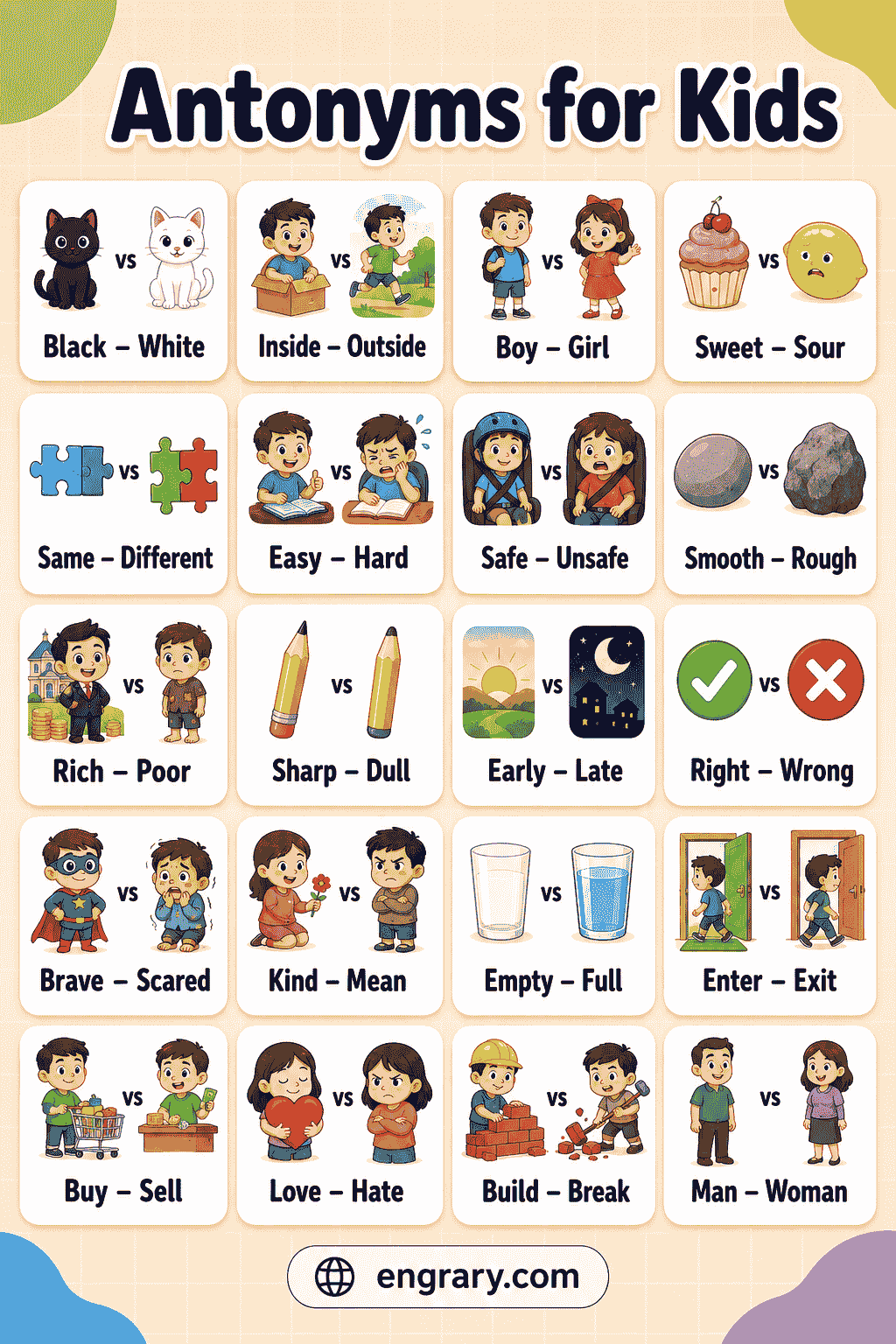
The correct antonym depends on the sentence. Some words can have more than one opposite, so children should think about the meaning first.
Important thinking questions:
- What does the word mean in this sentence?
- Is it about size, feeling, position, action, time, or quality?
- Which opposite word fits best?
- Does the sentence still make sense?
- Is the opposite word too strong?
- Is the opposite word clear for the reader?
- Does the antonym match the picture or story?
- Is the word used as a direction?
- Is the word used as a description?
- Is the word used as an action?
- Is the opposite word natural in the sentence?
- Would another opposite word fit better?
Useful checking pairs:
- light — dark
- light — heavy
- right — wrong
- right — left
- hard — soft
- hard — easy
- old — new
- old — young
Same Word, Different Opposite Meanings
Some words can have different opposite meanings because they can be used in more than one way.
- light — dark
- light — heavy
- right — wrong
- right — left
- hard — soft
- hard — easy
- open — closed
- open — hidden
- old — new
- old — young
- high — low
- high — deep
- fast — slow
- fast — loose
- clean — dirty
- clean — messy
- sharp — dull
- sharp — blunt
- fair — unfair
- fair — dark
Sentence examples:
- The room is light, but the cave is dark.
- The bag is light, but the box is heavy.
- The answer is right, but the other answer is wrong.
- Turn right, not left.
- The rock is hard, but the pillow is soft.
- The question is hard, but the answer is easy.
Antonym Practice Steps
Antonym practice should include reading, matching, speaking, comparing, drawing, and writing.
- Read the first word.
- Think about its meaning.
- Choose a word with the opposite meaning.
- Say both words together.
- Use the pair in a phrase.
- Use each word in a sentence.
- Compare the two meanings.
- Check if the opposite word fits the sentence.
- Draw a picture of the antonym pair.
- Read the sentence aloud.
- Sort the pair into a category.
- Try a new sentence with the same pair.
- Circle the antonym in a sentence.
- Match the pair with a picture.
- Use the pair in a short story.
- Say the pair with a partner.
- Add the pair to a word wall.
- Review the pair the next day.
Antonyms Chart

An antonyms chart helps kids review opposite word pairs, meanings, and uses in one place.
| Word | Antonym | Simple Meaning |
|---|---|---|
| big | small | large and little |
| hot | cold | warm and not warm |
| happy | sad | feeling good and unhappy |
| fast | slow | quick and not quick |
| up | down | high and low |
| in | out | inside and outside |
| open | closed | not shut and shut |
| full | empty | filled and not filled |
| clean | dirty | not messy and not clean |
| loud | quiet | much sound and little sound |
| good | bad | nice and not good |
| right | wrong | correct and not correct |
Antonym Word Bank and Word Wall for Kids
An antonym word bank helps kids find opposite words quickly. A classroom word wall can display the same pairs for daily review.
Size:
- big — small
- huge — tiny
- tall — short
- wide — narrow
- thick — thin
- heavy — light
- deep — shallow
- high — low
Feelings:
- happy — sad
- brave — scared
- calm — nervous
- excited — bored
- friendly — unfriendly
- proud — ashamed
- cheerful — gloomy
- relaxed — worried
Position:
- up — down
- in — out
- inside — outside
- above — below
- front — back
- near — far
- left — right
- top — bottom
Actions:
- open — close
- push — pull
- come — go
- start — stop
- begin — end
- buy — sell
- give — take
- win — lose
Quality:
- good — bad
- right — wrong
- true — false
- easy — hard
- safe — dangerous
- strong — weak
- polite — rude
- useful — useless
Printable Antonyms List for Kids
This printable antonyms list can be used for flashcards, word walls, worksheets, classroom practice, and writing lessons.
- big — small
- huge — tiny
- tall — short
- long — short
- wide — narrow
- thick — thin
- deep — shallow
- high — low
- hot — cold
- warm — cool
- happy — sad
- glad — upset
- excited — bored
- brave — scared
- calm — nervous
- fast — slow
- quick — slow
- rapid — gradual
- up — down
- in — out
- inside — outside
- above — below
- over — under
- front — back
- left — right
- near — far
- top — bottom
- open — closed
- full — empty
- clean — dirty
- wet — dry
- hard — soft
- loud — quiet
- light — dark
- old — new
- young — old
- good — bad
- right — wrong
- true — false
- easy — hard
- rich — poor
- strong — weak
- safe — dangerous
- polite — rude
- careful — careless
- kind — unkind
- honest — dishonest
- same — different
- awake — asleep
- early — late
- first — last
- begin — end
- start — stop
- push — pull
- buy — sell
- win — lose
- remember — forget
- enter — exit
- arrive — leave
- include — exclude
- possible — impossible
- useful — useless
Antonym Games and Activities
Games help children learn antonyms through matching, speaking, writing, movement, and play.
- Antonym match — Match two words with opposite meanings.
- Opposite cards — Turn over cards and find opposite word pairs.
- Word swap game — Replace a word in a sentence with its opposite.
- Antonym bingo — Cover the opposite word when it is called.
- Opposite word hunt — Find antonyms in a story or worksheet.
- Picture match — Match pictures that show opposite meanings.
- Act it out — Act out words like up/down, open/closed, or fast/slow.
- Antonym race — Name the opposite word as quickly as possible.
- Partner practice — One child says a word, and another says its opposite.
- Word wall review — Read opposite word pairs from a classroom wall.
- Sorting game — Sort antonyms by size, feeling, action, or position.
- Sentence flip — Change a sentence by replacing one word with its antonym.
- Drawing opposites — Draw big/small, full/empty, or day/night.
- Movement game — Move up/down, in/out, near/far, and front/back.
- Antonym story game — Write a short story using five opposite pairs.
- Find the opposite — Choose the opposite from three word choices.
- Opposite picture talk — Describe two pictures with opposite words.
- Classroom object game — Find objects that show hard/soft, full/empty, or heavy/light.
Antonym Matching Practice
Antonym matching practice helps kids connect opposite meanings.
- big → small
- hot → cold
- happy → sad
- fast → slow
- up → down
- in → out
- open → closed
- full → empty
- clean → dirty
- wet → dry
- hard → soft
- loud → quiet
- light → dark
- old → new
- near → far
- good → bad
- right → wrong
- easy → hard
- heavy → light
- safe → dangerous
- tall → short
- inside → outside
- above → below
- front → back
- first → last
- early → late
- awake → asleep
- strong → weak
- kind → unkind
- true → false
- begin → end
- start → stop
- push → pull
- buy → sell
- win → lose
- remember → forget
- enter → exit
- arrive → leave
- include → exclude
- possible → impossible
- useful → useless
- honest → dishonest
- polite → rude
- careful → careless
- same → different

Antonym Worksheets and Exercises for Kids
Antonym worksheets and exercises help kids practice opposite word meaning, word choice, and sentence writing.
- Match each word with its antonym.
- Circle the antonym in a word group.
- Choose the correct opposite word from a word bank.
- Fill in the blank with an antonym.
- Rewrite a sentence using an antonym.
- Sort antonyms by category.
- Match antonym pairs with pictures.
- Write two antonyms for a given word.
- Write a sentence using each antonym.
- Pick the correct opposite word for a story sentence.
- Underline antonym pairs in a short paragraph.
- Make an antonym word web.
- Draw a picture for an antonym pair.
- Sort synonyms and antonyms.
- Choose the antonym that fits the sentence.
- Write a short story using five antonym pairs.
- Sort pairs into size, feeling, position, action, or quality groups.
- Change a positive sentence into an opposite sentence.
- Complete a picture description with antonym pairs.
- Choose the best opposite for words with more than one meaning.
Exercise items:
- big → small / large
- happy → sad / glad
- fast → slow / quick
- start → finish / begin
- hot → cold / warm
- quiet → loud / silent
- open → closed / wide
- full → empty / filled
- clean → dirty / neat
- right → wrong / correct
- safe → dangerous / careful
- strong → weak / powerful
Common Mistakes When Teaching Antonyms
Avoid these common mistakes when teaching antonyms:
- Teaching antonyms only as memorized lists
- Forgetting to explain that antonyms are opposite words
- Giving too many hard pairs too early
- Skipping picture examples
- Teaching word pairs without sentence context
- Confusing antonyms with synonyms
- Confusing antonyms with homophones
- Not showing that some words have more than one opposite
- Using abstract pairs before visual pairs
- Asking children to memorize long lists without practice
- Skipping speaking practice
- Skipping writing practice
- Not checking if the antonym fits the sentence
- Using advanced terms like gradable antonyms too early
- Not reviewing opposite pairs regularly
- Teaching too many categories in one lesson
- Ignoring movement-based learning for young kids
- Forgetting to use real objects and pictures
- Not comparing pairs in full sentences
- Skipping word wall review
How to Teach Antonyms to Kids
Start with simple antonym pairs children can see, act out, or compare, such as big/small, hot/cold, happy/sad, fast/slow, up/down, in/out, open/closed, full/empty, clean/dirty, and wet/dry. Say both words together, explain that they have opposite meanings, and use each word in a short sentence. For example, write The door is open and The door is closed.
Teach antonyms with pictures, real objects, matching games, movement activities, word banks, sentence practice, and classroom word walls. Begin with visual opposites, then introduce feeling, action, position, quality, and writing antonyms. Use short practice sets, clear examples, and real sentences so kids understand meaning, not just memorization.
FAQs
Antonyms for kids are words with opposite meanings. Examples include big/small, hot/cold, happy/sad, fast/slow, up/down, open/closed, full/empty, and clean/dirty.
Easy antonym examples for kids include big/small, tall/short, hot/cold, happy/sad, fast/slow, in/out, up/down, clean/dirty, wet/dry, hard/soft, old/new, and full/empty.
Synonyms are words with the same or similar meaning, such as big and large. Antonyms are words with opposite meanings, such as big and small.
Antonyms help kids build vocabulary, understand word meanings, compare ideas, describe pictures, answer reading questions, and write clearer sentences.
Teach antonyms with simple opposite word pairs, pictures, real objects, matching games, movement activities, word banks, and sentence practice. Start with easy pairs like hot/cold, happy/sad, and big/small.
You May Also Like