The soft splash of milk in a bowl, the gentle scrape of a spoon, and the warm smell of toast can turn the kitchen into a fun place for learning new words. Children hear cooking words during daily routines, so words like mix, stir, pour, bake, and serve feel easy to understand.
Cooking vocabulary helps kids talk about food, follow simple instructions, and describe actions they see at home or in class. These words are useful for preschool, kindergarten, ESL lessons, picture cards, worksheets, and safe kitchen practice with adults.
Cooking Words Kids Hear in the Kitchen
Start with cooking words children hear often during meals, snacks, baking, cleaning, and family kitchen time.
- Mix — put things together.
- Stir — move food around.
- Pour — move liquid out.
- Wash — clean with water.
- Cut — make pieces.
- Bake — cook in an oven.
- Boil — cook in bubbling water.
- Fry — cook in a pan.
- Taste — try a little food.
- Serve — give food to someone.
- Clean — make something not dirty.
- Dry — remove water.
- Help — do something with someone.
- Cool — become less hot.
- Eat — put food in the mouth.
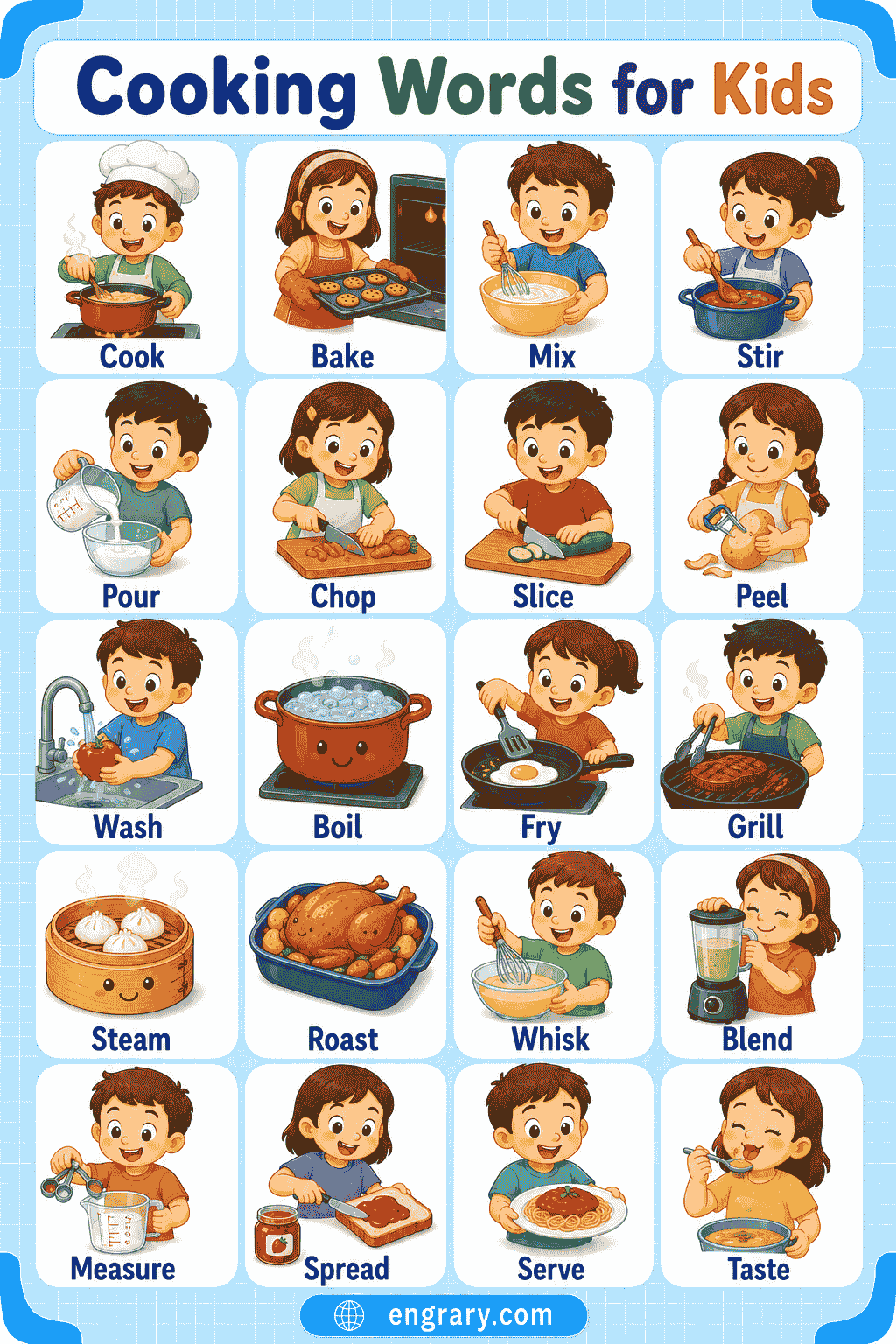
Easy Cooking Action Words
These action words name things children can watch, act out, or practice with picture cards.
- Add — put something in.
- Beat — mix quickly.
- Blend — mix until smooth.
- Carry — take from one place to another.
- Cook — make food ready to eat.
- Cool — let hot food become safe.
- Cut — divide into pieces.
- Dip — put food into sauce.
- Drain — remove water.
- Eat — chew and swallow food.
- Fill — put something inside.
- Flip — turn over.
- Heat — make warm or hot.
- Hold — keep in your hand.
- Make — prepare food.
- Melt — turn soft or liquid.
- Open — move something apart.
- Pass — give to another person.
- Pick — choose one item.
- Put — place somewhere.
- Roll — move or flatten by turning.
- Shake — move up and down.
- Share — give some to others.
- Scoop — lift with a spoon.
- Smell — use your nose.
- Spread — cover a surface.
- Taste — try a little food.
- Turn — flip or change position.
- Warm — make a little hot.
Picture-Friendly Cooking Words
Some cooking words are easy to show in pictures because the action is clear.
- Stir — a spoon moving in a bowl
- Pour — milk going into a cup
- Mix — ingredients together in a bowl
- Cut — food divided with a knife
- Slice — thin pieces of food
- Peel — skin coming off fruit
- Grate — cheese or carrot in small pieces
- Whisk — eggs mixed with a whisk
- Roll — dough flattened with a rolling pin
- Sprinkle — small bits falling on food
- Bake — food cooking in an oven
- Toast — bread becoming crisp
- Serve — food placed on a plate
- Wash — food or hands cleaned with water
- Wipe — a cloth cleaning a surface
Washing, Cutting, Mixing, and Preparing Food
Food preparation words describe what happens before food is cooked or served.
- Wash — clean with water.
- Rinse — wash quickly with water.
- Peel — remove the outside skin.
- Cut — make pieces.
- Slice — cut thin pieces.
- Chop — cut into small pieces.
- Dice — cut into tiny cubes.
- Grate — rub into small pieces.
- Measure — check the amount.
- Add — put something in.
- Mix — put together.
- Stir — move around with a spoon.
- Whisk — mix quickly with a whisk.
- Spread — cover the top.
- Scoop — lift with a spoon or scoop.
- Sprinkle — drop small bits on top.
- Drain — remove extra water.
- Crack — break open, like an egg.
Bake, Boil, Fry, and Heat Words
Heat words are important in cooking, but they should be taught with gentle safety language.
| Cooking Word | Easy Meaning |
|---|---|
| Bake | cook in an oven |
| Boil | cook in bubbling water |
| Fry | cook in a pan |
| Toast | make bread crisp |
| Grill | cook on a hot grill |
| Steam | cook with hot steam |
| Roast | cook with dry heat |
| Simmer | cook with small bubbles |
| Melt | turn soft or liquid |
| Warm | make a little hot |
| Heat | make hot |
| Cool | become less hot |
Baking Words Kids Can Learn
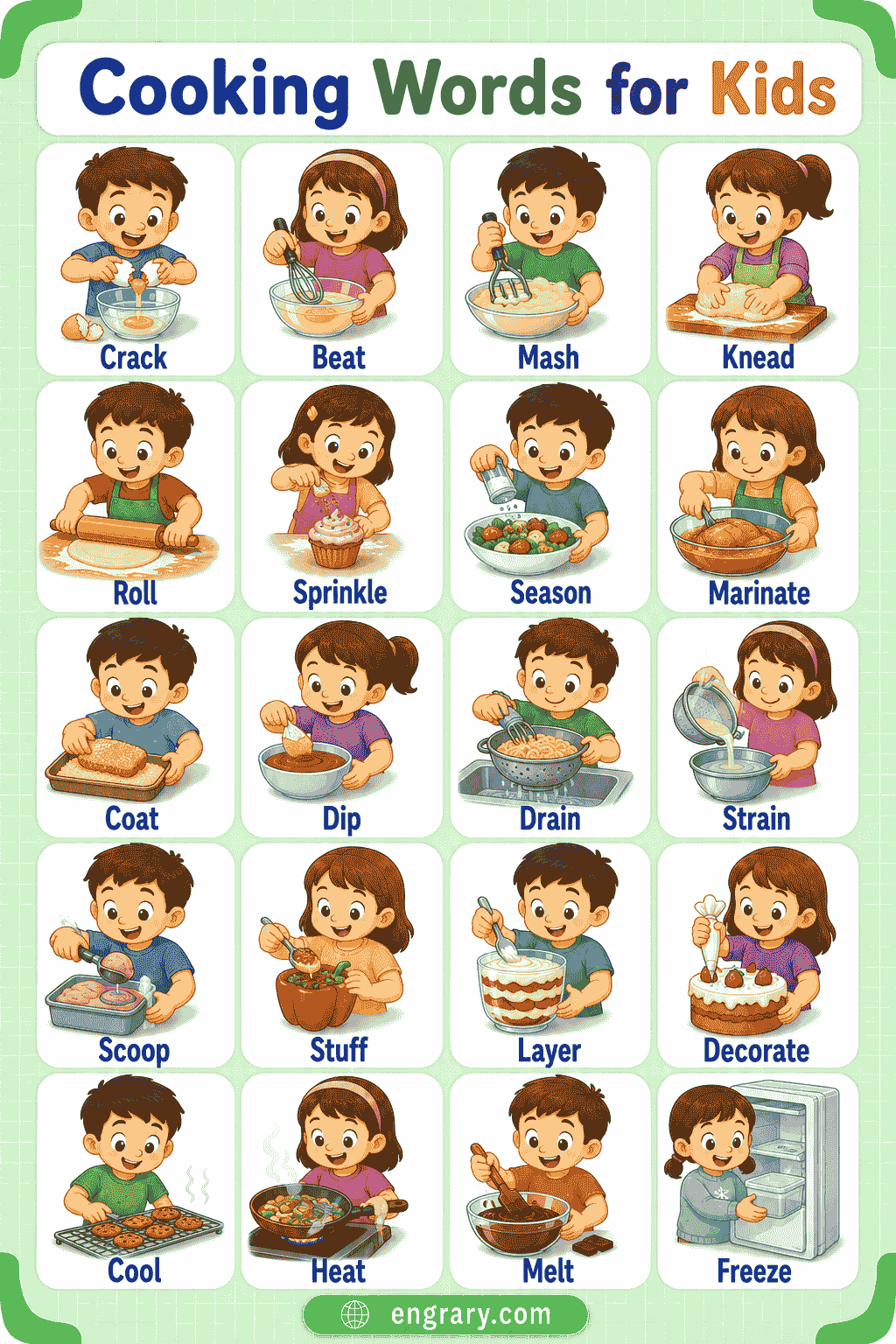
Baking words are useful because many actions are visual and hands-on.
- Measure — check how much.
- Pour — move liquid out.
- Mix — put things together.
- Stir — move around with a spoon.
- Whisk — mix quickly.
- Beat — mix with fast movement.
- Knead — press and fold dough.
- Roll — flatten dough.
- Sprinkle — drop small bits on top.
- Decorate — make food look nice.
- Bake — cook in an oven.
- Cool — let hot food become safe.
- Cut out — make shapes from dough.
- Fill — put something inside.
- Top — add a topping.
Serving, Tasting, and Eating Words
Serving words help children talk politely during meals, snack time, and pretend play.
- Serve — give food to someone.
- Share — give some to others.
- Taste — try a little food.
- Eat — chew and swallow food.
- Drink — take liquid into the mouth.
- Scoop — lift food with a spoon.
- Pour — move liquid into a cup or bowl.
- Spread — put butter, jam, or sauce on food.
- Pass — give something to another person.
- Carry — move something carefully.
- Choose — pick one thing.
- Offer — give or ask politely.
- Finish — eat or use all of it.
- Save — keep for later.
Cleaning Words After Cooking
Cooking often ends with cleaning, so cleanup words are an important part of kitchen vocabulary.
- Wash — clean with water.
- Rinse — wash with clean water.
- Wipe — clean with a cloth.
- Dry — remove water.
- Scrub — rub hard to clean.
- Sweep — clean the floor with a broom.
- Mop — clean the floor with water.
- Throw away — put in the trash.
- Recycle — put in the recycling bin.
- Store — put away for later.
- Close — shut something.
- Put away — return to the right place.
- Clean up — make the area neat.
- Clear — remove things from a place.
Hot, Sharp, and Safe Cooking Words
Safe cooking words help children understand careful kitchen language.
- Hot — very warm.
- Cold — not warm.
- Sharp — able to cut.
- Careful — paying attention.
- Safe — not dangerous.
- Steam — hot mist.
- Spill — liquid that falls out.
- Slippery — easy to slide on.
- Breakable — can break.
- Heavy — hard to lift.
- Clean hands — hands washed before food.
- Adult help — help from a grown-up.
- Oven mitt — glove for hot things.
- Cool down — become safer after being hot.
Cooking Words for Preschool Kids
Preschool cooking words should be short, familiar, and easy to act out.
- Mix
- Stir
- Pour
- Wash
- Eat
- Drink
- Help
- Open
- Close
- Put
- Pass
- Taste
- Clean
- Dry
- Hot
- Cold
- Cup
- Spoon
- Bowl
- Plate
Cooking Words for Kindergarten Kids
Kindergarten learners can handle longer cooking words, simple meanings, and basic sorting.
- Bake
- Boil
- Toast
- Serve
- Slice
- Chop
- Peel
- Grate
- Measure
- Sprinkle
- Whisk
- Knead
- Simmer
- Steam
- Roast
- Drain
- Spread
- Scoop
- Recipe
- Ingredients

Chop, Slice, and Dice: What Is the Difference?
Some cooking words look similar, but they do not mean exactly the same thing.
| Cooking Word | Meaning for Kids | Easy Example |
|---|---|---|
| Chop | Cut into small pieces. | Chop carrots into small chunks. |
| Slice | Cut into thin pieces. | Slice a banana into round pieces. |
| Dice | Cut into tiny cubes. | Dice potatoes into small cubes. |
Cooking Words Pronunciation Guide
Pronunciation support is helpful for harder cooking words.
- 🔊 Whisk — /wɪsk/
- 🔊 Knead — /niːd/
- 🔊 Grate — /ɡreɪt/
- 🔊 Measure — /ˈmeʒ.ər/
- 🔊 Sprinkle — /ˈsprɪŋ.kəl/
- 🔊 Simmer — /ˈsɪm.ər/
- 🔊 Ingredients — /ɪnˈɡriː.di.ənts/
- 🔊 Recipe — /ˈres.ə.pi/
- 🔊 Utensil — /juːˈten.səl/
- 🔊 Sauté — /sɔːˈteɪ/
Sauté — cook quickly in a pan.
Simple Cooking Sentences for Kids
Sentence practice helps children use cooking vocabulary in real speech.
- I mix the batter.
- I stir the soup.
- I pour milk into the bowl.
- I wash my hands.
- I slice the banana.
- I peel the apple.
- I sprinkle cheese on top.
- I bake bread in the oven.
- I toast the bread.
- I serve food on a plate.
- I wipe the table.
- I dry the cup.
- The pan is hot.
- The knife is sharp.
- I ask for adult help.
Sentence frames:
- I can _____ the food.
- We _____ the vegetables.
- Please _____ the milk.
- The _____ is hot.
- I need help to _____.
Cooking Words Quiz for Kids
Try this short quiz after reading the cooking words.
1. Which word means “move food around with a spoon”?
A. Stir
B. Sleep
C. Freeze
Answer: A. Stir
2. Which word means “cook in an oven”?
A. Pour
B. Bake
C. Wash
Answer: B. Bake
3. Which word needs adult help?
A. Chop
B. Drink
C. Smile
Answer: A. Chop
FAQs
Kids should learn easy cooking words first, such as mix, stir, pour, wash, eat, drink, serve, and clean. These words are common in daily kitchen routines.
Good preschool cooking words include mix, stir, pour, wash, taste, help, open, close, clean, and dry. These words are short and easy to act out.
Kindergarten children can learn words like bake, boil, slice, chop, peel, grate, measure, sprinkle, whisk, and knead. These words are useful for reading, sorting, and simple sentence practice.
Use picture cards that show clear actions, such as stir, pour, mix, slice, wash, and bake. Children can match the picture to the word, say the word aloud, and act out the action safely.
Words such as chop, slice, grate, fry, boil, and bake often need adult help because they may involve sharp tools, hot pans, hot water, or ovens.
You May Also Like