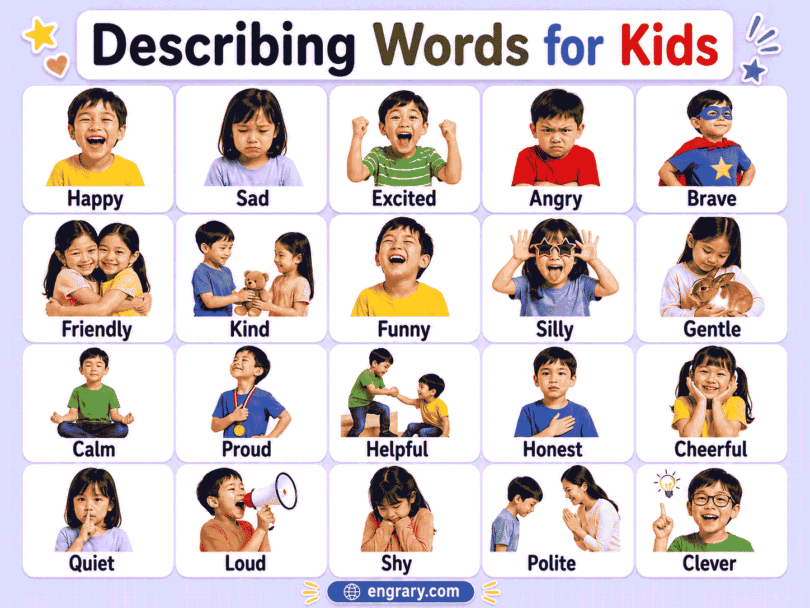
Describing words for kids are words that tell more about a person, place, animal, thing, or feeling. They help children explain what something looks like, feels like, sounds like, tastes like, or seems like. Words like big, small, red, happy, soft, loud, sweet, clean, kind, funny, bright, cold, tall, short, round, and smooth are describing words.
Children use describing words when they talk about pictures, write sentences, tell stories, answer questions, and explain the world around them. These words make writing more colorful and help readers imagine details clearly.

What Are Describing Words?
Describing words tell what someone or something is like. They add more detail to naming words such as boy, girl, dog, school, apple, chair, flower, house, car, teacher, book, and tree.
Examples:
- big dog
- red apple
- happy child
- soft pillow
- loud bell
- sweet mango
- tall tree
- clean room
- cold water
- round ball
In the phrase red apple, the word apple is a naming word, and the word red is a describing word because it tells what the apple is like.
More examples:
- The small cat sleeps.
- The blue bag is new.
- The kind teacher smiles.
- The hot soup is ready.
- The bright sun shines.
Describing Words as Adjectives
Describing words are called adjectives in grammar. For young learners, “describing words” is often easier to understand because it clearly shows what these words do.
Examples:
- small cat
- green leaf
- kind teacher
- cold water
- round ball
- quiet room
- sweet cake
- funny story
- clean shirt
- heavy bag
The describing word gives more information about the naming word. In green leaf, the word green describes the leaf. In kind teacher, the word kind describes the teacher.
Why Describing Words Are Important for Kids
Describing words help kids make sentences clearer and more interesting. Without describing words, a sentence can sound plain.
Plain sentence:
- I see a bird.
Better sentence:
- I see a small blue bird.
Another plain sentence:
- The dog runs.
Better sentence:
- The big brown dog runs.
Describing words also help children speak and write with more detail. They can describe colors, sizes, shapes, feelings, sounds, tastes, textures, places, animals, and people.
Examples:
- The little cat sleeps.
- My kind friend helps me.
- The yellow flower is pretty.
- I ate a sweet apple.
- The quiet room is clean.
- The loud bell rings.
- The soft blanket is warm.
- A happy child laughs.
- The round clock is on the wall.
- The fresh bread smells good.
Describing Words vs Naming Words
Describing words and naming words work together, but they do different jobs. Naming words name people, places, animals, things, or ideas. Describing words tell more about them.
| Term | Meaning | Examples |
|---|---|---|
| Naming Words | Words that name people, places, animals, or things | dog, school, apple, teacher |
| Describing Words | Words that tell what naming words are like | big, red, sweet, kind |
| Main Job | Name who or what | cat, book, flower |
| Main Job | Add detail | small cat, old book, red flower |
| Simple Sentence | The dog runs. | The big dog runs. |
Examples:
- Dog is a naming word.
- Big describes the dog.
- Apple is a naming word.
- Red describes the apple.
- Teacher is a naming word.
- Kind describes the teacher.
- Room is a naming word.
- Clean describes the room.
- Story is a naming word.
- Funny describes the story.
- Water is a naming word.
- Cold describes the water.
Describing Words vs Action Words
Describing words and action words are different. Describing words tell what something is like. Action words tell what someone or something does.
| Term | Meaning | Examples |
|---|---|---|
| Describing Words | Tell what someone or something is like | happy, small, blue |
| Action Words | Tell what someone or something does | run, jump, read |
| Main Job | Add detail | a happy child |
| Main Job | Show action | The child runs. |
| Simple Example | The dog is small. | The dog runs. |
Examples:
- The happy girl sings.
- The girl sings.
- The blue car stops.
- The car stops.
- The soft pillow is on the bed.
- The baby sleeps.
- The fast horse runs.
- The horse runs.
- The loud bell rings.
- The bell rings.
Common Describing Words Kids Use Every Day
Common describing words are words children hear and use often at home, in school, during play, and while reading. These words are useful for speaking, sentence writing, picture description, and storytelling.
- big
- small
- tall
- short
- long
- tiny
- huge
- red
- blue
- green
- yellow
- black
- white
- pink
- purple
- orange
- happy
- sad
- angry
- excited
- tired
- scared
- calm
- soft
- hard
- hot
- cold
- warm
- cool
- sweet
- sour
- salty
- spicy
- clean
- dirty
- neat
- messy
- fast
- slow
- loud
- quiet
- old
- new
- young
- funny
- kind
- brave
- bright
- dark
- round
- square
- heavy
- light
- smooth
- rough
- shiny
- dull
Describing Words with Pictures
Describing words tell us more about a person, animal, place, object, or feeling. Learning common describing words with pictures helps children and English learners understand adjectives, build stronger sentences, and describe things more clearly.
Big
Big describes something that has a large size. An elephant, bus, or building can be big.
Small
Small describes something that has a little size. A button, coin, or mouse can be small.
Tall
Tall describes someone or something with greater height. A giraffe, tree, or building can be tall.
Short
Short describes someone or something with less height or length. A short pencil or small plant can show this meaning clearly.
Fast
Fast describes something that moves quickly. A racing car, cheetah, or train can be fast.
Slow
Slow describes something that moves at a low speed. A tortoise or snail can be slow.
Happy
Happy describes a person who feels pleased or joyful. A smile often helps show this feeling.
Sad
Sad describes a person who feels unhappy or upset. Tears or a downturned face can show sadness.
Hot
Hot describes something with a high temperature. Soup, tea, or sunlight can feel hot.
Cold
Cold describes something with a low temperature. Ice, snow, or chilled water can feel cold.
Clean
Clean describes something free from dirt or mess. Fresh clothes, washed hands, or a tidy room can look clean.
Dirty
Dirty describes something covered with dirt, dust, mud, or stains. Muddy shoes or an unwashed surface can look dirty.
Soft
Soft describes something that feels smooth, gentle, or easy to press. Cotton, pillows, and fur can feel soft.
Hard
Hard describes something firm and difficult to press, bend, or break. Stone, metal, and wood can feel hard.
Heavy
Heavy describes something that has a lot of weight. A large suitcase or rock can be heavy.
Light
Light describes something that has little weight and is easy to lift. A feather or empty paper bag can be light.
Long
Long describes something with greater length from one end to the other. A rope, road, or snake can be long.
Round
Round describes something shaped like a circle or ball. A coin, plate, or orange can be round.
Bright
Bright describes something that gives off or reflects a lot of light or has vivid color. The sun, a lamp, or a yellow flower can look bright.
Dark
Dark describes something with little light or a deep color. A night sky, shadow, or dark room can show this meaning clearly.
Describing Words and Meanings for Kids
Short meanings help children understand describing words and use them correctly in sentences.
- Big — large in size
- Small — little in size
- Tall — high from bottom to top
- Short — not tall or not long
- Long — having a lot of length
- Tiny — very small
- Huge — very big
- Red — the color of a tomato or apple
- Blue — the color of the sky or sea
- Green — the color of grass or leaves
- Round — shaped like a circle or ball
- Square — having four equal sides
- Happy — feeling good or pleased
- Sad — feeling unhappy
- Angry — feeling mad
- Excited — feeling very happy or eager
- Hot — very warm
- Cold — not warm
- Soft — easy to press or touch gently
- Hard — firm and not soft
- Clean — not dirty
- Dirty — not clean
- Fast — moving quickly
- Slow — not fast
- Bright — full of light
- Dark — having little or no light
- Quiet — not loud
- Loud — making a strong sound
- Sweet — tasting like sugar
- Sour — having a sharp taste
Easy Describing Words for Beginners
Easy describing words are simple, visual, and useful for early learners. These words work well for preschool, kindergarten, first grade, ESL lessons, flashcards, and worksheets.
- big
- small
- tall
- short
- red
- blue
- green
- yellow
- happy
- sad
- hot
- cold
- warm
- cool
- soft
- hard
- clean
- dirty
- fast
- slow
- loud
- quiet
- old
- new
- good
- bad
- round
- square
- sweet
- sour
- heavy
- light
- full
- empty
- wet
- dry
- smooth
- rough
- bright
- dark
Beginner phrases:
- big dog
- small cat
- red ball
- blue bag
- happy boy
- sad girl
- hot soup
- cold water
- soft toy
- hard rock
Describing Words by Age and Grade Level
Describing words by age and grade level help parents and teachers choose words that match a child’s learning stage.
Preschool Describing Words
Preschool describing words should be simple, visual, and easy to show with pictures or real objects.
- big
- small
- red
- blue
- yellow
- hot
- cold
- happy
- sad
- soft
- hard
- clean
- dirty
- loud
- quiet
- fast
- slow
Easy preschool examples:
- big ball
- red apple
- happy baby
- soft toy
- loud bell
Kindergarten Describing Words
Kindergarten describing words can include colors, sizes, shapes, feelings, sounds, and simple opposite pairs.
- tall
- short
- long
- tiny
- round
- square
- loud
- quiet
- fast
- slow
- full
- empty
- old
- new
- sweet
- sour
- wet
- dry
- light
- heavy
Easy kindergarten examples:
- tall tree
- round clock
- full cup
- sweet cake
- heavy bag
First Grade Describing Words
First grade describing words can support sentence writing, picture description, reading practice, and story writing.
- brave
- kind
- helpful
- careful
- bright
- dark
- smooth
- rough
- shiny
- messy
- excited
- tired
- friendly
- honest
- colorful
- peaceful
- noisy
- gentle
- fresh
- cloudy
Easy first grade examples:
- brave child
- helpful student
- shiny coin
- colorful kite
- peaceful park

Describing Words by Type and Use
Grouped describing words help children learn words by meaning and use. These categories are helpful for grammar lessons, picture description, sentence writing, word walls, and worksheets.
Color Describing Words
Color describing words tell what color something is.
- red
- blue
- green
- yellow
- black
- white
- pink
- purple
- orange
- brown
- gray
- golden
- silver
- colorful
- light
- dark
Examples:
- red apple
- blue sky
- green leaf
- yellow sun
- colorful kite
Size Describing Words
Size describing words tell how big or small something is.
- big
- small
- tall
- short
- long
- tiny
- huge
- wide
- narrow
- thick
- thin
- deep
- shallow
- giant
- little
- mini
Examples:
- big house
- small bird
- tall tree
- long rope
- tiny ant
Shape Describing Words
Shape describing words tell what form or outline something has.
- round
- square
- flat
- curved
- straight
- oval
- pointed
- wide
- thin
- deep
- triangle-shaped
- heart-shaped
- star-shaped
- box-shaped
- circle-shaped
- smooth-edged
Examples:
- round ball
- square box
- flat plate
- curved road
- oval egg
Feeling Describing Words
Feeling describing words tell how someone feels.
- happy
- sad
- angry
- excited
- scared
- tired
- calm
- proud
- shy
- worried
- surprised
- thankful
- lonely
- cheerful
- nervous
- relaxed
Examples:
- happy child
- sad puppy
- excited student
- scared kitten
- tired baby
Taste Describing Words
Taste describing words tell how food or drink tastes.
- sweet
- sour
- salty
- bitter
- spicy
- fresh
- juicy
- tasty
- hot
- cold
- yummy
- creamy
- crunchy
- mild
- rich
- delicious
Examples:
- sweet mango
- sour lemon
- salty chips
- spicy soup
- juicy orange
Texture Describing Words
Texture describing words tell how something feels when touched.
- soft
- hard
- smooth
- rough
- sticky
- dry
- wet
- fluffy
- sharp
- bumpy
- silky
- slippery
- fuzzy
- scratchy
- creamy
- crunchy
Examples:
- soft blanket
- hard rock
- smooth glass
- rough wall
- fluffy pillow
Sound Describing Words
Sound describing words tell how something sounds.
- loud
- quiet
- noisy
- silent
- soft
- high
- low
- squeaky
- gentle
- booming
- sharp
- clear
- musical
- rough
- buzzing
- whispering
Examples:
- loud drum
- quiet room
- noisy street
- soft music
- squeaky door
Appearance Describing Words
Appearance describing words tell how someone or something looks.
- clean
- dirty
- shiny
- bright
- dark
- colorful
- pretty
- cute
- messy
- neat
- beautiful
- plain
- fancy
- fresh
- tidy
- dusty
Examples:
- clean shirt
- shiny coin
- bright light
- messy room
- pretty flower
Positive and Personality Describing Words
Positive and personality describing words tell what a person is like in a kind or helpful way.
- kind
- brave
- honest
- friendly
- helpful
- cheerful
- polite
- gentle
- creative
- careful
- calm
- funny
- smart
- patient
- thankful
- hardworking
Examples:
- kind friend
- brave girl
- honest boy
- helpful teacher
- cheerful child
Opposite Describing Words
Opposite describing words help kids compare two different meanings.
- big — small
- tall — short
- hot — cold
- fast — slow
- clean — dirty
- full — empty
- old — new
- soft — hard
- happy — sad
- loud — quiet
- wet — dry
- heavy — light
- bright — dark
- smooth — rough
- sweet — sour
- thick — thin
Examples:
- a big dog and a small cat
- hot soup and cold water
- a clean shirt and dirty shoes
- a full cup and an empty bowl
- a loud bell and a quiet room
Describing Words for People, Animals, Places, and Things
Describing words become easier when children use them with real naming words. These groups help kids describe people, animals, places, and things in simple sentences.
Describing Words for People
These words can describe how a person looks, feels, or behaves.
- kind
- brave
- happy
- tall
- short
- friendly
- helpful
- funny
- polite
- careful
- cheerful
- smart
- gentle
- honest
- shy
- calm
Examples:
- a kind teacher
- a happy child
- a brave girl
- a friendly friend
- a polite student
- a careful driver
Describing Words for Animals
These words can describe how animals look, move, sound, or act.
- small
- big
- fast
- slow
- furry
- cute
- wild
- quiet
- loud
- playful
- gentle
- hungry
- sleepy
- spotted
- fluffy
- strong
Examples:
- a small cat
- a fast horse
- a furry rabbit
- a wild tiger
- a fluffy puppy
- a strong lion
Describing Words for Places
These words can describe how a place looks, sounds, or feels.
- quiet
- noisy
- clean
- crowded
- beautiful
- sunny
- dark
- bright
- peaceful
- busy
- safe
- warm
- cool
- wide
- empty
- colorful
Examples:
- a quiet library
- a busy market
- a sunny park
- a clean classroom
- a peaceful garden
- a crowded street
Describing Words for Things
These words can describe objects, toys, tools, food, clothes, and classroom items.
- round
- square
- soft
- hard
- shiny
- old
- new
- colorful
- heavy
- light
- broken
- smooth
- rough
- tiny
- large
- useful
Examples:
- a round ball
- a soft pillow
- a shiny coin
- a heavy bag
- a new pencil
- a smooth table
Describing Word Examples for Kids
Describing word examples can be grouped by type so children can see how different words work.
- Color describing words: red, blue, green, yellow, purple, orange, black, white
- Size describing words: big, small, tall, short, tiny, huge, wide, narrow
- Shape describing words: round, square, flat, curved, oval, pointed, straight
- Feeling describing words: happy, sad, excited, scared, tired, calm, proud
- Taste describing words: sweet, sour, salty, spicy, fresh, juicy, tasty
- Texture describing words: soft, hard, smooth, rough, sticky, fluffy, slippery
- Sound describing words: loud, quiet, noisy, silent, squeaky, gentle, booming
- Appearance describing words: clean, shiny, bright, messy, colorful, pretty, neat
- Positive describing words: kind, brave, honest, friendly, helpful, polite, cheerful
- Opposite describing words: hot/cold, fast/slow, full/empty, wet/dry, heavy/light
More mixed examples:
- bright sun
- cold drink
- funny story
- soft bed
- loud horn
- fresh fruit
- smooth stone
- careful child
- clean classroom
- colorful picture
Describing Words with Sentences
Sentence examples help kids understand how describing words work in real reading and writing.
- Big — The big dog runs fast.
- Small — I see a small bird.
- Red — She has a red bag.
- Blue — The blue car is new.
- Green — The green leaf fell down.
- Happy — The happy child smiles.
- Sad — The sad puppy looks tired.
- Soft — The soft pillow is on the bed.
- Hard — The hard rock is heavy.
- Hot — The hot soup is on the table.
- Cold — I drink cold water.
- Round — The round ball rolls away.
- Square — The square box is empty.
- Fast — The fast horse runs.
- Slow — The slow turtle walks.
- Clean — The clean room smells fresh.
- Dirty — The dirty shoes are outside.
- Kind — My kind friend helps me.
- Loud — The loud bell rings.
- Quiet — The quiet library is peaceful.
- Bright — The bright sun shines.
- Smooth — The smooth stone feels nice.
- Sweet — The sweet cake tastes good.
- Funny — The funny story made us laugh.
Simple Sentence Patterns with Describing Words
Simple sentence patterns help children use describing words correctly. Describing words often come before naming words, but they can also come after words like is, are, was, and look.
Patterns:
- The + describing word + naming word
- A + describing word + naming word
- My + describing word + naming word
- This + naming word + is + describing word
- The + naming word + looks + describing word
- I see a + describing word + naming word
- It is + describing word
- They are + describing word
Examples:
- The red apple.
- A small cat.
- My blue bag.
- This flower is pretty.
- The dog looks happy.
- The soup is hot.
- A tall boy runs.
- My kind teacher smiles.
- I see a bright star.
- It is cold.
- They are excited.
Natural describing word phrases:
- a small red ball
- a big brown dog
- a soft blue blanket
- a pretty yellow flower
- a clean white shirt
- a tiny green frog
- a loud school bell
- a sweet red apple
- a shiny silver coin
- a quiet reading room
Longer examples:
- The small brown dog sleeps.
- A bright yellow sun shines.
- My soft blue blanket is warm.
- This sweet mango is fresh.
- The happy little girl sings.
- A noisy old bus stopped outside.
- The clean white plate is on the table.
- The colorful kite flew high in the sky.
Describing Words Chart

A describing words chart helps children review word groups, examples, and uses in one place.
| Group | Example Describing Words | Best Use |
|---|---|---|
| Color Describing Words | red, blue, green | Describing color |
| Size Describing Words | big, small, tall | Describing size |
| Shape Describing Words | round, square, flat | Describing shape |
| Feeling Describing Words | happy, sad, excited | Describing emotions |
| Taste Describing Words | sweet, sour, salty | Describing food |
| Texture Describing Words | soft, hard, rough | Describing touch |
| Sound Describing Words | loud, quiet, noisy | Describing sounds |
| Appearance Describing Words | shiny, clean, messy | Describing looks |
| Positive Describing Words | kind, brave, honest | Describing people |
| Opposite Describing Words | hot/cold, fast/slow | Comparing words |
Printable Describing Words List for Kids
This printable describing words list can be used for flashcards, word walls, posters, worksheets, grammar lessons, and sentence writing.
- big
- small
- tall
- short
- long
- tiny
- huge
- little
- wide
- narrow
- red
- blue
- green
- yellow
- black
- white
- pink
- purple
- orange
- brown
- round
- square
- flat
- curved
- straight
- oval
- happy
- sad
- angry
- excited
- scared
- tired
- calm
- proud
- soft
- hard
- smooth
- rough
- sticky
- dry
- wet
- fluffy
- loud
- quiet
- noisy
- silent
- squeaky
- gentle
- sweet
- sour
- salty
- spicy
- fresh
- juicy
- clean
- dirty
- shiny
- bright
- dark
- colorful
- neat
- messy
- kind
- brave
- honest
- helpful
- friendly
- polite
- funny
- careful
- heavy
- light
- full
- empty
- old
- new
- warm
- cool
Describing Word Games and Activities
Games help children learn describing words through pictures, speaking, reading, sorting, and play.
- Describing word hunt — Find describing words in a story or classroom.
- Describe the picture — Look at a picture and name describing words.
- Word match — Match each describing word with the correct naming word.
- Opposite word game — Match big/small, hot/cold, and fast/slow.
- Color word game — Describe objects by color.
- Mystery object — Describe an object and let others guess it.
- Feeling word charades — Act out words like happy, tired, or scared.
- Word sorting — Sort words by color, size, feeling, sound, or texture.
- Sentence race — Choose a describing word and make a sentence.
- Picture cards — Pick a card and describe it with two describing words.
- Describing word bingo — Cover a word when it is called.
- Classroom description — Describe objects around the room.
- Taste test words — Describe food with words like sweet, sour, salty, or fresh.
- Texture bag game — Touch an item and describe it as soft, hard, smooth, or rough.
- Sound walk — Listen around the room and name loud, quiet, soft, or noisy sounds.
Describing Word Worksheets and Exercises for Kids
Describing word worksheets and exercises help kids practice describing words in a clear and simple way.
- Circle the describing word in each sentence.
- Match describing words with pictures.
- Fill in the blank with a describing word.
- Choose the best describing word for a naming word.
- Sort describing words by type.
- Write a sentence using a describing word.
- Match opposite describing words.
- Describe a picture with three words.
- Add a describing word before each naming word.
- Underline describing words in a short story.
- Write three color describing words.
- Write three feeling describing words.
- Write three words to describe a person.
- Write three words to describe an animal.
- Write three words to describe food.
- Write three words to describe a place.
- Choose a describing word from a word bank.
- Draw a picture for a describing word.
- Rewrite a plain sentence with one describing word.
- Sort describing words and action words.
Example exercises:
- The big / runs dog barks.
- I see a red / jump apple.
- The pillow is soft / pencil.
- The soup is hot / chair.
- My friend is kind / table.
- The bell is loud / sleep.
- The room is clean / walk.
- The mango is sweet / book.
Common Mistakes When Teaching Describing Words
Avoid these common mistakes when teaching describing words:
- Teaching describing words only as a memorized list
- Forgetting to connect describing words with naming words
- Using advanced grammar terms too early
- Giving too many word types in one lesson
- Skipping picture description practice
- Not using describing words in sentences
- Confusing describing words with naming words
- Confusing describing words with action words
- Using difficult abstract words before visual words
- Not reviewing opposite describing words
- Making worksheets too hard for beginners
- Giving long rules instead of simple examples
- Teaching too many similar words at once
- Using words children cannot see, touch, hear, taste, or understand
- Skipping speaking practice before writing practice
How to Teach Describing Words to Kids
Start with describing words children can see, touch, taste, hear, or feel, such as big, small, red, blue, happy, sad, soft, hard, loud, quiet, hot, cold, clean, dirty, sweet, sour, smooth, and rough. Show a picture or real object, say the describing word, connect it to a naming word, and use it in a short sentence. For example, show an apple, say red, then write This is a red apple.
Teach describing words through pictures, real objects, sorting games, speaking practice, reading, and sentence writing. Begin with color, size, shape, feeling, taste, texture, sound, and appearance words, then introduce describing words for people, animals, places, and things. Use flashcards, posters, word walls, worksheets, picture books, and short stories so children see describing words in different ways.
FAQs
Describing words for kids are words that tell more about people, places, animals, things, or feelings. Examples include big, small, red, happy, soft, loud, sweet, clean, kind, funny, bright, cold, and round.
Yes, describing words are called adjectives in grammar. For kids, “describing words” is an easy way to understand that these words describe naming words.
Easy describing word examples for kids include big, small, tall, short, red, blue, happy, sad, hot, cold, soft, hard, clean, dirty, fast, slow, loud, quiet, sweet, and round.
Teach describing words with pictures, real objects, flashcards, sorting games, simple sentences, and worksheets. Start with visual words like color, size, shape, feeling, taste, texture, sound, and appearance words.
Describing words with sentences include big in “The big dog runs,” red in “I see a red apple,” happy in “The happy child smiles,” soft in “The soft pillow is on the bed,” and loud in “The loud bell rings.”
You May Also Like