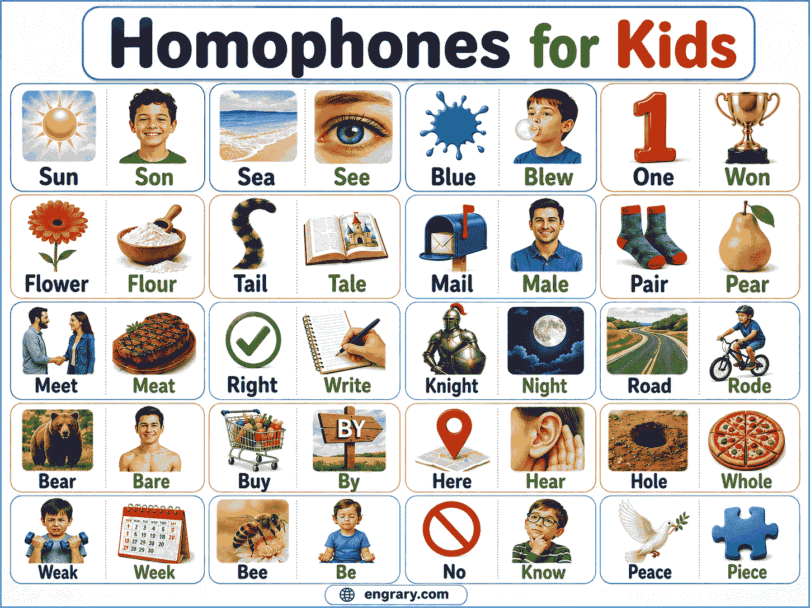
Homophones for kids are words that sound the same but have different meanings. Some homophones also have different spellings, such as see and sea, while others can be tricky groups, such as to, too, and two.
Children need homophones for reading, spelling, writing, and sentence meaning. This guide explains homophones with simple examples, charts, meanings, sentences, confusing pairs, grade-level lists, matching practice, fill-in-the-blank tasks, games, worksheets, and teaching tips.
What Are Homophones?
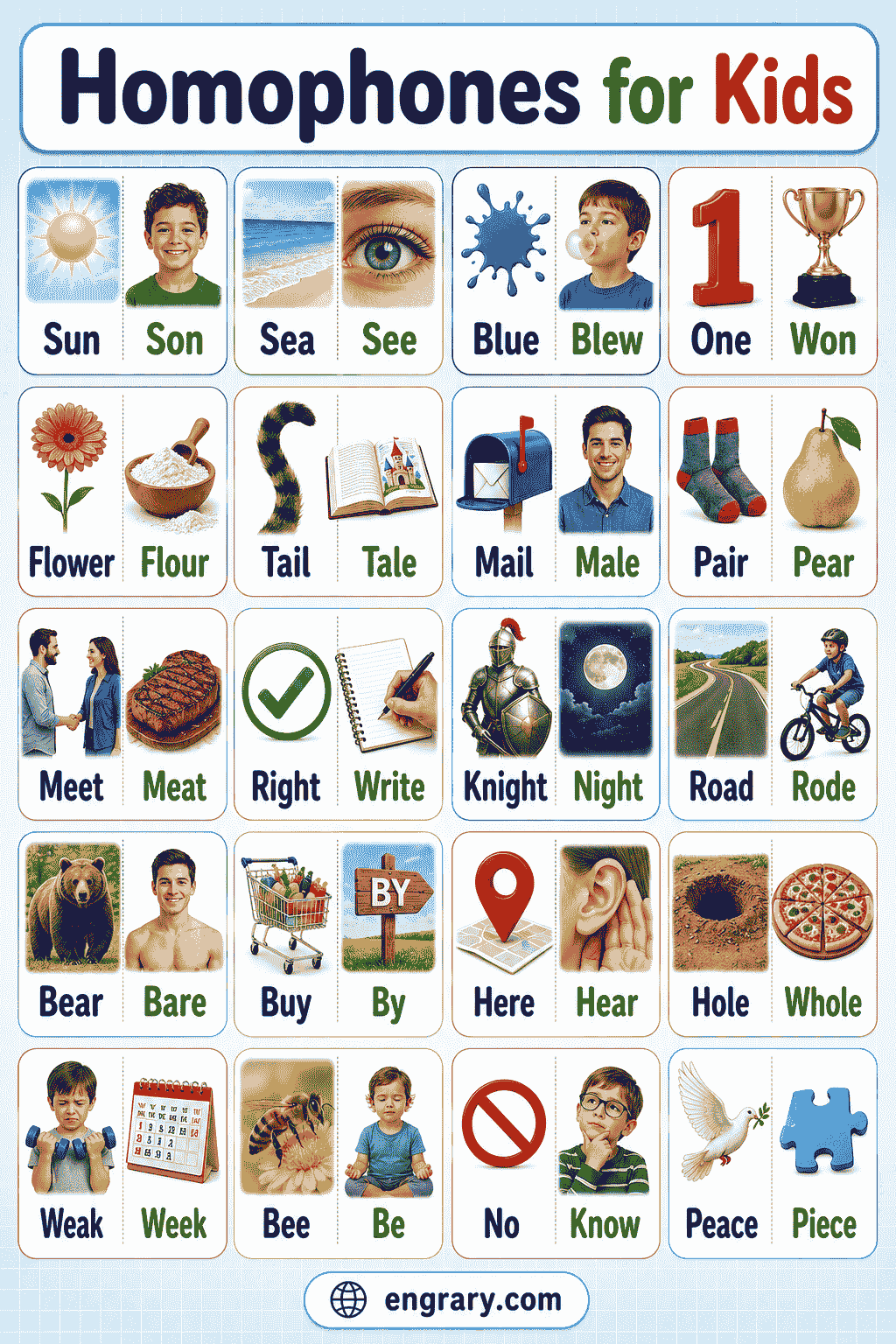
Homophones are words that sound the same but have different meanings. Many homophones also have different spellings.
- see / sea
- hear / here
- one / won
- ate / eight
- be / bee
- I / eye
- no / know
- new / knew
- sun / son
- to / too / two
The words see and sea sound the same, but they do not mean the same thing. See means to look with your eyes. Sea means a large body of salt water.
Simple Homophone Examples
Simple homophones are easy pairs or groups that children can hear clearly.
- see / sea
- hear / here
- one / won
- ate / eight
- be / bee
- I / eye
- no / know
- new / knew
- sun / son
- blue / blew
- red / read
- meet / meat
- right / write
- flower / flour
- pair / pear
- tail / tale
- road / rode
- mail / male
- by / buy / bye
- to / too / two
Why Homophones Are Important for Kids
Homophones help kids understand that words can sound the same but mean different things. This improves spelling, reading, and writing accuracy.
- They build vocabulary.
- They improve spelling skills.
- They help kids use context clues.
- They support sentence understanding.
- They reduce common writing mistakes.
- They help children choose the correct word.
Homophones vs Homonyms
| Topic | Homophones | Homonyms |
|---|---|---|
| Meaning | Words that sound the same but have different meanings | Words that may share spelling or sound but have different meanings |
| Example | see / sea | bat = animal, bat = sports tool |
| Sound | Same sound | May have same sound |
| Spelling | Often different | May be same or different |
| Kid-Friendly Tip | Same sound, different meaning | Same word or sound, different meaning |
Homophones vs Homographs
| Topic | Homophones | Homographs |
|---|---|---|
| Meaning | Words that sound the same | Words spelled the same |
| Example | hear / here | tear = rip, tear = drop from the eye |
| Sound | Same sound | May sound same or different |
| Spelling | Often different | Same spelling |
| Kid-Friendly Tip | Listen to the sound | Look at the spelling |
Common Words Kids Should Know
These common homophones are useful for spelling, reading, writing, ESL learning, and classroom practice.
- to / too / two
- there / their / they’re
- your / you’re
- its / it’s
- see / sea
- hear / here
- one / won
- ate / eight
- be / bee
- I / eye
- no / know
- new / knew
- sun / son
- blue / blew
- red / read
- meet / meat
- right / write
- flower / flour
- pair / pear
- tail / tale
- road / rode
- mail / male
- by / buy / bye
- where / wear
- which / witch
- our / hour
- peace / piece
- weather / whether
- deer / dear
- hair / hare
- night / knight
- plane / plain
- wood / would
Homophone Chart

| Homophones | Meaning 1 | Meaning 2 | Simple Example |
|---|---|---|---|
| see / sea | to look | ocean water | I can see the sea. |
| hear / here | to listen | in this place | I hear music here. |
| one / won | number 1 | past tense of win | One team won. |
| ate / eight | past tense of eat | number 8 | I ate eight grapes. |
| be / bee | to exist or become | honey-making insect | Be kind to the bee. |
| I / eye | the person speaking | body part used to see | I have one eye closed. |
| no / know | opposite of yes | to understand | No, I do not know. |
| sun / son | star in the sky | male child | My son saw the sun. |
| blue / blew | a color | past tense of blow | The wind blew the blue kite. |
| right / write | correct or direction | to form words | Write the right answer. |
Homophone Pairs and Groups
Some homophones come in pairs, while others come in groups of three.
- Pair: see / sea
- Pair: hear / here
- Pair: one / won
- Pair: ate / eight
- Pair: be / bee
- Pair: I / eye
- Pair: sun / son
- Pair: flower / flour
- Group: to / too / two
- Group: there / their / they’re
- Group: by / buy / bye
Homophone groups are often harder because children must choose from more than two words. Sentence meaning helps them pick the correct spelling.
Easy Words for Beginners
Beginner homophones should be familiar, simple, and easy to show with pictures or sentences.
- see / sea
- be / bee
- I / eye
- sun / son
- one / won
- to / two
- no / know
- ate / eight
- blue / blew
- red / read
- hear / here
- new / knew
- right / write
- meet / meat
- pair / pear
- tail / tale
- mail / male
- road / rode
- flower / flour
- night / knight
Picture-Friendly Homophones
Picture-friendly homophones are useful for posters, flashcards, worksheets, and matching games.
- see / sea
- I / eye
- be / bee
- sun / son
- flower / flour
- deer / dear
- hair / hare
- night / knight
- mail / male
- pair / pear
- plane / plain
- road / rode
- tail / tale
- blue / blew
- wood / would
- stair / stare
- hole / whole
- board / bored
- sale / sail
- week / weak

Homophone Meanings for Kids
Short meanings help children understand which word fits the sentence.
- to — shows direction
- too — means also or more than needed
- two — the number 2
- see — to look with your eyes
- sea — a large body of salt water
- hear — to listen with your ears
- here — in this place
- one — the number 1
- won — past tense of win
- ate — past tense of eat
- eight — the number 8
- be — to exist or become
- bee — an insect that makes honey
- I — the person speaking
- eye — the body part used for seeing
- no — opposite of yes
- know — to understand something
- sun — the star that gives us light
- son — a male child
- right — correct or the opposite of left
- write — to make letters or words
Simple Sentences with Homophones
Simple sentences show how meaning changes with each homophone.
- I want to go home.
- I want one too.
- I have two pencils.
- I can see the bird.
- The sea is blue.
- I can hear music.
- Put the book here.
- I ate lunch.
- She is eight years old.
- Please be kind.
- The bee is on the flower.
- I have one pencil.
- Our team won the game.
- The sun is bright.
- Her son is kind.
- I like the blue sky.
- The wind blew hard.
- I will write my name.
- That is the right answer.
- The pear is sweet.
- I have a pair of socks.
Commonly Confused Homophones
Some homophones cause many spelling mistakes because they sound the same in speech. Kids need sentence context to choose the correct word.
To, Too, and Two
- to shows direction: I went to school.
- too means also or more than needed: I want one too.
- two means the number 2: I have two books.
There, Their, and They’re
- there means in that place: The bag is over there.
- their shows something belongs to them: Their dog is small.
- they’re means they are: They’re playing outside.
Your and You’re
- your shows something belongs to you: Is this your pencil?
- you’re means you are: You’re my friend.
Its and It’s
- its shows something belongs to an animal or thing: The dog wagged its tail.
- it’s means it is or it has: It’s raining today.
Hear and Here
- hear means to listen: I can hear music.
- here means in this place: Come here.
See and Sea
- see means to look: I can see the moon.
- sea means ocean water: The sea is blue.
Ate and Eight
- ate means already eaten: I ate rice.
- eight means the number 8: I have eight crayons.
One and Won
- one means the number 1: I have one apple.
- won means past tense of win: She won the race.
Homophones in Daily Writing
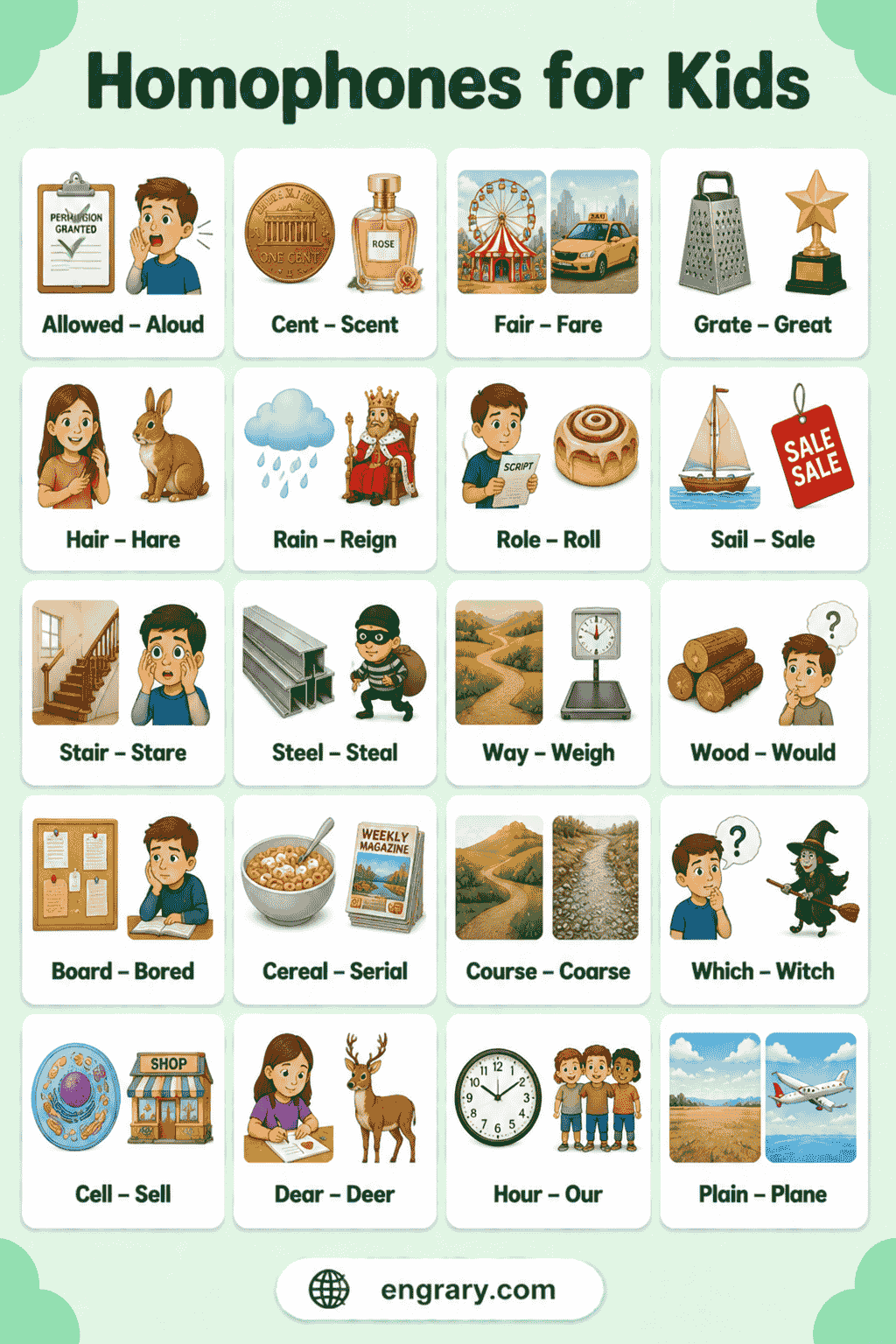
Homophones often cause mistakes in everyday writing because spell-check may not catch the wrong word if it is spelled correctly.
- Your / you’re: Your bag is blue. You’re doing well.
- There / their / they’re: Put it there. Their house is big. They’re happy.
- Its / it’s: The cat licked its paw. It’s cold today.
- To / too / two: I went to class. I came too. I have two pens.
- Right / write: Write your answer. That answer is right.
- No / know: No, I do not know.
- Hear / here: I hear you. Come here.
- New / knew: I have a new book. I knew the answer.
How to Choose the Correct Homophone
The best way to choose the correct homophone is to read the sentence and think about the meaning. Since homophones sound the same, the sound alone will not tell you which word is correct.
- Read the full sentence.
- Ask what the word means.
- Check if the word fits the sentence.
- Look for clues around the word.
- Try the other homophone in the sentence.
- Choose the word that makes sense.
- Read the sentence again.
- Write a new sentence with the other homophone.
Examples:
- I can ___ the bird. (see / sea)
Correct: I can see the bird. - The ___ is blue. (see / sea)
Correct: The sea is blue. - I have ___ pencils. (to / too / two)
Correct: I have two pencils. - Come over ___. (hear / here)
Correct: Come over here.
Homophones by Category
Grouping homophones by category helps children understand and remember them.
Number Homophones
- one / won
- two / too / to
- four / for
- eight / ate
Place Homophones
- there / their / they’re
- here / hear
- where / wear
- road / rode
- plain / plane
Action Homophones
- see / sea
- hear / here
- write / right
- read / red
- blew / blue
- knew / new
- rode / road
- ate / eight
People and Body Homophones
- I / eye
- son / sun
- male / mail
- hair / hare
- waist / waste
Animal and Nature Homophones
- bee / be
- deer / dear
- hare / hair
- sea / see
- sun / son
- flower / flour
- wood / would
Grade 1 Homophones
Grade 1 homophones should be simple, picture-friendly, and easy to use in short sentences.
- see / sea
- be / bee
- I / eye
- sun / son
- one / won
- to / two
- no / know
- ate / eight
- blue / blew
- red / read
- hear / here
- new / knew
Grade 2 Homophones
Grade 2 homophones can include more spelling and sentence-context practice.
- to / too / two
- hear / here
- new / knew
- right / write
- meet / meat
- flower / flour
- pair / pear
- tail / tale
- road / rode
- mail / male
- by / buy / bye
- where / wear
- night / knight
- plane / plain
- wood / would
Grade 3 Homophones
Grade 3 homophones can include more commonly confused writing words.
- there / their / they’re
- your / you’re
- its / it’s
- by / buy / bye
- where / wear
- which / witch
- our / hour
- peace / piece
- weather / whether
- principal / principle
- allowed / aloud
- brake / break
- cent / scent / sent
- waist / waste
- hole / whole

Matching Practice
Matching practice helps children connect each homophone with its meaning.
- see → to look
- sea → ocean water
- hear → to listen
- here → in this place
- one → number 1
- won → past tense of win
- ate → past tense of eat
- eight → number 8
- bee → insect
- be → to exist
- I → the person speaking
- eye → body part used to see
- sun → star in the sky
- son → male child
- right → correct
- write → make words
- flower → plant part
- flour → powder used for baking
- pair → two things together
- pear → fruit
Fill-in-the-Blank Practice
Fill-in-the-blank practice helps kids use context to choose the correct homophone.
- I can ___ the bird. (see / sea)
- The ___ is blue. (see / sea)
- I have ___ pencils. (to / too / two)
- I want one ___. (to / too / two)
- Come over ___. (hear / here)
- I can ___ the bell. (hear / here)
- She ___ lunch. (ate / eight)
- He is ___ years old. (ate / eight)
- The ___ is on the flower. (be / bee)
- Please ___ kind. (be / bee)
- I ___ the answer. (new / knew)
- I have a ___ book. (new / knew)
- I will ___ my name. (right / write)
- That is the ___ answer. (right / write)
- Put the bag over ___. (there / their / they’re)
- This is ___ dog. (there / their / they’re)
- ___ going home. (there / their / they’re)
Sentence Practice
Sentence practice helps children understand how homophone meaning changes in writing.
- I can see the sea.
- I hear you over here.
- One team won the game.
- I ate eight grapes.
- Please be kind to the bee.
- I got dust in my eye.
- No, I do not know.
- The sun is bright, and her son is happy.
- The wind blew my blue kite.
- I read the red book yesterday.
- I will write the right word.
- We will meet and eat meat.
- The flower is near the bag of flour.
- I bought a pair of pears.
- The dog wagged its tail in the tale.
Spelling Practice
Homophone spelling practice should focus on meaning, context, and correct word choice.
- Say both words aloud.
- Read the sentence.
- Think about the meaning.
- Choose the correct homophone.
- Write the word.
- Read the sentence again.
- Draw the meaning.
- Make a new sentence with the other homophone.
- Compare both spellings.
- Circle the clue word in the sentence.
- Sort easy and tricky homophones.
- Review confusing groups often.
- Correct the wrong homophone in a sentence.
- Use a picture clue when needed.
- Practice one homophone pair at a time.
Word Bank for Kids
A word bank gives children many homophones for spelling, writing, worksheets, flashcards, and classroom displays.
- to, too, two, see, sea, hear, here, one, won, ate, eight
- be, bee, I, eye, no, know, new, knew, sun, son
- blue, blew, red, read, meet, meat, right, write, flower, flour
- pair, pear, tail, tale, road, rode, mail, male, by, buy
- bye, there, their, they’re, your, you’re, its, it’s, where, wear
- which, witch, our, hour, peace, piece, weather, whether, deer, dear
- hair, hare, night, knight, plane, plain, wood, would, hole, whole
- board, bored, sale, sail, week, weak, allowed, aloud, brake, break
- cent, scent, sent, waist, waste, principal, principle, stair, stare, wait, weight
Printable Homophones List
Printable homophone lists are useful for homework, word walls, spelling practice, flashcards, and grammar folders.
- see / sea
- hear / here
- one / won
- ate / eight
- be / bee
- I / eye
- no / know
- new / knew
- sun / son
- blue / blew
- red / read
- meet / meat
- right / write
- flower / flour
- pair / pear
- tail / tale
- road / rode
- mail / male
- by / buy / bye
- to / too / two
- there / their / they’re
- your / you’re
- its / it’s
- where / wear
- which / witch
- our / hour
- peace / piece
- weather / whether
- deer / dear
- hair / hare
- night / knight
- plane / plain
- wood / would

Flashcard Ideas
Flashcards help children match homophones, meanings, pictures, and sentence clues.
- word card
- picture card
- meaning card
- sentence card
- homophone pair card
- homophone group card
- choose-the-word card
- fill-in-the-blank card
- draw-the-meaning card
- confusing pair card
- grade-level card
- correction card
- context clue card
- spelling card
- word bank card
Games and Activities
Homophone games make sound-alike word practice more active and memorable.
- Homophone match — Match each word with its homophone.
- Choose the word — Pick the correct homophone in a sentence.
- Fill the blank — Complete a sentence with the right word.
- Picture match — Match homophones to pictures.
- Draw both meanings — Draw both words in a pair, such as sea and see.
- Flashcard race — Read a card and give the meaning.
- Sentence swap — Write two sentences using both homophones.
- Mistake hunt — Find and fix the wrong homophone in a sentence.
- Homophone bingo — Cover the word when the meaning is called.
- Story search — Find homophones in a short passage.
- Category sort — Sort number, place, action, and picture homophones.
- Partner quiz — One child says the meaning, and the other writes the word.
- Board race — Write the correct homophone on the board.
- Clue game — Guess the homophone from a meaning clue.
- Memory match — Match homophone cards face down.
Worksheets and Exercises
Worksheets and exercises help kids practice homophone meaning, spelling, sentence context, and correct word choice.
- Match homophone pairs.
- Circle the correct homophone.
- Fill in the blank with the right word.
- Match homophones to pictures.
- Write a sentence for each homophone.
- Draw both meanings of a homophone pair.
- Sort homophones by category.
- Correct the wrong homophone in a sentence.
- Complete a homophones chart.
- Choose the correct word from two or three options.
- Make homophone flashcards.
- Find homophones in a short passage.
- Sort easy and tricky homophones.
- Match homophones to meanings.
- Write two sentences for one homophone pair.
- Use clue words to choose the answer.
- Sort pairs and groups.
- Complete commonly confused homophone sentences.
- Rewrite sentences with the correct homophone.
- Make a homophone mini-book.
Common Mistakes When Teaching Homophones
Avoid these common mistakes when teaching homophones to kids.
- Teaching long homophone lists without meanings
- Skipping sentence context
- Teaching confusing groups too early
- Mixing homophones with homonyms without explanation
- Not showing pictures for young kids
- Asking kids to memorize instead of understand
- Skipping spelling practice
- Not correcting common pairs like there/their/they’re
- Using advanced homophones too early
- Ignoring ESL learners who need extra context
- Teaching too many pairs in one lesson
- Skipping fill-in-the-blank practice
- Not explaining apostrophes in you’re and it’s
- Forgetting daily writing mistakes
- Not reviewing confusing pairs often
How to Teach Homophones to Kids
Start with simple, picture-friendly homophones such as see/sea, I/eye, bee/be, sun/son, and flower/flour. Say the words aloud, show both meanings with pictures, then use each word in a short sentence.
After children understand easy pairs, introduce confusing groups like to/too/two, there/their/they’re, and your/you’re. Use sentence clues, fill-in-the-blank tasks, matching cards, correction practice, and short writing activities so kids learn to choose the correct spelling from meaning and context.
FAQs
Homophones are words that sound the same but have different meanings. Examples include see/sea, hear/here, one/won, ate/eight, and be/bee.
Ten common homophone pairs are see/sea, hear/here, one/won, ate/eight, be/bee, I/eye, no/know, new/knew, sun/son, and right/write.
Homophones sound the same but have different meanings, such as see and sea. Homonyms may share spelling or sound but have different meanings, such as bat meaning an animal or a sports tool.
Homophones are hard because they sound the same, so children must use sentence meaning to choose the correct spelling.
Teach homophones with pictures, meanings, simple sentences, matching games, fill-in-the-blank practice, and common confusing pairs like to/too/two and there/their/they’re.
You May Also Like