A horse has many visible outer parts that support movement, balance, feeding, and posture. The main groups include the head, neck, torso, legs, hooves, tail, and coat, while smaller features such as the poll, withers, fetlock, pastern, and frog help each section perform a more specific role.
First, it helps to see the horse as one connected body rather than a list of separate names. You’ll learn how each horse part looks, what it is used for, and how to tell one from another, while also seeing how the head and neck support posture and feeding, the torso forms the main body structure, and the legs and hooves work together to carry weight, absorb impact, and create movement.
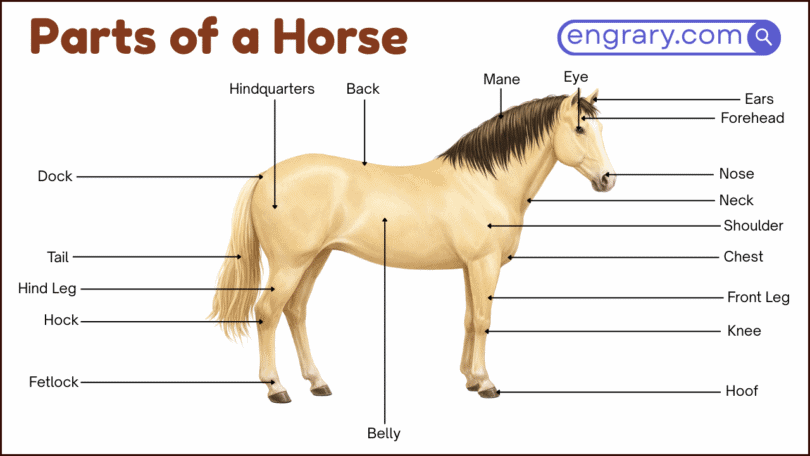
Horse Body Parts Labeled Diagram
The diagram below shows the main external parts of a horse and how they are arranged across the body. It highlights key areas such as the head, neck, torso, legs, hoof, and tail so readers can recognize each labeled part more easily.

Head And Neck Parts
Ear
The ear helps the horse hear sounds from different directions. Its movement also shows attention, mood, and awareness of the surroundings.
Forelock
The forelock is the section of hair that falls from the top of the head between the ears. It helps cover the forehead area and adds to the horse’s visible head profile.
Poll
The poll is the area at the top of the head just behind the ears. It connects the head to the upper neck and plays a key role in head movement.
Forehead
The forehead is the front upper area of the head between and above the eyes. It helps form the facial shape and sits below the forelock.
Eye
The eye allows the horse to detect light, movement, and nearby surroundings. It is one of the most noticeable parts of the face and supports wide-angle vision.
Cheek
The cheek forms the side of the face below the eye. It covers part of the jaw area and helps shape the horse’s facial outline.
Jaw
The jaw supports chewing and biting. It also forms much of the lower face and helps move food inside the mouth.
Muzzle
The muzzle is the front part of the face around the nose and mouth. It helps the horse smell, breathe, grasp food, and explore objects.
Nostril
The nostril is the opening in the nose that allows air to move in and out. It also helps with breathing during rest and movement.
Mouth
The mouth takes in food and water and supports chewing. It also works with the lips and jaw during feeding.
Lips
The lips help the horse pick up food and feel objects near the mouth. They are flexible and highly active during grazing.
Chin
The chin forms the lower front part of the jaw area under the mouth. It helps shape the lower face.
Neck
The neck connects the head to the body and supports head movement. It also carries muscles that help with balance and posture.
Crest
The crest is the upper curve along the top of the neck. It helps define the neck’s shape and is especially noticeable in some horses.
Throatlatch
The throatlatch is the area where the lower head meets the upper neck. It marks the transition point between the jaw and neck.
Mane
The mane is the line of hair that grows along the top of the neck. It covers the crest area and is one of the most recognizable outer features of a horse.
Body And Torso Parts
Withers
The withers are the raised area at the base of the neck above the shoulders. This point often marks the horse’s height and helps define the top line.
Shoulder
The shoulder connects the front leg to the body and supports forward motion. It also affects reach and movement in the front limb.
Chest
The chest is the front body area between the shoulders. It forms the front of the torso and supports the upper body structure.
Girth
The girth area lies just behind the front legs around the lower chest. It marks the body region that wraps around the horse behind the shoulders.
Back
The back runs from the withers toward the loin. It supports the upper body and helps maintain posture and movement.
Barrel
The barrel is the rounded middle body section that includes the rib area. It forms much of the horse’s side body shape.
Belly
The belly is the lower underside of the torso. It forms the lower body line below the barrel.
Flank
The flank is the side area between the barrel and the hind leg. It marks the transition from the middle body to the rear body.
Loin
The loin is the section between the back and the croup. It helps connect the middle body to the hindquarters.
Hip
The hip forms part of the upper hind body and supports rear-leg attachment. It plays a major role in body power and motion.
Croup
The croup is the top rear area of the body between the loin and the tail. It shapes the hind end and supports rear-body movement.
Buttock
The buttock is the rounded rear body area below the croup. It forms part of the hindquarters and supports powerful movement.
Dock
The dock is the upper base of the tail where it joins the body. It marks the start of the tail and sits behind the croup.
Front Leg Parts
Elbow
The elbow is the joint near the top of the front leg where the upper limb meets the lower section. It helps the leg bend and supports forward movement.
Forearm
The forearm is the upper section of the front leg below the elbow. It supports the lower limb and helps carry body weight during motion.
Knee
The knee is the large front-leg joint located below the forearm. It allows the front leg to bend and helps absorb movement forces.
Cannon Bone
The cannon bone is the long lower-leg bone below the knee. It supports weight and forms a major part of the horse’s lower front leg.
Chestnut
The chestnut is a small rough patch found on the inside of the leg above the knee on the front leg. It is a natural callus-like feature of the horse’s body.
Fetlock
The fetlock is the joint between the cannon bone and the pastern. It plays a major role in flexibility and shock absorption during movement.
Pastern
The pastern is the sloping section between the fetlock and the hoof. It helps soften impact and supports smoother movement.
Hind Leg Parts
Stifle
The stifle is the large joint on the upper hind leg. It works like a knee joint and helps the rear leg bend during movement.
Gaskin
The gaskin is the muscular section of the hind leg between the stifle and the hock. It helps provide strength and driving power from the rear.
Hock
The hock is the main rear joint below the gaskin. It helps the hind leg bend, push, and support motion.
Cannon Bone
The cannon bone is the long lower section of the hind leg below the hock. It supports the lower rear limb and helps carry force downward.
Fetlock
The fetlock is the joint above the pastern and hoof. It helps with flexibility, balance, and shock control during movement.
Pastern
The pastern is the sloping area between the fetlock and the hoof. It helps absorb impact and supports the lower leg during motion.
Hoof Parts
Hoof
The hoof is the hard outer foot structure at the bottom of the leg. It supports the horse’s weight and protects the lower foot.
Coronet
The coronet is the band-like area at the top edge of the hoof. It marks the point where the hoof meets the skin and hairline.
Hoof Wall
The hoof wall is the hard outer surface of the hoof. It protects the inner foot and bears much of the horse’s weight.
Sole
The sole is the underside of the hoof inside the outer wall. It helps protect the bottom of the foot.
Frog
The frog is the soft triangular structure on the underside of the hoof. It helps with grip and supports shock absorption.
Heel
The heel is the rear part of the hoof. It supports the back of the foot and helps with balance during standing and movement.
Tail And Outer Covering Parts
Tail
The tail extends from the rear end of the horse’s body. It helps with balance, movement, and visible body signaling.
Tail Hair
Tail hair is the long hair that grows from the tail. It helps cover the rear area and is one of the horse’s most noticeable outer features.
Coat
The coat is the layer of hair that covers the horse’s body. It helps protect the skin and supports body temperature control.
Key Takeaways
A horse’s body works through connected regions that each support movement, balance, protection, and feeding. The head and neck handle sensing, grazing, and posture, while the body and torso support the main frame and connect the front and rear sections. Meanwhile, the front and hind legs carry weight and create motion, and the hoof parts help absorb impact and protect the lower foot. Finally, the tail and coat support coverage, signaling, and body protection across the outer surface.
FAQs
The main parts of a horse include the head, neck, body, front legs, hind legs, hooves, tail, and coat. Each section supports movement, balance, protection, or feeding.
The poll is the area at the top of the head just behind the ears. It connects the head to the upper neck and supports head movement.
The fetlock is the joint above the pastern, while the pastern is the sloping area between the fetlock and the hoof. Both help with flexibility and shock absorption.
The croup is the top rear area of the body between the loin and the tail. It forms part of the hindquarters and supports rear-body movement.
The frog is the soft triangular part on the underside of the hoof. It helps with grip and supports shock absorption.
A horse’s body is covered by skin and coat. The coat forms the visible hair layer that helps protect the body and support temperature control.
You May Also Like