A cow’s body has many visible parts that work together to support movement, feeding, digestion, milk production, and protection. The main external groups include the head, neck, upper body, barrel, legs, feet, udder, and tail. In addition, each group contains smaller parts with specific jobs, such as the muzzle for taking in food, the dewlap for loose skin under the neck, and the hooves for support and walking.
Because these body regions connect closely, a cow can graze, chew, walk, stand, and digest food in a steady functional sequence. The head gathers food, the mouth and tongue help chewing begin, the body supports the digestive organs, the legs and feet carry weight, and the udder or tail serves its own specialized role. As a result, each part contributes to how a cow eats, moves, balances, rests, and functions as a ruminant animal.
Parts of a Cow With Labeled Diagram
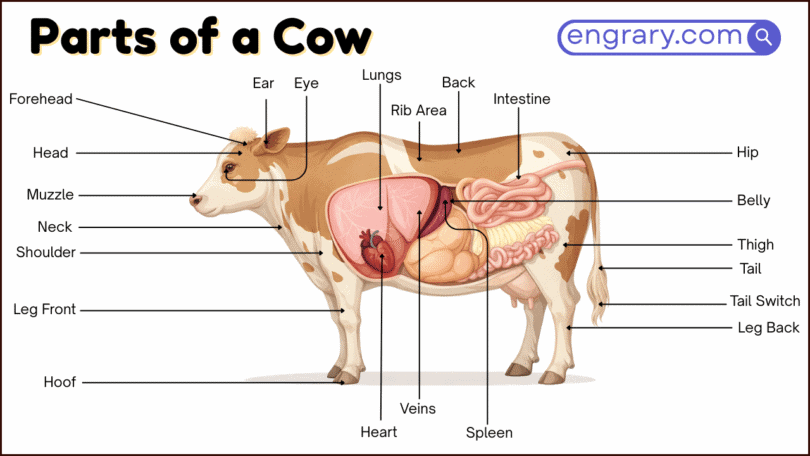
A labeled cow diagram usually shows the major outside body regions first because they are the easiest parts to identify. Most diagrams label the horns, ears, eyes, muzzle, mouth, neck, dewlap, shoulder, back, barrel, flank, legs, hooves, udder, tail, and tail switch. More detailed diagrams may also include the poll, withers, brisket, hook bones, pin bones, hock, fetlock, pastern, and dewclaws.
When readers use a labeled diagram, they can quickly match each name to its place on the body. This makes it easier to understand how the head handles sensing and feeding, how the trunk supports the body, how the legs and feet carry weight, and how the udder and tail fit into the cow’s visible anatomy.
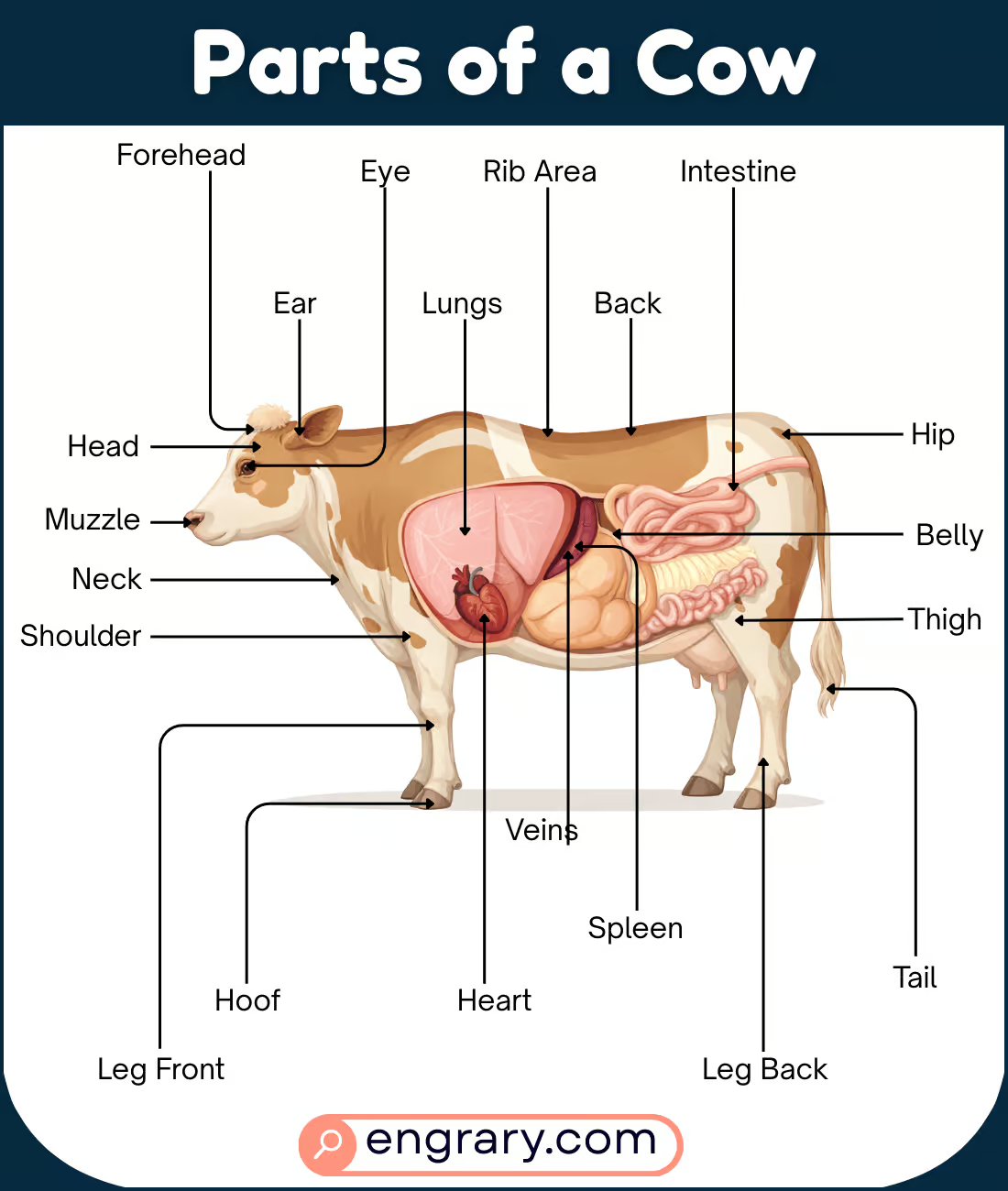
External Parts of a Cow
The external parts of a cow are the body features visible from the outside. These include the head and face, the neck and upper body, the barrel and rear body, the legs and feet, the udder, and the tail. Together, these visible parts form the cow’s large frame and support feeding, movement, and body balance.
Head and face
Horns
Horns grow from the top sides of the head in horned cattle. They are hard outer structures with a core beneath and form one of the most recognizable head features.
Poll
The poll is the top area of the head between or just behind the ears. It forms the upper back part of the head and is a common livestock anatomy term.
Forehead
The forehead is the broad front area above the eyes. It gives shape to the front of the head and connects the face to the top of the skull.
Ears
The ears help a cow hear sounds and notice changes around it. Their position on each side of the head also makes them easy to identify on a diagram.
Eyes
The eyes help with vision and awareness of the surroundings. They sit on the sides of the head, which gives cattle a wide field of view.
Cheeks
The cheeks form the side areas of the face below the eyes. They help shape the face and connect the muzzle region to the rest of the head.
Muzzle or muffle
The muzzle is the front part of the face around the nose and mouth. It is an important feeding area because it helps the cow gather grass and other feed.
Nostrils
The nostrils are the two openings in the nose. Air passes through them during breathing, and they are part of the muzzle area.
Mouth
The mouth takes in food and begins chewing. It works with the lips, tongue, teeth, and dental pad during feeding.
Tongue
A cow’s tongue is long and strong. It helps pull in forage and move food inside the mouth during chewing.
Teeth and dental pad
Cattle do not have upper front incisors. Instead, they have a dental pad on the upper front jaw and lower incisors that work against it while grazing.
Lower jaw
The lower jaw supports the lower teeth and helps the mouth open, close, and chew. It plays a major role in grinding feed.
Neck and upper body
Neck
The neck supports the head and connects it to the body. It allows the cow to lower its head for grazing and lift it again with steady control.
Neck crest
The neck crest is the upper curved line of the neck. It forms part of the top outline between the head and shoulders.
Dewlap
The dewlap is the loose fold of skin hanging under the neck. It is a common visible part in cattle anatomy and is easy to spot on many breeds.
Throat area
The throat area lies under the head at the front of the neck. It links the lower head region to the upper neck.
Brisket
The brisket is the lower front chest area between and behind the forelegs. It forms part of the front underside of the body.
Shoulder
The shoulder connects the front leg region to the front of the body. It helps support movement and the front body frame.
Withers
The withers are the raised area at the top of the shoulders. This landmark sits where the neck meets the back.
Jugular groove
The jugular groove is the lengthwise groove along the lower side of the neck. It is a recognized external neck landmark in cattle anatomy.
Body and barrel
Chest
The chest is the front body area behind the neck and above the brisket. It protects major organs and helps form the cow’s front body structure.
Ribs
The ribs shape the side of the upper body and protect organs inside the chest. They also help form the depth of the body.
Back
The back runs along the upper body behind the withers. It supports the frame and connects the front and rear sections of the body.
Loin
The loin is the upper body area behind the ribs and before the rump. It forms part of the top rear body line.
Barrel
The barrel is the large middle body section containing much of the digestive system. It gives the cow its wide trunk shape.
Belly or abdomen
The belly is the lower underside of the body, while the abdomen refers more broadly to the lower trunk area that contains major digestive organs. This region supports much of the cow’s internal digestive structure.
Flank
The flank is the side area between the ribs and the hind leg. It forms an important visible landmark on the rear part of the body.
Hip
The hip area connects the rear body to the hindquarters. It helps define the upper rear frame of the cow.
Hook bones
The hook bones are the prominent points at the front of the pelvic area. They are important livestock body landmarks near the hips.
Pin bones
The pin bones are the rear pelvic points below and behind the hook bones. They help define the rear shape of the cow.
Sacrum
The sacrum is the upper pelvic region near the rump. It forms part of the rear topline between the loin and tail area.
Rump
The rump is the top rear area of the body before the tail begins. It links the back, pelvis, and tail head.
Forelegs and hind legs
Forelegs
The forelegs support the front of the body and carry a large share of body weight. They help the cow stand, step, and move steadily.
Hind legs
The hind legs support the rear body and help drive movement forward. They work with the hips and pelvis during walking and standing.
Elbow
The elbow is the main front-leg joint between the upper and lower foreleg. It allows bending and controlled front-leg movement.
Knee
In cattle, the knee is the front leg joint below the forearm area. It helps the front leg bend and support weight.
Stifle
The stifle is the major hind-leg joint that corresponds to the knee region in the rear limb. It supports bending and extension in the hind leg.
Hock
The hock is the large rear joint below the stifle. It is one of the easiest hind-leg parts to identify on a cow diagram.
Feet, hooves, and dewclaws
Cannon area
The cannon area is the long lower section of the leg above the fetlock. It forms part of the straight lower limb.
Fetlock
The fetlock is the joint between the cannon area and the pastern. It helps absorb movement and support the lower leg.
Pastern
The pastern is the sloping part of the lower leg between the fetlock and hoof. It helps with flexibility and weight support.
Hoof
The hoof is the hard outer foot structure that supports the body on the ground. Cattle have cloven hooves split into two main toes.
Dewclaws
Dewclaws are the small accessory digits located higher behind the hoof. They usually do not bear weight during normal standing.
Tail and rear area
Tail head or root of tail
This is the point where the tail joins the body. It marks the start of the tail at the rear end.
Tail
The tail extends from the rear body and helps with body signaling and swatting insects. It is one of the most visible rear parts.
Tail switch
The tail switch is the tuft of longer hair at the end of the tail. It helps the cow brush away flies and other insects.
Rear end
The rear end includes the rump, tail head, and the area beneath the tail. It forms the back section of the body.
Anus
The anus is the rear opening for waste removal. It is located below the tail in both male and female cattle.
Parts of a Cow’s Head
A cow’s head contains the main parts used for sensing, feeding, chewing, and grazing. This area helps the cow see, hear, smell, gather food, and begin the chewing process before digestion continues deeper in the body.
Upper head parts
Horns
Horns grow from the upper sides of the head in horned cattle. They are hard outer structures and are one of the easiest parts to notice on the top of the head.
Poll
The poll is the top back area of the head between or just behind the ears. It forms an important upper head landmark in cattle anatomy.
Forehead
The forehead is the broad front area above the eyes. It gives shape to the front of the head and connects the face to the upper skull.
Sensory parts
Ears
The ears help a cow hear sounds and notice changes around it. Their side position also helps the cow stay alert to movement in the surroundings.
Eyes
The eyes support vision and awareness. Because they are placed on the sides of the head, they give cattle a wide field of view.
Cheeks
The cheeks form the side areas of the face below the eyes. They connect the upper face to the muzzle and help shape the head.
Feeding parts
Muzzle or muffle
The muzzle is the front part of the face around the nose and mouth. It helps the cow gather grass, hay, and other feed while grazing.
Nostrils
The nostrils are the two openings in the nose. They allow air to pass in and out during breathing.
Mouth
The mouth takes in food and starts the chewing process. It works with the tongue, teeth, and dental pad during feeding.
Tongue
A cow’s tongue is long, strong, and very useful during grazing. It helps pull in forage and move food around inside the mouth.
Teeth and dental pad
Cattle do not have upper front incisors. Instead, they use a dental pad on the upper front jaw and lower incisors to grip and tear grass.
Lower jaw
The lower jaw supports the lower teeth and helps the mouth open, close, and chew. It plays a major role in grinding feed.
Chin
The chin is the lower front part below the mouth. It completes the lower outline of the head and jaw area.
Parts of a Cow’s Neck and Upper Body
The neck and upper body connect the head to the main trunk and support the cow’s front frame. These parts help hold the head in position, carry body weight, and form the upper outline of the animal.
Neck parts
Neck
The neck supports the head and joins it to the body. It allows the cow to lower its head for grazing and raise it again with steady control.
Neck crest
The neck crest is the upper curved line of the neck. It forms part of the top outline between the head and the shoulders.
Dewlap
The dewlap is the loose fold of skin hanging under the neck. It is one of the most recognizable cattle body parts in many breeds.
Throat area
The throat area lies below the head at the front of the neck. It connects the lower head region to the upper neck.
Front upper body parts
Brisket
The brisket is the lower front chest area between and behind the forelegs. It forms the front underside of the cow’s body.
Shoulder
The shoulder connects the front legs to the front of the body. It supports movement and forms part of the cow’s front frame.
Withers
The withers are the raised area at the top of the shoulders. This point marks where the neck meets the back.
Jugular groove
The jugular groove is the line-like groove along the lower side of the neck. It is a recognized external landmark in cattle anatomy.
Topline support parts
Upper back line
The upper back line begins behind the withers and continues along the top of the body. It helps shape the cow’s topline and supports the main frame.
Front chest connection
This area links the neck, shoulder, and chest into one front body section. It helps create a strong connection between the head, neck, and trunk.
Parts of a Cow’s Body
The body forms the main frame of a cow and connects the head, legs, udder, and tail into one large working system. This central region supports posture, protects internal organs, carries the digestive system, and gives the cow its broad, heavy shape.
Main body parts
Chest
The chest is the front body area behind the neck and above the brisket. It protects major organs and helps form the strong front structure of the cow.
Ribs
The ribs shape the sides of the upper body and protect the organs inside the chest. They also help create body depth and support the frame of the trunk.
Back
The back runs along the top of the body behind the withers. It supports the upper frame and connects the front and rear sections of the body.
Loin
The loin is the upper area behind the ribs and before the rump. It forms an important rear topline section of the body.
Barrel
The barrel is the large middle section of the body. This region contains much of the digestive system and gives the cow its wide trunk shape.
Middle and lower body parts
Belly
The belly is the lower underside of the body. It covers the lower trunk and forms the hanging lower outline of the cow’s middle section.
Abdomen
The abdomen is the main lower body cavity behind the chest. It contains important digestive organs and makes up much of the cow’s internal body space.
Flank
The flank is the side area between the ribs and the hind leg. It is a key external landmark on the rear part of the body.
Hip
The hip region connects the rear body to the hindquarters. It helps define the upper rear frame and supports the back end of the body.
Rear body parts
Hook bones
The hook bones are the prominent points at the front of the pelvic area. They are important livestock landmarks near the hips.
Pin bones
The pin bones are the rear pelvic points below and behind the hook bones. They help shape the rear outline of the cow.
Sacrum
The sacrum is the upper pelvic region near the rump. It forms part of the rear topline between the loin and tail area.
Rump
The rump is the top rear part of the body before the tail begins. It links the back, pelvis, and tail head into one rear section.
Parts of a Cow’s Legs and Feet
A cow’s legs and feet support its large body weight and help it stand, walk, turn, and move across fields or barns. The front and rear limbs work together, while the lower leg and foot parts help absorb weight and maintain balance.
Front leg parts
Forelegs
The forelegs support much of the front body weight. They help the cow stand steadily and move forward with control.
Elbow
The elbow is the main joint in the upper front leg. It allows bending and controlled movement of the foreleg.
Knee
In cattle, the knee is the front leg joint below the forearm area. It helps the front leg bend and support body weight.
Cannon area
The cannon area is the long lower section of the leg above the fetlock. It forms part of the straight lower limb.
Hind leg parts
Hind legs
The hind legs support the rear body and help push the body forward during movement. They work with the hips and pelvis to carry the hindquarters.
Stifle
The stifle is the major joint in the upper hind leg. It helps the rear leg bend and extend during standing and walking.
Hock
The hock is the large rear joint below the stifle. It is one of the easiest hind-leg parts to identify on a cow.
Rear cannon area
This is the long lower hind-leg section above the fetlock. It supports the lower rear limb and helps carry body weight downward to the foot.
Foot parts
Fetlock
The fetlock is the joint between the cannon area and the pastern. It helps absorb movement and supports the lower leg.
Pastern
The pastern is the sloping lower part of the leg between the fetlock and hoof. It helps with flexibility and weight support.
Hoof
The hoof is the hard outer foot structure that supports the body on the ground. Cattle have cloven hooves split into two main toes.
Dewclaws
Dewclaws are the small accessory digits located higher behind the hoof. They usually do not carry weight during normal standing.
Toes
A cow’s hoof is divided into two main weight-bearing toes. These parts help spread weight and support steady standing and walking.
Parts of a Cow’s Tail and Rear Area
The tail and rear area form the back end of the cow’s body. These parts help with body balance, insect control, waste removal, and visible rear-body identification.
Tail parts
Tail head or root of tail
The tail head is the point where the tail joins the body. It marks the beginning of the tail at the rear end and connects the tail to the rump.
Tail
The tail is the long flexible rear part that extends downward from the body. It helps the cow swat insects and also adds to the visible outline of the hindquarters.
Tail switch
The tail switch is the tuft of longer hair at the end of the tail. It is especially useful for brushing away flies and other insects.
Rear area parts
Rear end
The rear end includes the rump, tail head, and the area below the tail. It forms the back section of the cow’s body and connects the hindquarters to the tail.
Anus
The anus is the rear opening through which body waste leaves the digestive tract. It is located below the tail in both male and female cattle.
Vulva
In female cattle, the vulva is the external reproductive opening below the anus. It is an important visible body part in cow anatomy.
Parts of a Cow’s Udder
The udder is one of the most important visible parts of a female cow. It contains the mammary glands and supports milk production, storage, and release.
Main udder parts
Udder
The udder is the large milk-producing structure attached to the lower rear body between the hind legs. It is made up of four quarters and forms a major part of external cow anatomy.
Udder quarters
A cow’s udder has four quarters. Each quarter works as a separate milk-producing section.
Teats
Teats are the narrow hanging parts below the udder. Each teat connects to one udder quarter and allows milk to come out.
Nearby udder area parts
Milk vein area
The milk vein area lies along the underside of the body in front of the udder. It is a well-known external landmark in dairy cow anatomy.
Milk well
The milk well is the point where the milk vein enters the body cavity. It is part of the external udder-related region.
Supernumerary teats
These are extra teats that may appear in addition to the normal four. They are usually smaller and are not always functional.
Internal Parts of a Cow
The internal parts of a cow keep the body alive and support the main functions of feeding, digestion, breathing, circulation, movement, and waste removal. Although these parts are not visible from the outside, they work together in a steady sequence that helps the cow eat forage, digest it as a ruminant, absorb nutrients, and maintain body function.
Control and support parts
Brain
The brain controls movement, behavior, sensation, and body responses. It receives signals from the senses and helps the cow react to its surroundings.
Skeleton
The skeleton gives the cow’s body its main structure. It supports posture, protects organs, and forms the framework for movement.
Spine
The spine runs from the neck through the back and into the tail region. It supports the body and connects many parts of the skeleton.
Breathing and circulation parts
Heart
The heart pumps blood through the body. This keeps oxygen and nutrients moving to tissues and organs.
Lungs
The lungs take in oxygen and remove carbon dioxide. They support breathing and help keep the body supplied with fresh air.
Digestive parts
Esophagus
The esophagus is the tube that carries swallowed food from the mouth toward the stomach compartments. It plays an important role in both swallowing and rumination.
Rumen
The rumen is the largest stomach compartment in a cow. It stores and ferments feed with the help of microbes, which makes it central to ruminant digestion.
Reticulum
The reticulum is the compartment next to the rumen. It works closely with the rumen and helps move feed material through the digestive process.
Omasum
The omasum is the third stomach compartment. It helps absorb water and further process feed before it moves onward.
Abomasum
The abomasum is the fourth stomach compartment and is often called the true stomach. It uses digestive juices to break down feed more completely.
Intestines
The intestines continue digestion and absorb nutrients from food. They also move waste material toward the end of the digestive tract.
Liver
The liver supports digestion and processes nutrients absorbed from food. It also helps with many important body functions.
Waste removal parts
Kidneys
The kidneys filter waste from the blood and help control fluid balance in the body. They are major organs in the urinary system.
Bladder
The bladder stores urine before it leaves the body. It is part of the body’s waste-removal system.
Male and Female Cow Parts
Male and female cattle share most body parts, but their external reproductive parts are different. In general cow-focused anatomy content, the female body is discussed more often because of the udder, teats, and dairy-related anatomy, while male cattle anatomy includes its own visible reproductive structures.
Female external parts
Vulva
The vulva is the female external reproductive opening below the anus. It is one of the main visible reproductive parts in a cow.
Udder
The udder is the milk-producing structure attached to the lower rear body. It is one of the most important external parts of a female cow.
Teats
Teats are the hanging parts below the udder that release milk. Each teat connects to one udder quarter.
Male external parts
Sheath
The sheath is the external fold of skin that covers and protects the penis in male cattle. It is a visible reproductive part on the underside of the body.
Penis
The penis is the male external reproductive organ. It is part of the reproductive and urinary system.
Scrotum
The scrotum is the external pouch below the rear body that holds the testicles. It forms the visible outer covering of these organs.
Testicles
The testicles are the male reproductive glands located inside the scrotum. They are part of the male reproductive system.
Key Takeaways
A cow’s body includes several main groups that work together in a clear functional sequence. The head and mouth gather and chew feed, while the neck and body support the frame and hold the major digestive organs. At the same time, the legs, feet, and hooves carry the cow’s weight and allow steady movement, the udder produces milk in females, and the tail helps with insect control and rear-body signaling. Inside the body, the rumen, reticulum, omasum, and abomasum handle ruminant digestion, while the heart, lungs, kidneys, and brain support circulation, breathing, waste removal, and body control.
FAQs
The main parts of a cow include the head, neck, body, legs, hooves, udder, and tail. Inside the body, cows also have organs such as the heart, lungs, liver, intestines, and four stomach compartments.
The front mouth area of a cow is called the muzzle, and it includes the nostrils and mouth. Cows also use a dental pad and lower incisors to gather forage while grazing.
The four stomach compartments of a cow are the rumen, reticulum, omasum, and abomasum. Together, they allow cattle to digest plant material as ruminant animals.
The loose skin under a cow’s neck is called the dewlap. It is a common visible external body part in many cattle breeds.
The milk-producing part of a female cow is called the udder. It contains four quarters, and each quarter connects to a teat for milk release.
You May Also Like