A cat’s body has many visible parts that work together to support movement, balance, grooming, hunting, and sensing its surroundings. The main external groups include the head, neck, trunk, legs, paws, claws, and tail. In addition, each group contains smaller parts with special jobs, such as whiskers for sensing nearby space and paw pads for quiet movement.
Because these body regions connect so closely, a cat can move with both speed and control. The head gathers sensory information, the trunk supports the body, the legs and paws make agile movement possible, and the tail helps with balance and communication. As a result, each part contributes to how a cat walks, lands, climbs, watches, and reacts.
Parts of a Cat With Labeled Diagram
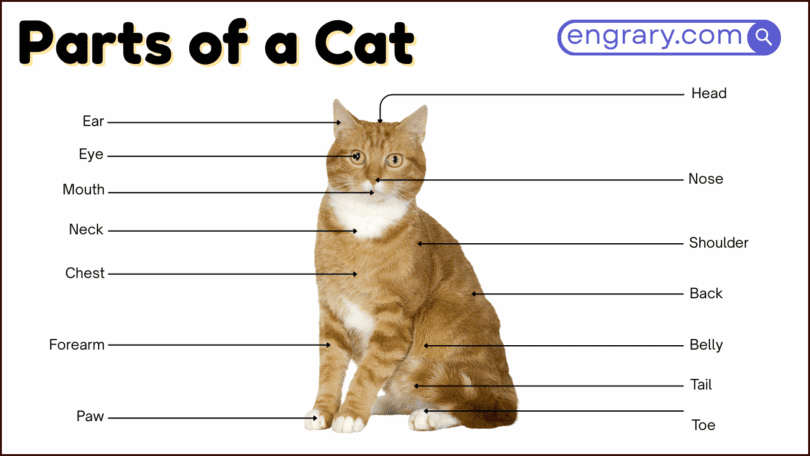
A labeled cat diagram usually shows the main outside body regions first, because these are the easiest parts to identify. Most diagrams label the ears, eyes, nose, whiskers, mouth, neck, back, chest, belly, legs, paws, claws, and tail. More detailed diagrams may also include the whisker pads, paw pads, dewclaw, rump, and primordial pouch.
When readers use a labeled diagram, they can quickly connect each name to its place on the body. This makes it easier to learn how the head handles sensing, how the trunk supports the body, and how the legs, paws, and tail help with movement and balance.
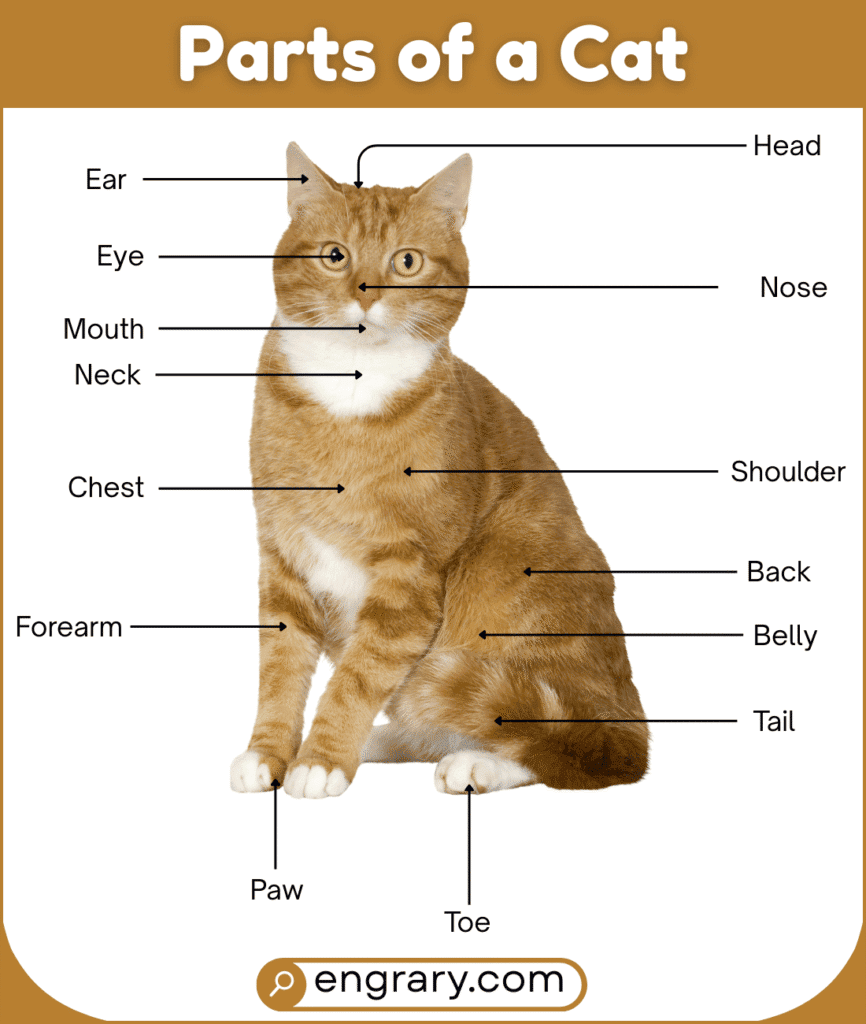
External Parts of a Cat
The external parts of a cat are the body features you can see from the outside. These include the head and face, the neck and trunk, the front and back legs, the paws and claws, and the tail. Together, these visible parts form the cat’s streamlined shape and support its flexible movement.
Head and Face
Ears
Large upright ears help a cat detect sound and notice changes around it. Their shape allows them to collect sound well, while their movement helps the cat focus on where a sound is coming from.
Eyes
Cat eyes are large in proportion to the head, which supports strong vision in dim light. They also play an important role in focus, tracking, and body-language signals.
Nose
The nose supports breathing and helps a cat detect scents in its environment. Since smell is important for recognition and exploration, this small part plays a very active role in daily behavior.
Muzzle
The muzzle is the front area of the face around the nose and mouth. This region holds important sensory hairs and helps position the mouth during sniffing, carrying, and biting.
Whiskers
Whiskers are specialized sensory hairs that help a cat sense nearby objects and air movement. Because their roots sit deep in the tissue and connect to many nerve endings, they provide detailed touch information.
Whisker Pads
These are the slightly raised areas on each side of the muzzle where the main whiskers grow. They support whisker movement and make the front of the face look fuller.
Mouth
The mouth includes the lips, teeth, gums, and tongue. It helps with eating, carrying objects, grooming, and defensive biting when needed.
Chin
The chin forms the lower front part of the face under the mouth. Although small, it helps shape the jawline and supports the lower mouth area.
Neck and Trunk
Neck
A cat’s neck supports the head and allows smooth turning and lowering movements. It also helps the cat adjust its posture quickly while watching, stalking, or grooming.
Shoulders
The shoulders connect the front legs to the front of the trunk and support flexible movement. Since cats need a wide range of motion, this area contributes to climbing, reaching, and landing.
Chest
The chest is the front body area behind the neck and between the forelegs. It protects important internal organs and forms part of the cat’s main body frame.
Back
The back runs from behind the shoulders toward the hips and contains the spinal support line of the body. Its flexibility helps cats stretch, twist, leap, and land with control.
Belly or Abdomen
The belly is the softer lower body region under the chest and rib area. It covers much of the digestive region and often appears more rounded or relaxed when a cat lies down.
Flanks
The flanks are the side areas between the ribs and hips. They form the middle side body and help define the cat’s narrow, athletic shape.
Hips
Located near the rear of the trunk, the hips connect the body to the hind legs. This area supports jumping power and helps transfer force from the rear legs through the body.
Rump
The rump is the upper rear body area just before the tail begins. It forms the back end of the trunk and links the hips to the base of the tail.
Front Legs and Hind Legs
Forelegs
The forelegs support landing, stepping, reaching, and balance. Cats use them to absorb force when they come down from jumps and to guide the body during careful movement.
Hind Legs
The hind legs provide much of a cat’s jumping and pushing power. Because they drive the body forward and upward, they are essential for sprinting, climbing, and leaping.
Elbows
The elbows are the joints in the forelegs that allow bending and controlled front-leg movement. They help the cat lower its body smoothly and adjust direction while walking or crouching.
Hocks
The hock is the backward-bending joint on the hind leg that looks a little like an ankle. It helps create spring and extension in the rear leg during movement.
Paws, Claws, and Toes
Paws
Paws are the contact points between the cat and the ground. They support walking, climbing, landing, gripping, and silent stalking.
Toes
Most cats have five toes on each front paw and four on each back paw, for a total of eighteen toes. These digits support grip, balance, and claw control.
Paw Pads
Paw pads are the soft cushions under the feet. They absorb impact, improve traction, and help reduce sound when a cat walks or stalks.
Claws
Cats have curved claws that stay sheathed when relaxed and extend when needed. This design helps protect the claws from wear and supports gripping, climbing, and traction.
Dewclaw
The dewclaw is the extra inner digit on the front leg, placed higher than the other toes. It usually does not touch the ground during normal standing or walking.
Toe Tufts
Toe tufts are small clumps of fur that may grow between or beyond the toes, especially in medium- and long-haired cats. They can soften contact with the ground and add to the paw’s furry appearance.
Tail and Rear Area
Tail
The tail is the long rear extension of the spine. It helps with balance during movement and also acts as a visible communication tool through position and motion.
Tail Base
This is the thick beginning part of the tail where it joins the body. It anchors the tail to the rear body and supports tail movement.
Tail Tip
The tip is the narrow end of the tail. Even this small section contributes to the overall line and motion of the tail during balance and signaling.
Rear End
The rear end includes the rump, tail base, and the area beneath the tail. It forms the back section of the body and connects the hindquarters to the tail.
Parts of a Cat’s Head
A cat’s head contains many of the body’s most important sensory and feeding parts. This region helps the cat hear, see, smell, touch, bite, and groom, so each structure in the head supports daily survival and fast reactions.
Ears
Outer ear
The outer ear is the visible upright flap on top of the head. It collects sound waves and helps direct them into the ear canal.
Ear canal
This passage carries sound inward from the outer ear. It connects the visible ear to the deeper hearing structures.
Inner ear
The inner ear helps with both hearing and balance. Because of this, it plays a role in how a cat stays steady while walking, jumping, and landing.
Henry’s pocket
Henry’s pocket is the small fold of skin along the lower outer edge of the ear. It is a normal part of ear shape and is easy to notice in many cats.
Eyes
Eye
A cat’s eye is large for its head size and supports sharp vision, especially in low light. It also helps the cat judge distance and track movement.
Pupil
The pupil is the dark center opening of the eye. It changes size to control how much light enters.
Iris
The iris is the colored ring around the pupil. It adjusts the pupil and helps manage light levels.
Third eyelid
The third eyelid is a thin protective membrane at the inner corner of the eye. It helps protect the eye surface and adds extra coverage.
Nose and muzzle
Nose
The nose helps with breathing and scent detection. Since cats rely strongly on smell, this part is important for recognition and exploration.
Nostrils
The nostrils are the two openings in the nose. Air moves through them during breathing and scent sampling.
Muzzle
The muzzle is the front facial area around the nose and mouth. It supports the mouth and holds important sensory hairs.
Whisker pads
These rounded areas sit on each side of the muzzle. They anchor the main whiskers and give the face its fuller front shape.
Whiskers and face
Whiskers
Whiskers are long sensory hairs that detect touch, movement, and nearby space. They help a cat judge openings and notice objects close to the face.
Cheeks
The cheeks form the sides of the face below the eyes. They help shape the face and connect the muzzle area to the rest of the head.
Chin
The chin is the lower front part under the mouth. It supports the lower jaw area and completes the front shape of the face.
Forehead
The forehead is the upper front part of the head between and above the eyes. It forms the broad front surface of the skull.
Mouth area
Mouth
The mouth is the opening used for eating, biting, carrying, and grooming. It contains the teeth, tongue, and gums.
Lips
The lips form the soft edge around the mouth opening. They help close the mouth and shape the front of the muzzle.
Jaw
The jaw supports biting and chewing. It also gives strength and structure to the lower part of the head.
Teeth
The teeth cut, grip, and tear food. Different types of teeth perform different jobs inside the mouth.
Parts of a Cat’s Mouth
A cat’s mouth contains the parts used for eating, grooming, carrying, and defense. While the mouth looks small from the outside, it includes several important structures that work together during biting, licking, and chewing.
Teeth
Incisors
Incisors are the small front teeth between the canines. Cats use them for nibbling, gripping, and small cutting actions.
Canines
Canines are the long pointed teeth near the front of the mouth. They are designed for gripping and tearing.
Premolars
Premolars sit behind the canines. They help slice and break food into smaller pieces.
Molars
Molars are farther back in the mouth. They assist with chewing and processing food before swallowing.
Soft parts of the mouth
Tongue
A cat’s tongue is muscular and rough. It helps with eating, licking, grooming, and moving food inside the mouth.
Gums
The gums are the soft tissue around the teeth. They hold the teeth in place and protect the base of each tooth.
Palate
The palate forms the roof of the mouth. It separates the mouth from the nasal area above.
Lower mouth floor
This is the soft area under the tongue inside the mouth. It supports tongue movement and the base of the oral cavity.
Supporting mouth structures
Jawbone area
The jawbone area provides strength for biting and chewing. It supports the teeth and allows the mouth to open and close.
Mouth corners
The corners are the side points where the upper and lower lips meet. They help define the shape of the mouth opening.
Saliva glands
These glands produce saliva, which keeps the mouth moist and helps with swallowing. Saliva also supports smoother food movement inside the mouth.
Parts of a Cat’s Body
The body forms the main frame of a cat and connects the head, legs, and tail into one flexible system. This central region supports posture, protects internal organs, and helps the cat bend, stretch, crouch, and jump with control.
Main trunk parts
Neck
The neck supports the head and allows smooth turning, lowering, and lifting movements. It also helps the cat shift posture quickly while watching, stalking, or grooming.
Shoulders
The shoulders connect the front legs to the trunk and support wide, flexible movement. This area helps the cat reach forward, climb upward, and absorb force during landing.
Chest
The chest is the front body region behind the neck and between the forelegs. It forms part of the main body frame and protects important organs inside.
Back
The back runs from behind the shoulders toward the hips. Its flexible structure helps the cat stretch, twist, leap, and land with balance.
Rib area
The rib area shapes the upper sides of the trunk and protects the organs in the chest. It also gives the middle body a firm but flexible form.
Middle and lower body parts
Belly
The belly is the lower front and middle underside of the body. It covers much of the abdominal region and often looks softer than the back and sides.
Abdomen
The abdomen is the body area below the ribs and above the pelvis. It contains much of the digestive region and forms the softer central underside of the trunk.
Flanks
The flanks are the side areas between the ribs and hips. They help form the narrow, athletic shape of the cat’s middle body.
Waist area
The waist area is the slightly narrowed part of the body before the hips. It links the middle trunk to the rear body.
Primordial pouch
The primordial pouch is the loose flap of skin and fat along the lower belly. It allows extra stretch during movement and gives the underside a hanging appearance in many cats.
Rear body parts
Hips
The hips connect the trunk to the hind legs and support powerful rear-leg movement. This area helps transfer force during running and jumping.
Pelvic area
The pelvic area forms the rear lower body structure behind the abdomen. It supports the hindquarters and connects the trunk to the back legs.
Rump
The rump is the upper rear body area just before the tail begins. It forms the back end of the trunk and links the hips to the tail base.
Rear end
The rear end includes the rump and the area beneath the tail. It completes the hind portion of the body and joins the hindquarters to the tail.
Parts of a Cat’s Legs and Paws
A cat’s legs and paws are built for balance, agility, grip, and quiet movement. The front and back limbs do different jobs, yet they work together so the cat can walk softly, climb easily, and jump with power.
Front leg parts
Forelegs
The forelegs guide the front of the body during walking, landing, and reaching. They help absorb impact and support balance during careful movement.
Upper foreleg
This upper section connects the shoulder area to the lower front limb. It helps position the foreleg during stepping and reaching.
Elbow
The elbow is the main bending joint in the front leg. It allows the leg to fold and extend during walking, crouching, and landing.
Forearm
The forearm is the lower part of the front leg below the elbow. It supports forward movement and helps carry body weight.
Wrist area
The wrist area sits above the front paw and helps the paw move and flex. This part supports smooth stepping and ground contact.
Hind leg parts
Hind legs
The hind legs provide much of the cat’s pushing and jumping power. They drive the body forward and upward during running, climbing, and leaping.
Thigh
The thigh is the upper part of the hind leg closest to the body. It contains strong muscles that help power movement.
Knee
The knee is the bending joint in the hind leg between the thigh and lower leg. It helps the cat crouch, spring, and extend the rear limb.
Lower hind leg
This section runs between the knee and the hock. It supports the rear paw and helps with strong leg extension.
Hock
The hock is the backward-bending joint on the hind leg that looks a little like an ankle. It adds spring and flexibility during motion.
Paw parts
Paws
Paws are the body parts that touch the ground. They help with walking, climbing, landing, gripping, and silent stalking.
Front paws
Front paws support balance, landing, and reaching. They also help the cat control fine ground contact.
Back paws
Back paws push the body forward and help provide jumping force. They work closely with the hind legs during fast or powerful movement.
Toes
Toes are the separate front parts of the paw that support grip and balance. Cats usually have five toes on each front paw and four on each back paw.
Paw pads
Paw pads are the soft cushions under the paws. They absorb shock, improve traction, and reduce sound during movement.
Digital pads
Digital pads are the smaller pads under each toe. They support the toes and help spread pressure across the paw.
Central pad
The central pad is the large main pad under the paw. It takes much of the body’s contact with the ground.
Claw and toe details
Claws
Claws are curved, sharp structures attached to the toes. They help with gripping, climbing, traction, and defense.
Retractable claws
Most cat claws stay pulled back when relaxed and extend when needed. This keeps them sharp and reduces wear during normal walking.
Dewclaw
The dewclaw is the extra inner digit on the front leg, placed higher than the other toes. It usually does not touch the ground during normal standing or walking.
Toe tufts
Toe tufts are small clumps of fur that grow between or beyond the toes, especially in long-haired cats. They add to the furry look of the paw and may soften contact with the ground.
Parts of a Cat’s Tail
A cat’s tail is more than a long rear body part. It extends from the end of the spine, helps steady the body during movement, and also shows mood and reaction through position and motion.
Main tail parts
Tail base
The tail base is the thick starting part where the tail joins the body. It connects the tail to the rear end and supports the tail’s full range of movement.
Tail length
The length forms the main body of the tail between the base and the tip. This section gives the tail its overall reach and shape.
Tail vertebrae
Inside the tail are small linked bones called vertebrae. These bones give the tail structure while still allowing flexible motion.
Tail muscles
Tail muscles help lift, lower, curl, and swing the tail. They allow the cat to make fine movements for both balance and signaling.
Tail tip
The tip is the narrow end of the tail. Even though it is small, it still contributes to the tail’s line, motion, and expression.
Tail functions
Balance support
The tail helps a cat stay balanced while walking along narrow places, turning quickly, or landing after a jump. It works with the rest of the body to steady movement.
Body communication
Tail position can show excitement, caution, comfort, or irritation. Because of that, the tail acts as an important visual signal.
Movement control
During fast action, the tail helps the body shift weight and direction. This makes turning and landing more controlled.
Cat Fur, Skin, and Sensory Parts
A cat’s outer covering does more than shape appearance. The Fur, skin, and sensory structures protect the body, support comfort, and help the cat gather information from its surroundings.
Fur and coat parts
Fur or coat
The fur, also called the coat, covers most of the cat’s body. It helps protect the skin and supports warmth and body covering.
Topcoat
The topcoat is the outer layer of longer guard hairs. It gives the coat its visible surface and helps protect the body from light dirt and moisture.
Undercoat
The undercoat is the softer layer under the outer fur. It adds insulation and helps keep the body warm.
Toe fur
Toe fur grows around and between the toes, especially in fluffier cats. It adds softness to the paw area and blends into the coat around the feet.
Skin parts
Skin
The skin is the body’s outer protective layer under the fur. It covers the whole body, supports the coat, and helps protect deeper tissues.
Loose skin
Cats have loose skin in several body areas, which helps the body stretch and move freely. This flexibility supports twisting, jumping, and quick body turns.
Scruff
The scruff is the loose skin at the back of the neck. It is a noticeable body area and forms part of the upper neck covering.
Sensory parts
Whiskers
Whiskers are long sensory hairs that help detect nearby objects, touch, and air movement. They are one of the cat’s most important external sensing tools.
Whisker pads
Whisker pads are the rounded raised areas where the main facial whiskers grow. They support whisker placement and shape the front of the face.
Eyebrow whiskers
These whiskers grow above the eyes. They help the cat sense contact and movement near the upper face.
Cheek whiskers
Cheek whiskers grow on the sides of the face behind the main muzzle whiskers. They add more sensory coverage around the head.
Carpal whiskers
Carpal whiskers grow on the front legs near the wrist area. They help the cat sense objects during climbing, grabbing, and close movement.
Third eyelid
The third eyelid is a thin protective membrane at the inner corner of the eye. It adds extra eye protection and helps shield the surface of the eye.
Internal Parts of a Cat
The internal parts of a cat keep the body alive and working smoothly. While these parts are not visible from the outside, they support breathing, blood flow, digestion, movement, waste removal, and body control.
Support and movement parts
Skeleton
The skeleton gives the cat’s body its main structure. It supports posture, protects organs, and provides the framework for movement.
Skull
The skull protects the brain and supports the face, jaw, and teeth. It forms the hard structure of the head.
Spine
The spine runs from the neck through the back and into the tail area. It supports the body and helps the cat bend, twist, and move with flexibility.
Ribs
The ribs form the protective cage around the chest organs. They help protect the heart and lungs while also supporting the chest shape.
Muscles
Muscles move the body by pulling on bones and joints. They help the cat walk, jump, stretch, crouch, and react quickly.
Nervous system parts
Brain
The brain controls movement, balance, reaction, and behavior. It receives information from the senses and sends signals through the body.
Nerves
Nerves carry messages between the brain, spinal cord, and body parts. They help the cat feel, move, and respond to its surroundings.
Breathing and circulation parts
Heart
The heart pumps blood through the body. This keeps oxygen and nutrients moving to the organs and tissues.
Lungs
The lungs take in oxygen and remove carbon dioxide. They support breathing and help the body stay supplied with fresh air.
Blood vessels
Blood vessels carry blood to and from the heart. They form the transport pathways for oxygen, nutrients, and waste materials.
Digestive parts
Mouth
The mouth begins the digestive process by taking in food and breaking it into smaller pieces. It also helps move food toward the throat.
Esophagus
The esophagus is the tube that carries food from the mouth to the stomach. It links swallowing to digestion.
Stomach
The stomach holds food and begins breaking it down further. It prepares food for the next stage of digestion.
Intestines
The intestines continue digestion and absorb useful nutrients from food. They also help move waste through the body.
Liver
The liver supports digestion and processes nutrients from food. It also helps with many important body functions.
Waste removal parts
Kidneys
The kidneys filter waste from the blood and help control fluid balance. They are important organs in the body’s cleaning system.
Bladder
The bladder stores urine before it leaves the body. It is part of the urinary system.
Reproductive support parts
Reproductive organs
These organs support reproduction in male and female cats. Their exact external and internal structures differ by sex.
Male and Female Cat Parts
Male and female cats share most body parts, although their external reproductive parts are different. This section covers the main outside parts that are usually discussed when comparing male and female cat anatomy.
Male cat parts
Penis
The penis is the male external reproductive organ. It is part of the reproductive and urinary system.
Scrotum
The scrotum is the pouch below the rear body that holds the testicles. It forms the visible outer covering of these organs.
Testicles
The testicles are the male reproductive glands. They are located inside the scrotum.
Female cat parts
Vulva
The vulva is the female external reproductive opening below the tail. It is the main visible external reproductive part in female cats.
Mammary glands
Mammary glands are the milk-producing glands along the underside of the body. They are part of the female reproductive system, especially after giving birth.
Nipples
Nipples are the small outer openings connected to the mammary glands. They are arranged in rows along the underside of the body.
Shared rear external area
Anus
The anus is the rear opening for waste removal. It sits below the tail in both male and female cats.
Genital area
The genital area is the body region around the external reproductive opening. Its shape and spacing differ between male and female cats.
Key Takeaways
A cat’s body includes several main groups that work together in a smooth functional chain. The head handles sensing through the eyes, ears, nose, and whiskers, while the mouth and teeth support feeding and grooming. At the same time, the trunk gives the body structure and protects internal organs, the legs and paws create quiet and agile movement, and the tail helps with balance and body signals. Inside the body, organs such as the heart, lungs, stomach, intestines, kidneys, and brain keep the cat alive and active by supporting circulation, breathing, digestion, waste removal, and control.
FAQs
The main parts of a cat are the head, neck, body, legs, paws, claws, and tail. Inside the body, cats also have organs such as the heart, lungs, stomach, and brain.
Most cats have 18 toes in total. They usually have 5 toes on each front paw and 4 toes on each back paw.
A cat’s whiskers help it sense nearby objects, touch, and air movement. They are important sensory hairs that support balance and spatial awareness.
The loose skin under a cat’s belly is called the primordial pouch. It hangs along the lower belly and allows extra stretch during movement.
A cat’s tail helps with balance, turning, and body control. It also shows mood and reaction through different positions and movements.
You May Also Like