
Tools that start with D include familiar hand tools, power tools, and equipment for home repairs, woodworking, gardening, and plumbing. A drill can make holes or drive screws, while a drywall saw cuts openings in wallboard. Other examples, such as a drawknife and Dutch hoe, serve more specialized woodworking and gardening tasks.
This guide introduces common tools that start with D and explains how people use them. The names are grouped by purpose, making it easier to find tools for a particular job, learn unfamiliar terms, and distinguish similar items such as a drain auger and a drain inspection camera.
Common Tools That Start With D
These common D tools support everyday repair, gardening, cleaning, and workshop tasks. Some make holes or cut materials, while others help move objects, prepare soil, or clear a drain.
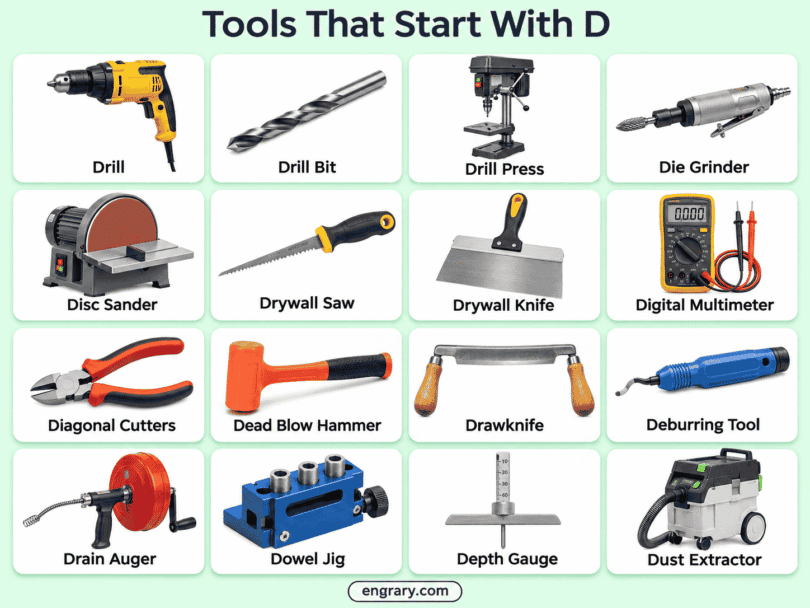
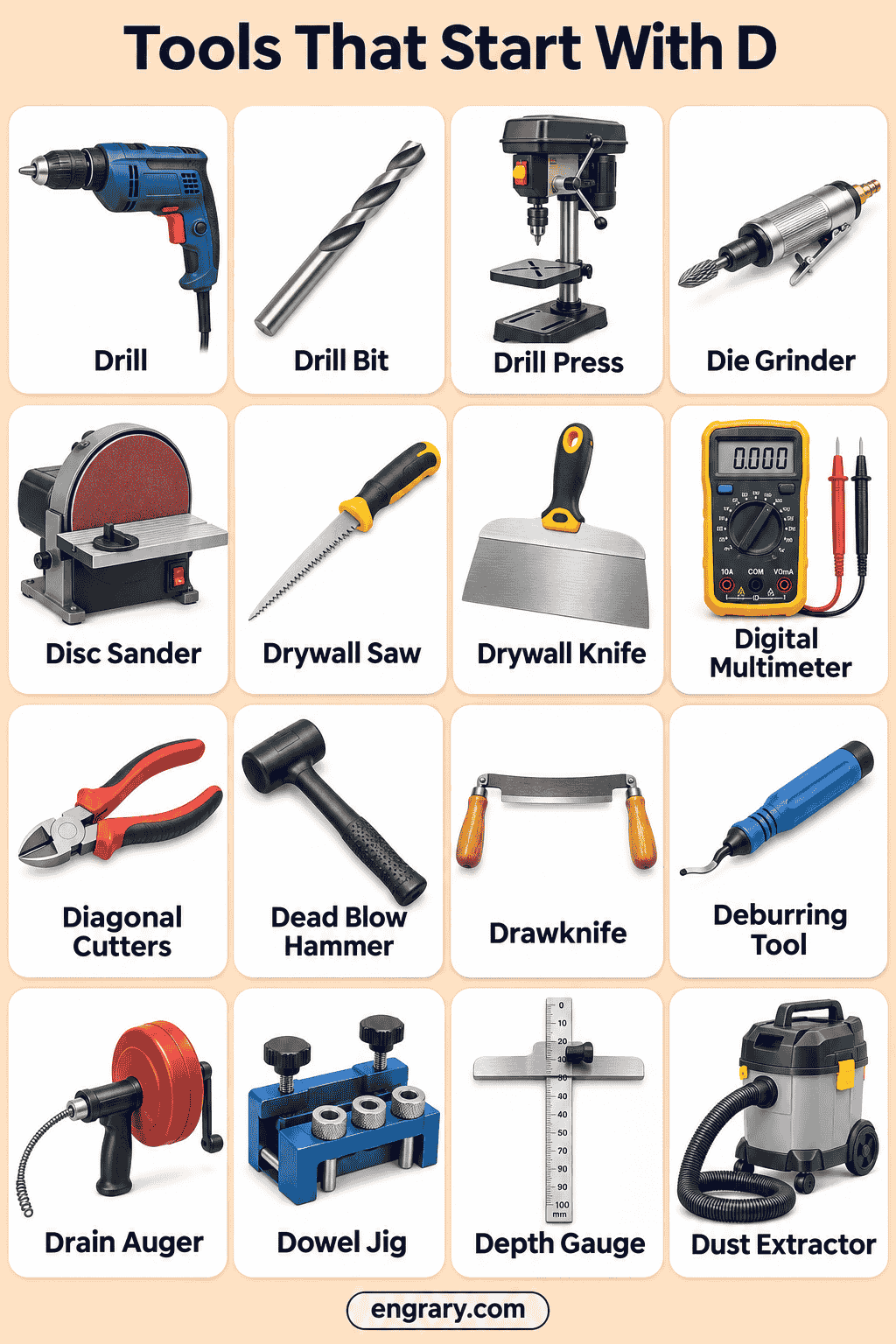
Drill
A drill uses a rotating bit to make holes in materials such as wood, metal, and plastic. With a screwdriver bit, it can also drive screws.
Drill driver
A drill driver combines drilling and screw-driving functions. Its adjustable clutch helps control the turning force, which can reduce the chance of driving a screw too deeply or damaging the material.
Diagonal pliers
Diagonal pliers have angled cutting edges for snipping wire, cable ties, and small fasteners. They are also called diagonal cutters or side-cutting pliers.
Dead-blow hammer
A dead-blow hammer delivers a firm strike with less bounce than a standard hammer. It is useful for positioning parts, assembling components, and tapping surfaces where a lighter, more controlled blow is needed.
Drywall saw
A drywall saw has a narrow, pointed blade that can cut openings in wallboard. It is often used to make space for electrical outlets, switches, and fixtures.
Drywall knife
A drywall knife spreads joint compound over seams, screw heads, and small surface imperfections. Wider knives help smooth compound across larger areas during finishing.
Drain auger
A drain auger has a flexible cable that travels into a pipe to loosen or retrieve a blockage. It is also commonly called a drain snake, although designs vary by drain type and job.
Drawknife
A drawknife is a woodworking tool with a blade held between two handles. The user pulls it toward them to shave off wood, shape curved surfaces, or remove bark.
Deburring tool
A deburring tool removes rough edges and small raised burrs left after cutting, drilling, or machining. It can help smooth the edges of metal, plastic, and other materials.
Dustpan
A dustpan collects dust, crumbs, and small debris swept from floors or work surfaces. Its flat edge helps gather material from the floor with a broom.
Ditching shovel
A ditching shovel has a narrow blade designed for digging or cleaning trenches. Gardeners and workers may use it for drainage channels, irrigation lines, and other narrow excavations.
Digging fork
A digging fork uses sturdy tines to loosen and turn soil. It can also help lift roots, mix compost into garden beds, and break up compacted ground.
Dutch hoe
A Dutch hoe cuts weeds just below the soil surface. Gardeners push or pull its flat blade through loose soil to remove young weeds between plants.
Dolly
A dolly is a wheeled platform or hand-operated cart used to move heavy or bulky items. Furniture dollies carry large objects, while hand-truck-style dollies help move boxes and appliances.
D Tools for Workshops and Construction
These tools help users cut, shape, sand, fasten, and break materials during building or repair work.
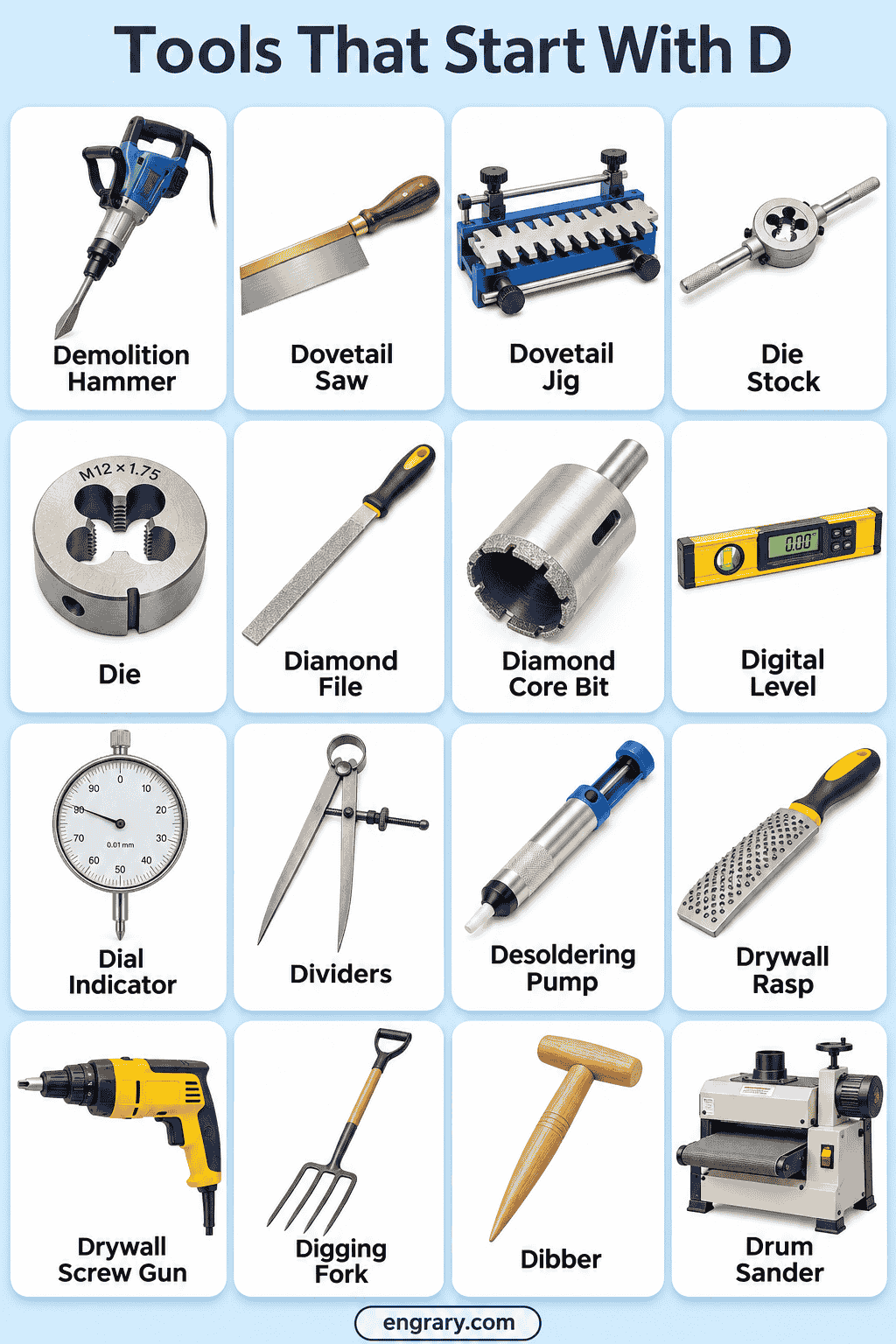
- Demolition hammer — Breaks concrete, masonry, and other hard materials with repeated blows.
- Die grinder — Spins small attachments for grinding, polishing, or shaping metal and other materials.
- Disc sander — Smooths and shapes material with a rotating abrasive disc. Bench-mounted models are common in workshops.
- Drum sander — Sands wood with an abrasive sleeve fitted around a rotating drum. Larger versions can refinish floors.
- Drywall screwdriver — Drives drywall screws to a consistent depth, helping prevent damage to the paper surface.
- Drywall rasp — Trims and shapes cut drywall edges.
- Duct cutter — Cuts duct materials; the appropriate cutter depends on the material and duct type.
- Door-jamb saw — Trims the bottom of a door jamb to make room for flooring.
- Drill press — Holds a drill in a fixed position for accurate, repeatable holes.
- Diamond core drill — Uses a diamond-tipped core bit to make larger holes in hard materials such as concrete, brick, or stone.
- Drill-bit sharpener — Restores the cutting edges of compatible drill bits.
- Drill-bit gauge — Identifies a drill bit’s size by matching it to a labeled opening.
D Measuring and Inspection Tools
Measuring and inspection tools help check dimensions, angles, alignment, and electrical conditions.
- Digital caliper — Measures inside and outside dimensions, as well as depth, using a digital display.
- Depth gauge — Measures the depth of holes, grooves, slots, and other recessed areas.
- Dial indicator — Detects small changes in position or runout when checking alignment or machine parts.
- Digital multimeter — Measures electrical values such as voltage, current, and resistance.
- Digital angle gauge — Measures angles or checks whether a surface or blade sits at a desired angle.
- Dial caliper — Measures dimensions using a dial display. It performs a similar role to a digital caliper but shows readings differently.
D Tools for Plumbing and Drain Work
Plumbers use these tools to clear blockages, inspect pipes, and work around sink fittings.
- Drain inspection camera — Sends a small camera into a pipe to help inspect its interior and locate problems.
- Drop-in sink wrench — Reaches mounting nuts beneath a sink, where an ordinary wrench may not fit.
- Drain cleaning bladder — Connects to a hose and uses water pressure to help clear some drain blockages. Use it only with compatible plumbing and according to the manufacturer’s directions.
D Tools for Woodworking and Finishing
Woodworkers use these tools to cut joints, shape stock, and prepare surfaces.
- Dovetail saw — Makes fine, controlled cuts when creating dovetail joints and other small woodworking details.
- Detail sander — Sands corners and tight areas that larger sanders cannot easily reach.
- Drum sander — Smooths broad wood surfaces with an abrasive drum. Its size and setup determine whether it suits small pieces or floors.
- Drawknife — Shapes wood by removing thin shavings, especially on curved or irregular surfaces.
Some tools appear in more than one trade. For example, a drum sander belongs in both woodworking and floor refinishing, while a drawknife is used for several kinds of wood shaping.
Choosing the Right D Tool
Start with the material and task. For example, use a drill for making holes, a drill driver for drilling and screw driving, and a drill press when you need consistent, accurately placed holes.
For a blocked drain, a drain auger can help loosen or retrieve debris. A drain inspection camera serves a different purpose: it helps locate or assess the problem inside the pipe. In addition, check that a tool’s size, attachment, and power source match the job before using it.
Frequently Asked Questions
A drill is one of the most familiar tools that starts with D. It makes holes in many materials and can drive screws when fitted with the right attachment.
A drill mainly makes holes, while a drill driver is designed for both drilling and driving screws. Many drill drivers include an adjustable clutch to help control screw depth.
The names often refer to the same flexible cable tool for clearing drain clogs. Designs vary, so check the tool’s intended use and the type of drain before choosing one.
Woodworkers may use a dovetail saw, drawknife, drill, drill press, detail sander, or drum sander. The right tool depends on whether the job involves cutting, shaping, drilling, or sanding.
A digital caliper measures small inside and outside dimensions, as well as depth. For alignment checks, a dial indicator can detect small changes in position.
You May Also Like

Leave a Comment