
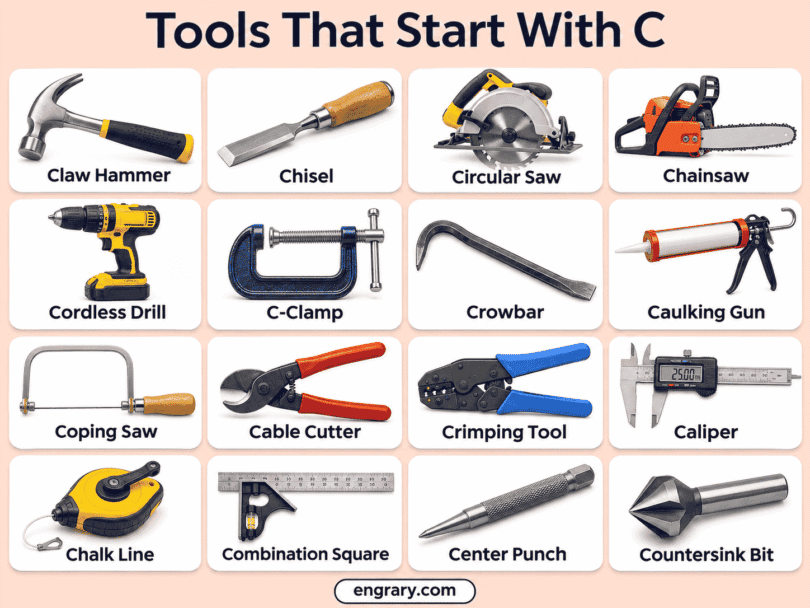
Tools that start with C include hand tools, power tools, measuring instruments, and equipment used in construction and repair. This guide introduces common examples and explains what each one does.
The tools are grouped by their main uses to make the list easier to browse. Some have alternate names or come in several designs, so the descriptions explain their typical functions.
Common Tools That Start With C
These familiar tools help with cutting, gripping, measuring, marking, and repair jobs around the home or workshop.
Chisel
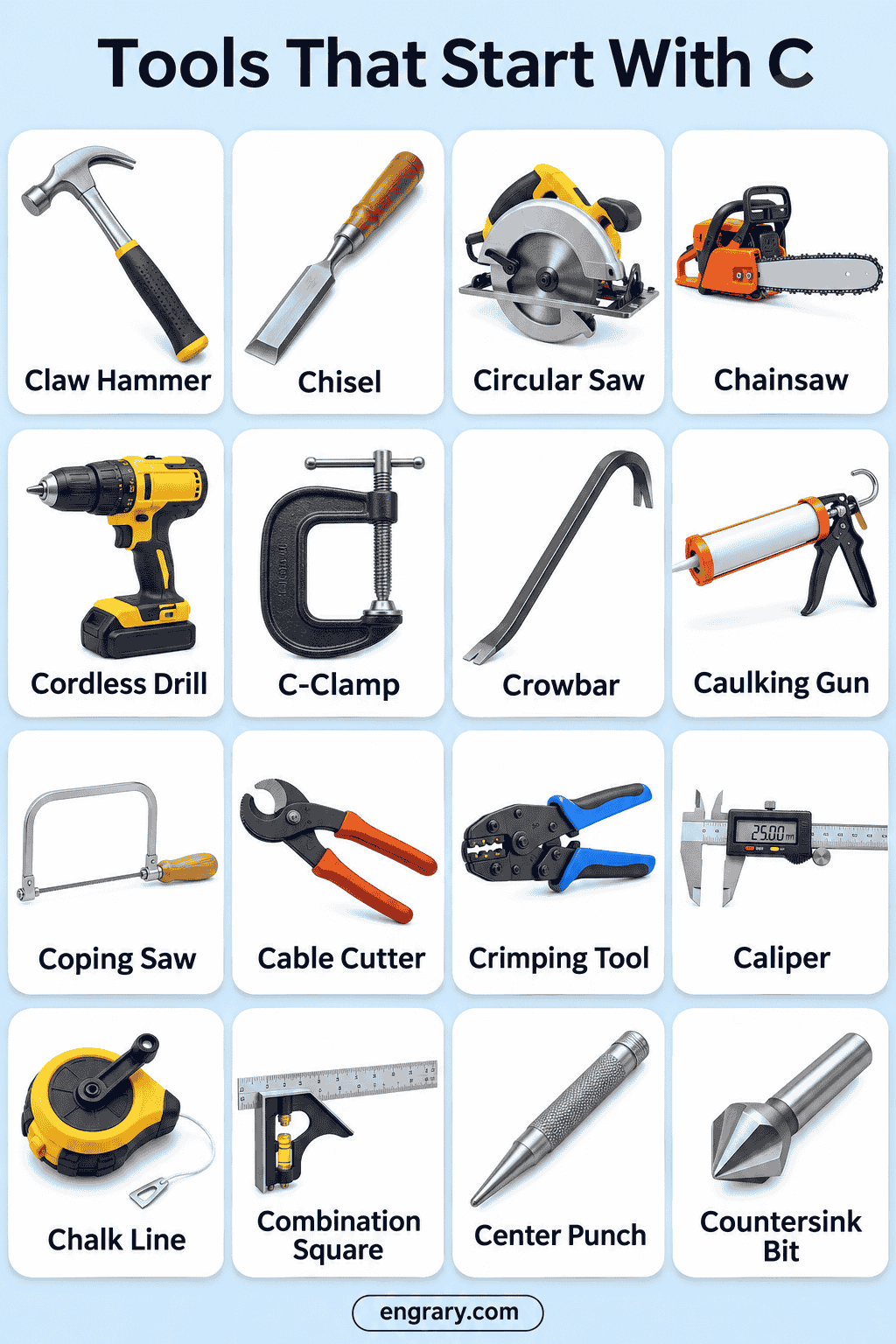
A chisel has a sharp cutting edge and a handle. Woodworkers, masons, and metalworkers use different types to cut, shape, or remove material.
Clamp
A clamp holds objects firmly in place while you glue, cut, drill, or assemble them. Its design depends on the size and shape of the workpiece.
C-clamp
A C-clamp has a C-shaped frame and a threaded screw that presses against a workpiece. Use it to hold pieces steady during woodworking or metalworking.
Coping saw
A coping saw has a narrow blade held in a U-shaped frame. It is useful for cutting curves and detailed shapes in wood or plastic.
Crowbar
A crowbar is a strong metal bar used for prying, lifting, and pulling nails. Some types are also called pry bars, although their designs can vary.
Combination square
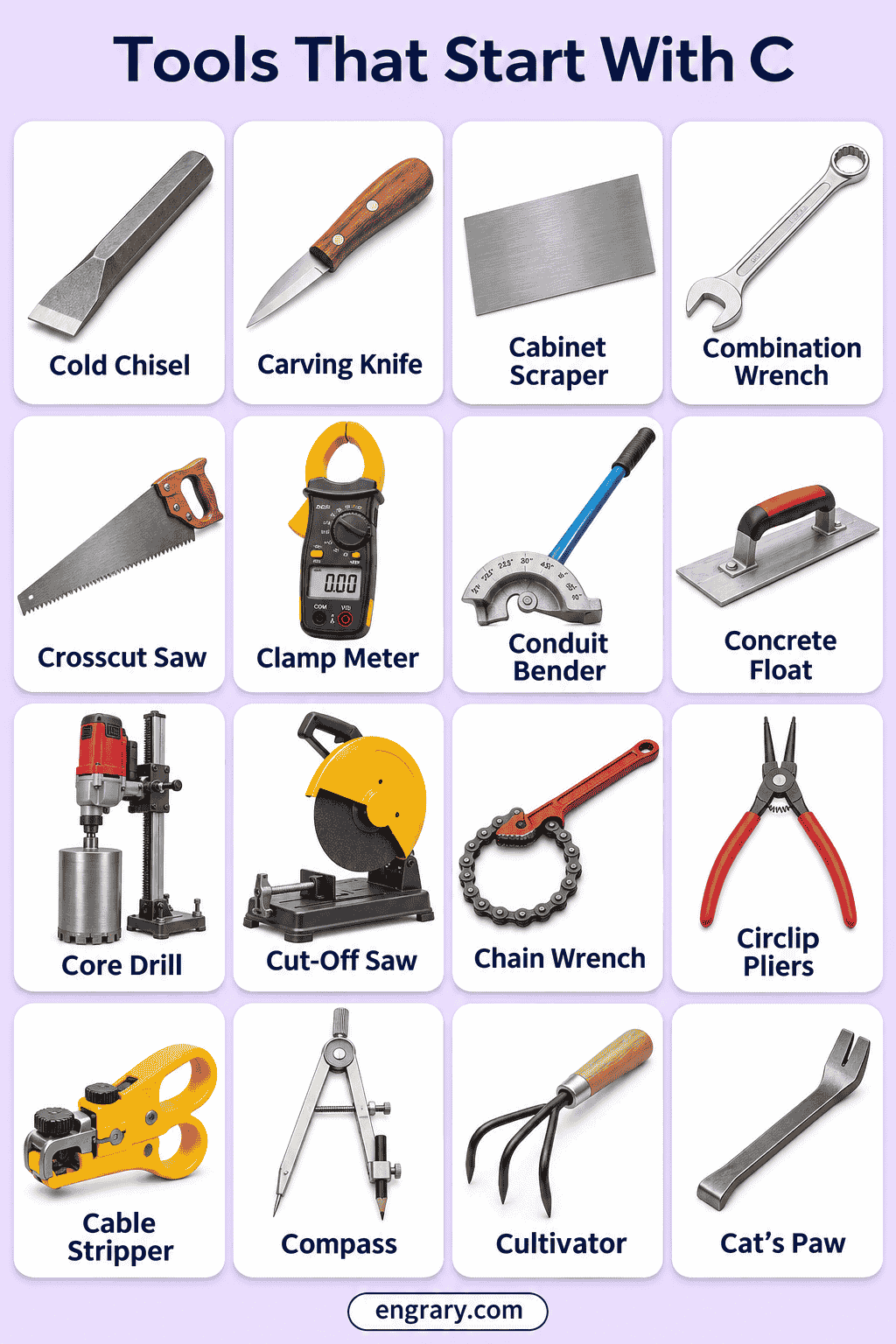
A combination square has a ruler and a movable head. It helps check right angles, measure, and mark straight lines.
Caulking gun
A caulking gun dispenses sealant or adhesive from a cartridge. It helps apply a controlled bead around windows, sinks, and joints.
Craft knife
A craft knife has a small, sharp blade for precise cutting. Crafters use it on paper, card, and other thin materials.
Cable cutter
A cable cutter has shaped jaws designed to cut cable cleanly. Choose a model rated for the cable type and size.
Crimping tool
A crimping tool joins a connector to a wire or cable by compressing the connector around it. Select one that matches the connector and wire gauge.
Caliper
A caliper measures the distance between two opposite sides of an object. Depending on its design, it can measure outside dimensions, inside openings, and depth.
Chalk line
A chalk line marks a long, straight guide on a surface. Pull its chalked cord taut and snap it against the material to leave a line.
Chain wrench
A chain wrench grips and turns round objects, such as pipes or large fittings. Its chain wraps around the object to provide a firm hold.
Cold chisel
A cold chisel cuts or shapes metal that is not heated. A user strikes it with a hammer to remove or reshape material.
Crosscut saw
A crosscut saw cuts across the grain of wood. Its teeth are shaped to sever wood fibers as the blade moves through the material.
Power and Workshop Tools
Power tools speed up cutting, drilling, grinding, and other repeated tasks. Use a blade or attachment designed for the tool and material.
Circular saw
A circular saw uses a rotating toothed blade to cut wood and other materials, depending on the blade. Secure the workpiece and follow the saw’s instructions.
Cordless drill
A cordless drill runs on a rechargeable battery and turns drill bits or driver bits. It is commonly used to drill holes and drive screws.
Chain saw
A chain saw uses a toothed chain that moves around a guide bar to cut wood. People use it for tasks such as pruning and cutting logs; safe handling and protective equipment are essential.
Cut-off tool
A cut-off tool uses a small rotating disc to cut materials such as metal or tile, depending on the disc. Choose an attachment made for the tool and job.
Concrete saw
A concrete saw uses a specialized blade to cut concrete, masonry, or asphalt. Models include handheld saws and larger walk-behind machines.
Concrete grinder
A concrete grinder uses rotating abrasive discs to smooth or remove material from concrete surfaces.
Concrete vibrator
A concrete vibrator removes trapped air from freshly poured concrete. It helps the concrete settle around reinforcement and into formwork.
Carving tool
A carving tool removes small amounts of material to create shapes or details. Depending on its design, it may be a hand tool or a powered rotary attachment.
Measuring and Marking Tools
Measuring and marking tools help plan cuts, check dimensions, and copy shapes. Choose a tool with the range and accuracy the task requires.
Contour gauge
A contour gauge copies the shape of an edge or surface. It is useful when fitting flooring, trim, or tile around irregular shapes.
Center punch
A center punch makes a small dimple in metal or another hard surface. The mark helps keep a drill bit from slipping when drilling begins.
Combination pliers
Combination pliers grip, bend, and cut wire. Their jaws often include gripping teeth and a cutting section near the pivot.
Compass
A drawing compass creates circles and arcs or transfers measurements. Other specialized compasses serve navigation or surveying.
Construction level
A construction level checks whether a surface is horizontal or vertical. Common models use liquid-filled vials, while laser levels project reference lines.
Construction and Masonry Tools
These tools help prepare, place, shape, and finish building materials. Use equipment designed for the material and stage of the job.
Concrete trowel
A concrete trowel spreads and smooths concrete or mortar. Different shapes and sizes suit different finishing stages.
Concrete float
A concrete float smooths and levels freshly placed concrete. It helps close small surface marks before final finishing.
Concrete edger
A concrete edger shapes the edge of a slab. It creates a neat, slightly rounded edge as the concrete begins to set.
Concrete screed
A concrete screed levels freshly poured concrete across a form. It removes excess material and helps create an even surface.
Conduit bender
A conduit bender forms electrical conduit to a desired angle. Hand-operated, hydraulic, and powered designs are available.
Come-along
A come-along is a hand-operated ratcheting tool used to pull or tension loads over a short distance. Check its rated capacity and secure the load before use.
Choosing and Using C-Tools Safely
The right tool depends on the material, task, and working conditions. Before starting, check the tool’s condition, capacity, and compatibility with any blade or accessory.
- Match the blade, bit, or attachment to the tool and material.
- Secure the workpiece before cutting, drilling, or grinding.
- Wear eye protection when using cutting, striking, or powered tools.
- Keep hands clear of blades, jaws, and moving parts.
- Disconnect power before changing a blade or attachment.
- Use cable cutters and crimping tools rated for the cable and connector.
- Follow the manufacturer’s instructions for tools used with concrete, electricity, or heavy loads.
Frequently Asked Questions
Common examples include a chisel, clamp, C-clamp, coping saw, crowbar, combination square, caulking gun, craft knife, and cordless drill. They help with tasks such as cutting, measuring, gripping, and fastening.
Examples include a chisel, C-clamp, coping saw, crowbar, combination square, chalk line, cable cutter, and chain wrench. Choose a tool designed for the material and task.
A C-clamp holds a workpiece against a surface or another piece of material. Tighten its screw until the jaws grip securely, without applying more pressure than the material can withstand.
A coping saw is a hand tool with a narrow blade for cutting curves and detailed shapes. A circular saw is a powered tool with a rotating blade, commonly used for straight cuts.
Woodworkers often use chisels, clamps, coping saws, combination squares, and circular saws. Construction workers may also use concrete trowels, floats, edgers, screeds, and conduit benders.
You May Also Like

Leave a Comment