

Tools that start with B include familiar items such as hammers, clamps, saws, and cutters, as well as specialized equipment for woodworking, masonry, automotive repair, and other trades. This guide groups common examples by purpose and explains what each tool does.
Some tool names have alternate spellings or describe related equipment. Where useful, the descriptions clarify those differences so you can identify each item accurately.

Common Tools That Start With B
These familiar tools are useful for repairs, construction, woodworking, gardening, and workshop tasks. The list begins with widely recognized hand tools and includes a few common power tools.
Backsaw
A backsaw has a stiffened spine along the top of its blade. Woodworkers use it for controlled, accurate cuts, especially in joinery.
Ball-peen hammer
A ball-peen hammer has one flat striking face and one rounded face. Metalworkers use it to shape metal, round rivet heads, and strike punches.
Band saw
A band saw uses a continuous loop blade to cut wood, metal, or other materials, depending on the machine and blade. It can make straight cuts and, on suitable models, curved cuts.
Bar clamp
A bar clamp holds pieces together during glue-ups, assembly, or repair. Its sliding jaw adjusts along a long bar to fit different workpiece widths.
Bench vise
A bench vise attaches to a workbench and grips a workpiece between its jaws. It keeps material steady while you saw, file, drill, or assemble it.
Belt sander
A belt sander moves a continuous abrasive belt across a surface. It removes material and smooths large or flat workpieces.
Bench grinder
A bench grinder has rotating abrasive wheels mounted on a workbench. It is commonly used to sharpen tools, shape metal, and remove burrs.
Bolt cutter
Bolt cutters have long handles and strong jaws for cutting bolts, chains, padlocks, and thick wire. Choose a cutter sized for the material.
Box cutter
A box cutter, also called a utility knife, has a replaceable or retractable blade. It is used to cut cardboard, packaging, and other suitable materials.
Brace
A brace is a hand-operated drilling tool with a crank handle and a chuck for holding a bit. It turns the bit slowly with high torque, often for boring holes in wood.
Brad nailer
A brad nailer drives thin brad nails into wood. Carpenters and finishers use it to attach trim and other lightweight pieces.
Breaker bar
A breaker bar is a long, non-ratcheting handle that provides extra leverage for loosening tight fasteners. It is often used with a socket in automotive repair.
Woodworking and Measuring Tools
These tools help woodworkers measure, shape, join, and finish material. Some hold a workpiece steady, while others guide a cut or remove small amounts of wood.
Bench plane
A bench plane has a sharp blade that shaves thin layers from a board. Woodworkers use it to flatten, smooth, or size wood.
Block plane
A block plane is a small hand plane designed for trimming edges and smoothing end grain. Its compact size makes it useful for detail work.
Bevel gauge
A bevel gauge transfers or checks an angle. It has a movable blade that locks in place, allowing a user to copy an angle from one workpiece to another.
Biscuit joiner
A biscuit joiner cuts crescent-shaped slots in adjoining pieces of wood. The slots hold compressed wooden biscuits and glue, helping align and join the pieces.
Bench hook
A bench hook sits on a workbench and helps hold a board steady while you saw or chisel it by hand.
Boring bar
A boring bar holds a cutting tool for enlarging or finishing an existing hole, usually on a lathe or machine tool. It is used in machining rather than ordinary hand drilling.
Bradawl
A bradawl is a pointed hand tool used to make small starter holes in wood. The hole helps guide a nail or screw and can reduce splitting.
Burnisher
A burnisher is a smooth, hard tool used to polish or refine an edge or surface. Its exact form varies by trade; for example, woodworkers use burnishers to raise a fine burr on a card scraper.
Power and Workshop Tools
Power and workshop tools make repeated or heavy tasks faster. Use the correct blade, abrasive, or accessory for the machine and material.
Bench drill
A bench drill, often called a drill press, is a stationary machine that drills straight, controlled holes. It holds the work and bit in a fixed alignment.
Bench shear
A bench shear is a mounted cutting tool for trimming sheet metal or similar material. Its lever-operated blade applies force through a cutting edge.
Bench sander
A bench sander is a stationary sanding machine used to smooth or shape material. Depending on the model, it may use a belt, disc, or combination of both.
Blowtorch
A blowtorch produces a controlled flame for tasks such as soldering, heating, or loosening certain fittings. Use the correct fuel and follow fire-safety instructions.
Blower
A blower moves air to clear leaves, dust, or debris from an area. Models may run on electricity, batteries, or fuel.
Brush cutter
A brush cutter is a powered garden tool used to cut thick weeds, brush, and small saplings. It uses a blade or cutting line suited to the vegetation.
Biscuit joiner blade
A biscuit joiner blade is a circular cutting accessory made for a biscuit joiner. It cuts the slots that receive wooden joining biscuits.

Automotive and Mechanical Tools
Mechanics use these tools to apply leverage, separate components, service brakes, and remove damaged fasteners. Select each tool to match the vehicle and job.
Ball-joint separator
A ball-joint separator helps disconnect a ball joint from its mating component, such as a steering knuckle. Some designs press the joint apart; others use a forked wedge.
Brake bleeder
A brake bleeder helps remove air from a vehicle’s hydraulic brake system. Designs include manual, vacuum, and pressure-operated types.
Bolt extractor
A bolt extractor removes a damaged, rounded, or broken fastener. Many extractors grip the fastener as the user turns it counterclockwise.
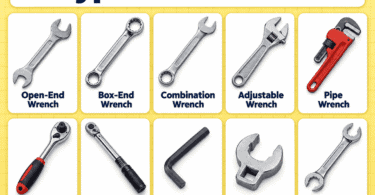
Box-end wrench
A box-end wrench has a closed ring that fits around a nut or bolt head. It provides a secure grip and helps reduce the chance of slipping.
Bearing puller
A bearing puller removes a bearing from a shaft or housing. Choose a puller with the right size and configuration for the bearing.
Masonry and Construction Tools
Masons and construction workers use these tools to cut, shape, place, or finish building materials. Match the tool to the material to avoid damaging it or the tool.
Brick hammer
A brick hammer has a flat striking face and a chisel-like edge. Masons use it to chip, trim, or shape bricks and masonry.
Brick trowel
A brick trowel spreads and shapes mortar when laying bricks or blocks. Its pointed blade helps place mortar in confined areas.
Brick jointer
A brick jointer shapes the mortar between bricks. It can create different joint profiles, such as concave or V-shaped finishes.
Bolster chisel
A bolster chisel has a wide blade for cutting or splitting bricks, blocks, and masonry. Strike it with a suitable hammer and keep hands clear of the cutting edge.
Bending brake
A bending brake clamps sheet material and bends it along a straight line. It is used to form metal flashing, panels, and other sheet-metal pieces.
Bar bender
A bar bender bends reinforcing bars, often called rebar, to specified angles. Manual and powered models are available.
Bushing driver
A bushing driver installs or removes bushings by applying force to the bushing without striking the surrounding component directly. Use a driver that matches the bushing.
Choosing and Using B-Tools Safely
The right tool depends on the material, task, and working conditions. Before using a tool, check its condition, capacity, and compatibility with any accessories.
- Choose a blade, bit, abrasive, or attachment designed for the tool and material.
- Secure the workpiece before cutting, drilling, sanding, or chiseling.
- Wear eye protection when cutting, grinding, drilling, or striking materials.
- Keep hands away from moving blades and cutting edges.
- Use a breaker bar only with compatible sockets, and avoid adding extensions that the manufacturer does not recommend.
- Follow the instructions for fueled tools such as blowtorches and brush cutters.
- Store sharp tools safely and unplug or disconnect powered tools before changing accessories.
Frequently Asked Questions
Common examples include a backsaw, ball-peen hammer, band saw, bar clamp, bench vise, bolt cutter, box cutter, and brace. They support tasks such as cutting, fastening, shaping, and holding materials.
Examples include a backsaw, ball-peen hammer, bar clamp, bench vise, bolt cutter, box cutter, brace, breaker bar, and brick trowel. Each serves a different purpose, so choose one suited to the task and material.
A ball-peen hammer is mainly used for shaping metal and striking punches or chisels. Its flat face delivers the blow, while its rounded face helps form or round metal.
A band saw is a powered machine with a continuous loop blade. A backsaw is a hand saw with a stiffened spine, used for controlled cuts such as joinery.
Woodworkers often use a backsaw, bar clamp, bench vise, bench plane, block plane, bevel gauge, biscuit joiner, bench hook, and brace. These tools help measure, cut, shape, join, and hold wood.
You May Also Like



Leave a Comment