
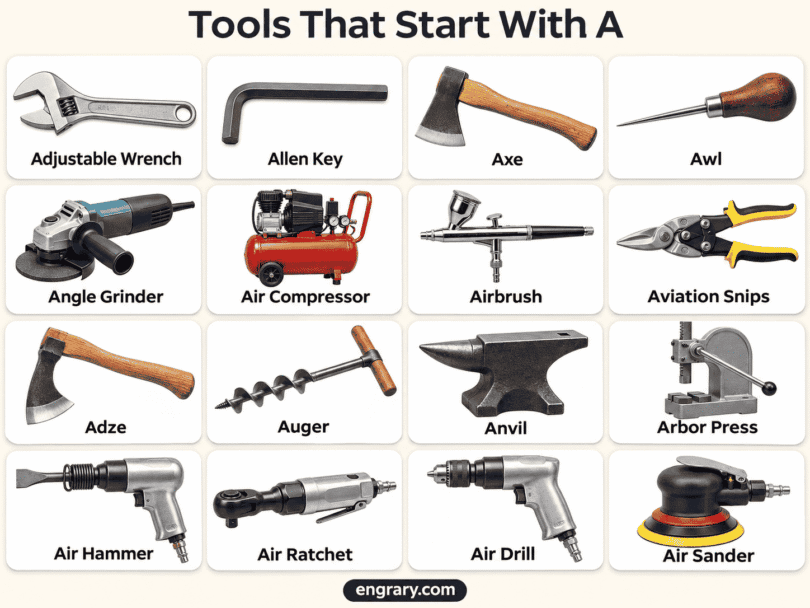
Tools that start with A range from everyday hand tools to specialized workshop equipment. This guide covers 50 names, grouped by their main uses, with a clear description of each.
Some names refer to similar tools or to tools with different power sources. For example, an auger may be operated by hand or machine, while an auger bit attaches to a compatible drill or brace.
Common Tools That Start With A
These familiar tools are useful for home repairs, crafts, gardening, and basic workshop tasks. Some are hand tools, while others need power or a specific attachment.
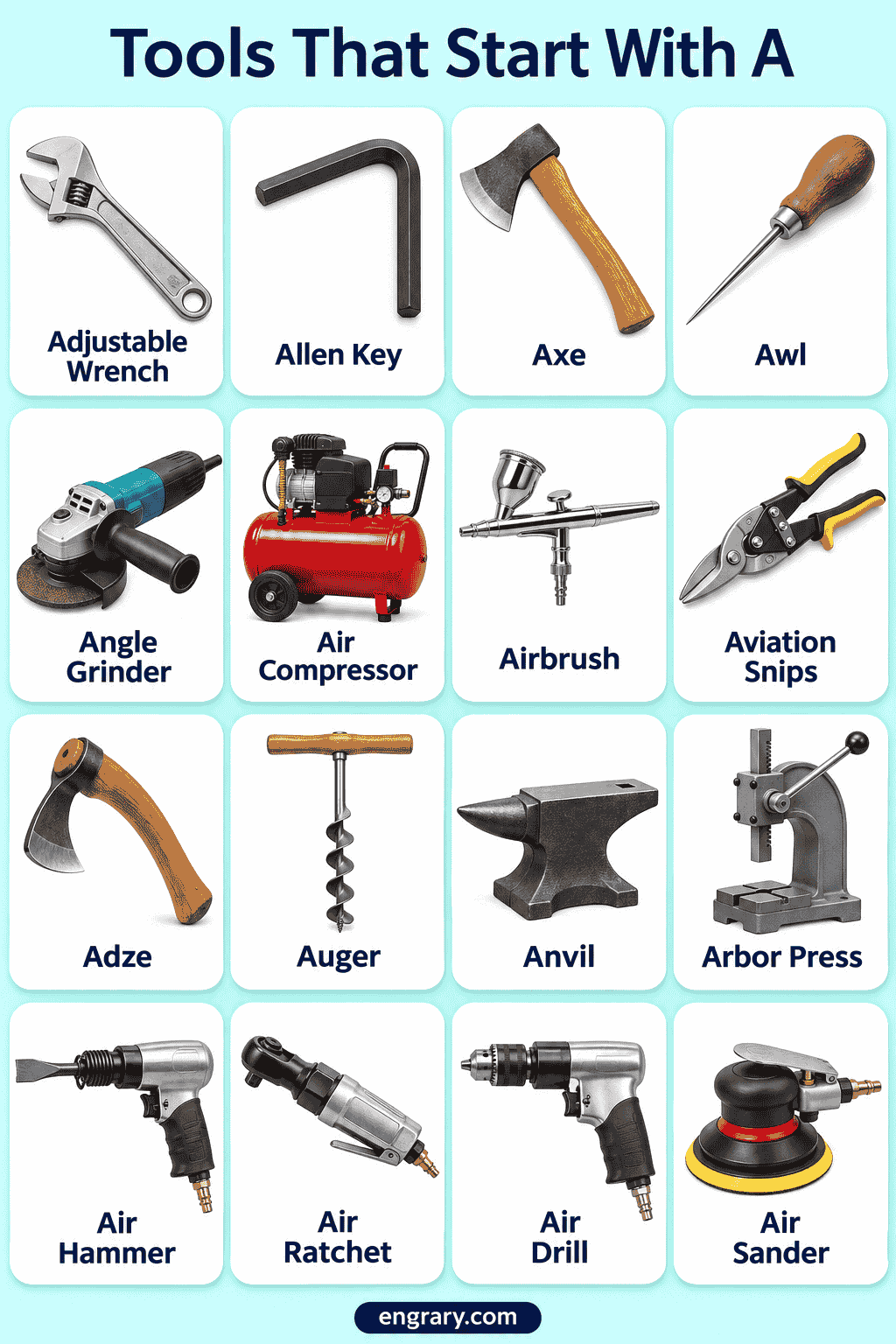
Adjustable wrench
An adjustable wrench has a movable jaw that fits nuts and bolts of different sizes. In some regions, it is called an adjustable spanner.
Allen key
An Allen key, also called a hex key, turns screws and bolts with hexagonal sockets. It is often used to assemble furniture and repair bicycles.
Axe
An axe has a sharp head attached to a handle. It is used to chop or split wood.
Awl
An awl is a pointed tool used to mark surfaces or make small starter holes in wood, leather, or fabric.
Angle grinder
An angle grinder uses a rotating disc to cut, grind, or polish materials such as metal and masonry. Use a disc that suits the material and task.
Air compressor
An air compressor stores and supplies compressed air. It powers compatible pneumatic tools, including air hammers and air ratchets.
Airbrush
An airbrush sprays paint or another liquid in a fine, controlled pattern. Artists and model makers use it for detailed work and smooth finishes.
Anvil
An anvil is a heavy, hard surface that supports metal while a blacksmith shapes it with a hammer.
Auger
An auger bores holes with a spiral-shaped cutting section. Depending on its design, it may be turned by hand or powered by a drill or machine.
Adze
An adze has a blade set across its handle. Woodworkers use it to shape or smooth wood, especially curved or uneven surfaces.
Aviation snips
Aviation snips are hand-operated shears for cutting thin sheet metal. Different designs handle straight cuts or curves to the left or right.
Arbor press
An arbor press is a hand-operated press that applies controlled pressure. It can install bearings, press pins, or fit parts together.
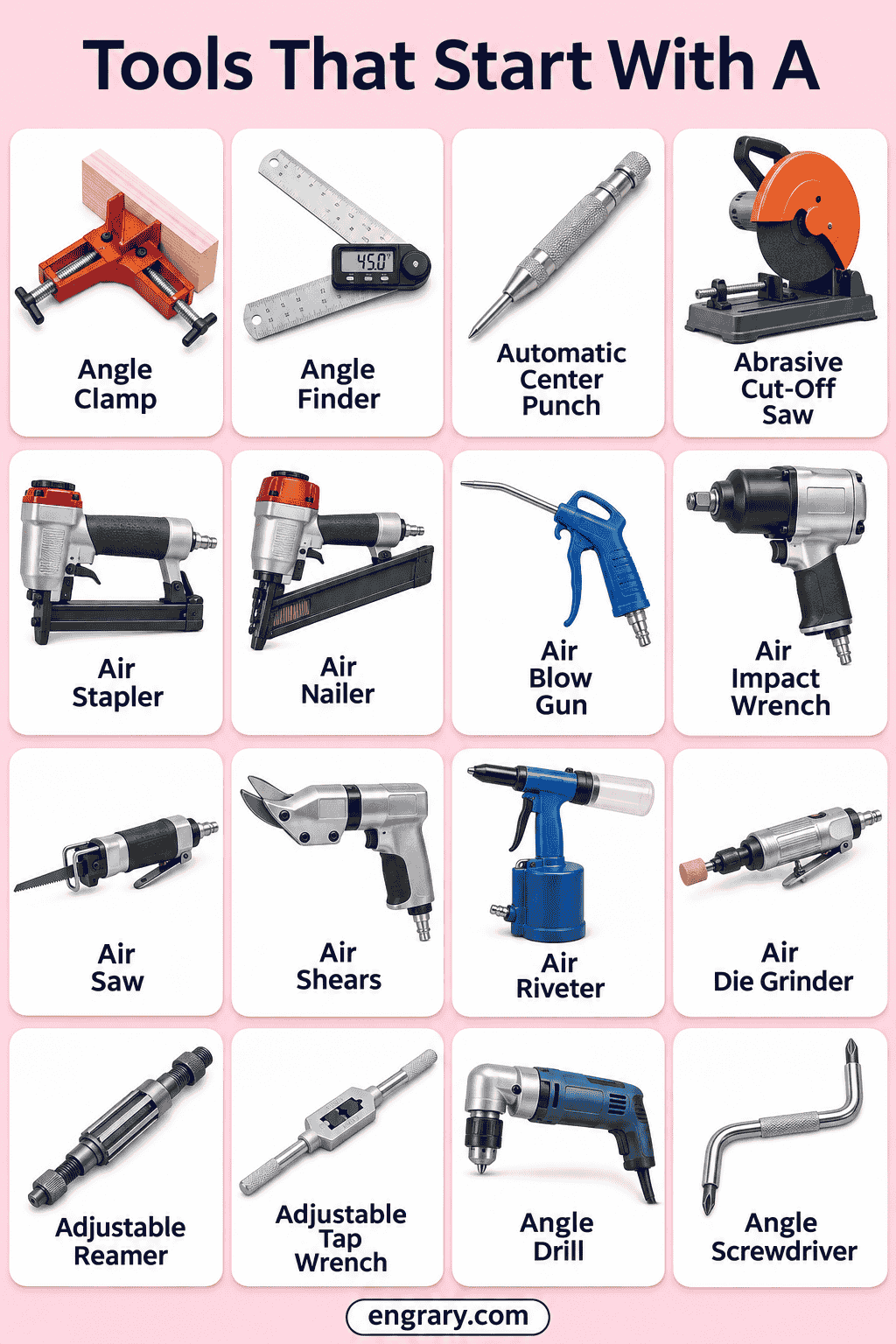
Angle finder
An angle finder measures the angle between two surfaces. Carpenters and installers use it to check corners, slopes, and cuts.
Automatic center punch
An automatic center punch makes a small dimple in metal or another hard surface. The mark helps keep a drill bit from slipping when drilling begins.
Appliance dolly
An appliance dolly is a wheeled moving aid with straps or a support plate. It helps transport heavy appliances such as refrigerators and washing machines.
Art knife
An art knife has a small, sharp blade for precise cutting. Artists and craft workers use it on paper, card, and other thin materials.
Angle clamp
An angle clamp holds two pieces at a set angle while you join, glue, or fasten them. It is useful for assembling frames and boxes.
Air hammer
An air hammer uses compressed air to deliver rapid, repeated blows. Mechanics and metalworkers use it with suitable attachments to cut, shape, or loosen parts.
Air ratchet
An air ratchet uses compressed air to turn sockets and fasteners, especially in tight spaces. It can speed up repetitive fastening work.
Air drill
An air drill uses compressed air to rotate a drill bit. Workshops use it for drilling holes and other jobs suited to pneumatic equipment.
Power and Air Tools
Power and air tools perform tasks with electricity, batteries, or compressed air. Choose attachments that suit the tool and material, and follow the manufacturer’s instructions.
Air die grinder
An air die grinder is a compact pneumatic tool for grinding, polishing, or deburring small areas. It accepts different bits and abrasive attachments.
Air rivet gun
An air rivet gun drives rivets using compressed air. It is used in fabrication and repair work involving sheet metal.
Air saw
An air saw is a pneumatic cutting tool. Depending on its blade, it can cut materials such as sheet metal, plastic, or vehicle body panels.
Air chisel
An air chisel delivers repeated blows through a chisel-shaped attachment. It can cut, separate, or shape materials in automotive and fabrication work.
Air impact wrench
An air impact wrench uses compressed air and rotational impacts to loosen or tighten fasteners. Mechanics often use it on vehicle wheels and other high-torque jobs.
Air sander
An air sander uses compressed air to move an abrasive pad or disc. It smooths surfaces in automotive refinishing, woodworking, and fabrication.
Air blow gun
An air blow gun directs compressed air to clear dust or debris from surfaces and equipment. Follow safety instructions, and never direct compressed air at a person.
Air nibbler
An air nibbler cuts sheet metal by removing small bites of material. It can follow straight or curved lines.
Air caulking gun
An air caulking gun uses compressed air to dispense sealant from a cartridge. It helps apply an even bead during construction and sealing work.
Air grease gun
An air grease gun uses compressed air to pump lubricant into grease fittings. Mechanics use it to lubricate bearings and other serviceable components.
Measuring, Marking, and Testing Tools
These tools help measure angles, mark workpieces, test electrical systems, or diagnose equipment. Their range and accuracy should match the job.
Angle gauge
An angle gauge measures or helps set an angle. Some models use a simple scale, while others provide a digital reading.
Angle meter
An angle meter measures the tilt or angle of a surface. Depending on its design, it may be used in construction, machining, or equipment setup.
Ammeter
An ammeter measures electric current in a circuit. Electricians and technicians use it when testing electrical systems.
Audio cable tester
An audio cable tester checks for broken wires, shorts, or incorrect connections in audio cables. It helps troubleshoot microphones, speakers, and sound equipment.
Automotive scan tool
An automotive scan tool reads diagnostic information from a vehicle’s computer system. Mechanics use it to investigate warning lights and system faults.
Alignment tool
An alignment tool helps position or line up parts before assembly or fastening. Its design depends on the equipment and task.
Alignment laser
An alignment laser projects a reference line or point to help position components accurately. It can assist with installation, construction, and machinery setup.
Auto level
An auto level is a surveying instrument used to establish level lines and compare elevations. Surveyors and construction workers use it with a leveling staff.
Angle ruler
An angle ruler combines a ruler with an angled scale or adjustable arm. It helps measure or mark angles and lengths on a workpiece.
Adjustable square
An adjustable square has a movable blade that can be set to different angles. Woodworkers and metalworkers use it to mark or check angles.
Workshop, Woodworking, and Automotive Tools
This group includes equipment for shaping metal, drilling, lifting, and vehicle repair. Some tools require training or a compatible power source.
Angle vise
An angle vise grips a workpiece at an adjustable angle. It helps keep small parts steady during drilling, filing, or assembly.
Anchor setter
An anchor setter helps install certain masonry anchors. Depending on the design, it drives or expands an anchor into position.
Auger bit
An auger bit is a spiral drill attachment designed to bore holes, commonly in wood. Its screw tip helps pull the bit into the material as it turns.
Auger drill
An auger drill is a powered tool designed to turn an auger for boring holes. Depending on the model and bit, it may be used in woodworking, landscaping, or construction.
Abrasive wheel
An abrasive wheel is a rotating wheel or disc used for grinding, cutting, or polishing. Use a wheel rated for the tool’s speed and intended material.
Abrasive belt sander
An abrasive belt sander moves a continuous abrasive belt over a surface. It removes material and smooths large or flat workpieces.
Abrasive cutter
An abrasive cutter uses a high-speed abrasive disc to cut hard materials such as metal. Its cutting ability depends on the disc.
A-frame jack
An A-frame jack is a lifting device used to raise or support compatible loads. Check its capacity and intended use before lifting.
Axle stand
An axle stand, also called a jack stand, supports a vehicle after a jack has lifted it. Never rely on a jack alone to support a vehicle during work underneath it.
Air valve tool
An air valve tool helps remove, install, or service valve cores in tires and other inflation systems. Some versions combine several valve-service functions.
Auto body hammer
An auto body hammer shapes or smooths vehicle body panels. It is used with a suitable dolly or backing tool for controlled metalwork.
Axle nut socket
An axle nut socket is a deep, heavy-duty socket designed for specific axle nuts. Mechanics use it when servicing vehicle hubs and axles.
Abrasive flap disc
An abrasive flap disc has overlapping abrasive pieces arranged around a backing plate. It is used with a compatible grinder to blend welds or smooth metal.
Air needle scaler
An air needle scaler uses a bundle of rapidly moving metal needles to remove rust, paint, or scale from rough surfaces. It is commonly used in metalworking and maintenance.
Air belt sander
An air belt sander is a pneumatic finishing tool with a narrow moving abrasive belt. It can sand edges, welds, and hard-to-reach areas.
Air chipping hammer
An air chipping hammer delivers repeated blows through a chisel or scaling attachment. Workers use it to remove material such as slag, concrete residue, or rust, depending on the attachment.
Air rivet nut tool
An air rivet nut tool installs threaded rivet nuts in sheet material. It creates a threaded fastening point where access to the back of the panel may be limited.
Air punch and flange tool
An air punch and flange tool makes holes and forms a recessed edge in sheet metal. Automotive repair technicians use it when preparing panels for joining.
Air tire inflator
An air tire inflator connects to an air supply to add air to a tire. Many models include a gauge to check pressure while inflating.
Air underbody coating gun
An air underbody coating gun sprays protective coating onto vehicle undersides. It is designed for compatible coatings and requires appropriate ventilation and protective equipment.
Axle puller
An axle puller attaches to or grips an axle component to help remove it from its housing. Use the correct puller design for the vehicle and part.
Axle seal installer
An axle seal installer helps press a seal into place evenly without damaging it. It must match the seal and installation point.
Axle bearing puller
An axle bearing puller removes a bearing from an axle or housing. Mechanics choose a puller suited to the bearing’s size and position.
Air hydraulic riveter
An air hydraulic riveter uses compressed air and hydraulic force to install rivets. It is used for production and repair work requiring consistent riveting force.
Choosing and Using A-Tools Safely
The right tool depends on the material, task, and working conditions. Before starting, check the tool’s size, capacity, power source, and compatible attachments.
- Match the tool to the job. For example, use aviation snips for thin sheet metal and an awl for marking.
- Confirm that a wrench fits the fastener and that a power tool accepts the selected attachment.
- Check lifting equipment’s load rating and abrasive wheels’ speed rating.
- Secure the workpiece before drilling, cutting, or grinding.
- Wear eye protection when cutting, grinding, drilling, or working with compressed air.
- Disconnect power or air before changing attachments or servicing a tool.
- When lifting a vehicle, use stands rated for the vehicle on a stable surface. Never work underneath a vehicle supported only by a jack.
- Store sharp and pointed tools safely when they are not in use.
Frequently Asked Questions
Common examples include an adjustable wrench, Allen key, angle grinder, anvil, awl, axe, and auger. Other examples include an air compressor, arbor press, and aviation snips.
Examples include an adjustable wrench, Allen key, adze, awl, axe, aviation snips, and angle clamp. These tools operate by hand, although some may be used alongside powered equipment.
They are names for the same type of driver, which turns fasteners with hexagonal sockets. Hex key is the general term, while Allen key is a widely used alternative.
An auger bores holes using a spiral-shaped cutting section. A hand auger works manually, while an auger bit attaches to a compatible drill or brace.
Mechanics may use an air impact wrench, air ratchet, air hammer, automotive scan tool, axle nut socket, axle stand, and air valve tool. The right choice depends on the repair and vehicle.
You May Also Like

Leave a Comment